For the following questions answer them individually
For the four sets of three measured physical quantities as given below. Which of the following options is correct?
$$(i)$$ $$A_1 = 24.36, B_1 = 0.0724, C_1 = 256.2$$
$$(ii)$$ $$A_2 = 24.44, B_2 = 16.082, C_2 = 240.2$$
$$(iii)$$ $$A_3 = 25.2, B_3 = 19.2812, C_3 = 236.183$$
$$(iv)$$ $$A_4 = 25, B_4 = 236.191, C_4 = 19.5$$
A spring mass system (mass $$m$$, spring constant $$k$$ and natural length $$l$$) rests in equilibrium on a horizontal disc. The free end of the spring is fixed at the centre of the disc. If the disc together with spring mass system rotates about it's axis with an angular velocity $$\omega$$, $$(k >> m\omega^2)$$ the relative change in the length of the spring is best given by the option:
A particle starts from the origin at $$t = 0$$ with an initial velocity of $$3.0\hat{i}$$ m/s and moves in the $$x - y$$ plane with a constant acceleration $$(6.0\hat{i} + 4.0\hat{j})$$ m/s$$^2$$. The $$x-$$ coordinate of the particle at the instant when its $$y-$$ coordinate is $$32m$$ is $$D$$ meters. The value of $$D$$ is:
A rod of length $$l$$ has non-uniform linear mass density given by $$\rho(x) = a + b\left(\frac{x}{l}\right)^2$$, where $$a$$ and $$b$$ are constants and $$0 < x \le l$$. The value of $$x$$ for the centre of mass of the rod is at:
A particle of mass $$m$$ is projected with a speed $$u$$ from the ground at an angle $$\theta = \frac{\pi}{3}$$ w.r.t. horizontal (x-axis). When it has reached its maximum height, it collides completely inelastically with another particle of the same mass and velocity $$u\hat{i}$$. The horizontal distance covered by the combined mass before reaching the ground is:
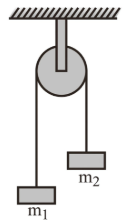
A uniformly thick wheel with moment of inertia $$I$$ and radius $$R$$ is free to rotate about its centre of mass (see fig). A massless string is wrapped over its rim and two blocks of masses $$m_1$$ and $$m_2$$ $$(m_1 > m_2)$$ are attached to the ends of the string. The system is released from rest. The angular speed of the wheel when $$m_1$$ descends by a distance $$h$$ is:
Planet $$A$$ has mass $$M$$ and radius $$R$$. Planet $$B$$ has half the mass and half the radius of Planet $$A$$. If the escape velocities from the Planets $$A$$ and $$B$$ are $$v_A$$ and $$v_B$$, respectively, then $$\frac{v_A}{v_B} = \frac{n}{4}$$. The value of $$n$$ is:
Two steel wires having same length are suspended from a ceiling under the same load. If the ratio of their energy stored per unit volume is 1 : 4, the ratio of their diameters is:
A small spherical droplet of density $$d$$ is floating exactly half immersed in a liquid of density $$\rho$$ and surface tension $$T$$. The radius of the droplet is (take note that the surface tension applies an upward force on the droplet):
Two gases - argon (atomic radius 0.07 nm, atomic weight 40) and xenon (atomic radius 0.1 nm, atomic weight 140) have the same number density and are at the same temperature. The ratio of their respective mean free times is closest to: