
Join Our JEE Preparation Group
Prep with like-minded aspirants; Get access to free daily tests and study material.
Sign in
Please select an account to continue using cracku.in
↓ →
Join Our JEE Preparation Group
Prep with like-minded aspirants; Get access to free daily tests and study material.
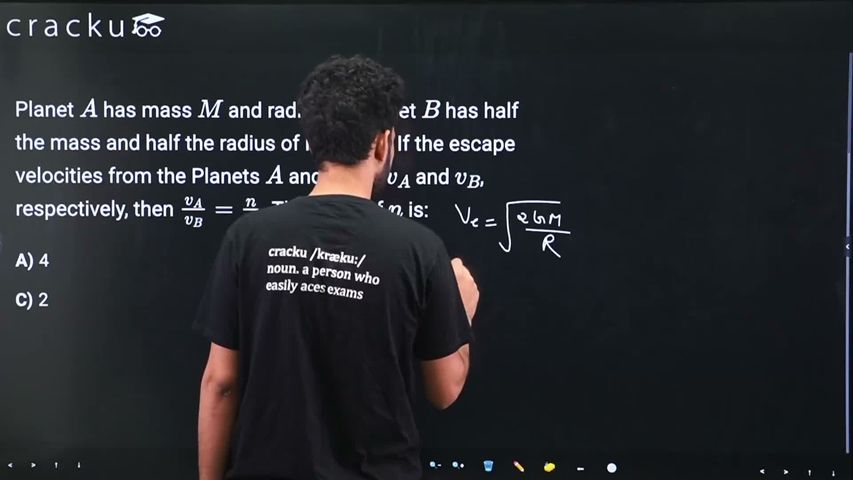
Planet $$A$$ has mass $$M$$ and radius $$R$$. Planet $$B$$ has half the mass and half the radius of Planet $$A$$. If the escape velocities from the Planets $$A$$ and $$B$$ are $$v_A$$ and $$v_B$$, respectively, then $$\frac{v_A}{v_B} = \frac{n}{4}$$. The value of $$n$$ is:
We know that the escape-velocity from the surface of a spherical planet of mass $$M$$ and radius $$R$$ is given by the standard formula
$$v_{\text{esc}} \;=\;\sqrt{\dfrac{2\,G\,M}{R}}$$
where $$G$$ is the universal gravitational constant.
First we apply this formula to Planet $$A$$. For Planet $$A$$ the mass is $$M_A = M$$ and the radius is $$R_A = R$$, so
$$v_A \;=\;\sqrt{\dfrac{2\,G\,M_A}{R_A}} \;=\;\sqrt{\dfrac{2\,G\,M}{R}}.$$
Now we consider Planet $$B$$. By statement of the question, Planet $$B$$ has half the mass and half the radius of Planet $$A$$, that is
$$M_B = \dfrac{M}{2}, \qquad R_B = \dfrac{R}{2}.$$
Substituting these values into the escape-velocity formula gives
$$\begin{aligned} v_B &= \sqrt{\dfrac{2\,G\,M_B}{R_B}} \\ &= \sqrt{\dfrac{2\,G\,\left(\dfrac{M}{2}\right)}{\dfrac{R}{2}}}. \end{aligned}$$
We simplify the expression inside the square root step by step:
$$\dfrac{2\,G\,\left(\dfrac{M}{2}\right)}{\dfrac{R}{2}} = \dfrac{G\,M}{\dfrac{R}{2}} = G\,M \times \dfrac{2}{R} = \dfrac{2\,G\,M}{R}.$$
Therefore
$$v_B = \sqrt{\dfrac{2\,G\,M}{R}}.$$
We can now compare the two escape velocities:
$$v_A = \sqrt{\dfrac{2\,G\,M}{R}}, \qquad v_B = \sqrt{\dfrac{2\,G\,M}{R}}.$$
Clearly, these two quantities are equal, so
$$\dfrac{v_A}{v_B} = 1.$$
The question states that this ratio can be written as $$\dfrac{v_A}{v_B} = \dfrac{n}{4}.$$ Equating the two expressions for the ratio, we have
$$\dfrac{n}{4} = 1 \;\;\Longrightarrow\;\; n = 4.$$
Hence, the correct answer is Option A.
Was this solution helpful?
Click on the Email ☝️ to Watch the Video Solution
Create a FREE account and get:
_1.webp)

Educational materials for JEE preparation

Ask our AI anything

AI can make mistakes. Please verify important information.
AI can make mistakes. Please verify important information.
