
Join Our JEE Preparation Group
Prep with like-minded aspirants; Get access to free daily tests and study material.
Sign in
Please select an account to continue using cracku.in
↓ →
Join Our JEE Preparation Group
Prep with like-minded aspirants; Get access to free daily tests and study material.
A uniformly thick wheel with moment of inertia $$I$$ and radius $$R$$ is free to rotate about its centre of mass (see fig). A massless string is wrapped over its rim and two blocks of masses $$m_1$$ and $$m_2$$ $$(m_1 > m_2)$$ are attached to the ends of the string. The system is released from rest. The angular speed of the wheel when $$m_1$$ descends by a distance $$h$$ is:
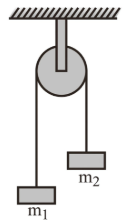
We begin by noting that the wheel can rotate without any slipping of the string, so the linear speed $$v$$ of each block is related to the angular speed $$\omega$$ of the wheel by the no-slip condition
$$v = R\,\omega.$$
The system is released from rest, therefore its initial kinetic energy is zero. Block $$m_1$$ descends a vertical distance $$h$$ while block $$m_2$$ rises the same distance. The change in gravitational potential energy of the two blocks is
$$\Delta U \;=\; -m_1gh \;+\; m_2gh \;=\; -(m_1 - m_2)gh.$$
Because energy is lost by the heavier block and gained by the lighter one, the net decrease in potential energy available to produce motion is
$$ (m_1 - m_2)gh. $$
We now invoke the principle of conservation of mechanical energy, which states:
“Loss of gravitational potential energy = Gain in kinetic energy of all moving parts.”
The kinetic energy acquired has two contributions:
Writing each term explicitly, we have
$$\text{Total K.E.} \;=\;\frac12 m_1v^2\;+\;\frac12 m_2v^2\;+\;\frac12 I\omega^2.$$
Combining the first two terms gives
$$\frac12(m_1+m_2)v^2 + \frac12 I \omega^2.$$
Substituting $$\omega = \dfrac{v}{R}$$ into the rotational part, we obtain
$$\frac12(m_1+m_2)v^2 \;+\;\frac12 I\left(\frac{v}{R}\right)^2 \;=\;\frac12\left[(m_1+m_2) + \frac{I}{R^2}\right]v^2.$$
Equating the loss in potential energy to this total kinetic energy, we write
$$ (m_1 - m_2)gh \;=\;\frac12\left[(m_1+m_2) + \frac{I}{R^2}\right]v^2.$$
Solving for $$v^2$$ gives
$$v^2 \;=\;\frac{2(m_1 - m_2)gh}{(m_1+m_2) \;+\;\dfrac{I}{R^2}}.$$
Multiplying numerator and denominator of the right-hand side by $$R^2$$ to prepare for finding $$\omega$$, we write
$$v^2 \;=\;\frac{2(m_1 - m_2)gh\,R^2}{(m_1+m_2)R^2 + I}.$$
Finally, using $$\omega = \dfrac{v}{R}$$, we have
$$\omega^2 \;=\;\frac{v^2}{R^2} \;=\;\frac{2(m_1 - m_2)gh}{(m_1+m_2)R^2 + I},$$
and therefore
$$\boxed{\displaystyle \omega \;=\;\left[\frac{2(m_1 - m_2)gh}{(m_1 + m_2)R^2 + I}\right]^{\tfrac12}}.$$
Comparing this result with the options provided, we see that it matches Option A.
Hence, the correct answer is Option A.
Was this solution helpful?
Click on the Email ☝️ to Watch the Video Solution
Create a FREE account and get:
_1.webp)

Educational materials for JEE preparation

Ask our AI anything

AI can make mistakes. Please verify important information.
AI can make mistakes. Please verify important information.
