
Join Our JEE Preparation Group
Prep with like-minded aspirants; Get access to free daily tests and study material.
Sign in
Please select an account to continue using cracku.in
↓ →
Join Our JEE Preparation Group
Prep with like-minded aspirants; Get access to free daily tests and study material.
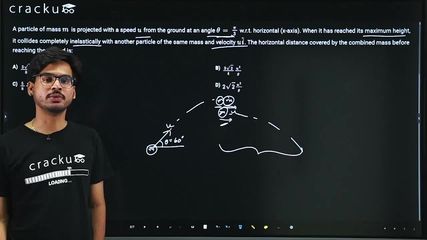
A particle of mass $$m$$ is projected with a speed $$u$$ from the ground at an angle $$\theta = \frac{\pi}{3}$$ w.r.t. horizontal (x-axis). When it has reached its maximum height, it collides completely inelastically with another particle of the same mass and velocity $$u\hat{i}$$. The horizontal distance covered by the combined mass before reaching the ground is:
We have a particle of mass $$m$$ projected from the ground with an initial speed $$u$$ making an angle $$\theta=\dfrac{\pi}{3}$$ with the horizontal. The Cartesian axes are chosen so that the horizontal is the $$x$$-axis and the vertical is the $$y$$-axis (positive upward).
First, we resolve the initial velocity of this projectile into its horizontal and vertical components. Using the basic trigonometric relations
$$u_x = u\cos\theta,\qquad u_y = u\sin\theta,$$
and putting $$\theta=\dfrac{\pi}{3}=60^{\circ}$$, we obtain
$$\cos\dfrac{\pi}{3}=\dfrac12,\qquad \sin\dfrac{\pi}{3}=\dfrac{\sqrt3}{2}.$$
Therefore
$$u_x = u\left(\dfrac12\right)=\dfrac{u}{2},\qquad u_y = u\left(\dfrac{\sqrt3}{2}\right)=\dfrac{u\sqrt3}{2}.$$
A projectile reaches its maximum height when its vertical component of velocity becomes zero. The time taken to reach that height is not needed directly here; we only need to note that at the topmost point the velocity of the first particle is purely horizontal and equal to its constant horizontal component $$u_x=\dfrac{u}{2}$$.
Now, exactly at this highest point it collides completely inelastically (they stick together) with another particle of the same mass $$m$$ that is moving horizontally with velocity $$u\hat{i}$$.
Because the collision is perfectly inelastic and no external horizontal force acts during the impact, the horizontal component of linear momentum is conserved. Denoting the common horizontal velocity immediately after the collision by $$v$$, we write
$$\text{Total initial horizontal momentum} = \text{Total final horizontal momentum}.$$ That is,
$$m\left(\dfrac{u}{2}\right)+m(u)=2m\,v.$$
Adding the momenta on the left gives
$$m\left(\dfrac{u}{2}+u\right)=m\left(\dfrac{3u}{2}\right)=2m\,v.$$
Dividing both sides by $$2m$$ yields the horizontal velocity of the combined mass:
$$v=\dfrac{3u}{4}.$$
At the instant just after collision the vertical velocity of the system is zero (both individual particles were moving purely horizontally), but the combined mass is now at the original projectile’s maximum height. We therefore need that height.
The maximum height reached by a projectile launched with initial vertical component $$u_y$$ is given by the kinematic formula
$$H=\dfrac{u_y^{\,2}}{2g},$$
where $$g$$ is the acceleration due to gravity. Substituting $$u_y=\dfrac{u\sqrt3}{2}$$, we get
$$H=\dfrac{\left(\dfrac{u\sqrt3}{2}\right)^2}{2g} =\dfrac{\dfrac{3u^2}{4}}{2g} =\dfrac{3u^{2}}{8g}.$$
Once the collision has occurred, the combined mass of $$2m$$ behaves like a single body projected horizontally from height $$H$$ with speed $$v=\dfrac{3u}{4}$$. Its vertical motion is free fall starting from rest; thus, the time taken to hit the ground is obtained from
$$H=\dfrac12 g t^{2}\quad\Longrightarrow\quad t=\sqrt{\dfrac{2H}{g}}.$$
Substituting $$H=\dfrac{3u^{2}}{8g}$$, we find
$$t=\sqrt{\dfrac{2\left(\dfrac{3u^{2}}{8g}\right)}{g}} =\sqrt{\dfrac{3u^{2}}{4g^{2}}} =\dfrac{u\sqrt3}{2g}.$$
During this time the horizontal velocity remains constant at $$v=\dfrac{3u}{4}$$, so the horizontal distance travelled after the collision is
$$x = v\,t =\left(\dfrac{3u}{4}\right)\left(\dfrac{u\sqrt3}{2g}\right) =\dfrac{3u^{2}\sqrt3}{8g}.$$
Writing it in the same form as the options,
$$x=\dfrac{3\sqrt3}{8}\,\dfrac{u^{2}}{g}.$$
Hence, the correct answer is Option A.
Was this solution helpful?
Click on the Email ☝️ to Watch the Video Solution
Create a FREE account and get:
Educational materials for JEE preparation

Ask our AI anything

AI can make mistakes. Please verify important information.
AI can make mistakes. Please verify important information.

_1.webp)
