NTA JEE Main 9th January 2020 Shift 2
For the following questions answer them individually
NTA JEE Main 9th January 2020 Shift 2 - Question 11
A wire of length $$L$$ and mass per unit length $$6.0 \times 10^{-3}$$ kg m$$^{-1}$$ is put under tension of 540 N. Two consecutive frequencies that it resonates at are: 420 Hz and 490 Hz. Then $$L$$ in meters is:
NTA JEE Main 9th January 2020 Shift 2 - Question 12
A small circular loop of conducting wire has radius $$a$$ and carries current $$I$$. It is placed in a uniform magnetic field $$B$$ perpendicular to its plane such that when rotated slightly about its diameter and released, it starts performing simple harmonic motion of time period $$T$$. The mass of the loop is $$m$$ then:
NTA JEE Main 9th January 2020 Shift 2 - Question 13
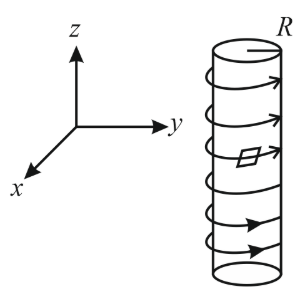
An electron gun is placed inside a long solenoid of radius $$R$$ on its axis. The solenoid has $$n$$ turns/length and carries a current $$I$$. The electron gun shoots an electron along the radius of the solenoid with speed $$v$$. If the electron does not hit the surface of the solenoid, maximum possible value of $$v$$ is (all symbols have their standard meaning):

NTA JEE Main 9th January 2020 Shift 2 - Question 14
In $$LC$$ circuit the inductance $$L = 40$$ mH and capacitance $$C = 100$$ $$\mu$$F. If a voltage $$V(t) = 10\sin(314t)$$ is applied to the circuit, the current in the circuit is given as:
NTA JEE Main 9th January 2020 Shift 2 - Question 15
Two identical capacitors $$A$$ and $$B$$, charged to the same potential $$5V$$ are connected in two different circuits as shown below at time $$t = 0$$. If the charge on capacitors $$A$$ and $$B$$ at time $$t = CR$$ is $$Q_A$$ and $$Q_B$$ respectively, then (Here $$e$$ is the base of natural logarithm)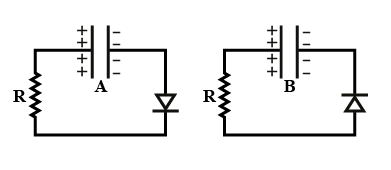
NTA JEE Main 9th January 2020 Shift 2 - Question 16
A plane electromagnetic wave is propagating along the direction $$\frac{\hat{i}+\hat{j}}{\sqrt{2}}$$, with its polarization along the direction $$\hat{k}$$. The correct form of the magnetic field of the wave would be (here $$B_0$$ is an appropriate constant):
NTA JEE Main 9th January 2020 Shift 2 - Question 17
There is a small source of light at some depth below the surface of water (refractive index $$= \frac{4}{3}$$) in a tank of large cross sectional surface area. Neglecting any reflection from the bottom and absorption by water, percentage of light that emerges out of surface is (nearly):
[Use the fact that surface area of a spherical cap of height $$h$$ and radius of curvature $$r$$ is $$2\pi rh$$]
NTA JEE Main 9th January 2020 Shift 2 - Question 18
An electron of mass $$m$$ and magnitude of charge $$e$$ at rest, gets accelerated by a constant electric field $$E$$. The rate of change of de-Broglie wavelength of this electron at time $$t$$ is (ignore relativistic effects):
NTA JEE Main 9th January 2020 Shift 2 - Question 19
The energy required to ionise a hydrogen like ion in its ground state is 9 Rydbergs. What is the wavelength of the radiation emitted when the electron in this ion jumps from the second excited state to the ground state?
NTA JEE Main 9th January 2020 Shift 2 - Question 20
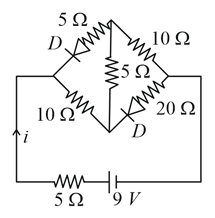
The current $$i$$ in the network is: