NTA JEE Main 9th January 2020 Shift 2
For the following questions answer them individually
NTA JEE Main 9th January 2020 Shift 2 - Question 61
Let $$a - 2b + c = 1$$.
If $$f(x) = \begin{vmatrix} x+a & x+2 & x+1 \\ x+b & x+3 & x+2 \\ x+c & x+4 & x+3 \end{vmatrix}$$, then:
NTA JEE Main 9th January 2020 Shift 2 - Question 62
Let $$[t]$$ denote the greatest integer $$\le t$$ and $$\lim_{x \to 0} x\left[\frac{4}{x}\right] = A$$. Then the function, $$f(x) = [x^2]\sin(\pi x)$$ is discontinuous, when $$x$$ is equal to:
NTA JEE Main 9th January 2020 Shift 2 - Question 63
If $$x = 2\sin\theta - \sin 2\theta$$ and $$y = 2\cos\theta - \cos 2\theta$$, $$\theta \in [0, 2\pi]$$, then $$\frac{d^2y}{dx^2}$$ at $$\theta = \pi$$ is:

NTA JEE Main 9th January 2020 Shift 2 - Question 64
Let $$f$$ and $$g$$ be differentiable functions on $$R$$ such that $$fog$$ is the identity function. If for some $$a, b \in R$$, $$g'(a) = 5$$ and $$g(a) = b$$, then $$f'(b)$$ is equal to:
NTA JEE Main 9th January 2020 Shift 2 - Question 65
Let a function $$f : [0, 5] \to R$$ be continuous, $$f(1) = 3$$ and $$F$$ be defined as:
$$F(x) = \int_1^x t^2 g(t) \; dt$$, where $$g(t) = \int_1^t f(u) \; du$$.
Then for the function $$F(x)$$, the point $$x = 1$$ is:
NTA JEE Main 9th January 2020 Shift 2 - Question 66
If $$\int \frac{d\theta}{\cos^2\theta(\tan 2\theta + \sec 2\theta)} = \lambda \tan\theta + 2\log_e|f(\theta)| + C$$ where $$C$$ is a constant of integration, then the ordered pair $$(\lambda, f(\theta))$$ is equal to:
NTA JEE Main 9th January 2020 Shift 2 - Question 67
Given: $$f(x) = \begin{cases} x, & 0 \le x \lt \frac{1}{2} \\ \frac{1}{2}, & x = \frac{1}{2} \\ 1-x, & \frac{1}{2} \lt x \le 1 \end{cases}$$
and $$g(x) = \left(x - \frac{1}{2}\right)^2, x \in R$$. Then, the area (in sq. units) of the region bounded by the curves, $$y = f(x)$$ and $$y = g(x)$$ between the lines $$2x = 1$$ and $$2x = \sqrt{3}$$, is:
NTA JEE Main 9th January 2020 Shift 2 - Question 68
If $$\frac{dy}{dx} = \frac{xy}{x^2+y^2}$$; $$y(1) = 1$$; then a value of $$x$$ satisfying $$y(x) = e$$ is:
NTA JEE Main 9th January 2020 Shift 2 - Question 69
If 10 different balls are to be placed in 4 distinct boxes at random, then the probability that two of these boxes contain exactly 2 and 3 balls is:
NTA JEE Main 9th January 2020 Shift 2 - Question 70
A random variable $$X$$ has the following probability distribution:
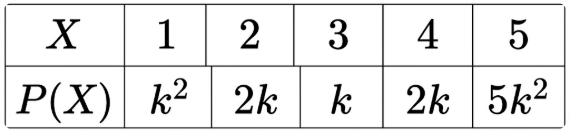
Then, $$P(X > 2)$$ is equal to: