
Join Our JEE Preparation Group
Prep with like-minded aspirants; Get access to free daily tests and study material.
Sign in
Please select an account to continue using cracku.in
↓ →
Join Our JEE Preparation Group
Prep with like-minded aspirants; Get access to free daily tests and study material.
To find the resistance of a galvanometer by the half deflection method, the following circuit is used with resistances $$R_1 = 9970$$ $$\Omega$$, $$R_2 = 30$$ $$\Omega$$ and $$R_3 = 0$$. The deflection in the galvanometer is d. With $$R_3 = 107$$ $$\Omega$$, the deflection changed to $$\frac{d}{2}$$. The galvanometer resistance is approximately:
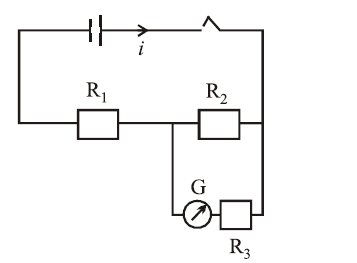
Initial state ($$R_3 = 0$$):
In this case, the galvanometer is in parallel with $$R_2$$. The total resistance of the circuit is $$R_{total} = R_1 + \frac{G R_2}{G + R_2}$$. Since $$R_1 \gg R_2$$, the current from the battery is $$I \approx \frac{V}{R_1}$$.
The current through the galvanometer ($$I_g$$) corresponding to deflection $$d$$ is $$I_g = I \left( \frac{R_2}{G + R_2} \right) = \frac{V}{R_1} \left( \frac{R_2}{G + R_2} \right) \quad \dots (1)$$
Final state ($$R_3 = 107\ \Omega$$):
The new current through the galvanometer ($$I_g'$$) corresponding to half deflection $$d/2$$ is $$I_g' = I \left( \frac{R_2}{G + R_3 + R_2} \right) = \frac{V}{R_1} \left( \frac{R_2}{G + 107 + R_2} \right) \quad \dots (2)$$
Since $$I_g' = \frac{1}{2} I_g$$, $$\frac{R_2}{G + 107 + R_2} = \frac{1}{2} \left( \frac{R_2}{G + R_2} \right)$$
$$2(G + R_2) = G + 107 + R_2$$
$$G + R_2 = 107$$
$$G + 30 = 107 \implies G = 77\ \Omega$$
Was this solution helpful?
Create a FREE account and get:
_1.webp)

Educational materials for JEE preparation

Ask our AI anything

AI can make mistakes. Please verify important information.
AI can make mistakes. Please verify important information.


