JEE WhatsApp Group




JEE Surface Tension PYQs
JEE Surface Tension PYQs are an important part of the JEE Physics syllabus. The chapter explains why the surface of a liquid behaves like a stretched membrane. It also covers surface energy, capillary action, excess pressure, liquid drops, soap bubbles, and wetting.
Questions from this chapter usually combine formulas with conceptual understanding. You may be asked to calculate the force caused by surface tension, the work done in increasing surface area, the rise of a liquid in a capillary tube, or the pressure inside a drop or bubble.
Some questions may appear complicated because the number of liquid surfaces changes from one situation to another. For example, a liquid drop has one surface, while a soap bubble has two. Drawing a simple diagram and marking each surface can make such questions much easier.
Instead of memorising every formula separately, try to understand the physical situation first. Identify whether the question involves a drop, bubble, film, capillary tube, or multiple droplets combining.
Regular practice with chapter-wise problems can improve both speed and accuracy. Solving numerical exercises, revising previous papers, and checking units can also help you recognise common question patterns. Surface tension is measured in newtons per metre, whereas surface energy is measured in joules per square metre.
This page includes a downloadable PYQ set, important formulas, common mistakes, and a practical strategy for solving questions. You can use it with your regular revision notes for focused preparation.
JEE Surface Tension Important PYQs PDF
The PYQ PDF can include JEE Surface Tension Questions from the most frequently tested areas of the chapter. These may cover surface force, surface energy, capillary rise and depression, angle of contact, excess pressure, soap films, liquid drops, bubbles, and the coalescence of droplets.
Practising previous-year questions helps you understand how the same concept can be tested in different ways. Some questions mainly require numerical calculation, while others test whether you have identified the correct number of surfaces or used the right pressure formula.
For example, a question involving a liquid drop may look similar to one involving a soap bubble. However, their excess-pressure formulas are different because a soap bubble has two surfaces.
Solving both conceptual and numerical questions regularly can help you read the problem more carefully and select the correct formula without wasting time.
Surface Tension Formula for JEE
Surface tension formulas become easier to remember when they are connected to the correct physical situation. Before applying any expression, check whether the question involves a liquid drop, soap bubble, capillary tube, liquid film, or several droplets joining together.
You can add the complete Surface Tension Formula Sheet to your JEE Study Material for quick revision before chapter practice, assignments, and mock tests.
| Concept | Formula |
|---|---|
| Surface tension | (T = \frac{F}{l}) |
| Surface energy | (E = T\Delta A) |
| Excess pressure inside a liquid drop | (\Delta P = \frac{2T}{r}) |
| Excess pressure inside a soap bubble | (\Delta P = \frac{4T}{r}) |
| Capillary rise or depression | (h = \frac{2T\cos\theta}{\rho gr}) |
| Force on a sliding wire | (F = 2Tl) |
| Work done in expanding a soap film | (W = 2T\Delta A) |
| Surface energy of a liquid drop | (E = 4\pi r^2T) |
| Radius after combining equal drops | (R = n^{1/3}r) |
| Energy released during coalescence | (\Delta E = T(A_{\text{initial}}-A_{\text{final}})) |
These formulas are commonly used in questions involving liquid drops, soap bubbles, capillaries, films, wetting, and coalescence.
While revising, pay special attention to the number of free surfaces. Also check whether the radius given in the question belongs to a liquid drop, soap bubble, or capillary tube.
Common Mistakes to Avoid in JEE Surface Tension PYQs
Most mistakes in this chapter happen because students count the surfaces incorrectly, miss an important factor, or apply a formula to the wrong physical system.
Confusing surface tension with surface energy
Surface tension is defined as force per unit length, whereas surface energy is energy per unit area. Their numerical values may be equal in SI units, but they represent different physical quantities.
Forgetting the two surfaces of a soap film
A soap film has two exposed surfaces. Therefore, the force and work expressions for a soap film contain an additional factor of two.
For example:
- Force on a movable wire in a soap film: (F = 2Tl)
- Work done in increasing the area of a soap film: (W = 2T\Delta A)
Using the same pressure formula for drops and bubbles
A liquid drop has one surface, so its excess pressure is:
[
\Delta P = \frac{2T}{r}
]
A soap bubble has two surfaces, so its excess pressure is:
[
\Delta P = \frac{4T}{r}
]
Using the wrong expression can change the final answer completely.
Ignoring the angle of contact
The capillary-rise formula contains (\cos\theta). The angle of contact must be measured through the liquid.
Its value determines whether the liquid rises, falls, or remains at the same level inside the capillary tube.
Assuming surface tension is always constant
Surface tension depends on temperature and the presence of impurities. It generally decreases when temperature increases.
Different dissolved substances may increase or decrease surface tension depending on their nature.
Drawing a clear diagram and marking every liquid surface before starting the calculation can help you avoid most of these errors.
How to Solve Surface Tension Questions Faster
Begin by identifying the physical system mentioned in the question. It may involve a liquid drop, soap bubble, capillary tube, soap film, or several droplets joining together.
Next, write down the given quantities and mark the radius, area, surface tension, density, contact angle, and number of surfaces wherever required.
Then identify what the question is asking you to calculate. It could be:
- Surface force
- Surface energy
- Excess pressure
- Capillary height
- Radius of a combined drop
- Energy released during coalescence
This step prevents random formula selection.
When attempting a JEE Mains Advanced Mock Test, pay particular attention to questions involving multiple drops or bubbles. Calculate the contribution of each surface separately before combining the results.
Always check the units before finalising the answer. For example, radius may be given in centimetres, while the formula requires metres. Converting all values into SI units at the beginning can reduce calculation errors.
List of JEE Surface Tension PYQs
Below is a test-style set of questions based on surface force, surface energy, capillary action, excess pressure, soap films, liquid drops, bubbles, and coalescence.
Try to solve every question independently before checking the answer. While solving, note the formula used, the number of surfaces involved, and the reason behind each step. This approach will help you understand the chapter instead of simply memorising results.
Question 1
A small spherical droplet of density $$d$$ is floating exactly half immersed in a liquid of density $$\rho$$ and surface tension $$T$$. The radius of the droplet is (take note that the surface tension applies an upward force on the droplet):
correct answer:- 4
Question 2
The ratio of surface tensions of mercury and water is given to be 7.5, while the ratio of their densities is 13.6. Their contact angles, with glass, are close to 135° and 0°, respectively. If it is observed that mercury gets depressed by an amount $$h$$ in a capillary tube of radius $$r_1$$, while water rises by the same amount $$h$$ in a capillary tube of radius $$r_2$$, then the ratio $$\frac{r_1}{r_2}$$ is close to
correct answer:- 4
Question 3
Pressure inside two soap bubbles are 1.01 and 1.02 atmosphere, respectively. The ratio of their volumes is:
correct answer:- 3
Question 4
A capillary tube is immersed vertically in water and the height of the water column is $$x$$. When this arrangement is taken into a mine of depth d, the height of the water column is $$y$$. If R is the radius of earth, the ratio $$\frac{x}{y}$$ is:
correct answer:- 4
Question 5
This question has Statement-1 and Statement-2. Of the four choices given after the Statements, choose the one that best describes the two Statements.
Statement-1: A capillary is dipped in a liquid and liquid rises to a height h in it. As the temperature of the liquid is raised, the height h increases (if the density of the liquid and the angle of contact remain the same).
Statement-2: Surface tension of a liquid decreases with the rise in its temperature.
correct answer:- 2

Question 6
The excess pressure inside a soap bubble is thrice the excess pressure inside a second soap bubble. The ratio between the volume of the first and the second bubble is:
correct answer:- 3
Question 7
A big drop is formed by coalescing 1000 small identical drops of water. If $$E_1$$ be the total surface energy of 1000 small drops of water and $$E_2$$ be the surface energy of single big drop of water, the $$E_1 : E_2$$ is $$x : 1$$, where $$x$$ = ________.
correct answer:- 10
Question 8
Pressure inside a soap bubble is greater than the pressure outside by an amount : (given : $$R$$ = Radius of bubble, $$S$$ = Surface tension of bubble)
correct answer:- 4
Question 9
When a part of a straight capillary tube is placed vertically in a liquid, the liquid raises uptocertain height h. If the inner radius of the capillary tube, density of the liquid and surface tension of the liquid decrease by 1 % each, then the height of the liquid in the tube will change by __ %.
correct answer:- 3
Question 10
The excess pressure inside a soap bubble A in air is half the excess pressure inside another soap bubble B in air. If the volume of the bubble A is $$n$$ times the volume of the bubble B, then the value of n is ________.
correct answer:- 8

Question 11
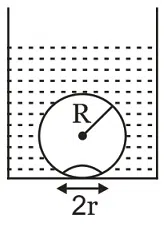
On heating water, bubbles being formed at the bottom of the vessel detach and rise. Take the bubbles to be spheres of radius R and making a circular contact of radius r with the bottom of the vessel. If $$r \ll R$$, and the surface tension of water is T, value of r just before bubbles detach is: (density of water is $$\rho_w$$)
correct answer:- 1
Question 12
An air bubble of volume 2.9 $$cm^{3}$$ rises from the bottom of a swimming pool of 5 m deep. At the bottom of the pool water temperature is $$17^{o}$$C. The volume of the bubble when it reaches the surface, where the water temperature is $$27^{o}$$C, is ______$$cm^{3}$$.
($$g = 10 m/s^{2}$$, density of water = $$10^{3} kg/m^{3}$$, and 1 atm pressure is $$10^{5}$$ Pa)
correct answer:- 3
Question 13
Wax is coated on the inner wall of a capillary tube and the tube is then dipped in water. Then, compared to the unwaxed capillary, the angle of contact $$\theta$$ and the height $$h$$ upto which water rises change. These changes are :
correct answer:- 3
Question 14
A capillary tube made of glass of radius 0.15 mm is dipped vertically in a beaker filled with methylene iodide (surface tension = 0.05 N m$$^{-1}$$, density = 667 kg m$$^{-3}$$) which rises to height h in the tube. It is observed that the two tangents drawn from observed that the two tangents drawn from liquid-glass interfaces (from opp. sides of the capillary) make an angle of 60$$°$$ with one another. Then h is close to (g = 10 m s$$^{-2}$$):
correct answer:- 2
Question 15
When two soap bubbles of radii $$a$$ and $$b$$ ($$b > a$$) coalesce, the radius of curvature of common surface is:
correct answer:- 1

Question 16
The height of liquid column raised in a capillary tube of certain radius when dipped in liquid $$A$$ vertically is, $$5$$ cm. If the tube is dipped in a similar manner in another liquid $$B$$ of surface tension and density double the values of liquid $$A$$, the height of liquid column raised in liquid B would be ______ m.
correct answer:- 3
Question 17
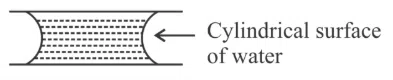
If two glass plates have water between them and are separated by very small distance (see the figure below), it is very difficult to pull them apart. It is because the water in between forms cylindrical surface on the side that gives rise to lower pressure in the water in comparison to atmosphere. If the radius of the cylindrical surface is R and surface tension of water is T then the pressure in water between the plates is lower by:
correct answer:- 4
Question 18
If 1000 droplets of water of surface tension 0.07 N m$$^{-1}$$, having same radius 1 mm each, combine to form a single drop. In the process the released surface energy is- (Take $$\pi = \dfrac{22}{7}$$)
correct answer:- 2
Question 19
A mercury drop of radius $$10^{-3}$$ m is broken into 125 equal size droplets. Surface tension of mercury is 0.45 N m$$^{-1}$$. The gain in surface energy is:
correct answer:- 1
Question 20
There is an air bubble of radius $$1.0$$ mm in a liquid of surface tension $$0.075$$ N m$$^{-1}$$ and density $$1000$$ kg m$$^{-3}$$ at a depth of $$10$$ cm below the free surface. The amount by which the pressure inside the bubble is greater than the atmospheric pressure is _____ Pa ($$g = 10$$ m s$$^{-2}$$).
correct answer:- 1150

Question 21
The surface tension of a soap solution is $$3.5 \times 10^{-2}$$ N/m. The work required to increase the radius of a soap bubble from 1 cm to 2 cm is $$\alpha \times 10^{-6}$$ J. The value of $$\alpha$$ is _____. $$(\pi = 22/7)$$
correct answer:- 264
Question 22
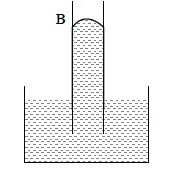
correct answer:- 3
Question 23
A $$20$$ cm long capillary tube is dipped in water. The water rises up to $$8$$ cm. If the entire arrangement is put in a freely falling elevator the length of water column in the capillary tube will be
correct answer:- 4
Question 24
If two soap bubbles of different radii are connected by a tube,
correct answer:- 3
Question 25
Work done in increasing the size of a soap bubble from a radius of $$3 \, \text{cm}$$ to $$5 \, \text{cm}$$ is nearly (Surface tension of soap solution $$= 0.03 \, \text{Nm}^{-1}$$):
correct answer:- 3

Question 26
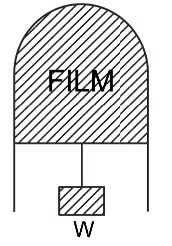
A thin liquid film formed between a U-shaped wire and a light slider supports a weight of $$1.5 \times 10^{-2}$$ N (see figure). The length of the slider is $$30$$ cm and its weight negligible. The surface tension of the liquid film is
correct answer:- 4
Question 27
A large number of droplets, each of radius $$r$$ coalesce to form a bigger drop of radius $$R$$. An engineer designs a machine so that the energy released in this process is converted into the kinetic energy of the drop. Velocity of the drop is ($$T$$ = surface tension, $$\rho$$ = density)
correct answer:- 2
Question 28
A capillary tube of radius 0.1 mm is partly dipped in water (surface tension 70 dyn/cm and glass water contact angle $$\simeq 0^\circ$$) with $$30^\circ$$ inclined with vertical. The length of water risen in the capillary is _____ cm. (Take $$g = 9.8$$ m/s$$^2$$)
correct answer:- 1
Question 29
Two water drops each of radius 'r' coalesce to form a bigger drop. If 'T' is the surface tension, the surface energy released in this process is :
correct answer:- 1
Question 30
Two liquids A and B have $$\theta_A$$ and $$\theta_B$$ as contact angles in a capillary tube. If $$K = \cos\theta_A / \cos\theta_B$$, then identify the correct statement:
correct answer:- 3