
Join Our JEE Preparation Group
Prep with like-minded aspirants; Get access to free daily tests and study material.
Sign in
Please select an account to continue using cracku.in
↓ →
Join Our JEE Preparation Group
Prep with like-minded aspirants; Get access to free daily tests and study material.
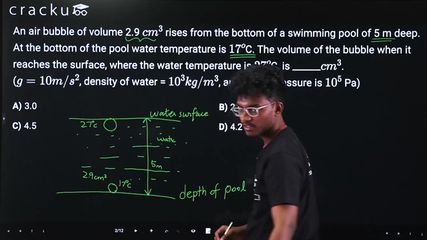
An air bubble of volume 2.9 $$cm^{3}$$ rises from the bottom of a swimming pool of 5 m deep. At the bottom of the pool water temperature is $$17^{o}$$C. The volume of the bubble when it reaches the surface, where the water temperature is $$27^{o}$$C, is ______$$cm^{3}$$.
($$g = 10 m/s^{2}$$, density of water = $$10^{3} kg/m^{3}$$, and 1 atm pressure is $$10^{5}$$ Pa)
We need to find the volume of an air bubble when it reaches the surface of a swimming pool. First, the combined gas law for a fixed amount of gas is given by $$\frac{P_1 V_1}{T_1} = \frac{P_2 V_2}{T_2}$$.
At the bottom of the pool, the bubble has volume $$V_1 = 2.9 \, \text{cm}^3$$, temperature $$T_1 = 17°\text{C} = 290 \, \text{K}$$, and pressure $$P_1 = P_{\text{atm}} + \rho g h = 10^5 + 10^3 \times 10 \times 5 = 10^5 + 0.5 \times 10^5 = 1.5 \times 10^5 \, \text{Pa}$$.
When the bubble reaches the surface, the temperature becomes $$T_2 = 27°\text{C} = 300 \, \text{K}$$ and the pressure is $$P_2 = P_{\text{atm}} = 10^5 \, \text{Pa}$$.
Substituting these values into the combined gas law gives $$V_2 = V_1 \times \frac{P_1}{P_2} \times \frac{T_2}{T_1}$$, then $$V_2 = 2.9 \times \frac{1.5 \times 10^5}{10^5} \times \frac{300}{290}$$, which simplifies to $$V_2 = 2.9 \times 1.5 \times \frac{300}{290}$$, and finally evaluates as $$V_2 = 4.35 \times 1.0345 = 4.5 \, \text{cm}^3$$.
The correct answer is Option (3): 4.5 cm$$^3$$.
Was this solution helpful?
Click on the Email ☝️ to Watch the Video Solution
Create a FREE account and get:
_1.webp)

Educational materials for JEE preparation

Ask our AI anything

AI can make mistakes. Please verify important information.
AI can make mistakes. Please verify important information.
