
Join Our JEE Preparation Group
Prep with like-minded aspirants; Get access to free daily tests and study material.
Sign in
Please select an account to continue using cracku.in
↓ →
Join Our JEE Preparation Group
Prep with like-minded aspirants; Get access to free daily tests and study material.
On heating water, bubbles being formed at the bottom of the vessel detach and rise. Take the bubbles to be spheres of radius R and making a circular contact of radius r with the bottom of the vessel. If $$r \ll R$$, and the surface tension of water is T, value of r just before bubbles detach is: (density of water is $$\rho_w$$)
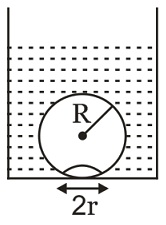
$$F_B = \text{Volume} \times \rho_w \times g = \frac{4}{3}\pi R^3 \rho_w g$$ (Buoyancy Force)
The surface tension of water pulls downward along the circular contact perimeter of radius $$r$$. From the geometry of the contact region, let $$\theta$$ be the angle that the bubble's surface makes with the vertical at the contact rim. For a spherical shape where $$r \ll R$$: $$\sin\theta \approx \frac{r}{R}$$
The downward component of the surface tension force acting along the circular perimeter of radius $$r$$ ($$2\pi r$$) is $$F_{ST} = T \cdot (2\pi r) \cdot \sin\theta$$
$$F_{ST} = 2\pi r T \left(\frac{r}{R}\right) = \frac{2\pi r^2 T}{R}$$
Just before detachment, the upward buoyancy force is exactly counterbalanced by the downward surface tension force holding the bubble to the bottom:
$$F_{ST} = F_B$$
$$\frac{2\pi r^2 T}{R} = \frac{4}{3}\pi R^3 \rho_w g$$
$$r^2 = \frac{4 R^4 \rho_w g}{6 T} = \frac{2 \rho_w g}{3T} R^4$$
$$r = R^2 \sqrt{\frac{2\rho_w g}{3T}}$$
Was this solution helpful?
Create a FREE account and get:
_1.webp)

Educational materials for JEE preparation

Ask our AI anything

AI can make mistakes. Please verify important information.
AI can make mistakes. Please verify important information.


