JEE WhatsApp Group



JEE Basic Principles of Organic Chemistry PYQ
Basic Principles of Organic Chemistry is an important chapter for every JEE student. It helps you understand how organic reactions take place and why one compound reacts differently from another.
This chapter includes topics such as inductive effect, resonance, hyperconjugation, acidity, basicity, reaction intermediates, electrophiles, nucleophiles, and aromaticity. These ideas are used again in almost every organic chemistry chapter.
Solving JEE Basic Principles of Organic Chemistry PYQ is a good way to check whether your concepts are clear. It also helps you understand the type of questions asked in JEE Main.
On this page, you can revise the main concepts, download the PYQ PDF, learn important rules, avoid common mistakes, and practise questions in a test format.
JEE Basic Principles of Organic Chemistry PYQ
Previous-year questions help you understand which topics are asked most often. In this chapter, many questions are based on stability, electron movement, acidity, basicity, and reaction intermediates.
While solving JEE Questions, do not try to memorise the answers. First, read the question carefully and understand what you need to compare.
For example, if the question asks about carbocation stability, check whether resonance or hyperconjugation is present. Also look at the number of alkyl groups attached to the positively charged carbon.
The same method can be used for carbanions and free radicals. Always check the complete structure before choosing an answer.
You should also practise questions within a fixed time. After solving a set, check your answers and write down the questions you got wrong. Try to find the real reason behind each mistake.
It may be because:
- The concept was not clear.
- You remembered the wrong stability order.
- You missed resonance.
- You confused an electrophile with a nucleophile.
- You selected the answer too quickly.
Regular practice will help you improve your speed and accuracy.
JEE Basic Principles of Organic Chemistry PYQs PDF
You can download the JEE Basic Principles of Organic Chemistry PYQs PDF from the section below.
First, solve the questions without looking at the answers. Try to complete the PDF in one sitting so that you can check your current level.
After completing it, divide the questions into three groups:
- Questions you solved easily
- Questions that took extra time
- Questions you could not solve
Revise the difficult topics and try those questions again after a few days.
You can also use this PDF as part of your JEE Study Material. While checking the solutions, do not only look at the correct option. Read the reason behind the answer.
In organic chemistry, the correct answer often depends on a small detail. It may be resonance, inductive effect, hybridisation, or the position of a charge.
Important Formulas for JEE Basic Principles of Organic Chemistry PYQs
This chapter does not have many numerical formulas. However, there are some important rules and orders that you should remember.
You can add the following points to your JEE Mains Formula Sheet for quick revision.
| Concept | Important Order or Rule | Simple Meaning |
|---|---|---|
| Carbocation stability | Benzylic or Allylic > 3° > 2° > 1° > CH₃⁺ | Resonance and alkyl groups increase stability. |
| Carbanion stability | CH₃⁻ > 1° > 2° > 3° | Alkyl groups usually reduce carbanion stability. |
| Free radical stability | Benzylic or Allylic > 3° > 2° > 1° > CH₃• | Resonance and hyperconjugation make radicals more stable. |
| Inductive effect | Decreases with distance | The effect becomes weaker as the distance increases. |
| Resonance | More stable resonance forms increase stability | Electron movement spreads the charge over the molecule. |
| Acidity | More stable conjugate base means stronger acid | A stable conjugate base makes the acid stronger. |
| Basicity | More available lone pair means stronger base | A lone pair involved in resonance is less available. |
| Electrophile | Accepts an electron pair | It is usually electron-deficient. |
| Nucleophile | Donates an electron pair | It usually has a lone pair or a negative charge. |
| Aromaticity | 4n + 2 pi electrons | The compound should also be cyclic, planar, and conjugated. |
Do not memorise these orders without understanding the reason behind them.
For example, resonance can make a carbocation more stable, but it can also reduce the basicity of a compound if the lone pair is involved in resonance.
Always check all the factors before choosing the final answer.
Common Mistakes to Avoid in JEE Basic Principles of Organic Chemistry PYQs
One common mistake is checking only one factor while comparing stability.
For example, students may look only at the degree of a carbocation and ignore resonance. In many questions, resonance is more important than the number of alkyl groups.
Another common mistake is confusing electrophiles and nucleophiles.
An electrophile accepts an electron pair. A nucleophile donates an electron pair. Some neutral compounds can also act as electrophiles or nucleophiles, so do not depend only on the charge.
Students also use the same stability order for carbocations and carbanions. This is incorrect. Alkyl groups usually stabilise carbocations but can make carbanions less stable.
While solving acidity questions, compare the stability of the conjugate bases. The acid with the more stable conjugate base is usually stronger.
For basicity questions, check whether the lone pair is free or involved in resonance. A lone pair involved in resonance is less available for donation.
While solving JEE Basic Principles of Organic Chemistry Questions, draw the structures clearly. Show the correct charge, lone pair, and electron movement.
Also remember that atoms do not move in resonance structures. Only electrons and charges move.
List of JEE Basic Principles of Organic Chemistry PYQs
Use the section below as a small practice test.
Question 1
The IUPAC name of the compound shown below is
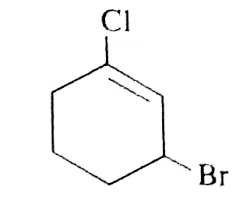
correct answer:- 3
Question 2
Which of the following is not an assumption of the kinetic theory of gases?
correct answer:- 3
Question 3
Given below are two statements:
Statement I: $$o$$-Toluidine (2-methylaniline) is a weaker base than both $$p$$-Toluidine and unsubstituted aniline.
Statement II: The basicity of $$o$$-Toluidine is exceptionally low because the $$-NH_2$$ group is forced out of the plane of the benzene ring by the adjacent $$-CH_3$$ group, an effect known as Steric Inhibition of Resonance (SIR).
In the light of the above statements, choose the most appropriate answer from the options given below:
correct answer:- 3
Question 4
The initial volume of a gas cylinder is 750.0 mL. If the pressure of gas inside the cylinder changes from 840.0 mmHg to 360.0 mmHg, the final volume the gas will be:
correct answer:- 1
Question 5
Which one of the following acids does not exhibit optical isomerism?
correct answer:- 3

Question 6
The order of stability of the following carbocations:
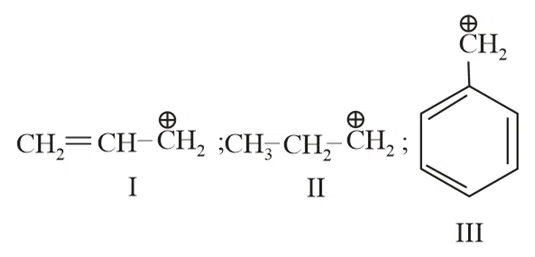
correct answer:- 2
Question 7
A sealed flask with a capacity of $$2 \text{ dm}^3$$ contains $$11 \text{ g}$$ of propane gas. The flask is so weak that it will burst if the pressure becomes $$2 \text{ MPa}$$. The minimum temperature at which the flask will burst is ______ °C. [Nearest integer]
(Given: $$R = 8.3 \text{ J K}^{-1} \text{ mol}^{-1}$$. Atomic masses of C and H are $$12u$$ and $$1u$$ respectively.) (Assume that propane behaves as an ideal gas.)
correct answer:- 1655
Question 8
The IUPAC name of the following compound is:
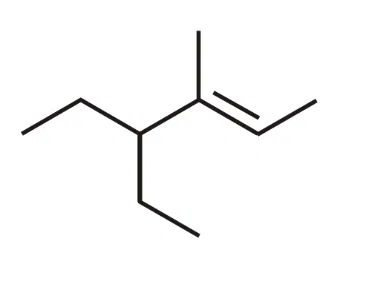
correct answer:- 4
Question 9
The IUPAC name of the following compound is:
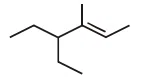
correct answer:- 4
Question 10
Which one of the following pairs of isomers is an example of metamerism?
correct answer:- 4

Question 11
Given below are four compounds :
(a) n-propyl choride
(b) iso-propyl chloride
(c) sec-butyl chloride
(d) neo-pentyl chloride
Percentage of carbon in the one which exhibits optical isomerism is:
correct answer:- 2
Question 12
Given below are two statements: Statement I: IUPAC name of $$HO - CH_2 - (CH_2)_3 - CH_2 - COCH_3$$ is 7-hydroxyheptan-2-one. Statement II: 2-oxoheptan-7-ol is the correct IUPAC name for the above compound. In the light of the above statements, Choose the most appropriate answer from the options given below:
correct answer:- 1
Question 13
An LPG cylinder contains gas at a pressure of 300 kPa at 27°C. The cylinder can withstand the pressure of $$1.2 \times 10^6$$ Pa. The room in which the cylinder is kept catches fire. The minimum temperature at which the bursting of cylinder will take place is _________ °C. (Nearest integer)
correct answer:- 927
Question 14
When does a gas deviate the most from its ideal behavior?
correct answer:- 4
Question 15
The major product of which of the following reaction is not obtained by rearrangement reaction?
correct answer:- 2

Question 16
At temperature T, the average kinetic energy of any particle is $$\frac{3}{2}kT$$. The de Broglie wavelength follows the order:
correct answer:- 1
Question 17
If Z is the compressibility factor, then Van der Waal's equation at low pressure can be written as:
correct answer:- 2
Question 18
Initially, the root-mean-square (RMS) velocity of $$N_2$$ molecules at certain temperature is u. If this temperature is doubled and all the nitrogen molecules dissociate into nitrogen atoms, then the new RMS velocity will be:
correct answer:- 1
Question 19
Match List I with List II :
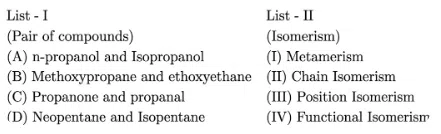
Choose the correct answer from the options given below :
correct answer:- 4
Question 20
Given below are two statements:
Statement I: There are several conformers for n-butane. Out of those conformers,
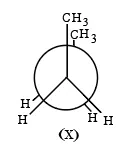
is the least stable and most stable conformer is
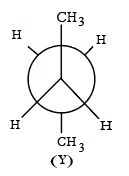
Statement II: As the dihedral angle increases, torsional strain decreases from (X) to (Y).
In the light of the above statements, choose the correct answer from the options given below
correct answer:- 2

Question 21
The correct IUPAC name of the following compound is:
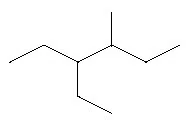
correct answer:- 2
Question 22
Which amongst the following is the strongest acid?
correct answer:- 1
Question 23
The correct stability order of carbocations is
correct answer:- 3
Question 24
Increasing order of stability of the resonance structure is:
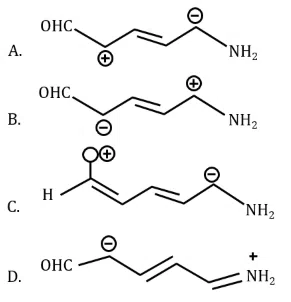
correct answer:- 2
Question 25
Given below are two statements:
Statement I:
The dipole moment of $$\overset{4}{\mathrm{CH_3}} - \overset{3}{\mathrm{CH}} = \overset{2}{\mathrm{CH}} - \overset{1}{\mathrm{CH}}=O$$ is greater than $$\overset{4}{\mathrm{CH_3}} - \overset{3}{\mathrm{CH_2}} - \overset{2}{\mathrm{CH_2}} - \overset{1}{\mathrm{CH}}=O$$.
Statement II:
$$C_1-C_2$$ bond length of $$\underset{4}{\mathrm{CH_3}} - \underset{3}{\mathrm{CH}} = \underset{2}{\mathrm{CH}} - \underset{1}{\mathrm{CH}}=O$$ is greater than $$C_1-C_2$$ bond length of $$\underset{4}{\mathrm{CH_3}} - \underset{3}{\mathrm{CH_2}} - \underset{2}{\mathrm{CH_2}} - \underset{1}{\mathrm{CH}}=O$$.
In the light of the above statements, choose the correct answer from the options given below
correct answer:- 3

Question 26
The difference in energy between the actual structure and the lowest energy resonance structure for the given compound is:
correct answer:- 2
Question 27
Match List I with List II:
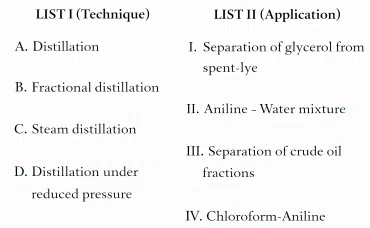
Choose the correct answer from the options given below:
correct answer:- 1
Question 28
The product (C) in the following sequence of reactions has ______ $$\pi$$ bonds.

correct answer:- 4
Question 29
The correct nomenclature for the following compound is
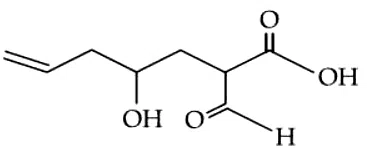
correct answer:- 2
Question 30
The molarity of a solution obtained by mixing 750 mL of 0.5(M) HCl with 250 mL of 2(M) HCl will be
correct answer:- 3
.webp)