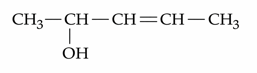
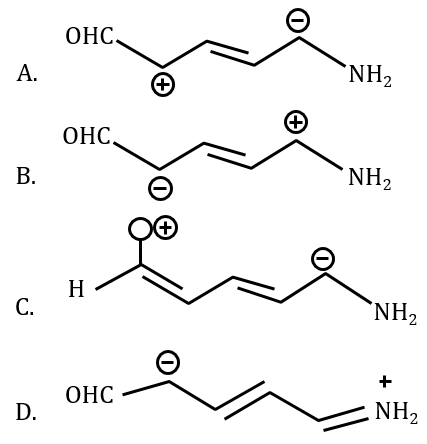
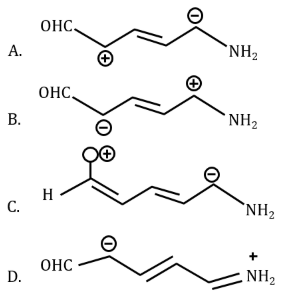
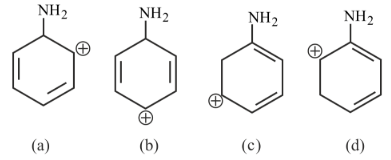
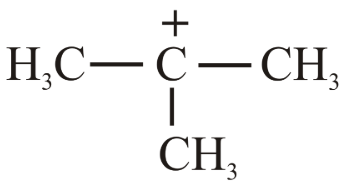
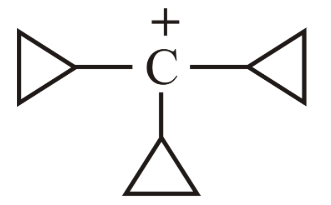
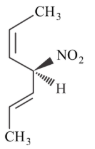
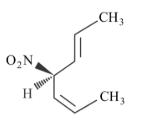
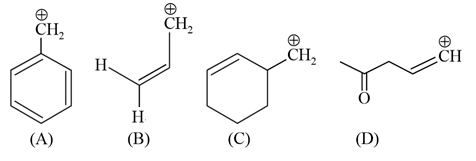
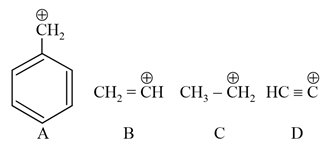
From the following, the least stable structure is :
JEE Basic Principles of Organic Chemistry Questions
Stability Rules:
- Octet Rule: Structures where all atoms have complete octets are more stable.
- Number of Bonds: More covalent bonds usually mean more stability.
- Charge Separation: Neutral structures are more stable than charged ones.
- Electronegativity: Negative charges are more stable on more electronegative atoms (like (O) or (N)).
- Adjacent Charges: Structures with like charges on adjacent atoms are highly unstable.
All have same number of $$\sigma$$ (sigma bonds) and $$\pi$$ bonds.
No neutral species. All are charged species.
Option (A)
- The positive charge is part of a conjugated system.
- The double bonds allow resonance delocalization of charge.
- The nitro group (-NO₂) helps in stabilizing the system via resonance. Both negative charges on high electronegative atom - Oxygen.
Conclusion:
Better stabilization due to conjugation and resonance. Most stable.
Option (B)
- Both positive charges next to each other so they repel each other and stability decreases
- The double bonds allow resonance delocalization of charge.
Conclusion:
Least stable.
Option (C)
- Charges are arranged such that resonance delocalization is possible.
- (+ve) charge and (-ve) charge are next to each other. So that stabilizes system. But distance between two positive charges (on Carbon and Nitrogen) are closer compared to D $$\rightarrow$$ they repel.
Conclusion:
More stable than option B due to better charge handling.
Option (D)
- Shows conjugation between double bond and charged centers.
- (+ve) charge and (-ve) charge are next to each other. So that stabilizes system more.
- Opposite charges are little far as compared to option C
Conclusion:
More stable compared to C.
Stability Order :
A > D > C > B
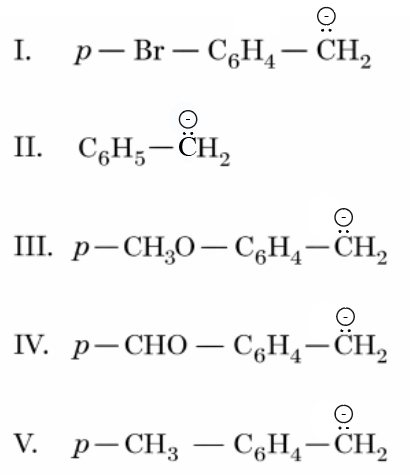
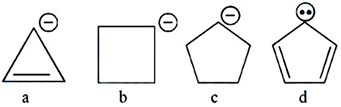
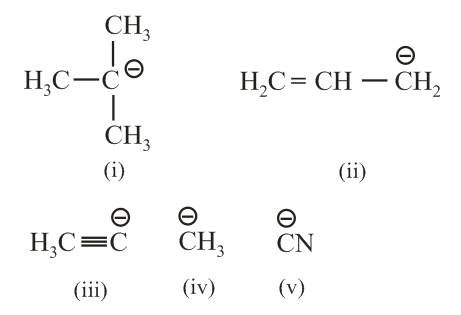
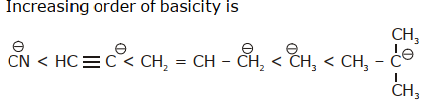
Arrange the following carbanions in the decreasing order of stability.

Choose the correct answer from the options given below:
Given below are four compounds :
(a) n-propyl choride
(b) iso-propyl chloride
(c) sec-butyl chloride
(d) neo-pentyl chloride
Percentage of carbon in the one which exhibits optical isomerism is:
We need to identify which compound exhibits optical isomerism and find its carbon percentage.
(a) n-propyl chloride: $$CH_3CH_2CH_2Cl$$ — no chiral center.
(b) iso-propyl chloride: $$(CH_3)_2CHCl$$ — no chiral center (the carbon bonded to Cl has two identical methyl groups).
(c) sec-butyl chloride: $$CH_3CH(Cl)CH_2CH_3$$ — has a chiral center at C-2 (bonded to H, Cl, CH₃, C₂H₅ — all different). Exhibits optical isomerism.
(d) neo-pentyl chloride: $$(CH_3)_3CCH_2Cl$$ — no chiral center.
sec-butyl chloride is $$C_4H_9Cl$$. Molecular formula: $$C_4H_9Cl$$.
Molar mass = 4(12) + 9(1) + 35.5 = 48 + 9 + 35.5 = 92.5 g/mol
% Carbon = $$\frac{48}{92.5} \times 100 = 51.89\% \approx 52\%$$
The answer is Option 2: 52.
80 mL of a hydrocarbon on mixing with 264 mL of oxygen in a closed U-tube undergoes complete combustion. The residual gases after cooling to 273 K occupy 224 mL. When the system is treated with KOH solution, the volume decreases to 64 ml. The formula of the hydrocarbon is:
80 mL hydrocarbon + 264 mL O₂. After combustion at 273K: 224 mL residual (CO₂ + unreacted O₂). After KOH: 64 mL (unreacted O₂, since KOH absorbs CO₂).
CO₂ volume = 224 - 64 = 160 mL. O₂ used = 264 - 64 = 200 mL.
$$C_xH_y + (x + y/4)O_2 \to xCO_2 + y/2 H_2O$$
From 80 mL: $$80x = 160 \Rightarrow x = 2$$. $$80(x+y/4) = 200 \Rightarrow 2+y/4 = 2.5 \Rightarrow y = 2$$.
Formula: $$C_2H_2$$ (acetylene).
The answer is Option 1: $$C_2H_2$$.
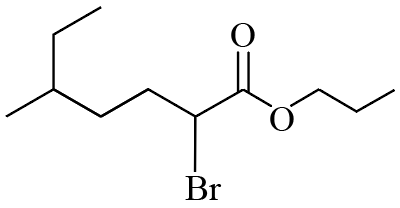
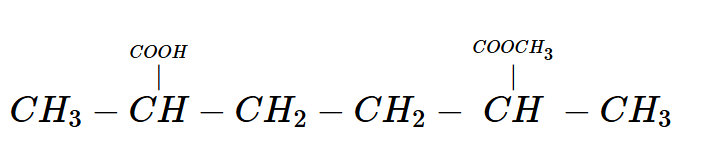
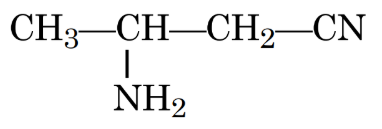
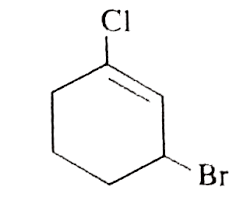
The IUPAC name of the following compound is :
- Principal Functional Group: The compound is an ester (indicated by the $$(R-COO-R')$$ structure). Esters are named as "alkyl alkanoate."
- Alkyl Group (Attached to Oxygen): The chain on the right consists of 3 carbons, making it a propyl group.
- Parent Carbon Chain (The Acyl Part):
- Number the chain starting from the carbonyl carbon C=O as (C1).
- The longest continuous chain containing the carbonyl group and moving to the left consists of 7 carbons, making the parent suffix heptanoate.
- Substituents:
- A bromo group is located at (C2).
- A methyl group is located at (C5).
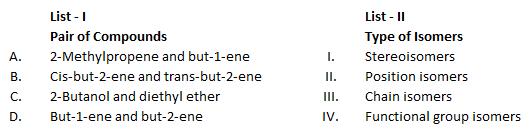
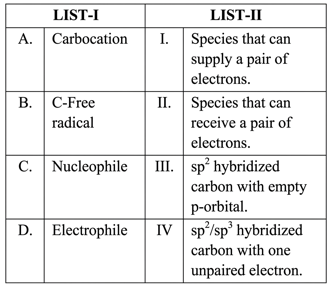
Match List - I with List - II.
Choose the correct answer from the options given below :
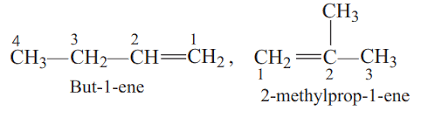
A) Chain isomer - Both have the formula $$(C_{4}H_{8})$$ but different carbon skeletons (branched vs. straight chain).
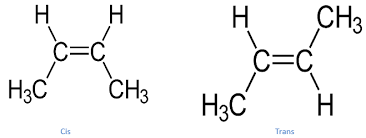
B)Stereo isomers - They have the same connectivity but differ in the spatial arrangement of atoms around the double bond.
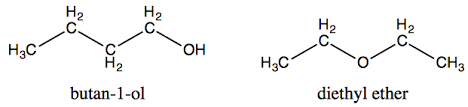
C)Functional group isomers - Both have the formula $$(C_4H_{10}O)$$ but belong to different functional classes (alcohol vs. ether).
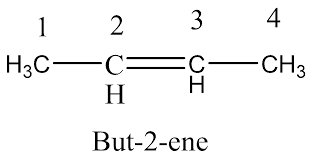
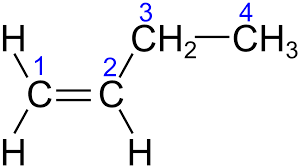
D)Position isomers - They have the same carbon chain but the double bond is at different positions (C1 vs. C2).
But-1-ene
Given below are two statements:
Statement I: $$(CH_3)_3C^+$$ is more stable than $$CH_3^+$$ as nine hyperconjugation interactions are possible in $$(CH_3)_3C^+$$.
Statement II: $$CH_3^+$$ is less stable than $$(CH_3)_3C^+$$ as only three hyperconjugation interactions are possible in $$CH_3^+$$.
In the light of the above statements, choose the correct answer from the options given below
Hyperconjugation is a stabilizing effect in carbocations where electrons from the C-H bond adjacent to the carbocation carbon (alpha hydrogens) are donated into the empty p-orbital of the carbocation. The number of hyperconjugation interactions depends on the number of alpha hydrogens.
Consider the methyl carbocation, $$CH_3^+$$. The carbocation carbon has no alkyl groups attached, so there are no alpha carbons and hence no alpha hydrogens. Therefore, the number of hyperconjugation interactions in $$CH_3^+$$ is zero.
Now, consider the tert-butyl carbocation, $$(CH_3)_3C^+$$. The carbocation carbon is attached to three methyl groups. Each methyl group has three hydrogens, so the total number of alpha hydrogens is 3 × 3 = 9. Therefore, nine hyperconjugation interactions are possible.
Statement I claims that $$(CH_3)_3C^+$$ is more stable than $$CH_3^+$$ because it has nine hyperconjugation interactions. This is correct because more hyperconjugation interactions lead to greater stability. Thus, Statement I is true.
Statement II claims that $$CH_3^+$$ is less stable than $$(CH_3)_3C^+$$ because it has only three hyperconjugation interactions. However, as established, $$CH_3^+$$ has zero hyperconjugation interactions, not three. Therefore, Statement II is false.
In summary, Statement I is true and Statement II is false.
The correct option is C: Statement I is true but Statement II is false.
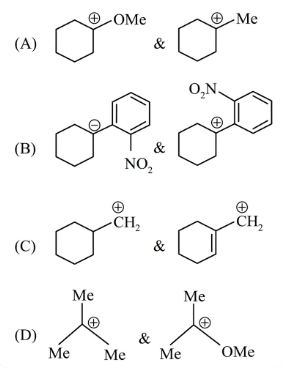
Given below are two statements :
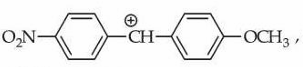
Statement I : In

the carbocation is stabilised by +R effect of $$-OCH_3$$ group.
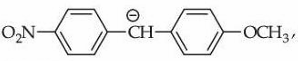
Statement II : In

the carbanion is stabilised by $$-R$$ effect of $$-NO_2$$ group.
Given below are two statements:
Statement I: On the basis of inductive effect, the order of stability of alkyl carbanions is $$CH_3^- > CH_3CH_2^- > (CH_3)_2CH^- > (CH_3)_3C^-$$.
Statement II: Allyl and benzyl carbanions are more stabilised by inductive effect and not by resonance effect.
In the light of the above statements, choose the correct answer from the options given below
Increasing order of electron withdrawing power of following functional groups is:
a. $$-\text{CN}$$, b. $$-\text{COOH}$$, c. $$-\text{NO}_2$$, d. $$-\text{I}$$
Electron-withdrawing power is determined mainly by two effects:
(i) the inductive effect (−I), which pulls electron density through σ-bonds, and
(ii) the resonance/mesomeric effect (−M when the group pulls electron density through π-bonds, +M when it donates).
Step 1 Analyse each substituent.
1. $$-\text{I}$$ (iodo) : Iodine is less electronegative than N, O, or Cl, so its −I effect is weak. Moreover, thanks to its lone pairs it can donate by +M into an attached π-system, further reducing the net electron-withdrawing ability. Hence this is the weakest EW group in the list.
2. $$-\text{COOH}$$ (carboxyl) : Oxygen atoms are electronegative, so the group shows a moderate −I effect. Inside the group itself the C=O pulls electron density from the O−H bond, but relative to other strong −I groups, $$-\text{COOH}$$ is only moderately electron-withdrawing.
3. $$-\text{CN}$$ (cyano) : The carbon of the triple bond is sp-hybridised (50 % s-character) and directly attached to a highly electronegative nitrogen; therefore the −I effect is strong. There is no +M donation, so the net electron-withdrawing power is high.
4. $$-\text{NO}_2$$ (nitro) : The nitro group possesses two strongly electronegative oxygens and a positively charged nitrogen in its major resonance form $$\text{O}^{-}\!-\!\text{N}^{+}\!=\!\text{O}$$. It shows both a very powerful −I effect and a very powerful −M effect (withdraws electron density via resonance), making it the strongest electron-withdrawing group among common substituents.
Step 2 Arrange in increasing order of withdrawing power (weakest → strongest):
$$-\text{I} \lt -\text{COOH} \lt -\text{CN} \lt -\text{NO}_2$$
This sequence corresponds to Option C.
Final Answer: Option C which is: $$d \lt b \lt a \lt c$$
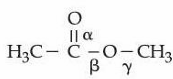
Shown below is the structure of methyl acetate with three different $$\alpha$$, $$\beta$$ and $$\gamma$$ carbon-oxygen bonds.

The correct order of bond lengths of these bonds is :
The major product of which of the following reaction is not obtained by rearrangement reaction?
Given below are two statements:
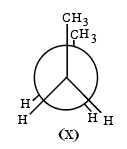
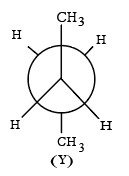
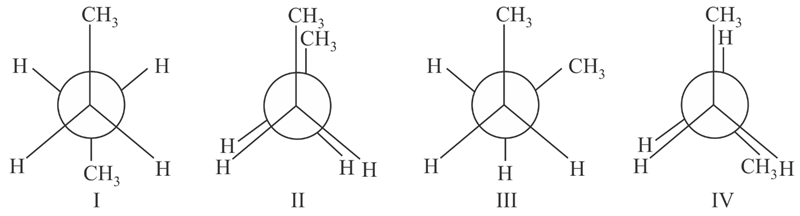
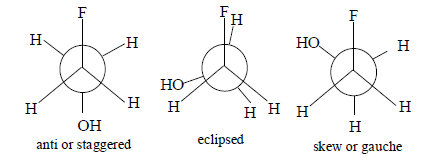
Statement I: There are several conformers for n-butane. Out of those conformers,

is the least stable and most stable conformer is
Statement II: As the dihedral angle increases, torsional strain decreases from (X) to (Y).
In the light of the above statements, choose the correct answer from the options given below
In IUPAC nomenclature, the correct order of decreasing priority of functional group is :
In IUPAC nomenclature every functional group is assigned a “seniority” (also called order of precedence).
When more than one functional group is present in the same molecule, the group with the higher seniority is chosen for the principal suffix, is given the lowest possible locant, and appears first in the priority list.
A greatly abbreviated portion of the official IUPAC priority table, sufficient for the groups that appear in this question, is:
$$\text{carboxylic acid derivatives (-COOR, -CONH}_{2}\text{ etc.)} \; \gt \; \text{nitrile (-CN)} \; \gt \; \text{aldehyde (-CHO)} \; \gt \; \text{ketone (>C=O)} \; \gt \; \text{alcohol (-OH)} \; \gt \; \text{amine (-NH}_{2}) \; \gt \; \text{alkene (C=C)} \; \gt \; \text{alkyne (C}\equiv\text{C)}$$
For the exact groups that appear in the four options we therefore have, in strictly decreasing priority:
$$-\text{CONH}_{2} \; (\text{carboxamide}) \; \gt \; -\text{CHO} \; (\text{aldehyde}) \; \gt \; >\!\text{C=O} \; (\text{ketone}) \; \gt \; -\text{NH}_{2} \; (\text{amine}) \; \gt \; -\text{C}\equiv\text{C}- \; (\text{alkyne})$$
Now compare each option with this correct sequence:
Option A: $$-\text{CONH}_{2}, >\text{C=O}, -\text{CHO}, -\text{NH}_{2}, -\text{C}\equiv\text{C}-$$ Here the ketone (>C=O) is placed above the aldehyde (-CHO), which violates the table. Hence Option A is wrong.
Option B: $$-\text{CONH}_{2}, -\text{COOCH}_{3}, -\text{CHO}, -\text{NH}_{2}, -\text{OH}$$ Within the acid derivatives an ester (-COOCH₃) outranks an amide (-CONH₂), and alcohol (-OH) outranks amine (-NH₂). Both orders are reversed here, so Option B is wrong.
Option C: $$-\text{CONH}_{2}, -\text{CHO}, >\text{C=O}, -\text{NH}_{2}, -\text{C}\equiv\text{C}-$$ This matches the correct decreasing priority exactly. So Option C is correct.
Option D: $$-\text{CONH}_{2}, -\text{CHO}, -\text{CN}, -\text{NH}_{2}, -\text{C}\equiv\text{C}-$$ The nitrile (-CN) should come immediately after the amide and before the aldehyde, not after it. Therefore Option D is wrong.
Hence the correct order and the correct choice is:
Option C which is: $$-\text{CONH}_2, -\text{CHO}, >\text{C=O}, -\text{NH}_2, -\text{C} \equiv \text{C}-$$
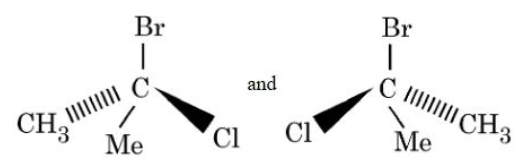
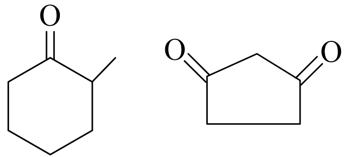
The following structures are
First write down the four groups that are bonded to the tetrahedral carbon in each drawing: $$Br$$, $$Cl$$, $$Me$$ and $$CH_3$$.
The symbols $$Me$$ and $$CH_3$$ mean exactly the same thing - a methyl group. Hence the carbon is attached to only three different groups:
$$Br,\;Cl,\;\text{and a methyl group (present twice)}$$
A carbon atom becomes a stereogenic (chiral) centre only when all four substituents are different. Because two of the substituents here are identical, the carbon is achiral; it cannot possess the $$R/S$$ configuration and cannot have any non-superimposable mirror image.
Therefore any two drawings that place these same groups around that carbon—no matter how the wedges and dashes are arranged—represent the same achiral molecule. They are not enantiomers (mirror images that are non-superimposable), not diastereomers (stereoisomers that are not mirror images) and not meso forms (which require at least two chiral centres with internal compensation).
Hence the two structures are identical molecules.
Option B which is: Identical
Identify correct statements from the following :
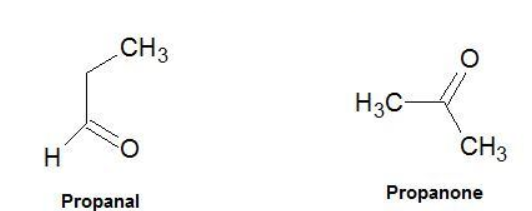
A Propanal and propanone are functional isomers.
B. Ethoxyethane and methoxypropane are metamers.
C. But-2-ene shows optical isomerism.
D. But-1-ene and but-2-ene are functional isomers.
E. Pentane and 2, 2-dimethyl propane ai-e chain isomers.
Choose the correct answer from the options given below:
We need to identify the correct statements about types of isomerism.
A. Propanal and propanone are functional isomers.
CORRECT. Propanal ($$CH_3CH_2CHO$$, an aldehyde) and propanone ($$CH_3COCH_3$$, a ketone) have the same molecular formula ($$C_3H_6O$$) but different functional groups. This is functional isomerism.
B. Ethoxyethane and methoxypropane are metamers.
CORRECT. Both are ethers with formula $$C_4H_{10}O$$: ethoxyethane ($$C_2H_5\text{-}O\text{-}C_2H_5$$) and methoxypropane ($$CH_3\text{-}O\text{-}C_3H_7$$). They have the same functional group (ether) but different distribution of alkyl groups around the oxygen. This is metamerism.
C. But-2-ene shows optical isomerism.
INCORRECT. But-2-ene ($$CH_3\text{-}CH=CH\text{-}CH_3$$) shows geometrical (cis-trans) isomerism, not optical isomerism. It has no chiral center.
D. But-1-ene and but-2-ene are functional isomers.
INCORRECT. Both are alkenes (same functional group: C=C double bond). They differ in the position of the double bond, so they are position isomers, not functional isomers.
E. Pentane and 2,2-dimethylpropane are chain isomers.
CORRECT. Both have the molecular formula $$C_5H_{12}$$ but differ in the arrangement of the carbon chain (straight vs. branched). This is chain isomerism.
Correct statements: A, B, and E.
The correct answer is Option (2): A, B and E only.
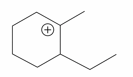
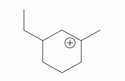
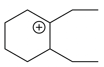
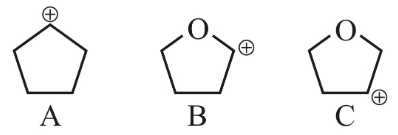
The cyclic cations having the same number of hyperconjugalion are :
A.

B.

C.

D.

Choose the correct answer from the options given below :
0.53 g of an organic compound (x) when heated with excess of nitric acid ( concentrated) and then with silver nitrate gave 0. 75 g of silver bromide precipitate. 1.0 g of (x) gave 1.32 g of $$CO_{2}$$ gas on combustion. The percentage of hydrogen in the compound (x) is __ %. [Nearest Integer]
[Given: Molar mass in g $$mol^{-1}$$ H : 1, C : 12, Br: 80, Ag: 108, O : 16 ; Compound (x) :$$C_{x}H_{y}Br_{z}$$]
We need to find the percentage of hydrogen in the organic compound $$C_xH_yBr_z$$.
First, the percentage of bromine is determined by precipitating bromide as silver bromide. From 0.53 g of the compound, 0.75 g of AgBr precipitate is produced. The molar mass of AgBr is 108 + 80 = 188 g/mol, so the moles of AgBr are $$\text{Moles of AgBr} = \frac{0.75}{188} = 0.003989 \text{ mol}$$. Since each mole of AgBr contains one mole of Br, the mass of bromine is $$\text{Mass of Br} = 0.003989 \times 80 = 0.31915 \text{ g}$$, corresponding to $$\% Br = \frac{0.31915}{0.53} \times 100 = 60.22\%$$.
Next, the percentage of carbon is found from the combustion analysis: burning 1.0 g of the compound yields 1.32 g of $$CO_2$$. With the molar mass of $$CO_2$$ being 44 g/mol and each mole of $$CO_2$$ containing one mole of carbon (12 g), the mass of carbon is $$\text{Mass of C from 1.0 g} = \frac{12}{44} \times 1.32 = 0.36 \text{ g}$$, giving $$\% C = \frac{0.36}{1.0} \times 100 = 36\%$$.
Finally, since the compound contains only carbon, hydrogen, and bromine, the percentage of hydrogen is obtained by difference: $$\% H = 100 - \% C - \% Br = 100 - 36 - 60.22 = 3.78\%$$. Rounding to the nearest integer yields $$\% H \approx 4\%$$.
Therefore, the percentage of hydrogen in the compound is 4.
The correct order of basicity for the following molecules is :
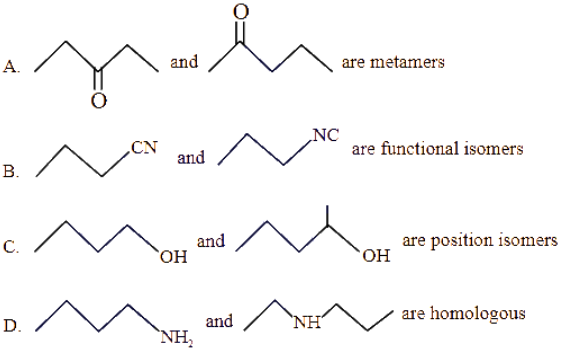
Given below are two statements : Statement (I) :
are isomeric compounds. Statement (II) :

are functional group isomers.
Match the LIST-I with LIST-II.

Choose the correct answer from the options given below :
For every species, identify its general electronic feature and hybridisation before matching with the statements in LIST-II.
Case A: Carbocation
A carbocation carries a positive charge on carbon. The carbon is $$sp^2$$ hybridised and possesses an empty $$p$$-orbital that can accept a pair of electrons.
Hence, A corresponds to statement III.
Case B: Carbon-centred free radical
A carbon free radical has one unpaired electron on carbon. Depending on the surrounding atoms it may be $$sp^2$$ or $$sp^3$$ hybridised, but the defining feature is the single unpaired electron.
Hence, B corresponds to statement IV.
Case C: Nucleophile
A nucleophile is a species that donates (supplies) an electron pair to an electron-deficient centre in a reaction.
Hence, C corresponds to statement I.
Case D: Electrophile
An electrophile is electron-deficient; it seeks (receives) an electron pair from a nucleophile.
Hence, D corresponds to statement II.
Collecting the matches:
A - III, B - IV, C - I, D - II.
This is exactly the pairing shown in Option D. Therefore the correct answer is Option D.
Mixture of 1 g each of chlorobenzene, aniline and benzoic acid is dissolved in 50 mL ethyl acetate and placed in a separating funnel, 5 M NaOH (30 mL) was added in the same funnel. The funnel was shaken vigorously and then kept aside. The ethyl acetate layer in the funnel contains :
Ethyl acetate is an organic solvent that is immiscible with water, so two separate layers form in a separating funnel.
The upper layer (lower density) is ethyl acetate, while the lower layer (higher density) is the aqueous solution of $$5 \text{ M } NaOH$$.
1. Behaviour of benzoic acid:
Benzoic acid is a carboxylic acid. In the presence of the strong base $$NaOH$$ it undergoes neutralisation: $$C_6H_5COOH + NaOH \rightarrow C_6H_5COONa + H_2O$$.
Sodium benzoate $$\left(C_6H_5COONa\right)$$ is an ionic salt, highly soluble in water and almost insoluble in ethyl acetate. Hence benzoic acid transfers completely to the aqueous layer as its salt.
2. Behaviour of aniline:
Aniline is a weak base. In strongly basic medium ($$5 \text{ M } NaOH$$) it remains in the free-base (neutral) form $$C_6H_5NH_2$$ because there is no proton source to convert it to the water-soluble ammonium ion $$C_6H_5NH_3^+$$. Neutral aniline is only sparingly soluble in water but is quite soluble in an organic solvent such as ethyl acetate. Therefore aniline stays in the ethyl acetate layer.
3. Behaviour of chlorobenzene:
Chlorobenzene is a non-polar, neutral molecule. It does not react with $$NaOH$$ under these conditions and is insoluble in water. Thus chlorobenzene also remains in the ethyl acetate layer.
Final distribution:
• Aqueous (lower) layer : sodium benzoate (from benzoic acid) and excess $$NaOH$$.
• Organic (upper ethyl acetate) layer : chlorobenzene + aniline.
Hence the ethyl acetate layer contains chlorobenzene and aniline.
Correct Option D: chlorobenzene and aniline.
In which pairs, the first ion is more stable than the second?
The correct order of stability of following carbocations is :
Total number of nucleophiles from the following is :
$$NH_{3},PhSH,(H_{3}C)_{2}S,H_{2}C=CH_{2},\ominus\\O H,H_{3}O^{\oplus},(CH_{3})_{2}CO,\rightleftharpoons NCH_{3}$$
A nucleophile is a species that can donate a pair of electrons to an electrophilic centre. We examine each species in turn.
$$NH_3$$ (ammonia): Nitrogen carries a lone pair of electrons, making it a well-known nucleophile. ✓
$$PhSH$$ (thiophenol): Sulfur has two lone pairs and is large and polarisable, making thiophenol a strong nucleophile. ✓
$$(H_3C)_2S$$ (dimethyl sulfide): The sulfur atom has two lone pairs readily available for donation. ✓
$$H_2C{=}CH_2$$ (ethylene): While the $$\pi$$-bond can participate in electrophilic addition, ethylene lacks a lone pair on a specific atom. In the JEE convention it is not counted as a nucleophile. ✗
$${}^{\ominus}OH$$ (hydroxide ion): Carries a full negative charge and lone pairs on oxygen. One of the strongest common nucleophiles. ✓
$$H_3O^{\oplus}$$ (hydronium ion): Positively charged and electron-deficient; it is an acid/electrophile, not a nucleophile. ✗
$$(CH_3)_2CO$$ (acetone): Although the carbonyl oxygen has lone pairs, acetone is classified as an electrophile at its carbonyl carbon and is not counted as a nucleophile in this context. ✗
$$:C{=}NCH_3$$ (methyl isocyanide, $$CH_3NC$$): In an isocyanide the terminal carbon bears a lone pair, making it an excellent nucleophile (this property is exploited in the carbylamine reaction). ✓
The five nucleophiles are therefore: $$NH_3,\; PhSH,\; (H_3C)_2S,\; {}^{\ominus}OH,\; CH_3NC$$.
Hence, the correct answer is Option D (5).
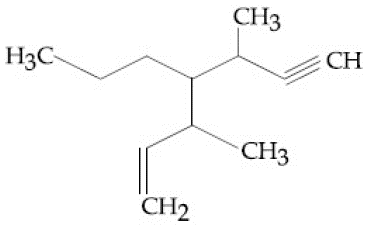
In 3,3-dimethylhex-1-ene-4-yne, there are _____ $$sp^3$$, _____ $$sp^2$$ and _____ $$sp$$ hybridised carbon atoms respectively :
The compound is named $$3,3\text{-dimethylhex}\!-\!1\text{-ene-4-yne}$$.
Step 1 : Draw the parent (hex-) chain and locate the multiple bonds
Hex means six carbon atoms in the parent chain. Numbering starts from the end that gives the lowest locants to the multiple bonds.
• Double bond at C-1 ⇒ $$C_1 = C_2$$.
• Triple bond between C-4 and C-5 ⇒ $$C_4 \equiv C_5$$.
Thus the skeleton is
$$C_1{=}C_2{-}C_3{-}C_4{\equiv}C_5{-}C_6$$.
Step 2 : Add the substituents
“3,3-dimethyl” means two methyl groups (-$$CH_3$$) attached to C-3:
$$C_1{=}C_2{-}C_3(-CH_3)(-CH_3){-}C_4{\equiv}C_5{-}C_6$$.
Step 3 : Assign the hybridisation of each carbon
| Carbon | Bonds present | Hybridisation |
| $$C_1$$ | one $$\pi$$ & two $$\sigma$$ (in C=C) | $$sp^2$$ |
| $$C_2$$ | one $$\pi$$ & two $$\sigma$$ (in C=C) | $$sp^2$$ |
| $$C_3$$ | four $$\sigma$$ (all single bonds) | $$sp^3$$ |
| $$C_4$$ | two $$\pi$$ & two $$\sigma$$ (in C≡C) | $$sp$$ |
| $$C_5$$ | two $$\pi$$ & two $$\sigma$$ (in C≡C) | $$sp$$ |
| $$C_6$$ | four $$\sigma$$ (terminal $$CH_3$$) | $$sp^3$$ |
| Both methyl C’s (attached to C-3) | four $$\sigma$$ each | $$sp^3$$ each |
Step 4 : Count the hybridised carbons
$$sp^3$$ carbons : C-3, C-6, and two methyl carbons ⇒ $$4$$.
$$sp^2$$ carbons : C-1, C-2 ⇒ $$2$$.
$$sp$$ carbons : C-4, C-5 ⇒ $$2$$.
Therefore the molecule contains $$4$$ $$sp^3$$, $$2$$ $$sp^2$$ and $$2$$ $$sp$$ hybridised carbon atoms.
The correct option is Option A $$4,\;2,\;2$$.
$$\text{Identify correct statement/s : }(A) -OCH_3 \text{ and } -NHCOCH_3 \text{ are activating groups. } (B)-CN \text{ and } -OH \text{ are meta directing groups. } (C) -CN \text{ and } -SO_3H$$ are meta directing groups. $$(D)$$ Activating groups act as ortho- and para-directing groups. $$(E)$$ Halides are activating groups. Choose the correct answer from the options given below:
We need to identify the correct statements about directing groups and activating/deactivating groups in electrophilic aromatic substitution.
Statement (A): $$-OCH_3$$ and $$-NHCOCH_3$$ are activating groups.
$$-OCH_3$$ (methoxy) is a strong activating group due to the lone pair donation from oxygen into the ring through resonance. $$-NHCOCH_3$$ (acetylamino) is a moderate activating group; the nitrogen lone pair donates electron density to the ring, though the carbonyl partially withdraws it. Overall, both are activating groups. Statement (A) is CORRECT.
Statement (B): $$-CN$$ and $$-OH$$ are meta-directing groups.
$$-CN$$ is an electron-withdrawing group (meta-directing), but $$-OH$$ is an electron-donating group that directs to ortho and para positions. Statement (B) is INCORRECT.
Statement (C): $$-CN$$ and $$-SO_3H$$ are meta-directing groups.
Both $$-CN$$ and $$-SO_3H$$ are electron-withdrawing groups that direct incoming electrophiles to the meta position. Statement (C) is CORRECT.
Statement (D): Activating groups act as ortho- and para-directing groups.
This is a well-established rule in electrophilic aromatic substitution. Activating groups donate electron density to the ring, preferentially stabilizing the carbocation intermediate at ortho and para positions. Statement (D) is CORRECT.
Statement (E): Halides are activating groups.
Halides ($$-F, -Cl, -Br, -I$$) are deactivating groups. Although they are ortho/para-directing (due to lone pair donation by resonance), the strong inductive electron-withdrawing effect makes the ring less reactive overall. Statement (E) is INCORRECT.
The correct statements are (A), (C), and (D).
The correct answer is Option 4: (A), (C) and (D) only.
Identify the correct statements from the following

Choose the correct answer from the options given below
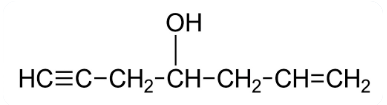
The IUPAC name of the following compound is :
The given structure is $$HC \equiv C - CH_2 - CH(OH) - CH_2 - CH = CH_2$$.
Step 1: Select the parent chain
The longest continuous chain that contains the hydroxyl group as well as both the double and the triple bonds has seven carbon atoms, so the parent hydrocarbon is $$hept$$.
Step 2: Decide the principal characteristic group
According to IUPAC priority order, the $${-}OH$$ group (alcohol) has higher suffix priority than double or triple bonds. Hence the compound will be named with the suffix $$-ol$$, not with the prefix “hydroxy”.
Step 3: Number the chain
We need the lowest possible set of locants for the principal group, the multiple bonds, and any substituents.
Case A (left → right):
C-1≡C-2-C-3-C-4(OH)-C-5-C-6= C-7
Locants: 1-yne, 4-ol, 6-ene ⇒ set $$(1,4,6)$$.
Case B: (right → left):
C-1= C-2-C-3-C-4(OH)-C-5-C-6≡C-7
Locants: 1-ene, 4-ol, 6-yne ⇒ set $$(1,4,6)$$.
Both directions give the same numerical set $$(1,4,6)$$. When a tie exists, IUPAC rules state that the lower locant is assigned to the double bond (-ene) rather than to the triple bond (-yne). Therefore Case B is preferred, keeping the double bond at $$C_1$$.
Step 4: Write the complete name
• Parent chain: $$hept$$ (7 carbons)
• Double bond between C-1 and C-2 ⇒ $$1-en$$
• Triple bond between C-6 and C-7 ⇒ $$6-yn$$
• Hydroxyl group on C-4 ⇒ $$4-ol$$ (suffix of highest priority)
Combining these parts in the correct order (ene, yne, ol):
$$\text{Hept-1-en-6-yn-4-ol}$$
Step 5: Match with the options
Option D states “Hept-1-en-6-yn-4-ol”, which is exactly the name obtained.
Hence, the correct answer is Option D (Hept-1-en-6-yn-4-ol).
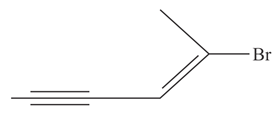
In the given structure, the number of $$sp \text{ and } sp^2 $$ hybridized carbon atoms present respectively are:
Match List - I with List - II.

Choose the correct answer from the options given below :
How many different stereoisomers are possible for the given molecule?
Given below are two statements:
Statement I: Hyperconjugation is not a permanent effect.
Statement II: In general, greater the number of alkyl groups attached to a positively charged C-atom, greater is the hyperconjugation interaction and stabilization of the cation.
In the light of above statements, Choose the correct answer from the options given below :
Step 1 - Recall the nature of hyperconjugation
Hyperconjugation involves delocalisation of the electrons of an $$\sigma$$-bond (generally C-H) with an adjacent empty p-orbital, a $$\pi$$-bond or a positively charged carbon centre. The overlap is present in the ground state of the molecule and does not require any external stimulus. Hence it is a permanent electronic effect, just like resonance.
Step 2 - Test Statement I
Statement I claims: “Hyperconjugation is not a permanent effect.”
But from Step 1 we know that hyperconjugation is permanent. Therefore, Statement I is $$\textbf{false}$$.
Step 3 - Understand the relation between alkyl substitution and hyperconjugation in carbocations
For a carbocation, each alkyl group attached to the positively charged carbon provides one or more $$\alpha$$-hydrogen atoms. Every $$\alpha$$-hydrogen can participate in hyperconjugation, generating a separate hyperconjugative structure. More such structures mean greater charge delocalisation and hence increased stability of the carbocation.
Step 4 - Test Statement II
Statement II says: “In general, the greater the number of alkyl groups attached to a positively charged C-atom, the greater is the hyperconjugation interaction and stabilisation of the cation.”
Step 3 confirms this: $$3^\circ$$ > $$2^\circ$$ > $$1^\circ$$ carbocations in stability because of increasing hyperconjugation. Hence, Statement II is $$\textbf{true}$$.
Step 5 - Choose the correct option
Statement I is false and Statement II is true. According to the option list, that corresponds to Option C.
Final answer: Option C.
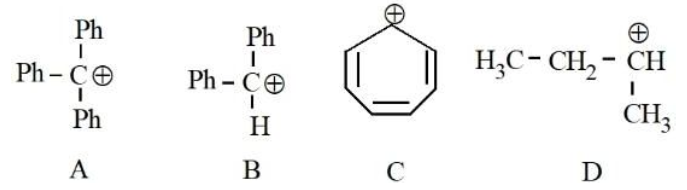
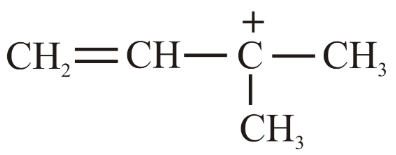
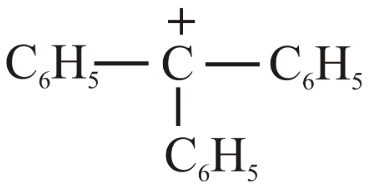
Which one of the carbocations from the following is most stable?
The IUPAC name of the following compound is :
The most stable carbocation from the following is :
Consider the following compound (X):

The most stable and least stable carbon radicals, respectively, produced by homolytic cleavage of corresponding C-H bond are:
Consider the following molecule (X). The structure of X is
Given below are two statements:
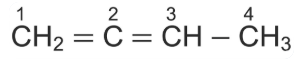
Statement I: The dipole moment of $$\overset{4}{\mathrm{CH_3}} - \overset{3}{\mathrm{CH}} = \overset{2}{\mathrm{CH}} - \overset{1}{\mathrm{CH}}=O$$ is greater than $$\overset{4}{\mathrm{CH_3}} - \overset{3}{\mathrm{CH_2}} - \overset{2}{\mathrm{CH_2}} - \overset{1}{\mathrm{CH}}=O$$.
Statement II: $$C_1-C_2$$ bond length of $$\underset{4}{\mathrm{CH_3}} - \underset{3}{\mathrm{CH}} = \underset{2}{\mathrm{CH}} - \underset{1}{\mathrm{CH}}=O$$ is greater than $$C_1-C_2$$ bond length of $$\underset{4}{\mathrm{CH_3}} - \underset{3}{\mathrm{CH_2}} - \underset{2}{\mathrm{CH_2}} - \underset{1}{\mathrm{CH}}=O$$.
In the light of the above statements, choose the correct answer from the options given below
Statement I compares the dipole moments of two aldehydes.
• $$CH_3-CH=CH-CH=O$$ is an α,β-unsaturated (conjugated) aldehyde.
• $$CH_3-CH_2-CH_2-CH=O$$ is a saturated aldehyde.
Dipole moment ( $$\mu$$ ) depends on the magnitude of charge separation and on the distance between the centres of positive and negative charge.
• In the conjugated aldehyde the $$C=O$$ group is conjugated with the $$C=C$$ bond. By resonance the electron pair of the $$C=C$$ bond can shift towards the oxygen, giving forms such as
$$CH_3-CH=CH-CH^{+}-O^{-}$$.
• This resonance increases the positive character on the carbonyl carbon and the negative character on the oxygen, thereby increasing the $$C=O$$ dipole moment.
• Any small dipole associated with the $$C=C$$ bond is approximately parallel to the carbonyl dipole, so the vectors add rather than cancel.
Therefore $$\mu\bigl(CH_3-CH=CH-CH=O\bigr) \gt \mu\bigl(CH_3-CH_2-CH_2-CH=O\bigr)$$ and Statement I is true.
Statement II compares the $$C_1-C_2$$ bond lengths.
• In $$CH_3-CH_2-CH_2-CH=O$$ both $$C_1$$ and $$C_2$$ are $$sp^3$$ hybridised. An $$sp^3-sp^3$$ single bond length is about $$1.54\ \text{Å}$$.
• In $$CH_3-CH=CH-CH=O$$, $$C_1$$ is $$sp^3$$ but $$C_2$$ is $$sp^2$$ (because it is part of the $$C=C$$ bond). An $$sp^3-sp^2$$ single bond has more $$s$$-character on one side and is therefore shorter (≈ $$1.50\ \text{Å}$$) than an $$sp^3-sp^3$$ bond.
Thus $$\text{bond length}(C_1-C_2)\bigl(CH_3-CH=CH-CH=O\bigr)$$ is smaller, not greater, than that in $$CH_3-CH_2-CH_2-CH=O$$. Statement II is false.
So, Statement I is true while Statement II is false. The correct choice is Option C.
The correct stability order of the following species/molecules is:
The possible number of stereoisomers for 5-phenylpent -4-en-2-ol is $$\underline{\hspace{2cm}}.$$
We are asked to find the number of possible stereoisomers for 5-phenylpent-4-en-2-ol.
The structure of 5-phenylpent-4-en-2-ol can be represented as $$C_6H_5-CH=CH-CH_2-CH(OH)-CH_3$$; numbering from the OH end gives C1 as $$CH_3$$, C2 as $$CH(OH)$$, C3 as $$CH_2$$, while the C4=C5 double bond connects to a phenyl group at C5.
At C2 there is a chiral center bearing four different groups ($$-CH_3$$, $$-OH$$, $$-H$$, and $$-CH_2CH=CHC_6H_5$$), which results in 2 optical isomers (R and S).
Moreover, the C4=C5 double bond allows geometric isomerism because C5 carries phenyl ($$C_6H_5$$) and H, while C4 carries H and $$-CH_2CH(OH)CH_3$$, so E/Z isomerism is possible, giving 2 geometric isomers.
Combining these possibilities yields a total of 2 optical isomers times 2 geometric isomers, giving $$2 \times 2 = 4$$ stereoisomers.
The number of possible stereoisomers for 5-phenylpent-4-en-2-ol is 4.
In Carius method for estimation of halogens, 180 mg of an organic compound produced 143.5 mg of AgCl . The percentage composition of chlorine in the compound is _______ \%. (Given : molar mass in $$gmol^{-1} \text{ of } Ag: 108, Cl: 35.5$$)
We need to find the percentage of chlorine in an organic compound using the Carius method.
We start by finding the moles of AgCl.
The molar mass of AgCl is 108 + 35.5 = 143.5 g/mol.
The mass of AgCl is 143.5 mg, which is 0.1435 g.
Using these values, we calculate the moles of AgCl:
$$\frac{0.1435}{143.5} = 0.001$$ mol
Next, we determine the mass of chlorine obtained.
Each mole of AgCl contains one mole of Cl, so the moles of Cl are 0.001 mol.
The mass of Cl is then calculated as:
$$0.001 \times 35.5 = 0.0355$$ g, which is 35.5 mg.
Then we calculate the percentage of chlorine in the compound.
$$\% \text{Cl} = \frac{\text{Mass of Cl}}{\text{Mass of compound}} \times 100$$
Substituting the values gives:
$$= \frac{35.5}{180} \times 100 = 19.72\%$$
$$\approx 20\%$$
Therefore, the percentage of chlorine in the compound is 20%.
The hydrocarbon $$(X)$$ with molar mass $$80\,g\,mol^{-1}$$ and $$90\% $$ carbon has $$\underline{\hspace{2cm}}$$ degree of unsaturation.
Molar mass=80, 90% C, 10% H. C: 0.9×80/12=6, H: 0.1×80/1=8. Formula: C₆H₈.
Degree of unsaturation = (2×6+2-8)/2 = (12+2-8)/2 = 3.
The answer is 3.
Given below are two statements : Statement (I) : The oxidation state of an element in a particular compound is the charge acquired by its atom on the basis of electron gain enthalpy consideration from other atoms in the molecule. Statement (II) : $$p\pi - p\pi$$ bond formation is more prevalent in second period elements over other periods. In the light of the above statements, choose the most appropriate answer from the options given below :
We need to evaluate two statements about oxidation states and $$p\pi - p\pi$$ bonding.
Analysis of Statement I:
"The oxidation state of an element in a particular compound is the charge acquired by its atom on the basis of electron gain enthalpy consideration from other atoms in the molecule."
This statement is incorrect. The oxidation state of an element is determined based on electronegativity, not electron gain enthalpy. In the concept of oxidation state, we assume that shared electron pairs are assigned entirely to the more electronegative atom. While electron gain enthalpy and electronegativity are related concepts, they are not the same:
- Electronegativity is the tendency of an atom to attract shared electrons in a chemical bond.
- Electron gain enthalpy is the energy change when a gaseous atom gains an electron to form an anion.
Oxidation states are assigned using electronegativity rules (e.g., in H$$_2$$O, oxygen is more electronegative, so both shared pairs are assigned to O, giving it an oxidation state of $$-2$$). Using electron gain enthalpy would not always give correct results because the two properties do not always follow the same trend (for example, fluorine has a lower electron gain enthalpy than chlorine, but fluorine is more electronegative).
Analysis of Statement II:
"$$p\pi - p\pi$$ bond formation is more prevalent in second period elements over other periods."
This statement is correct. Second period elements (such as C, N, O) have small atomic sizes, which allows their 2p orbitals to overlap laterally (sideways) very effectively to form strong $$\pi$$ bonds. For elements in higher periods (third period and beyond), the p orbitals are larger and more diffuse, leading to poor lateral overlap. This is why:
- Carbon readily forms $$C=C$$ and $$C\equiv C$$ bonds (with $$p\pi - p\pi$$ bonding)
- Nitrogen forms $$N=N$$ and $$N\equiv N$$ bonds
- Oxygen forms $$O=O$$ bonds
- But silicon prefers single bonds (Si-Si) rather than double bonds, and phosphorus and sulfur rarely form $$p\pi - p\pi$$ bonds
Elements in higher periods instead use $$d\pi - p\pi$$ bonding when they form multiple bonds.
Conclusion: Statement I is incorrect, and Statement II is correct.
The correct answer is Option (3): Statement I is incorrect but Statement II is correct.
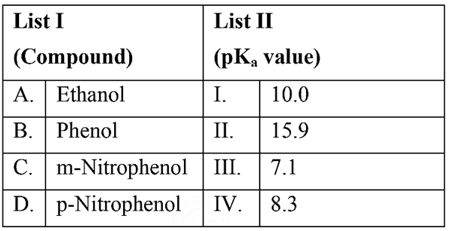
Match List I with List II

Choose the correct answer from the options given below:
The electron affinity values are negative for A. $$\text{Be} \rightarrow \text{Be}^-$$ B. $$\text{N} \rightarrow \text{N}^-$$ C. $$\text{O} \rightarrow \text{O}^{2-}$$ D. $$\text{Na} \rightarrow \text{Na}^-$$ E. $$\text{Al} \rightarrow \text{Al}^-$$. Choose the most appropriate answer from the options given below :
We need to identify which processes have negative electron affinity (i.e., the process is endothermic when an electron is added).
Key Concept: Electron affinity (EA) is the energy change when an electron is added to a neutral gaseous atom. A negative electron affinity (in the convention where exothermic = positive EA) means the atom resists gaining an electron, i.e., energy must be supplied.
Elements with negative EA (endothermic electron gain) typically have either:
- Fully filled subshells (extra stability makes electron addition unfavourable)
- Half-filled subshells (extra stability due to exchange energy)
- Second electron additions (always endothermic due to electron-electron repulsion)
A. Be $$\rightarrow$$ Be$$^-$$:
Beryllium has configuration $$1s^2 2s^2$$ (completely filled 2s subshell). Adding an electron requires placing it in the higher-energy 2p orbital against the nuclear charge shielded by the filled 2s. This process is endothermic (negative EA). ✓
B. N $$\rightarrow$$ N$$^-$$:
Nitrogen has configuration $$1s^2 2s^2 2p^3$$ (half-filled 2p subshell). The half-filled 2p configuration is extra stable due to maximum exchange energy. Adding a fourth electron to the 2p shell would disrupt this stability and require pairing in an already occupied orbital. This process is endothermic (negative EA). ✓
C. O $$\rightarrow$$ O$$^{2-}$$:
This is a two-step process: O $$\rightarrow$$ O$$^-$$ $$\rightarrow$$ O$$^{2-}$$. While the first EA of oxygen is positive (exothermic), the second EA is always endothermic because adding an electron to an already negatively charged ion (O$$^-$$) requires overcoming strong electrostatic repulsion. The overall process of forming O$$^{2-}$$ is endothermic. ✓
D. Na $$\rightarrow$$ Na$$^-$$:
Sodium ($$1s^2 2s^2 2p^6 3s^1$$) can accept an electron to complete its 3s subshell ($$3s^2$$). This process is exothermic (positive EA), similar to how hydrogen gains an electron. ✗
E. Al $$\rightarrow$$ Al$$^-$$:
Aluminium ($$1s^2 2s^2 2p^6 3s^2 3p^1$$) can accept an electron into its 3p orbital. This process is exothermic (positive EA), as the 3p subshell is far from half-filled. ✗
Conclusion: Elements with negative electron affinity values are Be, N, and O (for the second electron addition). These correspond to A, B, and C.
The correct answer is Option 2: A, B and C only.
Bond line formula of $$HOCH(CN)_2$$ is :
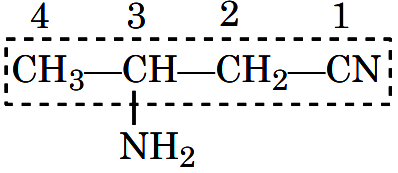
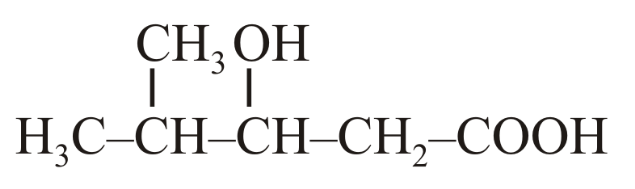
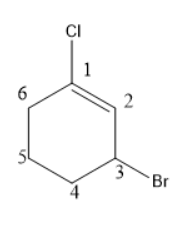
According to IUPAC system, the compound is named as:
IUPAC name of the following compound is:
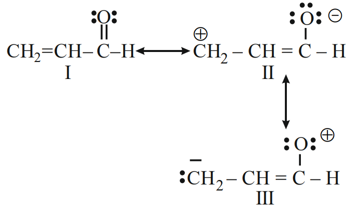
The order of relative stability of the contributing structures is :
Choose the correct answer from the options given below:
- Structure I is neutral and all its atoms have complete octets. Therefore, it is the most stable structure.
- Order so far: I > (II, III)
- When comparing the charged structures (II and III):
- In Structure II, the negative charge is on the highly electronegative oxygen atom ($$\text{O}^\ominus$$), and the positive charge is on a carbon atom. This is a favorable, stable distribution.
- In Structure III, the negative charge is placed on a carbon atom and a positive charge is placed on the highly electronegative oxygen atom ($$\text{O}^\oplus$$). This is highly unfavorable and unstable.
The statement(s) that are correct about the species $$O^{2-}, F^-, Na^+$$ and $$Mg^{2+}$$. (A) All are isoelectronic (B) All have the same nuclear charge (C) $$O^{2-}$$ has the largest ionic radii (D) $$Mg^{2+}$$ has the smallest ionic radii. Choose the most appropriate answer from the options given below :
Species: $$O^{2-}, F^-, Na^+, Mg^{2+}$$.
(A) All are isoelectronic: All have 10 electrons. $$O^{2-}$$ (8+2=10), $$F^-$$ (9+1=10), $$Na^+$$ (11-1=10), $$Mg^{2+}$$ (12-2=10). Correct. ✓
(B) All have the same nuclear charge: $$O$$ has 8 protons, $$F$$ has 9, $$Na$$ has 11, $$Mg$$ has 12. They have different nuclear charges. Incorrect. ✗
(C) $$O^{2-}$$ has the largest ionic radius: For isoelectronic species, the one with the smallest nuclear charge has the largest radius. $$O^{2-}$$ has the smallest nuclear charge (8), so it has the largest ionic radius. Correct. ✓
(D) $$Mg^{2+}$$ has the smallest ionic radius: $$Mg^{2+}$$ has the largest nuclear charge (12) among the isoelectronic species, so it has the smallest ionic radius. Correct. ✓
Correct statements: (A), (C), and (D).
The correct answer is Option (3): (A), (C) and (D) only.
A species having carbon with sextet of electrons and can act as electrophile is called
We need to identify the species in which carbon has a sextet of electrons and can act as an electrophile.
Understand what a "sextet of electrons" means.
A carbon atom normally has 4 valence electrons and achieves an octet (8 electrons) by forming 4 bonds. If carbon has only a sextet (6 electrons), it is 2 electrons short of an octet, meaning it has an empty p-orbital.
Analyze each option.
Carbon free radical: Has 7 electrons (3 bonds + 1 unpaired electron). This is a septet, not a sextet. It is reactive but primarily acts as a radical, not an electrophile.
Carbanion: Has 8 electrons (3 bonds + 1 lone pair). Carbon has a complete octet and a negative charge. It acts as a nucleophile (electron donor), not an electrophile.
Carbocation: Carbon has only 6 electrons (3 bonds, no lone pair). It has an empty p-orbital, making it electron-deficient. Since it seeks electrons to complete its octet, it acts as an electrophile (electron acceptor). This matches both criteria: sextet of electrons and electrophilic character.
Pentavalent carbon: This would have 10 electrons around carbon, which is not a sextet.
The correct answer is Option (3): carbocation.
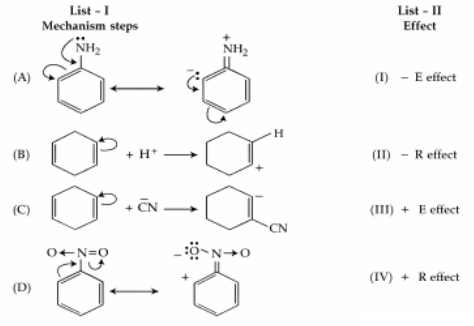
Match List I with List II :

Choose the correct answer from the options given below :
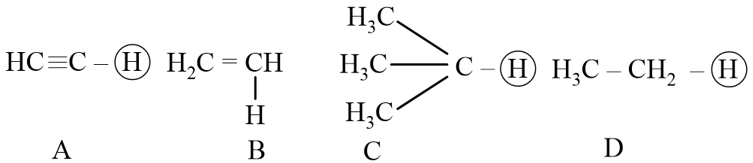
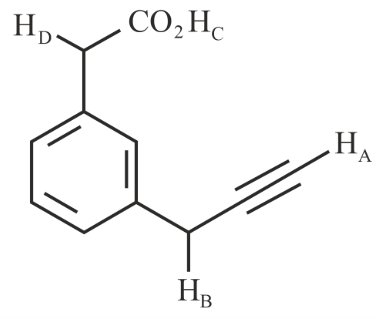
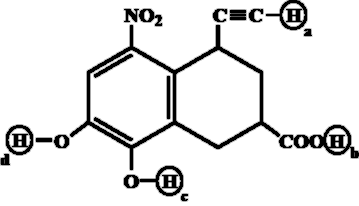
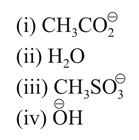
The ascending acidity order of the following H atoms is
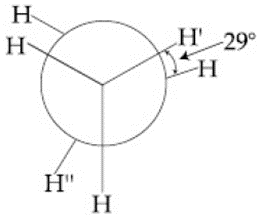
The incorrect statement regarding conformations of ethane is :
The incorrect statement regarding conformations of ethane:
- Ethane has infinite number of conformations: Correct - rotation around the C-C bond gives continuous conformations.
- The dihedral angle in staggered conformation is 60°: Correct - the H atoms are 60° apart in staggered form.
- Eclipsed conformation is the most stable conformation: Incorrect - the staggered conformation is the most stable. The eclipsed is the least stable.
- The conformations of ethane are interconvertible: Correct - they freely interconvert by rotation.
The incorrect statement is Option (3).
Match List I with List II
Choose the correct answer from the options given below:
{image}
The correct stability order of carbocations is
Carbocation stability depends on the degree of substitution due to hyperconjugation and inductive effects from alkyl groups.
The order of carbocation stability is:
Tertiary > Secondary > Primary > Methyl
$$(CH_3)_3C^+ > (CH_3)_2CH^+ > CH_3CH_2^+ > CH_3^+$$The correct answer is Option 3.
Correct order of stability of carbanion is
Given below are two statements: Statement I: IUPAC name of $$HO - CH_2 - (CH_2)_3 - CH_2 - COCH_3$$ is 7-hydroxyheptan-2-one. Statement II: 2-oxoheptan-7-ol is the correct IUPAC name for the above compound. In the light of the above statements, Choose the most appropriate answer from the options given below:
$$HO-CH_2-(CH_2)_3-CH_2-COCH_3$$: This is 7-hydroxyheptan-2-one.
IUPAC rules: ketone gets lowest locant when numbering. Numbering from ketone end: C1-C2(CO)-C3-C4-C5-C6-C7(OH). This gives 7-hydroxyheptan-2-one.
Statement I is correct. Statement II gives 2-oxoheptan-7-ol, which has the same locants but different principal characteristic group priority — ketone is preferred over alcohol, so the name should end in "-one" not "-ol". Hence Statement II is incorrect.
The answer is Option (1): Statement I is correct but Statement II is incorrect.
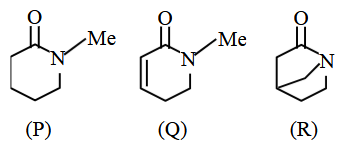
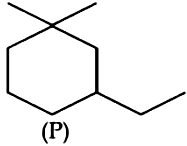
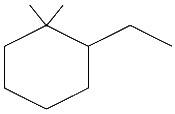
IUPAC name of the following compound (P) is :
For IUPAC naming of substituted cyclohexanes:
- First identify all substituents on the cyclohexane ring.
- The compound has two methyl groups on the same carbon and an ethyl group on another carbon.
- Number the ring to give the lowest set of locants. The ethyl group and the two methyl groups should receive the lowest possible numbers.
- With dimethyl on one carbon and ethyl on another, numbering gives: the dimethyl carbon as position 1 and ethyl as position 3, yielding 3-Ethyl-1,1-dimethylcyclohexane.
The answer is 3-Ethyl-1,1-dimethylcyclohexane, which corresponds to Option (2).
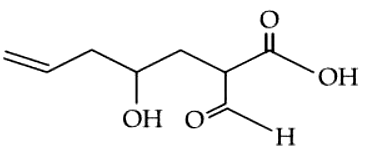
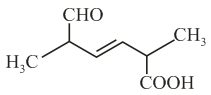
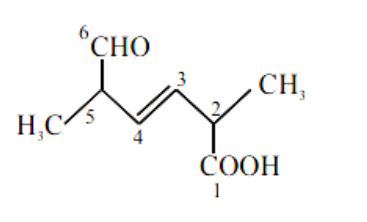
The correct nomenclature for the following compound is
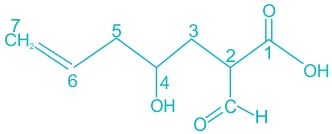
- Principal Group Priority: Carboxylic acid ($$-\text{COOH}$$) outranks aldehydes ($$-\text{CHO}$$), alcohols ($$-\text{OH}$$), and alkenes ($$\text{C}=\text{C}$$). The parent suffix is -oic acid.
- Chain Numbering: Numbering begins at the carboxylic acid carbon ($$\text{C-1}$$) and extends along the longest continuous chain containing the double bond ($$\text{C}=\text{C}$$).
- This gives a 7-carbon chain (heptane) with the double bond starting at position 6. Thus, the parent name is hept-6-enoic acid.
- Substituents: * At C-2: $$-\text{CHO}$$ acting as a prefix is named formyl.
- At C-4: $$-\text{OH}$$ acting as a prefix is named hydroxy.
Alphabetical Arrangement:
Combining the terms alphabetically (formyl before hydroxy):
2-formyl-4-hydroxyhept-6-enoic acid
Correct Option: B
The interaction between $$\pi$$ bond and lone pair of electrons present on an adjacent atom is responsible for
Question: The interaction between a $$\pi$$ bond and a lone pair of electrons present on an adjacent atom is responsible for which effect?
Review the electronic effects in organic chemistry.
Hyperconjugation (Option 1): This involves the interaction between $$\sigma$$ bond electrons (particularly C-H bonds) and an adjacent empty or partially filled p-orbital or $$\pi$$ system. It does not involve lone pairs directly.
Inductive effect (Option 2): This is the transmission of charge through a chain of atoms via $$\sigma$$ bonds. It involves $$\sigma$$ bonds only, not $$\pi$$ bonds or lone pairs interacting with each other.
Electromeric effect (Option 3): This is a temporary effect that occurs when a reagent approaches a $$\pi$$ bond, causing complete transfer of the $$\pi$$ electron pair. It does not specifically involve lone pairs on adjacent atoms.
Resonance effect (Option 4): Resonance (also called the mesomeric effect) involves the delocalisation of electrons through $$\pi$$ bonds and lone pairs on adjacent atoms. When a lone pair on an atom adjacent to a $$\pi$$ bond participates in conjugation, it is the resonance effect. For example, in aniline ($$C_6H_5NH_2$$), the lone pair on N interacts with the $$\pi$$ system of the benzene ring.
The correct answer is Option 4: Resonance effect.
Which among the following is incorrect statement?
We need to identify the incorrect statement about the electromeric effect.
Option 1: "Electromeric effect dominates over inductive effect." This is correct. The electromeric effect, being a complete transfer of $$\pi$$-electrons, is generally stronger than the inductive effect, which is a partial displacement of $$\sigma$$-electrons.
Option 2: "The electromeric effect is a temporary effect." This is correct. Unlike the inductive effect (which is permanent), the electromeric effect occurs only when an attacking reagent approaches the molecule. It is a temporary polarization of $$\pi$$-bonds.
Option 3: "Hydrogen ion (H⁺) shows negative electromeric effect." This is INCORRECT. H⁺ is an electrophile (electron-deficient species). When H⁺ attacks a $$\pi$$-bond, the $$\pi$$-electrons shift toward the attacking reagent — this is a positive electromeric effect (+E), not negative. The negative electromeric effect ($$-E$$) occurs when the attacking reagent is a nucleophile, and the electron pair shifts away from the attacking species.
Option 4: "The organic compound shows electromeric effect in the presence of the reagent only." This is correct, consistent with the temporary nature of the effect.
The incorrect statement is Option (3).
Which of the following molecule/species is most stable?
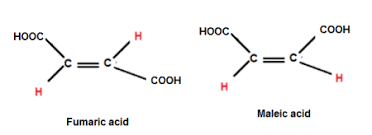
Which one of the following will show geometrical isomerism?
Common name of Benzene-1,2-diol is:
We need the common name of benzene-1,2-diol.
Benzene-1,2-diol has two hydroxyl (-OH) groups on adjacent carbon atoms of the benzene ring (ortho positions).
- Benzene-1,2-diol (ortho) = Catechol (also called pyrocatechol)
- Benzene-1,3-diol (meta) = Resorcinol
- Benzene-1,4-diol (para) = Hydroquinone (quinol)
Note: o-Cresol is 2-methylphenol, not a diol.
The correct answer is Option (1): Catechol.
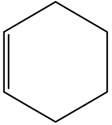
Cyclohexene is _________ type of an organic compound.
Identify structure of 2, 3-dibromo-1-phenylpentane.
Match List I with List II :
Choose the correct answer from the options given below :
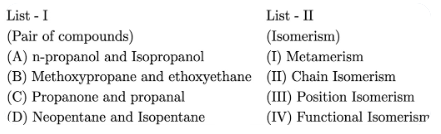
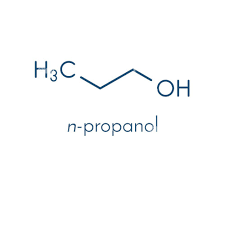
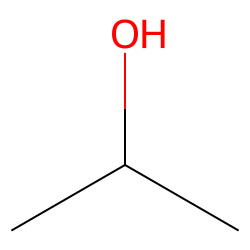
A)Both have the molecular formula $$(C_{3}H_{8}O)$$. In n-propanol, the $$(-OH)$$ group is at position 1, while in isopropanol, it is at position 2.
Isopropanol
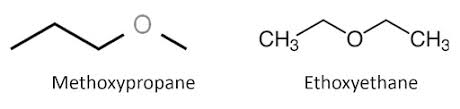
B)These compounds have the same molecular formula $$(C_4H_{10}O)$$ but differ in the distribution of carbon atoms on either side of the ether functional group $$(-O-)$$.
C)Both have the formula $$(C_{3}H_{6}O)$$, but they belong to different functional groups: propanone is a ketone and propanal is an aldehyde.
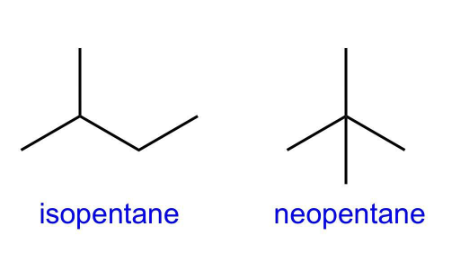
D)Both are isomers of pentane $$(C_{5}H_{12})$$ but differ in the structure of the carbon skeleton (branched chain vs. more highly branched chain).
Match List I with List II:

Choose the correct answer from the options given below:
The correct stability order of the following resonance structures of $$CH_3 - CH = CH - CHO$$ i
According to rules of making resonance structures, the most stable resonance structure is one which will have no charge, next would be the structure in which electronegative atom gets a negative charge i.e. Oxygen must have negative charge. The least stable resonating structure would be the structure that has a positive charge on oxygen opposite to its tendency. Hence, III>II>I
The difference in energy between the actual structure and the lowest energy resonance structure for the given compound is:
Understanding resonance energy:
Many organic compounds can be represented by two or more Lewis structures (called resonance structures or canonical structures). The actual molecule is a resonance hybrid of all these structures.
The lowest energy resonance structure (also called the most stable contributing structure) is a hypothetical reference. The actual molecule, being a hybrid of all resonance structures, has a lower energy than any single resonance structure — including the most stable one.
Definition of resonance energy:
Resonance energy is defined as the difference in energy between the actual structure (resonance hybrid) and the most stable (lowest energy) resonance structure:
$$\text{Resonance Energy} = E_{\text{lowest energy resonance structure}} - E_{\text{actual structure (hybrid)}}$$
Since the actual structure is always more stable (lower energy) than any individual resonance structure, the resonance energy is always a positive quantity.
For example, benzene has a resonance energy of approximately 150 kJ/mol, meaning the actual benzene molecule is 150 kJ/mol more stable than the hypothetical cyclohexatriene (Kekulé) structure.
Among the given options:
Option A (electromeric energy): This refers to the temporary shift of electrons in a multiple bond under the influence of an attacking reagent. It is not related to the stability difference between resonance structures.
Option B (resonance energy): This is exactly the energy difference between the actual structure and the lowest energy resonance structure. This is correct.
Option C (ionization energy): This is the energy required to remove an electron from an isolated gaseous atom. Unrelated to resonance.
Option D (hyperconjugation energy): This refers to the stabilization due to the interaction of electrons in a $$\sigma$$ bond with an adjacent empty or partially filled p-orbital. While it contributes to stability, it is not defined as the difference between the actual and resonance structures.
The correct answer is Option B: resonance energy.
Total number of stereo isomers possible for the given structure :
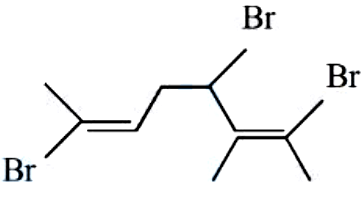
The Bromine substituted Carbon is a chiral carbon, hence it can have 2 configurations. Now, the double bond on left can either have cis or trans configuration and double bond on right could either have cis or trans configuration. Hence, total number of stereoisomers = 2*2*2 = 8
Ionic reactions with organic compounds proceed through: (A) Homolytic bond cleavage (B) Heterolytic bond cleavage (C) Free radical formation (D) Primary free radical (E) Secondary free radical. Choose the correct answer from the options given below:
We need to identify the mechanism through which ionic reactions with organic compounds proceed. Heterolytic bond cleavage involves the breaking of a covalent bond such that both shared electrons go to one atom, forming a cation and an anion: $$ A:B \rightarrow A^+ + :B^- \quad \text{(or } A:^- + B^+\text{)} $$
In contrast, homolytic bond cleavage assigns one electron to each atom, generating free radicals: $$ A:B \rightarrow A\cdot + B\cdot $$
Ionic reactions involve the formation of ionic intermediates (carbocations, carbanions) and proceed through attack by nucleophiles or electrophiles. This requires heterolytic bond cleavage, where electron pairs move as a unit, creating charged species. Free radical mechanisms (from homolytic cleavage) produce neutral radicals, not ions. Therefore, ionic reactions proceed through heterolytic bond cleavage (B) only.
The correct answer is Option C: (B) only.
{image}
The functional group that shows negative resonance effect is:
Identify the functional group that shows negative resonance effect ($$-R$$ effect).
What is the negative resonance effect ($$-R$$ effect)?
A group shows $$-R$$ effect when it withdraws electron density from the conjugated system through resonance. These groups typically have a multiple bond to an electronegative atom (like $$C=O$$), which pulls electron density away from the attached system.
What is the positive resonance effect ($$+R$$ effect)?
Groups with lone pairs on the atom directly bonded to the conjugated system can donate electron density through resonance. Examples: $$-NH_2$$, $$-OH$$, $$-OR$$.
Analyzing each option:
$$-NH_2$$: Has a lone pair on N that can be donated to the ring. Shows +R effect.
$$-OH$$: Has lone pairs on O that can be donated. Shows +R effect.
$$-COOH$$: The carbonyl group ($$C=O$$) withdraws electron density from the conjugated system. The $$-COOH$$ group pulls electrons away through the $$\pi$$ system. Shows -R effect.
$$-OR$$: Has lone pairs on O that can be donated. Shows +R effect.
The correct answer is Option C: $$-COOH$$.
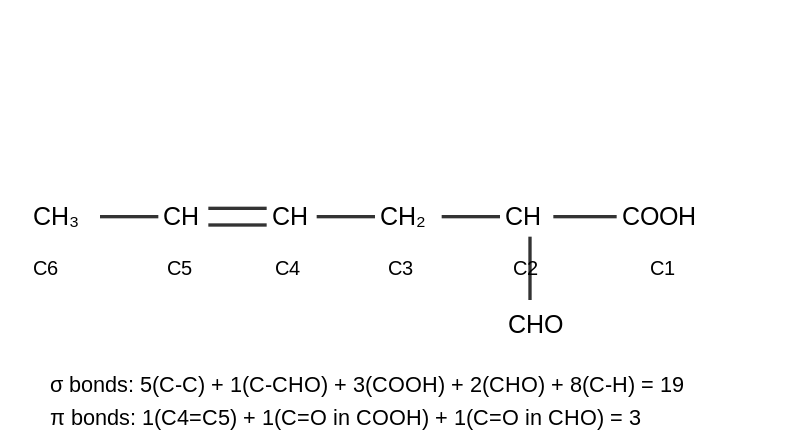
The total number of 'Sigma' and Pi bonds in 2-formylhex-4-enoic acid is ______.
We need to find the total number of sigma ($$\sigma$$) and pi ($$\pi$$) bonds in 2-formylhex-4-enoic acid.
2-formylhex-4-enoic acid has a 6-carbon chain (hexanoic acid) with a formyl group ($$-CHO$$) at C2 and a double bond between C4 and C5.
Structure: $$CH_3-CH=CH-CH_2-CH(CHO)-COOH$$

Every single bond is 1$$\sigma$$ bond, and every double bond contains 1$$\sigma$$ + 1$$\pi$$ bond.
C-C sigma bonds in main chain: C1-C2, C2-C3, C3-C4, C4=C5($$\sigma$$), C5-C6 = 5
C2-CHO branch: 1
In $$-COOH$$: C=O($$\sigma$$) + C-OH + O-H = 3
In $$-CHO$$: C=O($$\sigma$$) + C-H = 2
C-H bonds: C2(1H) + C3(2H) + C4(1H) + C5(1H) + C6(3H) = 8
Total $$\sigma$$ bonds = 5 + 1 + 3 + 2 + 8 = 19
C4=C5: 1$$\pi$$ bond
C=O in $$-COOH$$: 1$$\pi$$ bond
C=O in $$-CHO$$: 1$$\pi$$ bond
Total $$\pi$$ bonds = 3
Total = 19 + 3 = 22
The total number of sigma and pi bonds is $$\boxed{22}$$.
Number of compounds among the following which contain sulphur as heteroatom is _______.
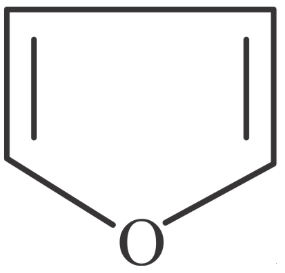
Furan, Thiophene, Pyridine, Pyrrole, Cysteine, Tyrosine
We need to count the number of compounds containing sulphur as a heteroatom from: Furan, Thiophene, Pyridine, Pyrrole, Cysteine, Tyrosine.
Define heteroatom.
A heteroatom is any atom in an organic compound that is not carbon or hydrogen. In heterocyclic chemistry, it specifically refers to atoms like N, O, S that replace carbon in a ring.
Analyse each compound.
Furan: A five-membered heterocyclic ring containing oxygen as the heteroatom. No sulphur.
Thiophene: A five-membered heterocyclic ring containing sulphur as the heteroatom. Counted.
Pyridine: A six-membered heterocyclic ring containing nitrogen as the heteroatom. No sulphur.
Pyrrole: A five-membered heterocyclic ring containing nitrogen as the heteroatom. No sulphur.
Cysteine: An amino acid with the structure $$HSCH_2CH(NH_2)COOH$$. It contains a thiol group ($$-SH$$), so sulphur is present as a heteroatom. Counted.
Tyrosine: An amino acid with a phenol group ($$HO-C_6H_4-CH_2CH(NH_2)COOH$$). It contains oxygen and nitrogen but no sulphur.
Count.
Compounds containing sulphur as heteroatom: Thiophene and Cysteine = 2.
The answer is 2.
The total number of 'sigma' and 'Pi' bonds in 2-oxohex-4-ynoic acid is ______
We need to find the total number of sigma and pi bonds in 2-oxohex-4-ynoic acid.
First, we draw its structure: 2-oxohex-4-ynoic acid is a 6-carbon chain with:
- Position 1: -COOH (carboxylic acid)
- Position 2: =O (oxo/keto group)
- Position 4-5: triple bond (ynoic = alkyne)
Thus, the structure is HOOC-CO-CH₂-C≡C-CH₃.
Next, we count the sigma bonds:
- O-H: 1 sigma
- C1=O (COOH): 1 sigma + 1 pi
- C1-O(H): 1 sigma
- C1-C2: 1 sigma
- C2=O: 1 sigma + 1 pi
- C2-C3: 1 sigma
- C3-H (×2): 2 sigma
- C3-C4: 1 sigma
- C4≡C5: 1 sigma + 2 pi
- C5-C6: 1 sigma
- C6-H (×3): 3 sigma
Summing these, the total number of sigma bonds is 1 + 1 + 1 + 1 + 1 + 1 + 2 + 1 + 1 + 1 + 3 = 14, and the total number of pi bonds is 1 + 1 + 2 = 4.
Therefore, the total number of sigma and pi bonds is 14 + 4 = 18, so the answer is 18.
Number of geometrical isomers possible for the given structure is/are ________.
Number of optical isomers possible for 2-chlorobutane is:
Find the number of optical isomers of 2-chlorobutane.
The structure of 2-chlorobutane can be represented as $$CH_3-CHCl-CH_2-CH_3$$.
In this molecule, carbon-2 is bonded to four different groups: $$-CH_3$$, $$-Cl$$, $$-H$$, and $$-CH_2CH_3$$, making C-2 a chiral center.
For a molecule with $$n$$ chiral centers and no internal plane of symmetry, the number of optical isomers is $$2^n$$. Here $$n = 1$$, so the number of optical isomers is $$2^1 = 2$$. These two isomers are enantiomers (R-2-chlorobutane and S-2-chlorobutane), which are non-superimposable mirror images of each other.
The answer is 2.
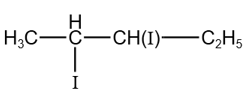
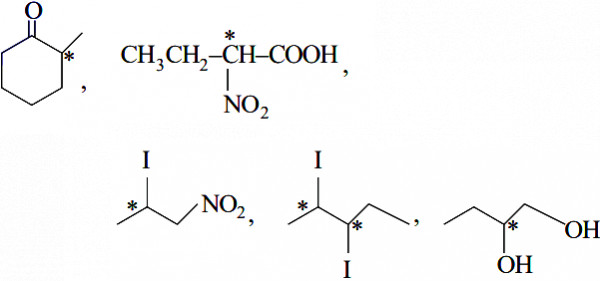
Total number of compounds with Chiral carbon atoms from following is
$$CH_3-CH_2-CHNO_2-COOH$$
$$CH_3-CH(I)-CH_2-NO_2$$
$$CH_3-CH_2-CHBr-CH_2-CH_3$$
$$CH_3-CH_2-CH(OH)-CH_2OH$$
2-chlorobutane + $$Cl_2 \rightarrow C_4H_8Cl_2$$ (isomers)
Total number of optically active isomers shown by $$C_4H_8Cl_2$$, obtained in the above reaction is ________.
2-chlorobutane: CH$$_3$$CHClCH$$_2$$CH$$_3$$. Monochlorination gives C$$_4$$H$$_8$$Cl$$_2$$ isomers.
Possible positions for the second Cl:
1. C1: CH$$_2$$ClCHClCH$$_2$$CH$$_3$$ — C2 is chiral, optically active (2 enantiomers)
2. C2: CH$$_3$$CCl$$_2$$CH$$_2$$CH$$_3$$ — no chiral center, not optically active
3. C3: CH$$_3$$CHClCHClCH$$_3$$ — two chiral centers, can have (R,R), (S,S), and meso. The (R,R) and (S,S) are optically active = 2 enantiomers. Also (R,S) which is meso.
4. C4: CH$$_3$$CHClCH$$_2$$CH$$_2$$Cl — C2 is chiral, 2 enantiomers
Total optically active isomers: 2 + 0 + 2 + 2 = 6.
Therefore, the answer is $$\boxed{6}$$.
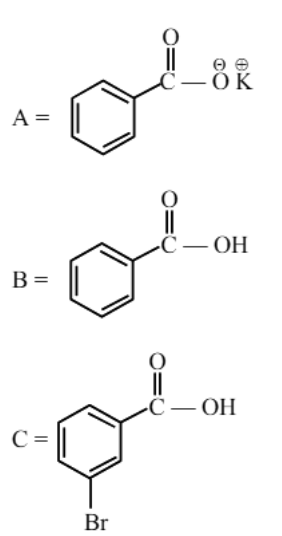
The product (C) in the following sequence of reactions has ______ $$\pi$$ bonds.
Step 1: Formation of Intermediate (A) and (B)
- Reactant: Propylbenzene ($$\text{C}_6\text{H}_5\text{CH}_2\text{CH}_2\text{CH}_3$$)
- Reagents: 1) $$\text{KMnO}_4\text{ - KOH, }\Delta$$ followed by 2) $$\text{H}_3\text{O}^+$$
- Reaction: Vigorous side-chain oxidation. Any alkyl group with at least one benzylic hydrogen is completely oxidized down to a carboxylic acid group attached directly to the benzene ring.
- Product (B): Benzoic acid ($$\text{C}_6\text{H}_5\text{COOH}$$)
Step 2: Formation of Major Product (C)
- Reactant: Benzoic acid ($$\text{C}_6\text{H}_5\text{COOH}$$)
- Reagents: $$\text{Br}_2\text{ / FeBr}_3$$ (Electrophilic Aromatic Substitution / Bromination)
- Reaction: The carboxylic acid group ($$-\text{COOH}$$) is a strongly deactivating and meta-directing group. Therefore, the bromine atom attacks the meta position.
- Product (C): m-Bromobenzoic acid (3-bromobenzoic acid)
Step 3: Counting the $$\pi$$-bonds in Product (C)
Let's count the $$\pi$$-bonds in the chemical structure of m-bromobenzoic acid:
- Benzene Ring: Contains 3 $$\pi$$-bonds (alternate double bonds).
- Carboxylic Acid Group ($$-\text{COOH}$$): Contains 1 $$\pi$$-bond (from the carbon-oxygen double bond, $$\text{C}=\text{O}$$).
- Bromine Atom ($$-\text{Br}$$): Contains only $$\sigma$$-bonds (no $$\pi$$-bonds).
$$\text{Total }\pi\text{-bonds} = 3 + 1 = 4$$
Vanillin compound obtained from vanilla beans, has total sum of oxygen atoms and $$\pi$$ electrons is ______
Vanillin: 4-hydroxy-3-methoxybenzaldehyde. C₈H₈O₃. O atoms: 3 (OH, OCH₃, CHO). π electrons: benzene ring (3 C=C→6π) + C=O (2π) = 8π... Wait: benzene has 6π electrons (3 double bonds), aldehyde C=O has 2π electrons. Total π electrons = 6+2=8.
Sum of O atoms + π electrons = 3+8=11.
The answer is $$\boxed{11}$$.
An organic compound P with molecular formula $$C_9H_{18}O_2$$ decolorizes bromine water and also shows positive iodoform test. P on ozonolysis followed by treatment with $$H_2O_2$$ gives Q and R. While compound Q shows positive iodoform test, compound R does not give positive iodoform test. Q and R on oxidation with pyridinium chlorochromate (PCC) followed by heating give S and T, respectively. Both S and T show positive iodoform test.
Complete copolymerization of 500 moles of Q and 500 moles of R gives one mole of a single acyclic copolymer U.
[Given, atomic mass: H = 1, C = 12, O = 16]
Sum of number of oxygen atoms in S and T is ______.
Step 1 - Index of hydrogen deficiency for $$P$$
For an open-chain compound $$C_9H_{18}O_2$$ the index is
$$\text{IHD}= \dfrac{2\times 9+2-18}{2}=1$$
So $$P$$ possesses one and only one π bond (no ring).
Step 2 - Nature of functional groups in $$P$$
$$P$$ decolorises bromine water ⇒ the single IHD corresponds to a $$C=C$$ bond.
$$P$$ also gives a positive iodoform test; without any carbonyl present (IHD already used up), this can only arise from a secondary alcohol of the type $$CH_3-C^*(OH)-$$. Hence both oxygen atoms of $$P$$ are present as non-carbonyl oxygens (alcohol/ether). In short, $$P$$ is an >C=C< containing di-oxygenated alcohol (or alcohol-ether).
Step 3 - Oxidative ozonolysis of the double bond
Ozonolysis followed by $$H_2O_2/H_2O$$ cleaves the $$C=C$$, converting each double-bond carbon into a -COOH group while leaving every pre-existing -OH intact. Thus both fragments, $$Q$$ and $$R$$, are $$\beta$$-hydroxy carboxylic acids.
Step 4 - Why $$Q$$ shows, but $$R$$ lacks, the iodoform test
The iodoform test in acids is positive only when the acid contains a $$CH_3CO-$$ or $$CH_3CH(OH)-$$ unit. Therefore the -OH in $$Q$$ is on the carbon that already bears a methyl group, giving $$CH_3-C(OH)(\ldots )-COOH$$; $$R$$ lacks this arrangement.
Step 5 - Oxidation with PCC followed by heating
(i) PCC oxidises the secondary -OH in each $$\beta$$-hydroxy acid to a carbonyl group, producing a $$\beta$$-keto acid.
(ii) A classic property of $$\beta$$-keto acids is thermal decarboxylation:
$$R-CO-CH_2-COOH \xrightarrow{\Delta} R-CO-CH_3 + CO_2$$
Thus $$Q$$ → $$S$$ and $$R$$ → $$T$$, where both $$S$$ and $$T$$ are methyl ketones.
Step 6 - Counting oxygen atoms in $$S$$ and $$T$$
A methyl ketone contains only one oxygen atom (the carbonyl oxygen).
Hence $$n_O(S)=1$$ and $$n_O(T)=1$$.
Step 7 - Required sum
$$n_O(S)+n_O(T)=1+1=2$$
Therefore, the sum of the number of oxygen atoms present in $$S$$ and $$T$$ is 2.
An organic compound P with molecular formula $$C_9H_{18}O_2$$ decolorizes bromine water and also shows positive iodoform test. P on ozonolysis followed by treatment with $$H_2O_2$$ gives Q and R. While compound Q shows positive iodoform test, compound R does not give positive iodoform test. Q and R on oxidation with pyridinium chlorochromate (PCC) followed by heating give S and T, respectively. Both S and T show positive iodoform test.
Complete copolymerization of 500 moles of Q and 500 moles of R gives one mole of a single acyclic copolymer U.
[Given, atomic mass: H = 1, C = 12, O = 16]
The molecular weight of U is ______.
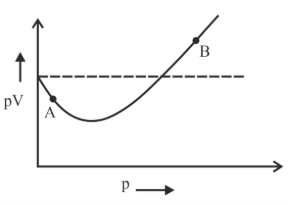
For 1 mol of gas, the plot of pV vs p is shown below. p is the pressure and V is the volume of the gas.

What is the value of compressibility factor at point A?
Which of the following conformations will be the most stable?
Increasing order of stability of the resonance structure is:
This is the "winner" because Nitrogen has 4 bonds and Oxygen has its full valence. Crucially, every single atom has a full octet. Nitrogen is more comfortable carrying a positive charge when it has 4 bonds than a Carbon atom is.
Here, the Carbon atoms do not all have full octets (the carbocation only has 6 electrons). However, the negative charge is on the Carbon closer to the Carbonyl group (OHC). This allows for better inductive or potential resonance stabilization from the Oxygen nearby.
This is very unstable. You have a positive charge on a Carbon right next to a Carbonyl group ($OHC$). Since the Carbon in the $C=O$ group is already partially positive, putting another positive charge right next to it causes massive electrostatic repulsion.
This structure is extremely unlikely because it places a positive charge on an Oxygen atom while it only has 6 electrons (incomplete octet), and it breaks the conjugation chain significantly.
What is the correct order of acidity of the protons marked $$A - D$$ in the given compounds?
Match List I with List II.
List I List II.
A. Propanamine and N-Methylethanamine I. Metamers
B. Hexan-2-one and Hexan-3-one II. Positional isomers
C. Ethanamide and Hydroxyethanimine III. Functional isomers
D. o-nitrophenol and pnitrophenol IV. Tautomers
Choose the correct answer from the options given below :-
The decreasing order of hydride affinity for following carbocations is:
(a)

(b)

(c)

(d)

Choose the correct answer from the options given below:
Hydride affinity is defined for the reaction
$$R^+ + H^- \;\rightarrow\; RH$$.
The larger the energy released (that is, the more negative the reaction enthalpy), the greater is the hydride affinity of the carbocation $$R^+$$.
A carbocation that is intrinsically less stable gains a larger amount of stabilisation on accepting a hydride ion, so it shows a higher hydride affinity.
Conversely, a more stable carbocation is already low in energy; it gains relatively little additional stabilisation on accepting $$H^-$$ and therefore exhibits a lower hydride affinity.
Hence,
$$\text{higher hydride affinity}\; \Longleftrightarrow\; \text{lower inherent stability of the carbocation}$$.
Case 1 (c):The methyl cation $$CH_3^+$$ possesses neither hyperconjugation nor resonance stabilisation. It is the least stabilised of the four; therefore it will have the highest hydride affinity.
Case 2 (a):The n-propyl (1°) carbocation $$CH_3CH_2CH_2^+$$ is stabilised by hyperconjugation with two α-hydrogen atoms. It is more stable than $$CH_3^+$$ but less stable than a 3° or resonance-stabilised cation. Its hydride affinity is therefore lower than that of (c) but higher than that of (b) and (d).
Case 3 (b):The tert-butyl (3°) carbocation $$(CH_3)_3C^+$$ enjoys extensive hyperconjugation (nine α-hydrogen atoms), making it markedly more stable than a 1° carbocation. Hence its hydride affinity is lower than those of (c) and (a).
Case 4 (d):The benzyl carbocation $$C_6H_5CH_2^+$$ is stabilised by resonance with the aromatic ring, distributing the positive charge over several atoms. This resonance stabilisation is stronger than the hyperconjugative stabilisation present in $$(CH_3)_3C^+$$. Therefore it is the most stable of the four and consequently has the lowest hydride affinity.
Combining the four cases, the order from highest to lowest hydride affinity is
$$\text{(c)} \; \gt \; \text{(a)} \; \gt \; \text{(b)} \; \gt \; \text{(d)}.$$
This corresponds to Option B: C, A, B, D.
Answer : Option B
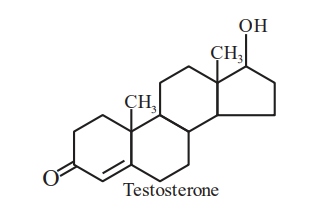
Testosterone, which is a steroidal hormone, has the following structure.
The total number of asymmetric carbon atom/s in testosterone is ______.
Match List-I with List-II.
List-I (Name of reaction) List-II (Reagent used)
A. Hell-Volhard Zelinsky reaction I. NaOH + I$$_2$$
B. Iodoform reaction II. (i) CrO$$_2$$Cl$$_2$$, CS$$_2$$ (ii) H$$_2$$O
C. Etard reaction III. (i) Br$$_2$$/red phosphorus (ii) H$$_2$$O
D. Gatterman-Koch reaction IV. CO, HCl, anhyd. AlCl$$_3$$
Matching each named reaction with its reagent:
A. Hell-Volhard-Zelinsky (HVZ) reaction: This reaction involves α-halogenation of carboxylic acids using Br₂ in the presence of red phosphorus, followed by hydrolysis. Reagent: (i) Br₂/red phosphorus (ii) H₂O → Match with III
B. Iodoform reaction: This reaction is used to detect methyl ketones and secondary alcohols using NaOH and I₂ (or NaOI). Reagent: NaOH + I₂ → Match with I
C. Etard reaction: This reaction converts a methyl group attached to an aromatic ring to an aldehyde using chromyl chloride in CS₂. Reagent: (i) CrO₂Cl₂, CS₂ (ii) H₂O → Match with II
D. Gattermann-Koch reaction: This reaction introduces an aldehyde group on an aromatic ring using CO and HCl in the presence of anhydrous AlCl₃. Reagent: CO, HCl, anhyd. AlCl₃ → Match with IV
The correct matching is: A → III, B → I, C → II, D → IV.
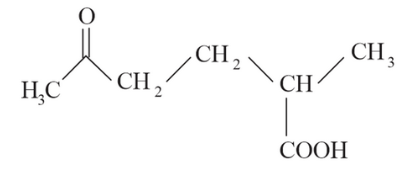
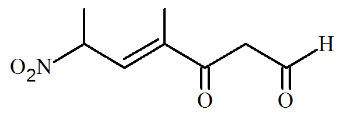
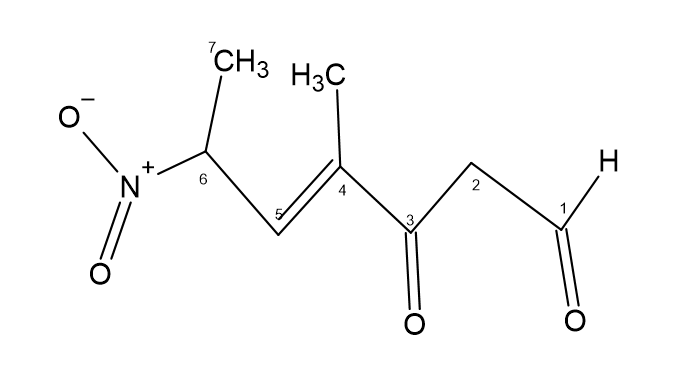
The correct IUPAC nomenclature for the following compound is:
In the given structure Numbering would be start from leftmost carbon hence methyl at 5 , oxo at 2 and since functional group is acetic acid hence name would be , 5-methyl-2-oxo-hexane-6-oic acid
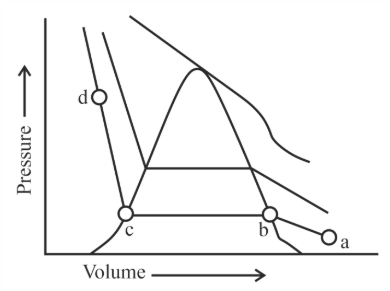
The number of statement's, which are correct with respect to the compression of carbon dioxide from point (a) in the Andrews isotherm from the following is _____.

A. Carbon dioxide remains as a gas upto point (b)
B. Liquid carbon dioxide appears at point (c)
C. Liquid and gaseous carbon dioxide coexist between points (b) and (c)
D. As the volume decreases from (b) to (c), the amount of liquid decreases

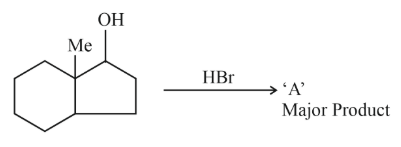
The number of hyperconjugation structures involved to stabilize carbocation formed in the reaction of 2-methylcyclohexan-1-ol with HBr is _______
When 2-methylcyclohexan-1-ol reacts with HBr, the OH group is first protonated to form a good leaving group ($$H_2O$$), which departs to give a secondary carbocation at C1.
Now, this secondary carbocation at C1 undergoes a 1,2-hydride shift from C2 to form a more stable tertiary carbocation at C2 (the carbon bearing the methyl group).
We have the tertiary carbocation at C2 bonded to:
- C1 (which now has 2 hydrogen atoms since OH left as water)
- C3 (which has 2 hydrogen atoms)
- $$CH_3$$ group (which has 3 hydrogen atoms)
Each $$\alpha$$-hydrogen can participate in hyperconjugation with the empty p-orbital of the carbocation.
So, total number of hyperconjugating hydrogens = 2 + 2 + 3 = 7.
Hence, the number of hyperconjugation structures is $$7$$.
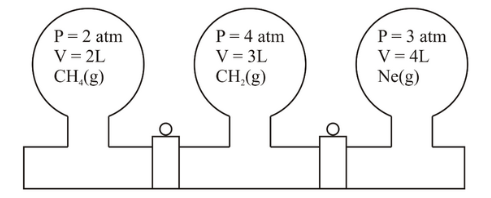
Three bulbs are filled with CH$$_4$$, CO$$_2$$ and Ne as shown in the picture. The bulbs are connected through pipes of zero volume. When the stopcocks are opened and the temperature is kept constant throughout, the pressure of the system is found to be ______ atm. (Nearest integer).
Problem Solution & Explanation
| Gas Component | Initial Pressure (P) | Initial Volume (V) |
|---|---|---|
| Bulb 1 (CH4) | 2 atm | 2 L |
| Bulb 2 (CO2) | 4 atm | 3 L |
| Bulb 3 (Ne) | 3 atm | 4 L |
Because temperature ($T$) and the total amount of gas moles ($n$) remain fixed and constant inside the closed setup, we can confidently apply Boyle's Law and Dalton's Law of Partial Pressures. The fundamental law states that the sum of the initial pressure-volume pairs equals the total final system pressure-volume state.
Since the connecting glass pipes add zero dead volume, the final total volume is the absolute sum of all individual gas chambers:
The consolidated equation used to find the final pressure of non-reacting mixed gases is:
Substitute our exact values directly into the core formula:
P_total * 9 = (2 * 2) + (4*3) + (3 * 4)
P_total * 9 = 4 + 12 + 12$
P_total* 9 = 28
P_total= 28/9 = 3.11(approx)
The precise value yields 3.11 atm. Rounding off to the closest whole integer gives us 3.
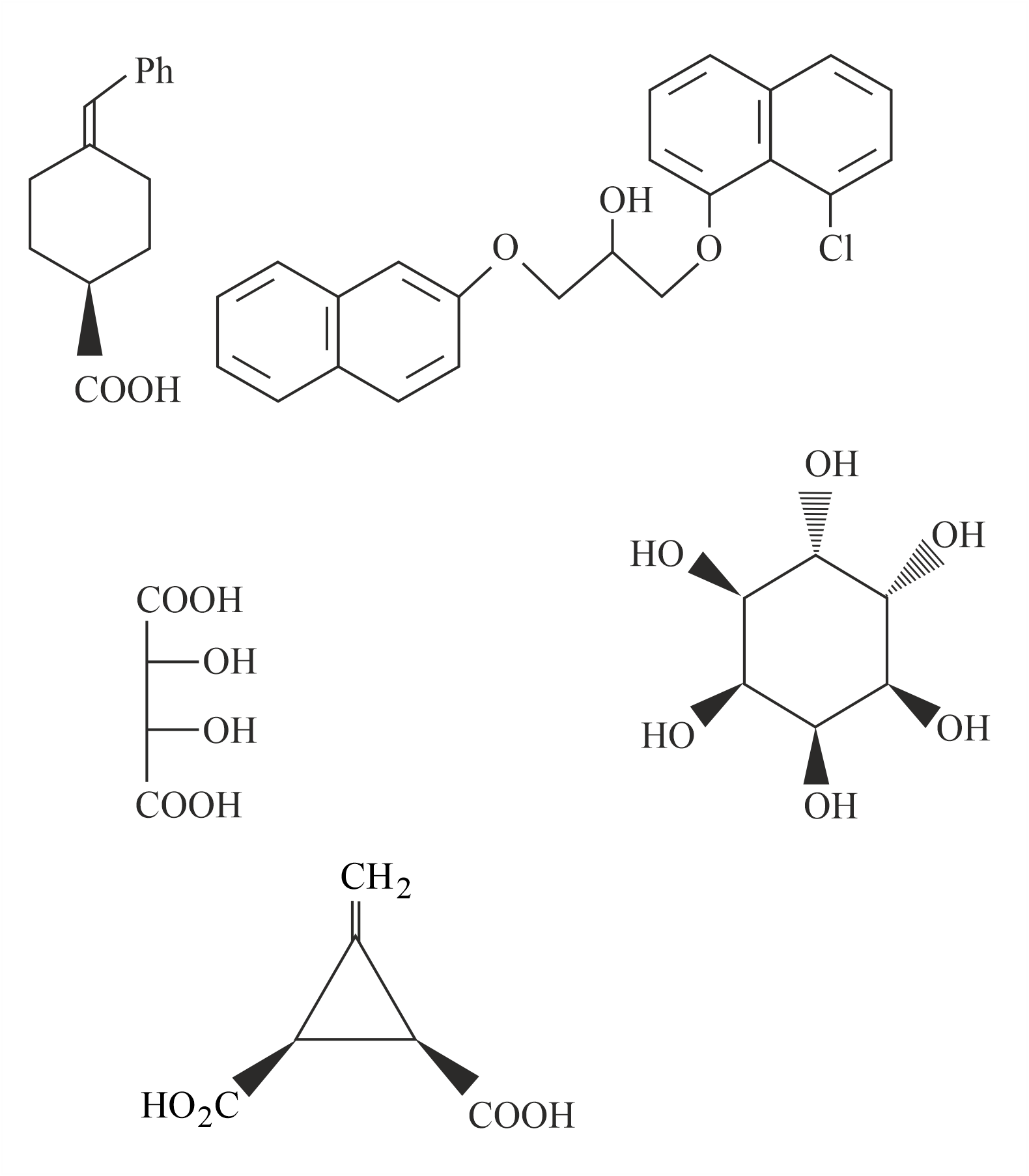
The total number of chiral compound/s from the following is
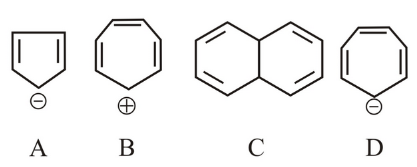
Which of the following structures are aromatic in nature?
aromatic compounds should have cyclic planar structure with (4n+2)pi electrons .
Which of the following is most stable?
Apply Huckel's rule for aromaticity.
A cyclic, planar, fully conjugated system is aromatic if it has $$(4n + 2)$$ $$\pi$$-electrons (where $$n = 0, 1, 2, ...$$), and antiaromatic if it has $$4n$$ $$\pi$$-electrons. Aromatic species are exceptionally stable, while antiaromatic species are very unstable.
Analyze each species.
Option A - Cyclopropenyl cation ($$C_3H_3^+$$):
This has 3 carbon atoms in a ring with one positive charge. Number of $$\pi$$-electrons = 2 (one double bond contributes 2 electrons; the cationic carbon has an empty p-orbital). With $$4n + 2 = 2$$ ($$n = 0$$), this is aromatic and highly stable.
Option B - Cyclopropenyl anion ($$C_3H_3^-$$):
This has 4 $$\pi$$-electrons. With $$4n = 4$$ ($$n = 1$$), this is antiaromatic and very unstable.
Option C - Cyclopentadienyl cation ($$C_5H_5^+$$):
This has 4 $$\pi$$-electrons. With $$4n = 4$$ ($$n = 1$$), this is antiaromatic and unstable.
Option D - Cyclohexadienyl:
The cyclohexadienyl species is not fully conjugated (it has an $$sp^3$$ carbon breaking the conjugation), so it is non-aromatic and less stable than an aromatic species.
Conclusion.
The cyclopropenyl cation (Option A) is the only aromatic species among the choices, making it the most stable.
The answer is $$\boxed{\text{Option A}}$$.
In the following structures, which one is having staggered conformation with maximum dihedral angle?
Arrange the following carbocations in decreasing order of stability.
- Carbocation B (Most Stable): In this structure, the positive charge is directly adjacent to the oxygen atom. The oxygen atom possesses lone pairs of electrons that it can donate into the empty p-orbital of the carbocation. This creates a powerful resonance stabilization (+R effect) where a double bond forms between the carbon and oxygen, successfully completing the octet for every atom in the molecule. This makes B exceptionally stable.
- Carbocation A (Intermediate): This is a standard secondary cyclopentyl carbocation. It does not have any resonance stabilization. Instead, it relies on the weaker stabilization provided by the electron-donating inductive effect (+I) of the surrounding carbon ring and hyperconjugation from the adjacent C-H bonds.
- Carbocation C (Least Stable): Here, the positive charge is separated from the oxygen atom by one carbon. Because it is not directly adjacent, the oxygen cannot share its lone pairs to stabilize the charge via resonance. Instead, the highly electronegative oxygen atom exerts a strong electron-withdrawing inductive effect (-I) through the sigma bonds. This pulls electron density away from an already electron-deficient positive center, severely destabilizing the carbocation.
Therefore, the correct decreasing order of stability is: B > A > C.
Match List-I with List-II.
| List-I | List-II |
|---|---|
A![]() | I. Spiro compound |
B![]() | II. Aromatic compound |
C![]() | III. Non-planar Heterocyclic compound |
D![]() | IV. Bicyclo compound |
The correct order of nucleophilicity is
We need to identify the correct order of nucleophilicity from the given options.
Key Principle: A stronger base (more electron-rich species) is generally a better nucleophile when comparing species with the same attacking atom or in the same solvent conditions. Negatively charged species are stronger nucleophiles than their neutral counterparts.
$$F^-$$ is a weaker nucleophile than $$OH^-$$ because fluorine is more electronegative and holds its electron density more tightly. Also, $$F^-$$ is heavily solvated in protic solvents. This order is incorrect.
$$OH^-$$ has a negative charge and is a much stronger nucleophile than neutral $$H_2O$$. This order is incorrect.
$$RO^-$$ (alkoxide ion) is negatively charged and is a much stronger nucleophile than the neutral alcohol $$ROH$$. This order is incorrect.
$$NH_2^-$$ (amide ion) carries a negative charge and has a lone pair readily available for donation. It is a much stronger nucleophile than neutral $$NH_3$$. This order is correct.
The correct answer is Option D: $$NH_2^- > NH_3$$.
Among the following marked proton of which compound shows lowest pKa value?
The correct decreasing order of priority of functional groups in naming an organic compound as per IUPAC system of nomenclature is
We need to find the correct decreasing order of priority of functional groups in IUPAC nomenclature according to IUPAC nomenclature rules, when a molecule has multiple functional groups, the principal characteristic group is chosen based on a defined priority order. The standard IUPAC priority order (from highest to lowest) for some common functional groups is:
$$-COOH > -SO_3H > -COCl > -COOR > -CONH_2 > -CN > -CHO > -C(=O)- > -OH > -NH_2$$
Next, we examine each option.
Option A: $$-COOH > -CONH_2 > -COCl > -CHO$$. Since this places $$-CONH_2$$ (amide) above $$-COCl$$ (acid chloride), it is incorrect because acid halides ($$-COCl$$) have higher priority than amides ($$-CONH_2$$) in the IUPAC system. The correct relative order among these is: $$-COOH > -COCl > -CONH_2 > -CHO$$.
Option B: $$-SO_3H > -COCl > -CONH_2 > -CN$$. We verify each pair against the IUPAC priority table:
- $$-SO_3H$$ (sulphonic acid) has very high priority, ranked just below $$-COOH$$. It is correctly placed first here.
- $$-COCl$$ (acid chloride) is next in the table after sulphonic acid derivatives. Correctly placed second.
- $$-CONH_2$$ (amide) comes after acid halides and esters. Correctly placed third.
- $$-CN$$ (nitrile/cyanide) comes after amides. Correctly placed fourth.
Every adjacent pair follows the standard IUPAC priority. This sequence is correct.
Option C: $$-COOH > -COOR > -COCl > -CONH_2$$. This places $$-COOR$$ (ester) above $$-COCl$$ (acid chloride) and is incorrect because acid chlorides rank higher than esters in the IUPAC priority order.
Option D: $$-COOH > -COOR > -CONH_2 > -COCl$$. This places $$-COCl$$ at the lowest priority among these groups and is incorrect because acid chlorides have higher priority than both esters and amides.
Therefore, the correct answer is Option B: $$-SO_3H > -COCl > -CONH_2 > -CN$$.
The correct IUPAC name of the following compound is
CH3COOH is primarily functional groups, so numbering would be start from there. C attached to primarily functional group would be rank 1 as per IUPAC nomenclature hence methyl would be at 4 nitro at 6 ,oxo at 3 and double bond at 4 with total 6 carbon hence name would be 4-methyl-6 nitro-3-oxhept-4-enal
Correct structure of $$\gamma$$-methylcyclohexane carbaldehyde is
Which of the following carbocations is most stable?
Longest
Given below are two statements.
Statement I: The compound is optically active.

Statement II: The second compound is mirror image of the above compound A.

In the light of the above statement, choose the most appropriate answer from the options given below.
In the given reaction

'A' can be
If the reaction sequence given below is carried out with 15 moles of acetylene, the amount of product D formed (in g) is ______.
The yields of A, B, C and D are given in parentheses.
[Given : Atomic mass of H = 1, C = 12, O = 16, Cl = 35]
Most stable product of the following reaction is
On complete combustion of 0.492 g of an organic compound containing C, H and O, 0.7938 g of $$CO_2$$ and 0.4428 g of $$H_2O$$ was produced. The % composition of oxygen in the compound is _____ (Nearest Integer)
The mass of the organic compound was 0.492 g and it contains C, H, and O. When combusted, it produced 0.7938 g of $$CO_2$$ and 0.4428 g of $$H_2O$$.
Since each mole of $$CO_2$$ (44 g) contains 1 mole of C (12 g), we calculate the mass of carbon as follows:
$$\text{Mass of C} = \frac{12}{44} \times 0.7938 = \frac{12 \times 0.7938}{44} = \frac{9.5256}{44} = 0.2163 \text{ g}$$
Similarly, every mole of $$H_2O$$ (18 g) contains 2 moles of H (2 g), so the mass of hydrogen is given by:
$$\text{Mass of H} = \frac{2}{18} \times 0.4428 = \frac{0.8856}{18} = 0.0492 \text{ g}$$
From the above masses, we find the mass of oxygen in the compound by subtracting the masses of C and H from the total mass:
$$\text{Mass of O} = 0.492 - 0.2163 - 0.0492 = 0.2265 \text{ g}$$
This gives the percentage of oxygen as:
$$\% \text{ of O} = \frac{0.2265}{0.492} \times 100 = 46.04\%$$
Therefore, the percentage composition of oxygen in the compound is 46% (nearest integer).
Number of electrophilic centres in the given compound is ______
Total number of possible stereoisomers of dimethyl cyclopentane is ______
We need to find the total number of stereoisomers of dimethylcyclopentane, considering all possible positions of the two methyl groups on the cyclopentane ring.
The possible positional isomers are 1,1-dimethylcyclopentane, 1,2-dimethylcyclopentane, and 1,3-dimethylcyclopentane. We analyze the stereoisomers for each case.
Case 1: 1,1-Dimethylcyclopentane
Both methyl groups are attached to the same carbon atom (C1). Since C1 now has two identical methyl groups, it is not a stereocenter. There is no possibility of cis-trans isomerism either.
Number of stereoisomers = 0
Case 2: 1,2-Dimethylcyclopentane
The two methyl groups are on adjacent carbon atoms C1 and C2. Consider C1: it is bonded to (i) a methyl group, (ii) hydrogen, (iii) the ring segment going through C2, and (iv) the ring segment going through C5, C4, C3. Since the path through C2 carries a methyl substituent while the path through C5 does not, all four groups on C1 are different, making C1 a stereocenter. By similar reasoning, C2 is also a stereocenter.
(i) cis-1,2-dimethylcyclopentane: Both methyl groups point to the same side of the ring plane. The two stereocenters have the same absolute configuration (both R,R or both S,S). This molecule lacks a plane of symmetry, so it is chiral and exists as a pair of non-superimposable mirror images (enantiomers). This gives 2 stereoisomers.
(ii) trans-1,2-dimethylcyclopentane: The methyl groups point to opposite sides of the ring plane. The stereocenters have opposite configurations (1R,2S). A plane of symmetry passes through the midpoint of the C1-C2 bond and the opposite vertex (C4), making this a meso compound. This gives 1 stereoisomer.
Subtotal for 1,2-position = 2 + 1 = 3 stereoisomers
Case 3: 1,3-Dimethylcyclopentane
The two methyl groups are on C1 and C3. Consider C1: it is bonded to (i) a methyl group, (ii) hydrogen, (iii) the ring path through C2 (which reaches the methyl-bearing C3), and (iv) the ring path through C5, C4 (which reaches C3 from the other side). These four groups are all different, making C1 a stereocenter. By the same argument, C3 is also a stereocenter.
(i) cis-1,3-dimethylcyclopentane: Both methyl groups are on the same side of the ring plane. Due to the symmetric placement of C1 and C3 relative to the ring, the stereocenters have opposite absolute configurations (1R,3S). A plane of symmetry passes through C5 and the midpoint of C2-C3 (bisecting the ring), making this a meso compound. This gives 1 stereoisomer.
(ii) trans-1,3-dimethylcyclopentane: The methyl groups point to opposite sides of the ring plane. The stereocenters have the same absolute configuration (both R,R or both S,S). There is no plane of symmetry, so this compound is chiral and exists as a pair of enantiomers. This gives 2 stereoisomers.
Subtotal for 1,3-position = 1 + 2 = 3 stereoisomers
Total count of stereoisomers:
From 1,2-dimethylcyclopentane: 3
From 1,3-dimethylcyclopentane: 3
Total = 3 + 3 = 6
Hence, the total number of possible stereoisomers of dimethylcyclopentane is 6.
A sealed flask with a capacity of $$2 \text{ dm}^3$$ contains $$11 \text{ g}$$ of propane gas. The flask is so weak that it will burst if the pressure becomes $$2 \text{ MPa}$$. The minimum temperature at which the flask will burst is ______ °C. [Nearest integer]
(Given: $$R = 8.3 \text{ J K}^{-1} \text{ mol}^{-1}$$. Atomic masses of C and H are $$12u$$ and $$1u$$ respectively.) (Assume that propane behaves as an ideal gas.)
We need to find the minimum temperature at which a sealed flask will burst.
Volume = $$2 \text{ dm}^3 = 2 \times 10^{-3} \text{ m}^3$$
Mass of propane = 11 g
Burst pressure = 2 MPa = $$2 \times 10^6 \text{ Pa}$$
$$R = 8.3 \text{ J K}^{-1} \text{ mol}^{-1}$$
Calculate moles of propane
Molecular formula of propane: $$C_3H_8$$
Molar mass = $$3 \times 12 + 8 \times 1 = 44 \text{ g/mol}$$
$$n = \frac{11}{44} = 0.25 \text{ mol}$$
Apply the ideal gas equation
$$PV = nRT$$
$$T = \frac{PV}{nR}$$
Substitute values
$$T = \frac{2 \times 10^6 \times 2 \times 10^{-3}}{0.25 \times 8.3}$$
$$T = \frac{4000}{2.075}$$
$$T = 1927.7 \text{ K}$$
Convert to Celsius
$$T = 1927.7 - 273 = 1654.7 \approx 1655 \text{ °C}$$
The answer is 1655.
The number of $$sp^3$$ hybridised carbons in an acyclic neutral compound with molecular formula $$C_4H_5N$$ is ______.
We need to find the number of $$sp^3$$ hybridised carbons in an acyclic neutral compound with molecular formula $$C_4H_5N$$.
For $$C_4H_5N$$:
Degree of unsaturation = $$\dfrac{2(4) + 2 - 5 + 1}{2} = \dfrac{8 + 2 - 5 + 1}{2} = \dfrac{6}{2} = 3$$
With 3 degrees of unsaturation in an acyclic neutral compound with $$C_4H_5N$$, we need a structure with 3 degrees of unsaturation (from double bonds/triple bonds and nitrogen contribution).
A suitable structure is: $$CH_3-CH_2-C \equiv N$$ has only 3 carbons with nitrogen.
With 4 carbons: $$CH_3-CH_2-CH=CH-CN$$ would have too many hydrogens.
Let us consider: $$CH_2=CH-CH=CH-NH_2$$... checking H count: $$C_4H_7N$$ — too many H's.
With 3 degrees of unsaturation, a nitrile group ($$C \equiv N$$) accounts for 2, leaving 1 more degree of unsaturation:
$$CH_2=CH-CH_2-C \equiv N$$ (3-butenenitrile)
Checking: C = 4, H = 2+1+2 = 5, N = 1. Formula = $$C_4H_5N$$. This works!
In $$CH_2=CH-CH_2-C \equiv N$$:
- $$CH_2=$$ : $$sp^2$$ (double bond)
- $$=CH-$$ : $$sp^2$$ (double bond)
- $$-CH_2-$$ : $$sp^3$$ (single bonds only)
- $$-C \equiv N$$ : $$sp$$ (triple bond)
There is 1 $$sp^3$$ hybridised carbon.
Hence, the answer is 1.
A sample of 0.125 g of an organic compound when analysed by Duma's method yields 22.78 mL of nitrogen gas collected over KOH solution at 280 K and 759 mmHg. The percentage of nitrogen in the given organic compound is _____
(a) The vapour pressure of water at 280 K is 14.2 mmHg
(b) $$R = 0.082$$ L atm K$$^{-1}$$ mol$$^{-1}$$
We are given a 0.125 g sample of an organic compound analyzed by Duma's method. The nitrogen gas collected over KOH solution has a volume of 22.78 mL at 280 K and 759 mmHg. The vapour pressure of water at 280 K is 14.2 mmHg. We need to find the percentage of nitrogen in the compound.
In Duma's method, the nitrogen gas is collected over KOH solution, so it is saturated with water vapour. We need to correct the pressure for water vapour to get the pressure of dry nitrogen gas.
The pressure of dry $$N_2$$ is:
$$P_{N_2} = P_{total} - P_{water} = 759 - 14.2 = 744.8 \text{ mmHg}$$
Converting to atm: $$P_{N_2} = \frac{744.8}{760} = 0.98 \text{ atm}$$
The volume of $$N_2$$ collected is $$V = 22.78 \text{ mL} = 0.02278 \text{ L}$$, and the temperature is $$T = 280 \text{ K}$$.
Using the ideal gas law $$PV = nRT$$, we find the moles of $$N_2$$:
$$n = \frac{PV}{RT} = \frac{0.98 \times 0.02278}{0.082 \times 280}$$
Calculating the numerator: $$0.98 \times 0.02278 = 0.022324$$
Calculating the denominator: $$0.082 \times 280 = 22.96$$
$$n = \frac{0.022324}{22.96} = 9.723 \times 10^{-4} \text{ mol}$$
Now, the mass of nitrogen is (since $$N_2$$ has molar mass 28 g/mol):
$$\text{Mass of } N_2 = 9.723 \times 10^{-4} \times 28 = 0.02722 \text{ g}$$
The percentage of nitrogen in the organic compound is:
$$\% N = \frac{\text{Mass of } N_2}{\text{Mass of sample}} \times 100 = \frac{0.02722}{0.125} \times 100 = 21.78\%$$
Rounding to the nearest integer, the percentage of nitrogen is approximately 22%.
Hence, the correct answer is 22.
In the following reaction,

the $$\%$$ yield for reaction I is $$60\%$$ and that of reaction II is $$50\%$$. The overall yield of the complete reaction is ______ $$\%$$.
We are given a two-step reaction where the yield of reaction I is 60% and the yield of reaction II is 50%.
The overall yield of a multi-step reaction is the product of the individual yields of each step.
Overall yield = Yield of Step I $$\times$$ Yield of Step II
$$\text{Overall yield} = \frac{60}{100} \times \frac{50}{100} = 0.6 \times 0.5 = 0.3$$
Converting to percentage:
$$\text{Overall yield} = 0.3 \times 100 = 30\%$$
Therefore, the overall yield of the complete reaction is $$\textbf{30}$$ %.
A $$100 \text{ mL}$$ solution of $$CH_3CH_2MgBr$$ on treatment with methanol produces $$2.24 \text{ mL}$$ of a gas at STP. The weight of gas produced is ______ mg (nearest integer).
A 100 mL solution of $$CH_3CH_2MgBr$$ on treatment with methanol produces 2.24 mL of a gas at STP. We need to find the weight of the gas produced.
When a Grignard reagent reacts with methanol (an active hydrogen compound), it produces an alkane:
$$CH_3CH_2MgBr + CH_3OH \rightarrow CH_3CH_3 + Mg(OCH_3)Br$$
The gas produced is ethane ($$C_2H_6$$).
At STP, 1 mole of any gas occupies 22400 mL.
Volume of gas = 2.24 mL
$$n = \frac{2.24}{22400} = \frac{2.24}{22400} = 1 \times 10^{-4} \text{ mol}$$
Molar mass of ethane ($$C_2H_6$$) = $$2 \times 12 + 6 \times 1 = 30 \text{ g/mol}$$
$$\text{Weight} = n \times M = 1 \times 10^{-4} \times 30 = 3 \times 10^{-3} \text{ g} = 3 \text{ mg}$$
Therefore, the weight of gas produced is $$\boxed{3}$$ mg.
The number of stereoisomers formed in a reaction of $$[\pm] PhC(=O)C(OH)(CN)Ph$$ with HCN is
We are given the racemic compound $$[\pm]\; \text{PhC}(=\text{O})\text{C}(\text{OH})(\text{CN})\text{Ph}$$, which is a cyanohydrin with structure $$\text{Ph}-\overset{\displaystyle O}{\overset{\displaystyle \|}{C}}-\overset{\displaystyle OH \quad CN}{\overset{\displaystyle | \quad\;\; |}{C}}-\text{Ph}$$. We have a carbonyl group ($$\text{C}=\text{O}$$) on one carbon and a chiral centre on the adjacent carbon that bears $$-\text{OH}$$, $$-\text{CN}$$, $$-\text{Ph}$$, and the bond to the carbonyl carbon. The $$[\pm]$$ indicates both enantiomers (R and S) of this chiral centre are present.
When HCN adds to the $$\text{C}=\text{O}$$ group, the cyanide nucleophile attacks the carbonyl carbon. This converts the $$\text{C}=\text{O}$$ into a $$\text{C}(\text{OH})(\text{CN})$$ group, creating a new chiral centre. The product is therefore $$\text{Ph}-\text{C}(\text{OH})(\text{CN})-\text{C}(\text{OH})(\text{CN})-\text{Ph}$$, which has two chiral centres.
Now we observe something important: both chiral carbons carry the same set of four groups — $$\text{Ph}$$, $$\text{OH}$$, $$\text{CN}$$, and a bond to the other chiral carbon (which itself bears $$\text{Ph}$$, $$\text{OH}$$, $$\text{CN}$$). Because both stereocentres are substituted identically, the molecule can potentially possess an internal plane of symmetry when the two centres have opposite configurations.
We enumerate the stereoisomers. With two stereocentres of identical substitution, the possibilities are: the $$(R,R)$$ form, the $$(S,S)$$ form (which is the mirror image of $$(R,R)$$), and the $$(R,S)$$ form. The $$(R,S)$$ configuration is the same as $$(S,R)$$ because the molecule has an internal mirror plane — this is the meso compound. So we get exactly three stereoisomers: one pair of enantiomers $$(R,R)$$ and $$(S,S)$$, plus the meso form $$(R,S)$$.
Hence, the correct answer is $$\boxed{3}$$.
In the given reaction

(Where Et is $$-C_2H_5$$)
The number of chiral carbon(s) in product A is ______.
Optical activity of an enantiomeric mixture is $$+12.6°$$ and the specific rotation of $$(+)$$ isomer is $$+30°$$. The optical purity is ______ $$\%$$.
We are given:
- Observed optical rotation of the enantiomeric mixture = $$+12.6°$$
- Specific rotation of the (+) isomer = $$+30°$$
Optical purity (enantiomeric excess) is defined as:
$$\text{Optical purity} = \frac{\text{Observed rotation}}{\text{Specific rotation of pure enantiomer}} \times 100\%$$
Substituting the values:
$$\text{Optical purity} = \frac{12.6}{30} \times 100$$
$$\text{Optical purity} = 0.42 \times 100 = 42\%$$
Therefore, the optical purity is $$\textbf{42}$$ %.
Which one of the following is the correct PV vs P plot at constant temperature for an ideal gas? (P and V stand for pressure and volume of the gas respectively)
At constant T, PV is constant. Thus, the PV graph is a straight line.
Among the given species the Resonance stabilised carbocations are:
For resonance stabilisation, conjugation is required.
Arrange the following conformational isomers of n-butane in order of their increasing potential energy:
- Anti Conformation (Most Stable): This is a staggered position where the two bulky methyl (-CH3) groups are exactly 180° apart. This maximizes the distance between them, minimizing steric hindrance and making it the lowest energy state.
- Gauche Conformation (Staggered but Less Stable): The two methyl groups are rotated to be 60° apart. While still staggered to avoid overlapping bonds, the bulky methyl groups are close enough to cause some steric hindrance, making it less stable than the Anti form.
- Eclipsed Conformation (Unstable): The bonds on the front and back carbons align perfectly. This forces the electron clouds to repel each other, creating high torsional strain and lowering the molecule's stability.
- Total Eclipsed Conformation (Least Stable): This is the highest energy state. The two massive methyl groups are directly aligned (0° apart) and perfectly eclipse one another, causing maximum physical crowding and repulsion.
Thus the correct order is I<III<IV<II. The right option is A.
Choose the correct name for compound given below:
According to NCERT Class 11 Chemistry, Chapter 8: Organic Chemistry - Some Basic Principles and Techniques, when there is a choice in numbering, the double bond gets preference over the triple bond for the lower locant. Additionally, the E/Z system of nomenclature is based on the Cahn-Ingold-Prelog (CIP) priority rules.
To name this compound, we first identify the longest continuous carbon chain containing both the double and triple bonds. This chain consists of six carbons, making the parent alkane hexane. When numbering the chain to give the multiple bonds the lowest possible locants, numbering from right to left assigns the double bond to carbon-2 and the triple bond to carbon-4. If we numbered from left to right, the triple bond would be at carbon-2 and the double bond at carbon-4. Because IUPAC rules dictate that a double bond receives priority for the lower number when they are equidistant from the ends, the right-to-left numbering is correct. This places the bromine substituent on carbon-2.
Next, we determine the stereochemistry of the double bond using the CIP priority rules by evaluating the atoms attached to carbon-2 and carbon-3. At carbon-2, the attached bromine atom has a higher atomic number than the carbon of the methyl group, giving bromine the higher priority. At carbon-3, the carbon of the alkyne group has priority over the implied hydrogen atom. Looking at the molecule's geometry, the high-priority bromine atom and the high-priority carbon chain are on opposite sides of the double bond axis. Because these groups are on opposite sides, the double bond is assigned an "E" configuration. Combining the stereochemistry, the substituent, and the parent chain with its multiple bonds gives the final name of (2E)-2-bromohex-2-en-4-yne.
Given below are two statements :
Statement I : C$$_2$$H$$_5$$OH and AgCN both can generate nucleophile.
Statement II : KCN and AgCN both will generate nitrile nucleophile with all reaction conditions.
Choose the most appropriate option :
Statement I says that both $$\text{C}_2\text{H}_5\text{OH}$$ and $$\text{AgCN}$$ can generate nucleophiles. Ethanol can generate the ethoxide ion ($$\text{C}_2\text{H}_5\text{O}^-$$), which is a nucleophile. Silver cyanide can generate the cyanide ion ($$\text{CN}^-$$), also a nucleophile. So Statement I is true.
Statement II says that both $$\text{KCN}$$ and $$\text{AgCN}$$ will generate a nitrile nucleophile (carbon-attack, giving $$-\text{CN}$$) under all reaction conditions. $$\text{KCN}$$ is ionic and provides free $$\text{CN}^-$$ ions that attack primarily through carbon to give nitriles. However, $$\text{AgCN}$$ is covalent with a strong Ag-C bond, so the nitrogen end is more available for attack, leading to isocyanide formation ($$-\text{NC}$$) rather than nitrile. Statement II is false.
Since Statement I is true and Statement II is false, the correct answer is option (1).
Given below are two statements:
Statement I : Hyperconjugation is a permanent effect.
Statement II : Hyperconjugation in ethyl cation $$\left(CH_3 - \overset{+}{CH_2}\right)$$ involves the overlapping of $$C_{sp^2} - H_{1s}$$ bond with empty 2p orbital of other carbon.
Choose the correct option:
We begin by recalling that in any organic molecule there are two broad kinds of electronic effects - permanent effects, which are present in the molecule in the ground state itself, and temporary or induced effects, which appear only in the presence of an external reagent or field. The hyperconjugation effect belongs to the first category because the delocalisation of electrons arising from it is built into the normal electronic structure of the molecule; no attacking reagent is required to set it up. Therefore hyperconjugation is indeed a permanent effect.
Hence, Statement I, “Hyperconjugation is a permanent effect”, is correct.
Now let us examine the mechanistic picture of hyperconjugation in the ethyl cation $$CH_3-CH_2^+.$$ The second carbon (the positively charged one) is $$sp^2$$-hybridised, so three of its $$sp^2$$ orbitals form $$\sigma$$-bonds with two hydrogens and with the adjacent carbon, while the remaining unhybridised orbital is a vacant $$2p$$ orbital perpendicular to the molecular plane.
The electrons that can be donated through hyperconjugation are the $$\sigma$$ electrons of the C-H bonds on the neighbouring $$\beta$$-carbon, i.e. the $$CH_3$$ group. Each such bond is built from
filled }C_{sp^3}\;( $$\text{on the }$$CH_3$$\text{ carbon}$$) \;+\;$$\text{filled }$$H_{1s
Expressed symbolically, one of these bonds can be written as
$$\sigma\bigl(C_{sp^3}-H_{1s}\bigr).$$
For hyperconjugation to operate, only the carbon lobe (the $$C_{sp^3}$$ part) of this bond can align laterally with the empty $$2p$$ orbital on the positively charged carbon; the spherical $$1s$$ orbital on hydrogen has no directional preference and therefore cannot overlap sideways with that $$2p$$ orbital. In other words, the interaction is effectively between
$$\boxed{\text{filled } C_{sp^3} \text{ lobe}}$$ and $$\boxed{\text{empty } 2p \text{ orbital on } C^+}.$$
The statement given in the question reads: “Hyperconjugation in ethyl cation involves the overlapping of $$C_{sp^3}-H_{1s}$$ bond with empty $$2p$$ orbital of other carbon.” Because it speaks of the entire $$C_{sp^3}-H_{1s}$$ bond overlapping with the vacant $$2p$$ orbital, it implicitly involves the hydrogen end as well, which is not capable of the required sideways overlap. Strictly, only the carbon end of the bond participates. Thus the wording of Statement II is inaccurate, and the statement is taken as false.
We therefore have: Statement I true, Statement II false.
Hence, the correct answer is Option C.
Staggered and eclipsed conformers of ethane are:
We start by recalling the basic idea of conformational isomerism. In a single-bonded molecule such as ethane, the two carbon atoms are joined by a $$\mathrm{C{-}C}$$ sigma bond. Rotation about this sigma bond is possible because a sigma bond is cylindrically symmetrical. As we rotate one $$\mathrm{CH_3}$$ group with respect to the other through an angle $$\theta$$, different spatial arrangements of the atoms are obtained without breaking any bond.
Among the infinitely many possible values of $$\theta$$ (from $$0^{\circ}$$ to $$360^{\circ}$$), two extreme positions are especially important:
• When $$\theta = 0^{\circ}$$, the hydrogen atoms on one carbon are directly in front of those on the other carbon. This arrangement is called the eclipsed conformer.
• When $$\theta = 60^{\circ}$$, each hydrogen on the front carbon lies exactly between two hydrogens on the rear carbon. This arrangement is called the staggered conformer.
These different arrangements are produced solely by rotation around the single bond; no bonds are broken or re-formed. Therefore, the staggered and eclipsed forms are not different compounds in the usual sense—they are simply different conformations (also known as conformers) of the same molecule.
In nomenclature, species that differ only by rotation about a single bond are called rotational isomers or, more concisely, rotamers. The word itself comes from “rotation” + “isomer.”
Let us verify that none of the other listed terms apply:
• Polymers are very large molecules made by linking together many repeating units (monomers). The staggered and eclipsed forms of ethane are not larger chains; they are simply two positions of the same small molecule. Hence, “polymers” is not appropriate.
• Enantiomers are non-superimposable mirror-image stereoisomers that arise from chirality. Ethane in any conformation is achiral, so these two conformers cannot be enantiomers.
• Mirror images would again imply a relationship of chirality between two molecules, which is absent here.
Therefore, the only correct descriptive term for the relationship between the staggered and eclipsed conformers of ethane is “rotamers.”
Hence, the correct answer is Option B.
Which of the following compounds does not exhibit resonance?
Due to lack of conjugation in option D. It does not show resonance.
In

molecule, the hybridization of carbon 1, 2, 3 and 4 respectively, are:
The molecule is $$CH_2 = C = CH - CH_3$$, which is 1,2-butadiene (an allene derivative). We number the carbons from left to right as C1, C2, C3, and C4.
Carbon 1 ($$CH_2=$$): This carbon is double-bonded to C2 and has two hydrogen atoms. It has three regions of electron density (two C-H bonds and one C=C bond), so it is $$sp^2$$ hybridized.
Carbon 2 ($$=C=$$): This carbon is involved in two double bonds (one with C1 and one with C3). It has only two regions of electron density, so it is $$sp$$ hybridized. This is characteristic of the central carbon in an allene system.
Carbon 3 ($$=CH-$$): This carbon is double-bonded to C2 and single-bonded to C4 and one hydrogen. It has three regions of electron density, so it is $$sp^2$$ hybridized.
Carbon 4 ($$-CH_3$$): This carbon is single-bonded to C3 and three hydrogen atoms. It has four regions of electron density, so it is $$sp^3$$ hybridized.
The hybridizations are $$sp^2, sp, sp^2, sp^3$$ respectively, which matches Option (2).
The correct order of stability of given carbocation is:
Depends on electronegativity and resonance stabilisation.
The order is A > C > B > D
Thus, the option is A.
Which of the following molecules does not show stereo isomerism?
Stereoisomerism includes geometric (E/Z) isomerism and optical isomerism. We check each compound for the presence of a chiral centre or a restricted-rotation unit (such as a double bond) with two different groups on each carbon.
3,4-Dimethylhex-3-ene: the double bond is between C3 and C4. Carbon 3 bears a methyl group and an ethyl group ($$\text{CH}_2\text{CH}_3$$); carbon 4 bears a methyl group and an ethyl group. Both carbons carry two different substituents, so E/Z isomerism is possible.
3-Methylhex-1-ene: carbon 3 is bonded to H, $$\text{CH}_3$$, $$\text{CH}=\text{CH}_2$$, and $$\text{CH}_2\text{CH}_2\text{CH}_3$$ — four different groups, making it a chiral centre. This compound shows optical isomerism.
3-Ethylhex-3-ene has the structure $$\text{CH}_3\text{CH}_2\text{C}(=\text{CHCH}_2\text{CH}_2\text{CH}_3)\text{CH}_2\text{CH}_3$$. Carbon 3 carries two identical ethyl groups ($$\text{CH}_2\text{CH}_3$$). Since one of the doubly-bonded carbons has two identical substituents, E/Z isomerism is not possible. There is also no chiral centre in the molecule. Therefore, 3-ethylhex-3-ene does not show stereoisomerism.
4-Methylhex-1-ene: carbon 4 is bonded to H, $$\text{CH}_3$$, $$\text{CH}_2\text{CH}=\text{CH}_2$$, and $$\text{CH}_2\text{CH}_3$$ — four different groups, making it a chiral centre capable of optical isomerism.
The answer is option (3): 3-Ethylhex-3-ene.
Which one of the following pairs of isomers is an example of metamerism?
Metamerism in organic chemistry is a type of functional isomerism where compounds with the same molecular formula and functional group exhibit different alkyl group arrangements on either side of the functional group. These isomers, known as metamers, occur due to unequal distribution of carbon atoms around heteroatoms like Oxygen ($$O$$), Nitrogen ($$N$$), or Sulphur ($$S$$).
Metamers have the same functional group (e.g., ether, amine, ketone, ester) but differ in the carbon chain length attached to it.
Thus option D has a pair of metamers (ketone functional group attached to different chain lengths).
Choose the correct statement regarding the formation of carbocations A and B given:
In the following sequence of reactions the P is:
The number of stereoisomers possible for 1,2-dimethyl cyclopropane is:
We need to find the number of stereoisomers possible for 1,2-dimethylcyclopropane.
1,2-dimethylcyclopropane has two methyl groups attached to adjacent carbon atoms (C-1 and C-2) of a cyclopropane ring. The two carbons bearing the methyl groups are each bonded to four different groups, making them stereocentres.
For a cyclic compound with two stereocentres bearing similar substituents, we consider two cases based on the relative orientation of the methyl groups:
cis-1,2-dimethylcyclopropane: Both methyl groups are on the same side of the ring. This molecule has a plane of symmetry passing through C-3 and the midpoint of the C1-C2 bond. Due to this internal symmetry, the molecule is a meso compound — it is optically inactive despite having two stereocentres. This gives 1 stereoisomer.
trans-1,2-dimethylcyclopropane: The methyl groups are on opposite sides of the ring. This molecule has no plane of symmetry. The two possible arrangements — $$(R,R)$$ and $$(S,S)$$ — are non-superimposable mirror images of each other, forming a pair of enantiomers. This gives 2 stereoisomers.
Total number of stereoisomers = 1 (meso/cis) + 2 (trans enantiomers) = 3.
The correct answer is Option D: Three.
A car tyre is filled with nitrogen gas at 35 psi at 27°C. It will burst if pressure exceeds 40 psi. The temperature in °C at which the car tyre will burst is ______ (Rounded-off to the nearest integer)
The tyre contains nitrogen gas at a fixed volume, so we can apply Gay-Lussac's Law, which states that at constant volume, $$\frac{P_1}{T_1} = \frac{P_2}{T_2}$$.
The initial conditions are $$P_1 = 35$$ psi and $$T_1 = 27°C = 27 + 273 = 300$$ K. The tyre bursts when $$P_2 = 40$$ psi, and we need to find $$T_2$$.
Substituting into the equation: $$\frac{35}{300} = \frac{40}{T_2}$$
Solving for $$T_2$$: $$T_2 = \frac{40 \times 300}{35} = \frac{12000}{35} = 342.86 \text{ K}$$
Converting to Celsius: $$T_2 = 342.86 - 273 = 69.86°C \approx 70°C$$
The temperature at which the car tyre will burst is $$\mathbf{70}$$°C.
The wavelength of electrons accelerated from rest through a potential difference of 40 kV is X $$\times 10^{-12}$$ m. The value of X is. (Nearest integer)
Given: Mass of electron = 9.1 $$\times 10^{-31}$$ kg
Charge on an electron = 1.6 $$\times 10^{-19}$$ C
Planck's constant = 6.63 $$\times 10^{-34}$$ Js
The de Broglie wavelength of an electron accelerated through a potential difference $$V$$ is given by:
$$\lambda = \frac{h}{\sqrt{2meV}}$$
Substituting the given values: $$h = 6.63 \times 10^{-34}$$ Js, $$m = 9.1 \times 10^{-31}$$ kg, $$e = 1.6 \times 10^{-19}$$ C, and $$V = 40{,}000$$ V:
$$2meV = 2 \times 9.1 \times 10^{-31} \times 1.6 \times 10^{-19} \times 40000$$
$$= 2 \times 9.1 \times 1.6 \times 4 \times 10^{-31-19+4}$$
$$= 2 \times 58.24 \times 10^{-46} = 116.48 \times 10^{-46} = 1.1648 \times 10^{-44} \text{ kg}^2\text{m}^2\text{s}^{-2}$$
$$\sqrt{2meV} = \sqrt{1.1648 \times 10^{-44}} = 1.0793 \times 10^{-22} \text{ kg m s}^{-1}$$
$$\lambda = \frac{6.63 \times 10^{-34}}{1.0793 \times 10^{-22}} = 6.14 \times 10^{-12} \text{ m}$$
So $$\lambda = X \times 10^{-12}$$ m, where $$X \approx 6$$.
The value of X is $$\mathbf{6}$$.
A proton and a $$Li^{3+}$$ nucleus are accelerated by the same potential. If $$\lambda_{Li}$$ and $$\lambda_p$$ denote the de Broglie wavelengths of $$Li^{3+}$$ and proton respectively, then the value of $$\frac{\lambda_{Li}}{\lambda_p}$$ is $$x \times 10^{-1}$$. The value of $$x$$ is ______ (Rounded off to the nearest integer) [Mass of $$Li^{3+}$$ = 8.3 mass of proton]
We are given that a proton and a $$Li^{3+}$$ nucleus are accelerated by the same potential. We need to find $$\frac{\lambda_{Li}}{\lambda_p}$$.
The de Broglie wavelength of a charged particle accelerated through potential $$V$$ is given by:
$$\lambda = \frac{h}{\sqrt{2mqV}}$$where $$h$$ is Planck's constant, $$m$$ is the mass, $$q$$ is the charge, and $$V$$ is the accelerating potential.
For the proton: $$\lambda_p = \frac{h}{\sqrt{2 m_p \cdot e \cdot V}}$$
For $$Li^{3+}$$: $$\lambda_{Li} = \frac{h}{\sqrt{2 m_{Li} \cdot 3e \cdot V}}$$
Here $$m_{Li} = 8.3 \, m_p$$ and the charge on $$Li^{3+}$$ is $$3e$$.
Taking the ratio:
$$\frac{\lambda_{Li}}{\lambda_p} = \frac{\sqrt{2 m_p \cdot e \cdot V}}{\sqrt{2 m_{Li} \cdot 3e \cdot V}} = \sqrt{\frac{m_p \cdot e}{m_{Li} \cdot 3e}}$$ $$= \sqrt{\frac{m_p}{8.3 \, m_p \times 3}} = \sqrt{\frac{1}{24.9}}$$ $$= \frac{1}{\sqrt{24.9}} = \frac{1}{4.99} \approx 0.2$$We are told the ratio equals $$x \times 10^{-1}$$. So:
$$0.2 = x \times 10^{-1}$$ $$x = 2$$So, the answer is $$2$$.
An LPG cylinder contains gas at a pressure of 300 kPa at 27°C. The cylinder can withstand the pressure of $$1.2 \times 10^6$$ Pa. The room in which the cylinder is kept catches fire. The minimum temperature at which the bursting of cylinder will take place is _________ °C. (Nearest integer)
We have an LPG cylinder that contains gas initially at a pressure of $$P_1 = 300 \,\text{kPa} = 3 \times 10^5 \,\text{Pa}$$ and an initial temperature of $$t_1 = 27^\circ\text{C}$$. To work with gas-law equations we must always convert Celsius to Kelvin, because the Kelvin scale starts from absolute zero. The conversion formula is
$$T (\text{K}) = t (^\circ\text{C}) + 273.$$
Applying this conversion, the initial absolute temperature is
$$T_1 = 27 + 273 = 300 \,\text{K}.$$
The cylinder can safely withstand a maximum pressure of $$P_2 = 1.2 \times 10^6 \,\text{Pa}.$$ We are asked to find the temperature $$t_2$$ (in °C) at which the cylinder will reach this pressure and burst.
An LPG cylinder is a rigid container; therefore its volume remains constant during heating. For a fixed amount of an ideal gas kept at constant volume, pressure is directly proportional to absolute temperature. This relation is expressed by Gay-Lussac’s (or the Isochoric) gas law:
$$\frac{P}{T} = \text{constant} \qquad\Longrightarrow\qquad \frac{P_1}{T_1} = \frac{P_2}{T_2}.$$
Rearranging this formula to solve for the unknown absolute temperature $$T_2$$, we write
$$T_2 = \frac{P_2 \, T_1}{P_1}.$$
Now we substitute each known value carefully:
$$T_2 = \frac{1.2 \times 10^6 \,\text{Pa} \times 300 \,\text{K}}{3 \times 10^5 \,\text{Pa}}.$$
First, notice that the pascal (Pa) units cancel out. Next, perform the arithmetic with the numbers and powers of ten:
$$T_2 = \frac{1.2 \times 10^6}{3 \times 10^5} \times 300 \,\text{K}.$$
The fraction of the coefficients is $$\frac{1.2}{3} = 0.4$$, and the fraction of the powers of ten is $$\frac{10^6}{10^5} = 10^{6-5} = 10^1 = 10$$. Therefore
$$T_2 = 0.4 \times 10 \times 300 \,\text{K}.$$
Multiplying step by step, $$0.4 \times 10 = 4$$, and then $$4 \times 300 = 1200.$$ Hence
$$T_2 = 1200 \,\text{K}.$$
We now convert this absolute temperature back to the Celsius scale by reversing the earlier formula:
$$t_2 (^\circ\text{C}) = T_2 (\text{K}) - 273.$$
Substituting $$T_2 = 1200 \,\text{K}$$, we get
$$t_2 = 1200 - 273 = 927^\circ\text{C}.$$
This temperature is the minimum room temperature at which the cylinder pressure will reach $$1.2 \times 10^6 \,\text{Pa}$$ and consequently burst.
So, the answer is $$927^\circ\text{C}.$$
An empty LPG cylinder weighs 14.8 kg. When full, it weighs 29.0 kg and shows a pressure of 3.47 atm. In the course of use at ambient temperature, the mass of the cylinder is reduced to 23.0 kg. The final pressure inside the cylinder is _________ atm. (Nearest integer)
(Assume LPG to be an ideal gas)
We are given that the empty (tare) mass of the cylinder is $$14.8\ \text{kg}.$$
When the cylinder is completely filled with LPG its total mass becomes $$29.0\ \text{kg}.$$
Hence the initial mass of LPG present is obtained by simple subtraction:
$$m_1 \;=\; 29.0\ \text{kg} - 14.8\ \text{kg} = 14.2\ \text{kg}.$$
At this stage the gauge shows an initial pressure
$$P_1 = 3.47\ \text{atm}.$$
During usage the mass of the cylinder (shell + remaining LPG) falls to $$23.0\ \text{kg}.$$
Therefore the mass of LPG that still remains is
$$m_2 \;=\; 23.0\ \text{kg} - 14.8\ \text{kg} = 8.2\ \text{kg}.$$
We treat LPG as an ideal gas. The ideal-gas equation is first stated:
$$PV = nRT,$$
where $$n = \dfrac{m}{M}$$ is the number of moles, $$m$$ is the mass of gas, and $$M$$ its molar mass. For a rigid steel cylinder, the volume $$V$$ is constant. The problem says the ambient temperature is unchanged, so $$T$$ is also constant. Hence, for two different states of the same gas in the same cylinder, the ratio
$$\dfrac{P}{n} = \dfrac{RT}{V}$$
remains fixed. Substituting $$n = m/M$$, we get
$$P = \dfrac{RT}{VM}\,m.$$
Everything in the prefactor $$\dfrac{RT}{VM}$$ is constant, so pressure is directly proportional to mass when temperature and volume stay fixed:
$$\dfrac{P_1}{P_2} = \dfrac{m_1}{m_2}.$$
We now substitute the numerical values:
$$P_2 = P_1 \times \dfrac{m_2}{m_1} = 3.47\ \text{atm} \times \dfrac{8.2\ \text{kg}}{14.2\ \text{kg}}.$$
First compute the mass ratio:
$$\dfrac{8.2}{14.2} = 0.57746\;(\text{approximately}).$$
Then multiply by the initial pressure:
$$P_2 = 3.47 \times 0.57746 = 2.0038\ \text{atm}\;(\text{approximately}).$$
Rounding to the nearest whole number, we have
$$P_2 \approx 2\ \text{atm}.$$
So, the answer is $$2$$.
The pressure exerted by a non-reactive gaseous mixture of 6.4 g of methane and 8.8 g of carbon dioxide in a 10 L vessel at 27°C is ________ kPa. (Round off to the Nearest Integer).
[Assume gases are ideal, R = 8.314 J mol$$^{-1}$$ K$$^{-1}$$, Atomic masses: C: 12.0 u, H: 1.0 u, O: 16.0 u]
First, calculate the moles of each gas. The molar mass of methane ($$CH_4$$) is $$12 + 4 \times 1 = 16$$ g/mol, so moles of methane = $$\frac{6.4}{16} = 0.4$$ mol. The molar mass of carbon dioxide ($$CO_2$$) is $$12 + 2 \times 16 = 44$$ g/mol, so moles of carbon dioxide = $$\frac{8.8}{44} = 0.2$$ mol.
The total moles of gas in the mixture is $$n_{total} = 0.4 + 0.2 = 0.6$$ mol. The temperature in Kelvin is $$27 + 273 = 300$$ K.
Using the ideal gas law $$PV = nRT$$, the total pressure is $$P = \frac{nRT}{V} = \frac{0.6 \times 8.314 \times 300}{10} = \frac{1496.52}{10} = 149.652$$ kPa. Rounding to the nearest integer gives $$P \approx 150$$ kPa.
Two flasks I and II shown below are connected by a valve of negligible volume.
When the valve is opened, the final pressure of the system in bar is $$x \times 10^{-2}$$. The value of x is _________. (Integer answer)
[Assume : Ideal gas; 1 bar = $$10^5$$ Pa; Molar mass of N$$_2$$ = 28.0 mol$$^{-1}$$; R = 8.31 J mol$$^{-1}$$ K$$^{-1}$$]
$$n_1 = \frac{2.8}{28} = 0.1\ mol$$
$$n_2 = \frac{0.2}{28} = 0.00714\ mol$$
Since the system is insulated,
$$n_1T_1 + n_2T_2 = (n_1+n_2)T_f$$
$$T_f = \frac{n_1T_1+n_2T_2}{n_1+n_2}$$
$$T_f = \frac{(0.1)(300)+(0.00714)(60)}{0.1+0.00714}$$
$$T_f = \frac{30+0.4284}{0.10714}$$
$$T_f = 284K$$
$$V_f = 1L + 2L = 3L = 3\times10^{-3}m^3$$
$$n_f = \frac{2.8}{28}+\frac{0.2}{28} = 0.10714\ mol$$
$$P_f = \frac{n_fRT_f}{V_f}$$
$$P_f = \frac{(0.10714)(8.31)(284)}{3\times10^{-3}}$$
$$P_f = 8.41\times10^4Pa$$
$$1bar = 10^5Pa$$
$$P_f = \frac{8.41\times10^4}{10^5}$$
$$P_f = 0.841bar$$
$$P_f = 84\times10^{-2}bar$$
$$\therefore x = 84$$
The dihedral angle in staggered form of Newmann's projection of 1, 1, 1-Trichloro ethane is _________ degree. (Round off to the nearest integer)
Since the gap between two back bonds is 120°, and the front bond sits exactly in the dead-center of that gap, the dihedral angle (the angle between a front bond and its nearest adjacent back bond) is exactly half of 120°. Therefore, 120 / 2 = 60°.

Consider the above chemical reaction. The total number of stereoisomers possible for Product "P" is _________
A metal surface is exposed to 500 nm radiation. The threshold frequency of the metal for photoelectric current is $$4.3 \times 10^{14}$$ Hz. The velocity of ejected electron is _________ $$\times 10^5$$ ms$$^{-1}$$ (Nearest integer)
[Use: h = $$6.63 \times 10^{-34}$$ Js, m$$_e$$ = $$9.0 \times 10^{-31}$$ kg]
We have been told that monochromatic radiation of wavelength $$\lambda = 500\ \text{nm}$$ (nanometres) is incident on a metal surface. The corresponding photon frequency is obtained from the fundamental relation between wavelength, frequency and the speed of light, namely $$c = \nu \lambda$$, where $$c = 3.0 \times 10^{8}\ \text{m s}^{-1}$$ is the speed of light.
Re-arranging, the frequency of the incident photons is
$$ \nu \;=\; \frac{c}{\lambda}. $$
Substituting $$c = 3.0 \times 10^{8}\ \text{m s}^{-1}$$ and $$\lambda = 500\ \text{nm} = 500 \times 10^{-9}\ \text{m} = 5.0 \times 10^{-7}\ \text{m},$$ we get
$$ \nu \;=\; \frac{3.0 \times 10^{8}}{5.0 \times 10^{-7}} \;=\; 6.0 \times 10^{14}\ \text{Hz}. $$
The metal has a threshold (cut-off) frequency $$\nu_0 = 4.3 \times 10^{14}\ \text{Hz}$$. According to Einstein’s photoelectric equation, the maximum kinetic energy $$K_{\text{max}}$$ of an ejected electron is given by
$$ K_{\text{max}} = h(\nu - \nu_0), $$
where $$h = 6.63 \times 10^{-34}\ \text{J s}$$ is Planck’s constant.
First find the excess frequency above the threshold:
$$ \nu - \nu_0 = 6.0 \times 10^{14} - 4.3 \times 10^{14} = 1.7 \times 10^{14}\ \text{Hz}. $$
Now calculate the kinetic energy:
$$ K_{\text{max}} = h(\nu - \nu_0) = (6.63 \times 10^{-34}\ \text{J s})(1.7 \times 10^{14}\ \text{Hz}) = 1.1271 \times 10^{-19}\ \text{J}. $$
For an electron, this kinetic energy is related to its speed $$v$$ through the classical formula $$K = \tfrac12 m_e v^{2}$$, where the electron mass is $$m_e = 9.0 \times 10^{-31}\ \text{kg}$$. Stating the formula first:
$$ \frac12 m_e v^{2} = K_{\text{max}}. $$
Solving for $$v$$ gives
$$ v = \sqrt{\frac{2K_{\text{max}}}{m_e}}. $$
Substituting the numerical values:
$$ v = \sqrt{\frac{2(1.1271 \times 10^{-19})}{9.0 \times 10^{-31}}} = \sqrt{\frac{2.2542 \times 10^{-19}}{9.0 \times 10^{-31}}}. $$
Divide the mantissas and handle the powers of ten separately:
$$ \frac{2.2542}{9.0} = 0.250466\quad\text{and}\quad 10^{-19} \div 10^{-31} = 10^{12}. $$
Thus
$$ v = \sqrt{0.250466 \times 10^{12}} = \sqrt{2.50466 \times 10^{11}}. $$
Taking the square root:
$$ v \approx 5.0 \times 10^{5}\ \text{m s}^{-1}. $$
Because the question asks for the velocity expressed as “_________ $$\times 10^{5}$$ m s$$^{-1}$$ (nearest integer)”, we read off the factor as $$5$$.
So, the answer is $$5$$.
Identify the correct labels of A, B and C in the following graph from the options given below:
Root mean square speed (V$$_{rms}$$); most probable speed (V$$_{mp}$$); Average speed (V$$_{av}$$)
Which one of the following graphs is not correct for ideal gas?
d = Density, P = Pressure, T = Temperature
A mixture of one mole each of $$H_2$$, He and $$O_2$$ each are enclosed in a cylinder of volume V at temperature T. If the partial pressure of $$H_2$$ is 2 atm, the total pressure of the gases in the cylinder is:
First, we recall the ideal-gas equation for any single component: $$P\,V = n\,R\,T$$ where $$P$$ is the pressure exerted by that component, $$V$$ is the volume it occupies, $$n$$ is the amount of substance in moles, $$R$$ is the universal gas constant, and $$T$$ is the absolute temperature.
Because the gases behave ideally and are contained in the same vessel, each gas exerts its own pressure as if the others were absent. This individual pressure is called the partial pressure. Mathematically, for any one gas, we have $$P_i = \dfrac{n_i R T}{V}.$$
We are told that one mole of $$H_2$$ exerts a partial pressure of $$2\;\text{atm}$$. Substituting $$n_{H_2}=1$$ into the formula gives
$$P_{H_2} \;=\; \dfrac{(1)\,R\,T}{V} \;=\; 2\;\text{atm}.$$
From this equality we can express the common factor $$\dfrac{R\,T}{V}$$ directly:
$$\dfrac{R\,T}{V} \;=\; 2\;\text{atm}.$$
Now, the mixture contains three different gases—$$H_2$$, He, and $$O_2$$—each present in one mole. Hence the total amount of substance is
$$n_{\text{total}} = 1 + 1 + 1 = 3\;\text{mol}.$$
The total pressure of the mixture, according to Dalton’s law, is the sum of the partial pressures. Using the ideal-gas expression for the whole mixture, we have
$$P_{\text{total}} = \dfrac{n_{\text{total}}\,R\,T}{V}.$$
Substituting $$n_{\text{total}} = 3$$ and our earlier result $$\dfrac{R\,T}{V} = 2\;\text{atm}$$, we obtain
$$P_{\text{total}} = 3 \times 2\;\text{atm} = 6\;\text{atm}.$$
Hence, the correct answer is Option A.
Which one of the following compounds possesses the most acidic hydrogen?
Which of the following compounds shows geometrical isomerism?
First, let us recall the fundamental requirement for the existence of geometrical (cis-trans) isomerism in an alkene. In an alkene $$\mathrm{R^1R^2C = CR^3R^4}$$ each of the two doubly-bonded carbon atoms must be attached to two different groups. Symbolically:
$$\text{For C}_\alpha:\; R^1 \neq R^2 \quad\text{and}\quad \text{For C}_\beta:\; R^3 \neq R^4$$
If either carbon carries two identical substituents, interchange of positions of the groups around the $$\pi$$-bond no longer produces a distinct compound, and geometrical isomerism becomes impossible. Now we apply this criterion to every option one by one, writing out the full structure each time.
Option A : 2-methylpent-2-ene
The parent pent-2-ene is $$\mathrm{CH_3-CH = CH-CH_2-CH_3}$$. Introducing the 2-methyl group on the second carbon gives
$$\mathrm{CH_3-C(CH_3)=CH-CH_2-CH_3}$$
At the doubly-bonded carbon on the left (the second carbon) the attached groups are $$\mathrm{CH_3}$$ and another $$\mathrm{CH_3}$$ (identical) while the other carbon of the double bond has $$\mathrm{H}$$ and $$\mathrm{CH_2-CH_2-CH_3}$$. Because the first carbon of the $$\mathrm{C=C}$$ bears two identical $$\mathrm{CH_3}$$ groups, we have
$$R^1 = R^2 = \mathrm{CH_3}$$
which violates $$R^1 \neq R^2$$, so no geometrical isomerism is possible here.
Option B : 4-methylpent-2-ene
First write pent-2-ene again: $$\mathrm{CH_3-CH = CH-CH_2-CH_3}$$. Now place a methyl group on carbon 4 (counting from the left end):
$$\mathrm{CH_3-CH = CH-CH(CH_3)-CH_3}$$
Let us examine the two double-bonded carbons separately.
• For the left carbon of the double bond (carbon 2) the two single-bonded substituents are
$$R^1 = \mathrm{CH_3}\quad\text{and}\quad R^2 = \mathrm{H}$$
Clearly, $$R^1 \neq R^2$$.
• For the right carbon of the double bond (carbon 3) the two single-bonded substituents are
$$R^3 = \mathrm{H}\quad\text{and}\quad R^4 = \mathrm{CH(CH_3)-CH_3}$$
Again, $$R^3 \neq R^4$$.
Since both carbons meet the inequality condition, two distinct spatial arrangements (cis and trans, or Z and E) are possible. Therefore geometrical isomerism is exhibited by 4-methylpent-2-ene.
Option C : 4-methylpent-1-ene
Its structure is $$\mathrm{CH_2 = CH-CH_2-CH(CH_3)-CH_3}$$. The leftmost carbon of the double bond is $$\mathrm{CH_2}$$ and hence has two identical hydrogens:
$$R^1 = R^2 = \mathrm{H}$$
Because $$R^1 = R^2$$, the necessary condition fails and geometrical isomerism is not possible.
Option D : 2-methylpent-1-ene
The structure is $$\mathrm{CH_2 = C(CH_3)-CH_2-CH_2-CH_3}$$. The terminal $$\mathrm{CH_2}$$ of the double bond again carries two identical hydrogens:
$$R^1 = R^2 = \mathrm{H}$$
With identical groups on one carbon, geometrical isomerism is not feasible.
Among all the given compounds, only 4-methylpent-2-ene satisfies the requirement that each carbon of the $$\mathrm{C=C}$$ bond bears two different substituents. Hence it alone can exist as a pair of geometrical isomers.
Hence, the correct answer is Option B.
Arrange the following labelled hydrogens in decreasing order of acidity:
The IUPAC name of the following compound is:
Among the following compounds, geometrical isomerism is exhibited by:
The IUPAC name of the following compound is:
The increasing order of basicity for the following intermediates is (from weak to strong):
Which of the following reactions will not produce a racemic product?
The IUPAC name for the following compound is:
A spherical balloon of radius $$3\,\text{cm}$$ containing helium gas has a pressure of $$48 \times 10^{-3}\,\text{bar}$$. At the same temperature, the pressure, of a spherical balloon of radius $$12\,\text{cm}$$ containing the same amount of gas will be............ $$\times 10^{-6}\,\text{bar}$$.
We have an initial spherical balloon of radius $$r_1 = 3\;\text{cm}$$ which contains helium gas at a pressure $$P_1 = 48 \times 10^{-3}\;\text{bar}$$. A second balloon of radius $$r_2 = 12\;\text{cm}$$ is filled with the same amount of helium gas and is kept at the same temperature. For an ideal gas the relation $$PV = nRT$$ holds. Because the temperature $$T$$ and the amount of gas $$n$$ remain unchanged, the product $$PV$$ is constant, so
$$P_1 V_1 = P_2 V_2.$$
The volume of a sphere is given by the formula $$V = \dfrac{4}{3}\pi r^{3}$$. Substituting the two radii, we write
$$V_1 = \dfrac{4}{3}\pi r_1^{3}, \qquad V_2 = \dfrac{4}{3}\pi r_2^{3}.$$
Dividing the second volume by the first, the common factor $$\dfrac{4}{3}\pi$$ cancels:
$$\frac{V_2}{V_1} \;=\; \frac{r_2^{3}}{r_1^{3}}.$$
Now we substitute the numerical radii:
$$\frac{V_2}{V_1} = \left(\frac{12}{3}\right)^{3} = 4^{3} = 64.$$
Hence $$V_2 = 64\,V_1.$$ Putting this result in $$P_1 V_1 = P_2 V_2$$, we have
$$P_1 V_1 = P_2 (64\,V_1).$$
The volume factor $$V_1$$ now cancels from both sides, yielding
$$P_2 = \frac{P_1}{64}.$$
Substituting $$P_1 = 48 \times 10^{-3}\;\text{bar}$$, we get
$$P_2 = \frac{48 \times 10^{-3}}{64}\;\text{bar}.$$
We first carry out the division of the numerical coefficients. Writing the fraction explicitly,
$$\frac{48}{64} = \frac{48 \div 16}{64 \div 16} = \frac{3}{4} = 0.75.$$
Therefore,
$$P_2 = 0.75 \times 10^{-3}\;\text{bar}.$$
The answer is required in the form “$$\dots \times 10^{-6}\;\text{bar}$$”. To convert $$0.75 \times 10^{-3}$$ into a $$\times 10^{-6}$$ expression, we shift the factor $$10^{-3}$$ three powers lower:
$$0.75 \times 10^{-3} \;=\; 0.75 \times 10^{3} \times 10^{-6}.$$\; (since $$10^{-3} = 10^{3} \times 10^{-6}$$)
Now, $$0.75 \times 10^{3} = 0.75 \times 1000 = 750.$$ Hence
$$P_2 = 750 \times 10^{-6}\;\text{bar}.$$
So, the answer is $$750$$.
The work function of sodium metal is $$4.41 \times 10^{-19}$$ J. If photons of wavelength 300 nm are incident on the metal, the kinetics energy of the ejected electrons will be $$(h = 6.63 \times 10^{-34}$$ J s; $$c = 3 \times 10^8$$ m s$$^{-1})$$ ___________ $$\times 10^{-21}$$ J.
For photoelectric emission we use Einstein’s photoelectric equation, which states
$$E_{\text{photon}} = \phi \;+\; K.E.$$
where $$E_{\text{photon}}$$ is the energy of the incident photon, $$\phi$$ is the work-function of the metal, and $$K.E.$$ is the kinetic energy of the emitted electron.
First we calculate the photon energy from its wavelength. The energy-wavelength relation is
$$E_{\text{photon}} \;=\; \dfrac{h\,c}{\lambda}.$$
We have the numerical values
$$h = 6.63 \times 10^{-34}\,\text{J s}, \qquad c = 3.00 \times 10^{8}\,\text{m s}^{-1}, \qquad \lambda = 300\,\text{nm} = 300 \times 10^{-9}\,\text{m}.$$
Substituting these in the formula gives
$$E_{\text{photon}} = \dfrac{(6.63 \times 10^{-34})\,(3.00 \times 10^{8})}{300 \times 10^{-9}}\;\text{J}.$$
Multiplying the numerators,
$$6.63 \times 3.00 = 19.89, \quad\text{and}\quad 10^{-34}\times 10^{8}=10^{-26},$$
so the numerator becomes
$$19.89 \times 10^{-26}\;\text{J m}.$$
For the denominator, write
$$300 \times 10^{-9} = (3.00 \times 10^{2}) \times 10^{-9} = 3.00 \times 10^{-7}\;\text{m}.$$
Now divide:
$$E_{\text{photon}} = \dfrac{19.89 \times 10^{-26}}{3.00 \times 10^{-7}}\;\text{J} = \left(\dfrac{19.89}{3.00}\right) \times 10^{-26+7}\;\text{J}.$$
Calculating the numeric and exponent parts separately,
$$\dfrac{19.89}{3.00} = 6.63, \qquad -26 + 7 = -19,$$
hence
$$E_{\text{photon}} = 6.63 \times 10^{-19}\;\text{J}.$$
The work-function of sodium is given as
$$\phi = 4.41 \times 10^{-19}\;\text{J}.$$
Using Einstein’s equation, the kinetic energy of the photoelectrons is
$$K.E. = E_{\text{photon}} - \phi = (6.63 \times 10^{-19}) - (4.41 \times 10^{-19})\;\text{J}.$$
Subtracting the coefficients while keeping the common power of ten,
$$6.63 - 4.41 = 2.22,$$
so
$$K.E. = 2.22 \times 10^{-19}\;\text{J}.$$
Finally, the problem asks for the answer in units of $$\times 10^{-21}\;\text{J}.$$ To rewrite the kinetic energy accordingly, note that
$$2.22 \times 10^{-19}\;\text{J} = 2.22 \times 10^{2} \times 10^{-21}\;\text{J} = 222 \times 10^{-21}\;\text{J}.$$
So, the answer is $$222$$.
The number of chiral carbons present in the molecule given below is ___________.
The number of chiral carbons in chloramphenicol is
Chloramphenicol is an antibiotic whose IUPAC name is 2,2-dichloro-$$N$$-[(1$$R$$,2$$R$$)-2-hydroxy-1-(hydroxymethyl)-2-(4-nitrophenyl)ethyl]acetamide.
Its structural formula is:
$$O_2N - C_6H_4 - CH(OH) - CH(NH - CO - CHCl_2) - CH_2OH$$
To find chiral carbons, we look for $$sp^3$$ hybridised carbon atoms bonded to four different groups.
Carbon 1: The carbon bearing the $$-OH$$ group, i.e. $$-CH(OH)-$$. Its four substituents are: (i) $$-C_6H_4(NO_2)$$ (the para-nitrophenyl ring), (ii) $$-OH$$, (iii) $$-H$$, (iv) the adjacent carbon bearing the amide group. All four groups are different, so this carbon is chiral.
Carbon 2: The carbon bearing the amide group, i.e. $$-CH(NHCO-CHCl_2)-$$. Its four substituents are: (i) $$-NHCO-CHCl_2$$, (ii) $$-CH_2OH$$, (iii) $$-H$$, (iv) the adjacent carbon bearing $$-OH$$. All four groups are different, so this carbon is also chiral.
Other carbons in the molecule are either part of the aromatic ring ($$sp^2$$), the carbonyl carbon ($$sp^2$$), the $$-CHCl_2$$ carbon (two identical Cl substituents, so not chiral), or the $$-CH_2OH$$ carbon (two identical H atoms, so not chiral).
Therefore, the number of chiral carbons in chloramphenicol is $$2$$.
The correct answer is $$2$$.
The number of chiral centres in penicillin is __________.
The number of chiral centres present in [B] is __________
The number of sp$$^2$$ hybridised carbons present in "Aspartame" is
First we recall the definition of an $$\text{sp}^2$$-hybridised carbon. A carbon atom is $$\text{sp}^2$$-hybridised when it forms three $$\sigma$$-bonds and one unhybridised $$p$$-orbital participates in a $$\pi$$-bond; this happens in every carbon that is part of a double bond ($$C=C$$ or $$C=O$$) and in every carbon atom of an aromatic ring such as benzene.
Now we write the full structural formula of Aspartame (methyl L-α-aspartyl-L-phenylalaninate). In condensed form the molecule can be expressed as
$$$\mathrm{CH_3OOC\!-\!CH(NH_2)\!-\!CH_2\!-\!CO\!-\!NH\!-\!CH(CH_2\!-\!C_6H_5)\!-\!COOCH_3}$$$
For clarity we expand it, separating every carbon so that we can inspect their hybridisation:
$$$ \begin{aligned} &\text{(i) } \mathrm{COOCH_3} &&\longrightarrow &&\underline{\mathrm{O=}}\boxed{\mathrm{C}}\!-\!\mathrm{O}\!-\!\mathrm{CH_3} \\ &\text{(ii) } \mathrm{-CH(NH_2)-} &&\longrightarrow &&\boxed{\mathrm{C}}\!-\!\mathrm{H},\;\mathrm{NH_2} \\ &\text{(iii) } \mathrm{-CH_2-} &&\longrightarrow &&\boxed{\mathrm{C}}\!-\!\mathrm{H_2} \\ &\text{(iv) } \mathrm{-CO-} &&\longrightarrow &&\underline{\mathrm{O=}}\boxed{\mathrm{C}}\!-\!\mathrm{NH-} \\ &\text{(v) } \mathrm{-CH(}\mathrm{CH_2\!-\!C_6H_5}\mathrm{)-} &&\longrightarrow &&\boxed{\mathrm{C}}\!-\!\mathrm{H},\;\mathrm{CH_2},\;\mathrm{C_6H_5} \\ &\text{(vi) } \mathrm{-COOCH_3} &&\longrightarrow &&\underline{\mathrm{O=}}\boxed{\mathrm{C}}\!-\!\mathrm{O}\!-\!\mathrm{CH_3} \end{aligned} $$$
The phenyl ring $$\mathrm{C_6H_5}$$ is an ordinary benzene ring, so every one of its six carbons is $$\text{sp}^2$$-hybridised.
We now count the $$\text{sp}^2$$ carbons one by one.
1. In the benzene (phenyl) ring there are $$6$$ carbons. All $$6$$ are $$\text{sp}^2$$.
2. Each carbonyl group $$\mathrm{C=O}$$ contributes one $$\text{sp}^2$$ carbon because the carbon in $$\mathrm{C=O}$$ is involved in one double bond. Aspartame possesses three separate carbonyls: (a) the ester carbonyl on the extreme left, (b) the amide carbonyl in the middle, and (c) the second ester carbonyl on the right. Therefore the number of $$\text{sp}^2$$ carbons from carbonyls is $$3$$.
3. All remaining carbons (those in $$\mathrm{CH_3}$$, $$\mathrm{CH_2}$$ and $$\mathrm{CH}$$ groups that are not part of a double bond or an aromatic ring) are $$\text{sp}^3$$, so they do not contribute to our count.
Adding the contributions, we have
$$$\text{Total sp}^2 \text{ carbons} \;=\; 6 \;(\text{benzene}) \;+\; 3 \;(\text{carbonyls}) \;=\; 9.$$$
So, the answer is $$9$$.
At a given temperature T, gases Ne, Ar, Xe and Kr are found to deviate from ideal gas behaviour. Their equation of state is given as $$p = \frac{RT}{V - b}$$ at T. Here, b is the van der Waals constant. Which gas will exhibit steepest increase in the plot of Z (compression factor) vs p?
We recall that the compression factor is defined as $$Z=\dfrac{pV}{RT}.$$
For the gases in the problem the experimentally observed equation of state neglects the attraction term and is written as $$p=\dfrac{RT}{V-b},$$ where $$b$$ is the van der Waals excluded-volume constant.
We first manipulate this equation to obtain $$V$$ in terms of $$p$$.
Starting with $$p(V-b)=RT,$$ we multiply out to get $$pV-pb=RT.$$
Now we isolate $$V$$. Adding $$pb$$ to both sides and dividing by $$p$$, we obtain $$V=b+\dfrac{RT}{p}.$$
We substitute this expression for $$V$$ in the definition of the compressibility factor: $$Z=\dfrac{pV}{RT}= \dfrac{p\left(b+\dfrac{RT}{p}\right)}{RT}.$$
We separate the two terms in the numerator: $$Z=\dfrac{pb}{RT}+\dfrac{p}{RT}\cdot \dfrac{RT}{p}.$$
The second term simplifies immediately to 1, giving the very convenient linear relation $$Z=1+\dfrac{b}{RT}\,p.$$
Thus, at the fixed temperature $$T$$ of the experiment, the plot of $$Z$$ versus $$p$$ is a straight line with slope $$\text{slope}= \dfrac{b}{RT}.$$
Because $$R$$ and $$T$$ are common to all the gases, the steepness of the line is governed solely by the magnitude of $$b$$. The larger the value of $$b$$, the steeper the increase of $$Z$$ with pressure.
The van der Waals constant $$b$$ reflects the effective molecular size; for the noble gases it increases with atomic size in the order $$\text{Ne} < \text{Ar} < \text{Kr} < \text{Xe}.$$
Therefore, xenon (Xe) has the largest $$b$$ and consequently the largest value of $$\dfrac{b}{RT}$$, giving the greatest slope in the $$Z$$ vs. $$p$$ plot.
Hence, the correct answer is Option D.
Points I, II and III in the following plot respectively correspond to (V$$_{mp}$$: most probable velocity)
The volume of gas A is twice than that of gas B. The compressibility factor of gas A is thrice than that of gas B at same temperature. What are the pressures of the gases for equal number of moles?
For real gases we use the relation $$PV = Z\,nRT$$, where $$P$$ is pressure, $$V$$ is volume, $$n$$ is the number of moles, $$T$$ is the temperature, $$R$$ is the universal gas constant and $$Z$$ is the compressibility factor.
Both gases A and B are taken at the same temperature and contain an equal number of moles, so $$n$$, $$R$$ and $$T$$ are common to both. Hence we can write
$$P_A V_A = Z_A nRT \quad\text{and}\quad P_B V_B = Z_B nRT.$$
Dividing the first equation by the second we get
$$\dfrac{P_A V_A}{P_B V_B} = \dfrac{Z_A}{Z_B}.$$
The problem tells us that the volume of gas A is twice that of gas B, so $$V_A = 2V_B.$$ Substituting this into the ratio gives
$$\dfrac{P_A (2V_B)}{P_B V_B} = \dfrac{Z_A}{Z_B}.$$
Simplifying the left side, $$V_B$$ cancels:
$$\dfrac{2P_A}{P_B} = \dfrac{Z_A}{Z_B}.$$
We are also told that the compressibility factor of gas A is three times that of gas B, so $$Z_A = 3Z_B.$$ Substituting this value yields
$$\dfrac{2P_A}{P_B} = \dfrac{3Z_B}{Z_B} = 3.$$
Now solving for the ratio of the pressures, we have
$$2P_A = 3P_B.$$
This is exactly the relation asked for between the two pressures. Hence, the correct answer is Option A.
Consider the following table:
Gas a/(kPa dm$$^6$$ mol$$^{-1}$$) b/(dm$$^3$$ mol$$^{-1}$$)
A 642.32 0.05196
B 155.21 0.04136
C 431.91 0.05196
D 155.21 0.4382
a and b are van der Waals constants. The correct statement about the gases is:
We begin by writing the van der Waals equation. For n moles of a real gas the equation is stated as
$$\left(P+\frac{a n^{2}}{V^{2}}\right)\,(V-nb)=nRT.$$
Here $$a$$ corrects the pressure term for intermolecular attractions, while $$b$$ corrects the volume term for the finite size of the molecules. A larger $$a$$ therefore signifies stronger attractions (the gas can be squeezed more easily), and a larger $$b$$ signifies a larger “excluded volume’’ per mole (each mole physically occupies more space).
To compare the four gases we put $$n=1$$ (one mole):
$$\left(P+\frac{a}{V^{2}}\right)\,(V-b)=RT. \quad -(1)$$
Throughout the comparison we imagine all gases kept at the same temperature $$T$$ and pressure $$P$$ so that the right-hand side, $$RT,$$ is the same for every gas.
Comparison of gases A and C (volume occupied)
For gas A $$a_A = 642.32\;\text{kPa dm}^6\text{ mol}^{-1},\qquad b_A = 0.05196\;\text{dm}^3\text{ mol}^{-1}.$$
For gas C $$a_C = 431.91\;\text{kPa dm}^6\text{ mol}^{-1},\qquad b_C = 0.05196\;\text{dm}^3\text{ mol}^{-1}.$$
Both gases have exactly the same value of $$b,$$ but gas A possesses a larger value of $$a$$ than gas C. From equation (1) we see that for a fixed $$P$$ the factor $$\displaystyle\left(P+\frac{a}{V^{2}}\right)$$ becomes larger when $$a$$ is larger. To keep the product equal to the constant $$RT,$$ the other factor $$(V-b)$$ must then become smaller. Therefore,
$$a_A > a_C\quad\Longrightarrow\quad (V_A-b) < (V_C-b)\quad\Longrightarrow\quad V_A < V_C.$$
Thus one mole of gas C occupies more volume than one mole of gas A under identical conditions.
Comparison of gases B and D (ease of compressibility)
For gas B $$a_B = 155.21,\; b_B = 0.04136.$$
For gas D $$a_D = 155.21,\; b_D = 0.4382.$$
Both gases have the same value of $$a,$$ so the attraction effect is identical. Their difference lies in $$b$$: gas D has a much larger excluded volume than gas B. To see how this affects compressibility, we rewrite equation (1) in the form of the compressibility factor $$Z$$:
$$Z \;=\; \frac{PV}{RT}\;=\;\frac{V}{V-b} \;-\; \frac{a}{RTV}. \quad -(2)$$
The first term $$\dfrac{V}{V-b}$$ (the repulsive correction) becomes larger as $$b$$ becomes larger, making $$Z$$ increase above 1. A larger $$Z$$ indicates that the gas resists compression (its volume is already “puffed up’’ by repulsions). Consequently, a gas with the larger $$b$$ is less compressible.
Because $$b_D \gg b_B,$$ we have
$$Z_D > Z_B \quad\Longrightarrow\quad \text{gas D is less compressible than gas B}.$$
Equivalently, gas B is more compressible than gas D.
Putting both parts together
We have shown that
(i) Gas C occupies more volume than gas A, and
(ii) Gas B is more compressible than gas D.
The option that states both facts correctly is Option C.
Hence, the correct answer is Option C.
Consider the van der Waal's constants, a and b, for the following gases.
Which gas is expected to have the highest critical temperature?
We recall the van der Waals relation between the critical temperature $$T_c$$ and the constants $$a$$ and $$b$$:
$$T_c=\frac{8a}{27Rb}$$
Here $$R$$ is the universal gas constant. Since $$R$$ is the same for all gases being compared, the factor $$\dfrac{8}{27R}$$ is common and need not be calculated explicitly. Thus, for the purpose of comparison, the critical temperature is directly proportional to the ratio $$\dfrac{a}{b}$$.
So, to find which gas has the highest $$T_c$$, we need to compute $$\dfrac{a}{b}$$ for each gas. The given data are:
Argon (Ar): $$a = 1.3\;\text{atm dm}^6\text{ mol}^{-2}, \; b = 3.2\times10^{-2}\;\text{dm}^3\text{ mol}^{-1}$$
Neon (Ne): $$a = 0.2\;\text{atm dm}^6\text{ mol}^{-2}, \; b = 1.7\times10^{-2}\;\text{dm}^3\text{ mol}^{-1}$$
Krypton (Kr): $$a = 5.1\;\text{atm dm}^6\text{ mol}^{-2}, \; b = 1.0\times10^{-2}\;\text{dm}^3\text{ mol}^{-1}$$
Xenon (Xe): $$a = 4.1\;\text{atm dm}^6\text{ mol}^{-2}, \; b = 5.0\times10^{-2}\;\text{dm}^3\text{ mol}^{-1}$$
Now we evaluate the ratios one by one.
For Ar: $$\frac{a}{b}=\frac{1.3}{3.2\times10^{-2}}=\frac{1.3}{0.032}=40.625$$
For Ne: $$\frac{a}{b}=\frac{0.2}{1.7\times10^{-2}}=\frac{0.2}{0.017}=11.7647$$
For Kr: $$\frac{a}{b}=\frac{5.1}{1.0\times10^{-2}}=\frac{5.1}{0.01}=510$$
For Xe: $$\frac{a}{b}=\frac{4.1}{5.0\times10^{-2}}=\frac{4.1}{0.05}=82$$
We observe that:
$$\frac{a}{b}\;(\text{Ne}) < \frac{a}{b}\;(\text{Ar}) < \frac{a}{b}\;(\text{Xe}) < \frac{a}{b}\;(\text{Kr})$$
Since $$T_c \propto \dfrac{a}{b}$$, the gas with the largest $$\dfrac{a}{b}$$ value will possess the highest critical temperature. The highest ratio is clearly for Krypton (Kr) with a value of 510.
Hence, the correct answer is Option A.
An open vessel at $$27°C$$ is heated until two fifth of the air (assumed as an ideal gas) in it has escaped from the vessel. Assuming that the volume of the vessel remains constant, the temperature to which the vessel has heated is:
What is the IUPAC name of the following compound?
The correct IUPAC name of the following compound is:
Sum of locants must be the smallest so we start numbering from Para and go right from it.
The IUPAC name for the following compound is:
Which of the following compounds reacts with ethylmagnesium bromide and also decolourizes bromine water solution?
We have to select that compound which fulfils both of the following conditions:
(i) it must react with the Grignard reagent $$\mathrm{C_2H_5MgBr}$$ (ethyl-magnesium bromide), and
(ii) it must decolourize an aqueous bromine solution (bromine water).
First we recall the general behaviour of a Grignard reagent. Ethyl-magnesium bromide is represented as $$\mathrm{C_2H_5^- \,\,Mg^{2+}Br^-}$$, so the carbon attached to magnesium behaves as a very strong base and nucleophile. Therefore, any compound containing an acidic hydrogen (-OH, -NH, -SH, etc.) instantly reacts with a Grignard reagent according to
$$\mathrm{R{-}H \;+\; C_2H_5MgBr \;\longrightarrow\; R^-\,MgBr^+ \;+\; C_2H_6}\,,$$
where $$\mathrm{R{-}H}$$ denotes the acidic compound and the ethyl group becomes $$\mathrm{C_2H_6}$$ (ethane).
Now we recall the test with bromine water. Aqueous $$\mathrm{Br_2}$$ is ruddy brown; it gets decolourised by
• compounds containing an electron-rich double bond $$\mathrm{C=C}$$ (alkenes, enols), and
• compounds whose aromatic ring is strongly activated, for example phenol, which undergoes electrophilic bromination to give 2,4,6-tribromophenol:
$$\mathrm{C_6H_5OH + 3\,Br_2(aq) \;\longrightarrow\; C_6H_2Br_3OH + 3\,HBr}$$
and the reddish colour of $$\mathrm{Br_2}$$ disappears.
Let us check each option qualitatively:
• Option A carries a $$\mathrm{C\equiv N}$$ and a carbonyl oxygen. It does react with a Grignard reagent (nitrile and carbonyl are both reactive), but neither group can decolourise bromine water because there is no strongly activated aromatic ring nor an alkenic double bond able to add bromine in water. So Option A fails condition (ii).
• Option B contains a nitrile $$\mathrm{-C\!\equiv N}$$ and an ester $$\mathrm{-CO_2CH_3}$$. Again, it reacts with the Grignard reagent, but an ester/nitrile does not affect bromine water. Hence Option B also fails condition (ii).
• Option C shows an ether $$\mathrm{-OCH_3}$$ and a carbon-carbon double bond $$\mathrm{CH=CH_2}$$. The double bond definitely decolourises bromine water, satisfying condition (ii). However, simple alkenes do not possess an acidic hydrogen and therefore do not react with ethyl-magnesium bromide. Thus Option C fails condition (i).
• Option D bears a hydroxyl group $$\mathrm{-OH}$$, and from the context of typical JEE questions this -OH is almost always on an aromatic ring (phenol). We analyse it quantitatively:
Reaction with Grignard reagent
Applying the general acid-base formula written earlier, we let $$\mathrm{ArOH}$$ represent phenol:
$$\mathrm{ArOH + C_2H_5MgBr \;\longrightarrow\; ArO^-\,MgBr^+ + C_2H_6}.$$
The hydrogen of the hydroxyl group is sufficiently acidic (pKₐ ≈ 10), so it is abstracted, giving magnesium phenoxide and ethane gas. Condition (i) is thus satisfied.
Decolourisation of bromine water
The aromatic ring of phenol is strongly activated by the $$\mathrm{-OH}$$ group. When bromine water is added, electrophilic substitution occurs at the ortho and para positions:
$$\mathrm{ArOH + 3\,Br_2 (aq) \;\longrightarrow\; Ar(Br)_3OH + 3\,HBr},$$
and the brown colour of $$\mathrm{Br_2}$$ vanishes. Hence condition (ii) is also satisfied.
Therefore only the compound possessing the hydroxyl (phenolic) group fulfils both required properties.
Hence, the correct answer is Option 4.
The increasing order of nucleophilicity of the following nucleophiles is:
The IUPAC name of the following compound is:
The numbering starts from the rightmost carbon, since COOH comes above in the priority order, the prefix -OH group is used as suffix of the Carboxylic Acid will be taken. Hence, as the longest carbon chain is of 5 members including -COOH. The IUPAC name would be 3-Hydroxy-4-methylpentanoic acid
In the following skew conformation of ethane, H' - C - C - H'' dihedral angle is:
Which amongst the following is the strongest acid?
We have to compare the acid strengths of the four molecules $$CH(CN)_3$$, $$CHI_3$$, $$CHBr_3$$ and $$CHCl_3$$. In every case the acidic hydrogen is attached to the same kind of carbon framework, namely a $$-CHX_3$$ type group where the three substituents X are either $$CN$$, $$I$$, $$Br$$ or $$Cl$$. So the deciding factor is how strongly each group X withdraws electron density from the $$C-H$$ bond. A greater electron-withdrawing effect stabilises the conjugate base more, which in turn gives a stronger acid.
First, we recall the relationship between acid strength and the stability of its conjugate base. The acid-base equilibrium can be written as
$$\text{HA}\rightleftharpoons \text{H}^+ + \text{A}^-.$$
The equilibrium constant for this reaction is the acid-dissociation constant $$K_a$$, given by the formula
$$K_a=\dfrac{[\text{H}^+][\text{A}^-]}{[\text{HA}]}.$$
When the conjugate base $$\text{A}^-$$ is stabilised by any effect (inductive, resonance, hyperconjugation, etc.), the numerator becomes effectively larger, the value of $$K_a$$ increases and the acid is stronger (p$$K_a=-\log K_a$$ becomes smaller).
Now we analyse the nature of the groups:
• The $$CN$$ group exerts a very powerful −I (inductive) effect because the nitrogen is highly electronegative and is doubly bonded to carbon. Moreover, the $$CN$$ group also has a −M (electron-withdrawing resonance) effect because the $$\pi$$ electrons can delocalise toward the nitrogen. Both effects strongly pull electron density away from the central carbon, greatly stabilising the conjugate base $$C(CN)_3^-$$.
• The halogens $$I$$, $$Br$$ and $$Cl$$ also show a −I effect; however, their strengths decrease in the order $$Cl > Br > I$$ because inductive withdrawal becomes weaker as the atom becomes larger and less electronegative.
• None of the halogens can offer an additional strong −M effect toward a saturated carbon the way the $$CN$$ group does in this molecule, so their total withdrawing capacity is much less than that of $$CN$$.
So, to arrange the groups in order of total electron withdrawal we have
$$CN \;\; \gg \;\; Cl \; > \; Br \; > \; I.$$
Consequently, the conjugate base of $$CH(CN)_3$$ is the most stabilised, giving the largest $$K_a$$ and the smallest p$$K_a$$ value among the four acids. In other words, $$CH(CN)_3$$ is the strongest acid.
Therefore the order of acid strength is
$$CH(CN)_3 \; \text{(strongest)} \; > \; CHCl_3 \; > \; CHBr_3 \; > \; CHI_3 \; \text{(weakest)}.$$
Among the given options the molecule $$CH(CN)_3$$ corresponds to Option A.
Hence, the correct answer is Option A.
Which of these factors does not govern the stability of a conformation in acyclic compounds?
We begin by recalling that the different conformations of an acyclic (open-chain) molecule arise from rotation about single (σ) bonds. The relative stability of any two such conformers is decided by the types of strains or interactions that become more or less severe as the bond rotates.
Four commonly discussed factors are:
1. Steric interactions – also called van der Waals repulsions. When two bulky groups come too close, their electron clouds repel. Increased repulsion raises potential energy, so minimising steric crowding stabilises a conformation.
2. Torsional strain – extra energy due to eclipsing of bonds. It is quantified by the Fourier form $$E_{\text{torsion}} = \frac{V}{2}\bigl(1 - \cos 3\theta\bigr),$$ where $$\theta$$ is the dihedral angle. A staggered arrangement ($$\theta = 60^\circ,\,180^\circ$$) lowers this energy, whereas an eclipsed arrangement ($$\theta = 0^\circ$$) raises it. Thus torsional strain definitely governs conformational stability.
3. Electrostatic forces of interaction – favourable dipole-dipole alignments (antiparallel) or unfavourable ones (parallel) can make one conformer lower or higher in energy. Therefore these intermolecular-style intramolecular effects also contribute.
4. Angle strain – this is the strain that results when bond angles deviate from the ideal tetrahedral value $$109.5^\circ$$ for an $$sp^3$$ carbon. However, in an acyclic molecule the C-C-C bond angles are virtually free to assume their ideal values; simple rotation about a σ-bond does not force them to compress or expand. Angle strain is a concept that becomes important mainly in cyclic systems (small rings such as cyclopropane or cyclobutane) where the ring geometry locks the angles at non-ideal values.
So, among the four listed factors, steric interactions, torsional strain, and electrostatic interactions all influence how much potential energy a conformer possesses, whereas angle strain does not come into play for an open chain.
Hence, the correct answer is Option B.
The total number of optically active compounds formed in the following reaction is:
The IUPAC name of the following compound is:
In the following structure, the double bonds are marked as I, II, III and IV.
Geometrical isomerism is not possible at the site(s):
For geometric isomerism, each carbon of a $$C=C$$ bond must be bonded with two different groups. The carbon of the double bond $$I$$ is bonded with 2 methyl groups. Thus, geometric isomerism is not possible at the double bond $$I$$
The IUPAC name of the following compound is:
Initially, the root-mean-square (RMS) velocity of $$N_2$$ molecules at certain temperature is u. If this temperature is doubled and all the nitrogen molecules dissociate into nitrogen atoms, then the new RMS velocity will be:
We begin with the well-known expression for the root-mean-square (RMS) speed of an ideal-gas species:
$$u_{\text{rms}}=\sqrt{\dfrac{3RT}{M}}$$
Here $$R$$ is the universal gas constant, $$T$$ is the absolute temperature and $$M$$ is the molar mass of the gas whose molecules (or atoms) are moving.
For the given nitrogen gas $$N_2$$ at the initial temperature $$T$$, its RMS speed is stated to be $$u$$. Therefore, using the formula, we may write
$$u=\sqrt{\dfrac{3RT}{M_1}}$$
where $$M_1$$ is the molar mass of molecular nitrogen. Molecular nitrogen contains two nitrogen atoms, each of atomic mass $$14\ \text{g mol}^{-1}$$, so
$$M_1=28\ \text{g mol}^{-1}=28\times10^{-3}\ \text{kg mol}^{-1}.$$
Now the temperature is doubled, so it becomes $$2T$$, and simultaneously every $$N_2$$ molecule dissociates completely into two separate nitrogen atoms. After dissociation we are dealing with atomic nitrogen, whose molar mass is
$$M_2=14\ \text{g mol}^{-1}=14\times10^{-3}\ \text{kg mol}^{-1}.$$
The RMS speed under the new conditions is therefore
$$u'=\sqrt{\dfrac{3R(2T)}{M_2}}.$$
To find the ratio of the new speed to the old speed we divide the two expressions:
$$\dfrac{u'}{u}=\dfrac{\sqrt{\dfrac{3R(2T)}{M_2}}}{\sqrt{\dfrac{3RT}{M_1}}}.$$
Because the common factor $$3R$$ appears under both radicals, it cancels out. Hence we simplify step by step:
$$\dfrac{u'}{u}=\sqrt{\dfrac{2T}{M_2}}\;\Bigg/\;\sqrt{\dfrac{T}{M_1}} =\sqrt{\dfrac{2T}{M_2}\times\dfrac{M_1}{T}} =\sqrt{\dfrac{2M_1}{M_2}}.$$
Now substitute the numerical molar masses:
$$\dfrac{u'}{u}=\sqrt{\dfrac{2\times28}{14}} =\sqrt{\dfrac{56}{14}} =\sqrt{4} =2.$$
Thus
$$u' = 2u.$$
Hence, the correct answer is Option A.
At very high pressures, the compressibility factor of one mole of a gas is given by:
The quantity that is asked for is the compressibility factor, defined for one mole as
$$Z=\dfrac{P\,V}{R\,T}.$$
To connect $$P$$, $$V$$ and $$T$$ for a real gas we start from the van der Waals equation
$$\left(P+\dfrac{a}{V^{2}}\right)\,(V-b)=R\,T.$$
We first expand the product on the left hand side:
$$P(V-b)+\dfrac{a}{V^{2}}\,(V-b)=P\,V-P\,b+\dfrac{a}{V}-\dfrac{a\,b}{V^{2}}.$$
Equating this expression to $$R\,T$$ we obtain
$$P\,V-P\,b+\dfrac{a}{V}-\dfrac{a\,b}{V^{2}}=R\,T.$$
Now we isolate the term $$P\,V$$ because it appears directly in $$Z$$:
$$P\,V=R\,T+P\,b-\dfrac{a}{V}+\dfrac{a\,b}{V^{2}}.$$
Dividing every term by $$R\,T$$ converts this into the desired compressibility factor:
$$Z=\dfrac{P\,V}{R\,T}=1+\dfrac{P\,b}{R\,T}-\dfrac{a}{R\,T\,V}+\dfrac{a\,b}{R\,T\,V^{2}}.$$
We are interested in the behaviour at very high pressures. At such large pressures
- the volume $$V$$ becomes extremely small, which means the dominant effect is the finite size of the molecules (parameter $$b$$),
- the term proportional to $$a$$ (intermolecular attractions) becomes insignificant compared with the huge repulsive contribution represented by $$P\,b$$.
Consequently we neglect the last two attraction-related terms and keep only the first correction term. Hence
$$Z\;\approx\;1+\dfrac{P\,b}{R\,T}.$$
This matches option A.
Hence, the correct answer is Option A.
Two closed bulbs of equal volume (V) containing an ideal gas initially at pressure $$p_i$$ and temperature $$T_1$$ are connected through a narrow tube of negligible volume, as shown in the figure below. The temperature of one of the bulbs is then raised to $$T_2$$. The final pressure $$P_f$$ is:
Initially, both bulbs have a volume $$V$$, pressure $$p_i$$, and temperature $$T_1$$.
Using the Ideal Gas Law ($$PV = nRT$$), the number of moles in each bulb is:
$$n_1 = \frac{p_i V}{R T_1}$$, $$n_2 = \frac{p_i V}{R T_1}$$
$$n_{total} = n_1 + n_2 = \frac{2 p_i V}{R T_1}$$
In the final state, the bulbs reach a common pressure $$P_f$$. Bulb 1 remains at temperature $$T_1$$, while bulb 2 is raised to temperature $$T_2$$.
$$n'_1 = \frac{P_f V}{R T_1}$$, $$n'_2 = \frac{P_f V}{R T_2}$$
The total number of moles remains the same:
$$n_{total} = n'_1 + n'_2$$
$$n_{total} = \frac{P_f V}{R} \left( \frac{1}{T_1} + \frac{1}{T_2} \right)$$
$$n_{total} = \frac{P_f V}{R} \left( \frac{T_1 + T_2}{T_1 T_2} \right)$$
$$\frac{2 p_i V}{R T_1} = \frac{P_f V}{R} \left( \frac{T_1 + T_2}{T_1 T_2} \right)$$
$$P_f = 2 p_i \left( \frac{T_2}{T_1 + T_2} \right)$$
The absolute configuration of
is:
The second carbon (C2) is attached to $$-OH$$, $$-CO_2H$$, $$H$$, and the C3 group.
(1) $$-OH$$: Oxygen (atomic number 8) is the highest.
(2) $$-C3$$ group: This carbon is attached to $$(Cl, C, H)$$. Since Chlorine (17) has a higher atomic number than Oxygen (8), this group beats the carboxylic acid.
(3) $$-CO_2H$$: This carbon is attached to $$(O, O, O)$$.
(4) $$-H$$: Hydrogen is always the lowest.
The sequence $$1 \rightarrow 2 \rightarrow 3$$ ($$OH \rightarrow C3 \rightarrow CO_2H$$) moves clockwise. In a Fischer projection, if the lowest priority group ($$H$$) is on a horizontal bond, we reverse the result. Clockwise becomes S.
The third carbon (C3) is attached to $$-Cl$$, the C2 group, $$-CH_3$$, and $$H$$.
(1) $$-Cl$$: Chlorine (17) is the highest.
(2) $$-C2$$ group: This carbon is attached to $$(O, C, H)$$. Oxygen beats the hydrogens of the methyl group.
(3) $$-CH_3$$: Carbon attached to $$(H, H, H)$$.
(4) $$-H$$: Lowest priority.
The sequence $$1 \rightarrow 2 \rightarrow 3$$ ($$Cl \rightarrow C2 \rightarrow CH_3$$) moves counter-clockwise. Since $$H$$ is on a horizontal bond, we reverse the result. Counter-clockwise becomes R.
The gas evolved on heating $$CH_3MgBr$$ in methanol is:
First, we recall a very important general fact about Grignard reagents. A Grignard reagent has the general formula $$R{-}MgX$$, where $$R$$ is an alkyl group and $$X$$ is a halogen. Because the carbon-magnesium bond is highly polar, the carbon atom behaves as a strong carbanion. Therefore, a Grignard reagent is extremely reactive toward any source of acidic hydrogen (denoted by $$H^+$$), such as water, alcohols, phenols, carboxylic acids, and even terminal alkynes.
The standard reaction that expresses this reactivity is written first in its most general form:
$$R{-}MgX \;+\; H{-}Y \;\rightarrow\; R{-}H \;+\; MgX{-}Y$$
Here, $$H{-}Y$$ is any compound supplying a proton. The key observation is that the $$R$$ group from the Grignard reagent simply abstracts (removes) the proton. As a result, the hydrocarbon $$R{-}H$$ is liberated, often as a gas if it is small and volatile, while the magnesium-containing residue $$MgX{-}Y$$ remains in solution or as a solid.
Now we apply this general idea to the specific substances given in the problem. The Grignard reagent supplied is $$CH_3MgBr$$. The proton source present is methanol, which we write as $$CH_3OH$$. Placing these into the general reaction pattern, we write:
$$CH_3MgBr \;+\; CH_3OH \;\rightarrow\; CH_3H \;+\; MgBr(OCH_3)$$
At this stage we notice that the formula $$CH_3H$$ can be simplified. Joining the carbon atom with three hydrogens from the methyl group and the single hydrogen abstracted from methanol gives the simplest alkane, methane, whose correct molecular formula is $$CH_4$$. Therefore we rewrite the equation more neatly as:
$$CH_3MgBr \;+\; CH_3OH \;\rightarrow\; CH_4 \;+\; Mg(OCH_3)Br$$
Because methane is a very small, non-polar molecule, it is a gas under ordinary laboratory conditions. Consequently, when the mixture is warmed, methane escapes as a gas.
We can underline the reasoning in words: the methyl group $$CH_3{-}$$ from the Grignard reagent accepts a proton $$H^+$$ from methanol, directly forming methane $$CH_4$$. No other gaseous hydrocarbon (such as ethane or propane) can appear, because only one carbon atom is present in the fragment leaving as the hydrocarbon.
Therefore, the gas evolved is methane, which corresponds to Option A.
Hence, the correct answer is Option A.
At temperature T, the average kinetic energy of any particle is $$\frac{3}{2}kT$$. The de Broglie wavelength follows the order:
We start from the statement that, for any non-relativistic particle in thermal equilibrium at temperature $$T$$, the average kinetic energy is
$$K=\frac32\,kT.$$
For a particle of rest mass $$m$$ the kinetic energy is also related to the linear momentum $$p$$ by the classical formula
$$K=\frac{p^{2}}{2m}.$$
Solving this for the momentum gives
$$p=\sqrt{2mK}.$$
The de Broglie wavelength is defined as
$$\lambda=\frac{h}{p},$$
so after substituting $$p=\sqrt{2mK}$$ we obtain
$$\lambda=\frac{h}{\sqrt{2mK}}.$$
Now we insert $$K=\dfrac32 kT$$ to express the wavelength of a thermal particle explicitly in terms of its mass:
$$\lambda=\frac{h}{\sqrt{2m\left(\dfrac32 kT\right)}} =\frac{h}{\sqrt{3mkT}}.$$
From this final form we notice the crucial dependence
$$\lambda\propto\frac1{\sqrt{m}}.$$
In simple words, for particles that possess the same thermal kinetic energy, the lighter the mass, the longer the de Broglie wavelength.
Let us now deal with each object mentioned in the problem.
1. Thermal electron
The electron mass is
$$m_e\approx9.11\times10^{-31}\,\text{kg}.$$
Its thermal de Broglie wavelength at temperature $$T$$ is therefore
$$\lambda_e=\frac{h}{\sqrt{3m_e kT}}.$$
2. Thermal neutron
The neutron mass is
$$m_n\approx1.675\times10^{-27}\,\text{kg},$$
which is about $$1836$$ times heavier than the electron. Because $$\lambda\propto1/\sqrt{m}$$ we immediately see that
$$\lambda_n=\frac{h}{\sqrt{3m_n kT}}$$
is much smaller than $$\lambda_e$$. Quantitatively, the ratio is
$$\frac{\lambda_e}{\lambda_n}=\sqrt{\frac{m_n}{m_e}}\approx\sqrt{1836}\approx43,$$
so the electron wavelength exceeds the neutron wavelength by roughly two orders of magnitude.
3. Visible photon
A photon is massless; its wavelength is fixed by its energy through the Planck relation
$$E=\frac{hc}{\lambda_{\text{ph}}}.$$
For visible light, $$\lambda_{\text{ph}}$$ lies roughly between $$400\;\text{nm}$$ and $$700\;\text{nm}$$; a central value $$\lambda_{\text{ph}}\approx500\;\text{nm}=5\times10^{-7}\text{ m}$$ is adequate for comparison.
To see the numerical contrast, let us evaluate the actual thermal wavelengths at room temperature, say $$T=300\;\text{K}$$.
Thermal electron
$$K=\frac32 kT=\frac32(1.38\times10^{-23})(300) \approx6.21\times10^{-21}\,\text{J},$$
$$p_e=\sqrt{2m_eK} =\sqrt{2(9.11\times10^{-31})(6.21\times10^{-21})} \approx1.06\times10^{-25}\,\text{kg m s}^{-1},$$
$$\lambda_e=\frac{h}{p_e} =\frac{6.626\times10^{-34}}{1.06\times10^{-25}} \approx6.2\times10^{-9}\,\text{m}=6.2\;\text{nm}.$$
Thermal neutron
$$p_n=\sqrt{2m_nK} =\sqrt{2(1.675\times10^{-27})(6.21\times10^{-21})} \approx4.56\times10^{-24}\,\text{kg m s}^{-1},$$
$$\lambda_n=\frac{h}{p_n} =\frac{6.626\times10^{-34}}{4.56\times10^{-24}} \approx1.45\times10^{-10}\,\text{m}=0.145\;\text{nm}.$$
Visible photon
We already have $$\lambda_{\text{ph}}\approx5\times10^{-7}\,\text{m}=500\;\text{nm}.$$
Collecting the three wavelengths we find
$$\lambda_{\text{photon}}\;(\sim500\text{ nm}) \; > \; \lambda_{\text{electron}}\;(\sim6\text{ nm}) \; > \; \lambda_{\text{neutron}}\;(\sim0.15\text{ nm}).$$
Thus the required descending order is
Visible photon > thermal electron > thermal neutron.
Comparing with the options supplied in the question, this sequence corresponds exactly to Option A.
Hence, the correct answer is Option A.
Which of the following is not an assumption of the kinetic theory of gases?
The kinetic theory of gases is based on several key assumptions that help explain the behavior of ideal gases. Let's recall these assumptions:
1. A gas is composed of a large number of identical particles (atoms or molecules) that are in continuous, random motion.
2. The volume occupied by the gas particles themselves is negligible compared to the total volume of the gas (i.e., the particles are considered point masses).
3. The collisions between gas particles and between particles and the container walls are perfectly elastic, meaning no kinetic energy is lost during collisions.
4. There are no intermolecular forces of attraction or repulsion between the gas particles, except during collisions.
5. The average kinetic energy of the gas particles is directly proportional to the absolute temperature of the gas.
Now, let's evaluate each option:
Option A states: "Collisions of gas particles are perfectly elastic." This matches assumption 3 above. Therefore, this is an assumption of the kinetic theory.
Option B states: "A gas consists of many identical particles which are in continual motion." This matches assumption 1 above. Therefore, this is an assumption of the kinetic theory.
Option C states: "At high pressure, gas particles are difficult to compress." This is not an assumption of the kinetic theory. The theory assumes that gas particles have negligible volume at all pressures, and it does not claim that particles themselves become difficult to compress. In reality, at high pressures, real gases deviate from ideal behavior because the volume of the particles becomes significant, but this is a limitation of the theory, not an assumption. The kinetic theory does not include any condition about compressibility changing with pressure.
Option D states: "Gas particles have negligible volume." This directly matches assumption 2 above. Therefore, this is an assumption of the kinetic theory.
After reviewing all options, we see that option C is not an assumption of the kinetic theory of gases.
Hence, the correct answer is Option C.
When does a gas deviate the most from its ideal behavior?
For an ideal gas we use the familiar equation $$PV = nRT$$, which is based on two crucial assumptions: (i) the molecules themselves occupy a negligible volume, and (ii) there are no intermolecular attractive or repulsive forces. Whenever these two assumptions begin to fail, the gas shows non-ideal or real-gas behaviour.
To see how these assumptions break down, we recall the van der Waals equation, which is the first correction applied to the ideal-gas law:
$$\left(P + \frac{a n^2}{V^2}\right)\,(V - nb) = nRT.$$
Here, $$\frac{a n^2}{V^2}$$ compensates for attractive forces between molecules, and the term $$nb$$ corrects for the finite molecular volume. Let us now discuss how pressure and temperature influence these two corrections one by one.
First, look at the attractive-force correction $$\frac{a n^2}{V^2}$$. The magnitude of this term increases when the distance between the molecules becomes smaller, i.e. when the volume $$V$$ becomes small. A small volume is usually produced by a high pressure. Furthermore, low temperature decreases the kinetic energy of the molecules, allowing attractive forces to act for a longer time. Thus at a low temperature the attractive-force correction grows more important. So, attractions become most significant at high pressure and low temperature.
Now consider the volume correction $$nb$$. This is a direct measure of how much space the molecules themselves occupy. When the external pressure is high, the total volume $$V$$ of the sample becomes comparable to $$nb$$, and the assumption of “negligible molecular volume” fails badly. Hence, again, a high pressure exaggerates this deviation. The role of temperature in $$nb$$ is indirect, but at a low temperature the gas cannot easily overcome the limit set by its own molecular size, so the deviation persists.
Combining both effects, we see that both corrections of the van der Waals equation become simultaneously the largest under one common set of conditions:
$$\text{High pressure} \; \& \; \text{Low temperature}.$$
Under such conditions (high $$P$$, low $$T$$) the ideal-gas equation $$PV = nRT$$ gives the poorest prediction, whereas the real-gas equation must be used. Conversely, at low pressure and high temperature the corrections tend to vanish and the gas becomes almost ideal.
Therefore, a gas deviates most from ideal behaviour at high pressure and low temperature.
Hence, the correct answer is Option D.
The optically inactive compound from the following is:
To determine the optically inactive compound, we need to recall that optical inactivity occurs when a compound does not rotate the plane of polarized light. This typically happens if the molecule is achiral, meaning it either lacks a chiral center or possesses a plane of symmetry. A chiral center is a carbon atom bonded to four different groups. Let's analyze each option step by step.
Starting with Option A: 2-chloropropanal. The structure is $$CH_{3}-CHCl-CHO$$. The carbon at position 2 is bonded to four groups: hydrogen (H), chlorine (Cl), methyl group ($$CH_{3}$$), and aldehyde group ($$CHO$$). Since $$CH_{3}$$ and $$CHO$$ are different, and all four groups are distinct (H, Cl, $$CH_{3}$$, $$CHO$$), this carbon is a chiral center. The molecule has no plane of symmetry, so it is chiral and optically active.
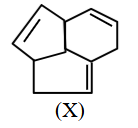
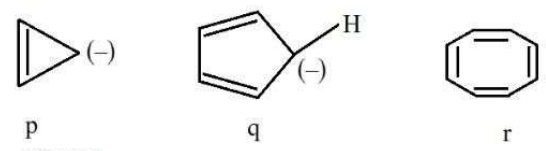
Next, Option B: 2-chloro-2-methylbutane. The structure is $$CH_{3}-C(Cl)(CH_{3})-CH_{2}-CH_{3}$$, which can be written as:
|
$$CH_{3}-C-CH_{2}-CH_{3}$$
|
$$Cl$$
Moving to Option C: 2-chlorobutane. The structure is $$CH_{3}-CHCl-CH_{2}-CH_{3}$$. The carbon at position 2 is bonded to H, Cl, $$CH_{3}$$, and $$CH_{2}CH_{3}$$. These groups are all different: methyl ($$CH_{3}$$) and ethyl ($$CH_{2}CH_{3}$$) have different sizes and compositions. Thus, carbon-2 is a chiral center, and the molecule lacks a plane of symmetry, making it chiral and optically active.
Finally, Option D: 2-chloropentane. The structure is $$CH_{3}-CHCl-CH_{2}-CH_{2}-CH_{3}$$. The carbon at position 2 is bonded to H, Cl, $$CH_{3}$$, and propyl group ($$CH_{2}CH_{2}CH_{3}$$). All four groups are distinct (H, Cl, $$CH_{3}$$, $$CH_{2}CH_{2}CH_{3}$$), so carbon-2 is a chiral center. The molecule has no plane of symmetry, rendering it chiral and optically active.
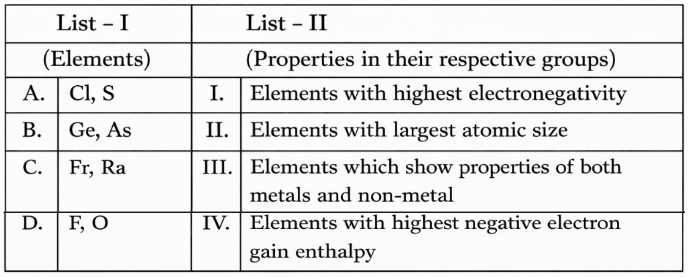
Therefore, the only optically inactive compound is Option B, 2-chloro-2-methylbutane, due to its plane of symmetry and absence of a chiral center.
Hence, the correct answer is Option B.
If $$\lambda_0$$ and $$\lambda$$ be threshold wavelength and wavelength of incident light, the velocity of photoelectron ejected from the metal surface is:
We start with the photoelectric effect equation. The maximum kinetic energy of the ejected photoelectron is given by the difference between the energy of the incident photon and the work function of the metal. The work function is the minimum energy required to eject an electron, which corresponds to the threshold wavelength λ₀.
The energy of the incident photon with wavelength λ is $$ E = \frac{hc}{\lambda} $$, where h is Planck's constant and c is the speed of light. The work function φ is $$ \phi = \frac{hc}{\lambda_0} $$. Therefore, the kinetic energy (K.E.) is:
$$ K.E. = \frac{hc}{\lambda} - \frac{hc}{\lambda_0} $$
Simplifying this expression:
$$ K.E. = hc \left( \frac{1}{\lambda} - \frac{1}{\lambda_0} \right) $$
Note that $$ \frac{1}{\lambda} - \frac{1}{\lambda_0} = \frac{\lambda_0 - \lambda}{\lambda \lambda_0} $$, so we can write:
$$ K.E. = hc \left( \frac{\lambda_0 - \lambda}{\lambda \lambda_0} \right) $$
This kinetic energy is also equal to $$ \frac{1}{2} m v^2 $$, where m is the mass of the electron and v is its velocity. Setting them equal:
$$ \frac{1}{2} m v^2 = hc \left( \frac{\lambda_0 - \lambda}{\lambda \lambda_0} \right) $$
Now, solve for v²:
$$ v^2 = \frac{2 hc}{m} \left( \frac{\lambda_0 - \lambda}{\lambda \lambda_0} \right) $$
Taking the square root of both sides to find v:
$$ v = \sqrt{ \frac{2 hc}{m} \left( \frac{\lambda_0 - \lambda}{\lambda \lambda_0} \right) } $$
Comparing this with the given options, we see that it matches option C:
$$ \sqrt{\frac{2hc}{m}\left(\frac{\lambda_0 - \lambda}{\lambda \lambda_0}\right)} $$
Option A lacks the factor c and has incorrect units. Option B has an extra (λ₀ - λ) without the denominator, leading to incorrect units. Option D has the reciprocal terms reversed and lacks c, making it incorrect both dimensionally and physically.
Hence, the correct answer is Option C.
The de-Broglie wavelength of a particle of mass 6.63 g moving with a velocity of 100 ms$$^{-1}$$ is:
The de-Broglie wavelength $$\lambda$$ of a particle is given by the formula $$\lambda = \frac{h}{p}$$, where $$h$$ is Planck's constant and $$p$$ is the momentum of the particle. Momentum $$p$$ is calculated as $$p = m \times v$$, where $$m$$ is the mass and $$v$$ is the velocity. So, the formula becomes $$\lambda = \frac{h}{m v}$$.
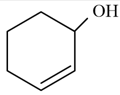
We are given the mass $$m = 6.63$$ grams and velocity $$v = 100$$ meters per second. However, the SI unit for mass is kilograms, so we must convert grams to kilograms. Since 1 kilogram = 1000 grams, we have:
$$m = \frac{6.63}{1000} = 0.00663 \text{ kg}$$
This can also be written as $$m = 6.63 \times 10^{-3}$$ kg. The velocity $$v = 100$$ m/s remains as is. Planck's constant $$h$$ is $$6.63 \times 10^{-34}$$ Joule seconds (J s), and since Joule is kg m² s⁻², the units are consistent.
Now substitute the values into the formula:
$$\lambda = \frac{6.63 \times 10^{-34}}{m \times v} = \frac{6.63 \times 10^{-34}}{(6.63 \times 10^{-3}) \times 100}$$
First, compute the denominator: $$m \times v = (6.63 \times 10^{-3}) \times 100$$. Since $$100 = 10^2$$, we have:
$$m \times v = 6.63 \times 10^{-3} \times 10^2 = 6.63 \times 10^{-3 + 2} = 6.63 \times 10^{-1}$$
Now the expression is:
$$\lambda = \frac{6.63 \times 10^{-34}}{6.63 \times 10^{-1}}$$
Simplify by dividing the numerical coefficients and the powers of 10 separately. The numerical part is $$\frac{6.63}{6.63} = 1$$. The exponent part is $$\frac{10^{-34}}{10^{-1}} = 10^{-34 - (-1)} = 10^{-34 + 1} = 10^{-33}$$. Therefore:
$$\lambda = 1 \times 10^{-33} \text{ m}$$
So, the de-Broglie wavelength is $$10^{-33}$$ meters. Comparing with the options, this matches option A.
Hence, the correct answer is Option A.
Sulphur dioxide and oxygen were allowed to diffuse through a porous partition. 20 dm$$^3$$ of SO$$_2$$ diffuses through the porous partition in 60 seconds. The volume of O$$_2$$ in dm$$^3$$ which diffuses under the similar condition in 30 seconds will be (atomic mass of sulphur = 32 u):
According to Graham's law of diffusion, the rate of diffusion of a gas is inversely proportional to the square root of its molar mass. The rate can be expressed as the volume diffused per unit time. For two gases, SO₂ and O₂, under similar conditions, the relationship is given by:
$$\frac{\text{Rate}_{\text{SO}_2}}{\text{Rate}_{\text{O}_2}} = \sqrt{\frac{M_{\text{O}_2}}{M_{\text{SO}_2}}}$$
where Rate = Volume / Time, and M is the molar mass.
Given:
- Volume of SO₂ diffused, $$ V_{\text{SO}_2} = 20 \text{dm}^3 $$
- Time for SO₂ diffusion, $$ t_{\text{SO}_2} = 60 \text{seconds} $$
- Time for O₂ diffusion, $$ t_{\text{O}_2} = 30 \text{seconds} $$
- Volume of O₂ diffused, $$ V_{\text{O}_2} = ? \text{dm}^3 $$ (to be found)
First, calculate the molar masses:
- Atomic mass of S = 32 u, O = 16 u
- Molar mass of SO₂, $$ M_{\text{SO}_2} = 32 + 2 \times 16 = 32 + 32 = 64 \text{u} $$
- Molar mass of O₂, $$ M_{\text{O}_2} = 2 \times 16 = 32 \text{u} $$
Using Graham's law:
$$\frac{\text{Rate}_{\text{SO}_2}}{\text{Rate}_{\text{O}_2}} = \sqrt{\frac{M_{\text{O}_2}}{M_{\text{SO}_2}}}$$
Substitute the rate expressions:
$$\frac{\frac{V_{\text{SO}_2}}{t_{\text{SO}_2}}}{\frac{V_{\text{O}_2}}{t_{\text{O}_2}}} = \sqrt{\frac{M_{\text{O}_2}}{M_{\text{SO}_2}}}$$
Plug in the known values:
$$\frac{\frac{20}{60}}{\frac{V_{\text{O}_2}}{30}} = \sqrt{\frac{32}{64}}$$
Simplify the left side:
$$\frac{20}{60} = \frac{1}{3}$$
So:
$$\frac{\frac{1}{3}}{\frac{V_{\text{O}_2}}{30}} = \frac{1}{3} \times \frac{30}{V_{\text{O}_2}} = \frac{30}{3V_{\text{O}_2}} = \frac{10}{V_{\text{O}_2}}$$
Simplify the right side:
$$\sqrt{\frac{32}{64}} = \sqrt{\frac{1}{2}} = \frac{1}{\sqrt{2}}$$
Now the equation is:
$$\frac{10}{V_{\text{O}_2}} = \frac{1}{\sqrt{2}}$$
Solve for $$ V_{\text{O}_2} $$:
Cross-multiply:
$$10 \times \sqrt{2} = V_{\text{O}_2}$$
So:
$$V_{\text{O}_2} = 10\sqrt{2}$$
Calculate the numerical value. $$ \sqrt{2} \approx 1.414 $$:
$$V_{\text{O}_2} = 10 \times 1.414 = 14.14 \approx 14.1 \text{dm}^3$$
Hence, the volume of O₂ that diffuses in 30 seconds is 14.1 dm³.
So, the answer is Option C.
If Z is the compressibility factor, then Van der Waal's equation at low pressure can be written as:
We start from the Van der Waals equation for one mole of a real gas
$$\left(P + \frac{a}{V^{2}}\right)\,(V - b)=RT$$
where $$P$$ is the pressure, $$V$$ is the molar volume, $$T$$ is the absolute temperature, $$R$$ is the gas constant, and the constants $$a$$ and $$b$$ account for intermolecular attraction and finite molecular size respectively.
At very low pressure the molar volume $$V$$ becomes very large. Because of this largeness, the correction term $$b$$ (which is a small volume) is negligible in comparison with $$V$$. So we drop $$b$$ but we keep the attractive term containing $$a$$, as its effect can still be significant even when the gas is dilute. Therefore the equation simplifies to
$$\left(P + \frac{a}{V^{2}}\right)V = RT$$
Now we expand the left-hand side:
$$P\,V + \frac{a}{V} = RT$$
We wish to obtain the compressibility factor $$Z$$, which is defined for one mole as
$$Z = \frac{P\,V}{R\,T}$$
Re-arranging the simplified Van der Waals expression to isolate $$P\,V$$ gives
$$P\,V = RT - \frac{a}{V}$$
Dividing every term of this equality by $$R\,T$$ we obtain
$$\frac{P\,V}{R\,T} = 1 - \frac{a}{V\,R\,T}$$
The left-hand side is precisely the definition of $$Z$$, so we can write
$$Z = 1 - \frac{a}{V\,R\,T}$$
This expression matches option B in the list provided.
Hence, the correct answer is Option B.
The temperature at which oxygen molecules have the same root mean square speed as helium atoms have at 300 K is: (Atomic masses: He = 4 u, O = 16 u)
The root mean square speed (vrms) of a gas is given by the formula:
$$ v_{\text{rms}} = \sqrt{\frac{3RT}{M}} $$
where R is the universal gas constant, T is the temperature in Kelvin, and M is the molar mass of the gas in kg/mol. However, since we are comparing two gases and R is common, we can work with molar masses in the same unit (like g/mol) because the conversion factor cancels out in ratios.
For helium atoms (He) at 300 K, the molar mass MHe = 4 g/mol (since helium is monatomic). For oxygen molecules (O2), the molar mass MO₂ = 32 g/mol (since oxygen is diatomic, 16 u × 2 = 32 u).
We need the temperature T for oxygen such that its vrms equals the vrms of helium at 300 K. So we set the two expressions equal:
$$ \sqrt{\frac{3R \cdot 300}{M_{\text{He}}}} = \sqrt{\frac{3R \cdot T}{M_{\text{O₂}}}} $$
Since the square roots are equal, we can square both sides to eliminate them:
$$ \frac{3R \cdot 300}{M_{\text{He}}} = \frac{3R \cdot T}{M_{\text{O₂}}} $$
The factor 3R appears on both sides and is non-zero, so we can cancel it:
$$ \frac{300}{M_{\text{He}}} = \frac{T}{M_{\text{O₂}}} $$
Now, solve for T by cross-multiplying:
$$ T = 300 \times \frac{M_{\text{O₂}}}{M_{\text{He}}} $$
Substitute the molar masses:
$$ T = 300 \times \frac{32}{4} $$
Simplify the fraction:
$$ \frac{32}{4} = 8 $$
So,
$$ T = 300 \times 8 = 2400 $$
Therefore, the temperature for oxygen molecules is 2400 K.
Comparing with the options:
A. 600 K
B. 2400 K
C. 1200 K
D. 300 K
The value 2400 K corresponds to option B.
Hence, the correct answer is Option B.
The initial volume of a gas cylinder is 750.0 mL. If the pressure of gas inside the cylinder changes from 840.0 mmHg to 360.0 mmHg, the final volume the gas will be:
According to Boyle's Law, for a fixed amount of gas at constant temperature, the product of pressure and volume remains constant. This means that the initial pressure multiplied by the initial volume equals the final pressure multiplied by the final volume. So, we can write the equation as $$ P_1 V_1 = P_2 V_2 $$.
In this problem, the initial volume $$ V_1 $$ is given as 750.0 mL, the initial pressure $$ P_1 $$ is 840.0 mmHg, and the final pressure $$ P_2 $$ is 360.0 mmHg. We need to find the final volume $$ V_2 $$. Rearranging Boyle's Law to solve for $$ V_2 $$, we get $$ V_2 = \frac{P_1 V_1}{P_2} $$.
Now, substitute the given values into the equation: $$ V_2 = \frac{840.0 \text{mmHg} \times 750.0 \text{mL}}{360.0 \text{mmHg}} $$. Notice that the units of mmHg will cancel out, leaving the volume in mL.
First, calculate the numerator: $$ 840.0 \times 750.0 $$. Multiply 840 by 750. Break it down: 840 multiplied by 700 is 588,000, and 840 multiplied by 50 is 42,000. Adding these together gives 588,000 + 42,000 = 630,000. Since both 840.0 and 750.0 have one decimal place, the product is 630,000.00, but we can work with 630,000 for simplicity.
Now, divide this result by the final pressure: $$ V_2 = \frac{630,000}{360.0} $$. To make the division easier, we can eliminate the decimal in the denominator by multiplying both numerator and denominator by 10: $$ V_2 = \frac{630,000 \times 10}{360.0 \times 10} = \frac{6,300,000}{3600} $$.
Simplify this fraction by dividing both numerator and denominator by 100: $$ \frac{6,300,000}{3600} = \frac{63,000}{36} $$. Now, divide 63,000 by 36. Calculate step by step: 36 multiplied by 1,000 is 36,000. Subtract 36,000 from 63,000 to get 27,000. Now, 36 multiplied by 750 is 27,000 (since 36 × 700 = 25,200 and 36 × 50 = 1,800, and 25,200 + 1,800 = 27,000). Adding the parts: 1,000 + 750 = 1,750. So, $$ \frac{63,000}{36} = 1,750 $$.
Therefore, the final volume is 1,750 mL. However, the options are given in liters (L). Convert mL to L by dividing by 1,000 since 1 L = 1,000 mL. So, $$ V_2 = \frac{1,750 \text{mL}}{1,000} = 1.750 \text{L} $$.
Hence, the correct answer is Option A.
Van der Waal's equation for a gas is stated as, $$P = \frac{nRT}{V - nb} - a\left(\frac{n}{V}\right)^2$$. This equation reduces to the perfect gas equation, $$P = \frac{nRT}{V}$$ When,
The Van der Waals equation is given as:
$$P = \frac{nRT}{V - nb} - a\left(\frac{n}{V}\right)^2$$
We need this equation to reduce to the perfect gas equation:
$$P = \frac{nRT}{V}$$
For this reduction to occur, the corrections introduced by the Van der Waals constants $$a$$ and $$b$$ must become negligible. Let's examine each term.
First, consider the volume correction term $$\frac{nRT}{V - nb}$$. In the perfect gas equation, the volume $$V$$ is assumed to be much larger than the volume occupied by the gas molecules themselves. The term $$nb$$ represents the excluded volume due to the molecules. So, when $$V$$ is very large compared to $$nb$$, we can approximate:
$$V - nb \approx V$$
Substituting this approximation:
$$\frac{nRT}{V - nb} \approx \frac{nRT}{V}$$
This approximation holds when the pressure is low because low pressure corresponds to a large volume (from Boyle's law, $$P \propto \frac{1}{V}$$ at constant temperature).
Second, consider the intermolecular forces term $$-a\left(\frac{n}{V}\right)^2$$. This term accounts for the attractive forces between molecules. For this term to become negligible, its value must be very small. This happens when $$\frac{n}{V}$$ (the concentration of gas molecules) is small, meaning the gas is dilute. A small concentration occurs when the volume $$V$$ is large (low pressure) or when the temperature is high (because high kinetic energy reduces the effect of intermolecular forces).
Specifically:
$$a\left(\frac{n}{V}\right)^2 \rightarrow 0 \quad \text{as} \quad \frac{n}{V} \rightarrow 0$$
Thus, under low pressure (large $$V$$) and high temperature, this term approaches zero.
Combining both conditions:
- Low pressure ensures $$V$$ is large, making $$V \gg nb$$ and $$\frac{n}{V}$$ small.
- High temperature ensures that even if $$\frac{n}{V}$$ is not extremely small, the increased kinetic energy overcomes intermolecular forces, making the $$a$$ term negligible.
Therefore, substituting both approximations into the Van der Waals equation:
$$P \approx \frac{nRT}{V} - 0 = \frac{nRT}{V}$$
This matches the perfect gas equation.
Now, evaluating the options:
A. Temperature is sufficiently high and pressure is low: Matches our conditions.
B. Both temperature and pressure are very low: Low pressure helps, but low temperature increases intermolecular forces, so the $$a$$ term does not vanish.
C. Both temperature and pressure are very high: High temperature helps, but high pressure reduces volume ($$V$$ small), so $$V - nb$$ is not approximately $$V$$ and $$\frac{n}{V}$$ is large, making the $$a$$ term significant.
D. Temperature is sufficiently low and pressure is high: Low temperature increases intermolecular forces, and high pressure reduces volume, worsening both corrections.
Hence, the correct answer is Option A.
In which of the following pairs is A more stable than B?
Option A: B is more stable than A because B is a tertiary ($$3^\circ$$) radical stabilized by more hyperconjugation, whereas A is only a secondary ($$2^\circ$$) radical.
Option B: B is more stable than A because the cyclopropyl radical (A) suffers from high angle strain and has greater s-character in its radical orbital, making it highly unstable compared to the standard cyclohexyl radical (B).
Option C: B is more stable than A because B is an allylic radical stabilized by resonance, whereas A is a vinylic radical where the unpaired electron sits directly on a $$sp^2$$ carbon, making it exceptionally unstable.
Option D: A is more stable than B because the triphenylmethyl radical ($$\text{Ph}_3\text{C}^\bullet$$) is extensively stabilized by resonance across three aromatic rings, which vastly outperforms the simple hyperconjugation stabilizing the tert-butyl radical ($$(\text{CH}_3)_3\text{C}^\bullet$$).
The correct IUPAC name of the following compound is:
The longest continuous carbon chain contains 6 carbon atoms, identifying the parent alkane as hexane.
The molecule has two alkyl branches: an ethyl group and a methyl group.
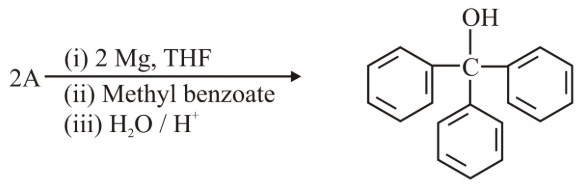
Numbering from either end results in the same locant set (3, 4). According to IUPAC rules, when locants are identical from both sides, the lower number is assigned to the substituent that comes first alphabetically.
Ethyl (E) precedes Methyl (M). Thus, Ethyl is assigned position 3 and Methyl is assigned position 4.
IUPAC Name: 3-ethyl-4-methylhexane
Which one of the following acids does not exhibit optical isomerism?
To determine which acid does not exhibit optical isomerism, we must recall that optical isomerism arises when a molecule has a chiral center, typically a carbon atom with four different substituents, and the molecule lacks a plane of symmetry. A chiral molecule is non-superimposable on its mirror image. Let's examine each option step by step.
Starting with option A: Lactic acid. Its molecular formula is $$CH_{3}CH(OH)COOH$$. The central carbon atom (the one attached to the OH group) is bonded to four different groups: a hydrogen atom (H), a hydroxyl group (OH), a methyl group ($$CH_{3}$$), and a carboxyl group ($$COOH$$). Since all four groups are distinct, this carbon is a chiral center. Therefore, lactic acid exhibits optical isomerism and exists as two enantiomers.

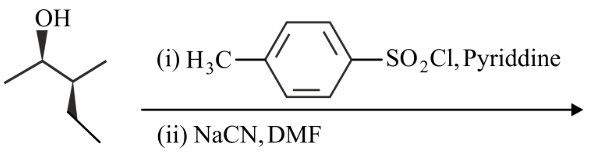
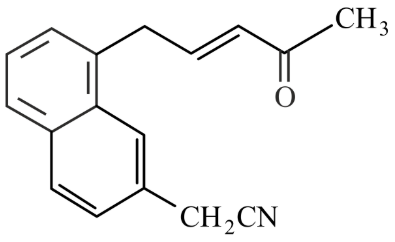
Next, option B: Tartaric acid. Its molecular formula is $$HOOCCH(OH)CH(OH)COOH$$. This molecule has two carbon atoms, each bonded to an OH group. Each of these carbons is attached to four different groups: H, OH, COOH, and the other $$CH(OH)COOH$$ group. Thus, both carbons are chiral centers. Tartaric acid exists in three stereoisomeric forms: the d-form, the l-form (which are enantiomers and optically active), and the meso-form (which has a plane of symmetry and is optically inactive due to internal compensation). However, since tartaric acid can exist in optically active forms (the d- and l-enantiomers), it does exhibit optical isomerism.
Now, option C: Maleic acid. Maleic acid is the cis-isomer of butenedioic acid, with the formula $$HOOCCH=CHCOOH$$. The structure can be represented as:
$$\begin{array}{c} \text{H} & & \text{COOH} \\ & \backslash & \\ & C = C \\ & / & \\ \text{COOH} & & \text{H} \end{array}$$
In maleic acid, the double bond between the two carbon atoms restricts rotation. Each carbon in the double bond is sp² hybridized and bonded to three atoms: one hydrogen (H), one carboxyl group (COOH), and the other carbon via the double bond. Since neither carbon has four substituents, there are no chiral centers. Additionally, the molecule is planar and has a plane of symmetry that bisects the double bond and aligns the two identical halves, making it achiral. Therefore, maleic acid does not exhibit optical isomerism.
Finally, option D: α-amino acids. These have the general formula $$R-CH(NH_{2})COOH$$, where the α-carbon is bonded to four groups: a hydrogen atom (H), an amino group ($$NH_{2}$$), a carboxyl group ($$COOH$$), and a side chain (R). For most α-amino acids, R is different from H, $$NH_{2}$$, and $$COOH$$, making the α-carbon a chiral center. For example, alanine (R = $$CH_{3}$$) has a chiral center and exhibits optical isomerism. However, glycine is an exception where R = H, so the α-carbon has two identical H atoms and is not chiral. Despite glycine not exhibiting optical isomerism, the class of α-amino acids as a whole includes compounds that do exhibit optical isomerism (like alanine). Therefore, this option does not universally lack optical isomerism.
Comparing all options, lactic acid (A) and tartaric acid (B) exhibit optical isomerism due to chiral centers. α-amino acids (D) include some that exhibit optical isomerism. Maleic acid (C) has no chiral center and is achiral, so it does not exhibit optical isomerism.
Hence, the correct answer is Option C.
An organic compound A, C$$_5$$H$$_8$$O; reacts with H$$_2$$O, NH$$_3$$ and CH$$_3$$COOH as described below:
Hydration: $$CH_3CH_2C(CH_3)=C=O + H_2O \rightarrow CH_3CH_2CH(CH_3)COOH$$
Ammonolysis: $$CH_3CH_2C(CH_3)=C=O + NH_3 \rightarrow CH_3CH_2CH(CH_3)CONH_2$$
Reaction with Acetic Acid: $$CH_3CH_2C(CH_3)=C=O + CH_3COOH \rightarrow CH_3CH_2CH(CH_3)CO-O-COCH_3$$
Correct Option: C
The molarity of a solution obtained by mixing 750 mL of 0.5(M) HCl with 250 mL of 2(M) HCl will be
We are required to find the molarity of the final mixture formed by combining two hydrochloric acid solutions of different concentrations. The fundamental idea is that when two solutions are mixed, the total number of moles of solute present in the mixture equals the sum of the moles originally present in each solution. After mixing, the new molarity is obtained by dividing this total number of moles by the total volume of the mixture.
First, recall the definition of molarity (M):
$$\text{Molarity (M)} \;=\; \frac{\text{Number of moles of solute}}{\text{Volume of solution in litres}}.$$
Hence, the number of moles in any given solution is given by the product of its molarity and its volume in litres. We shall apply this one‐step formula separately to both HCl solutions, then add the results.
For the first solution, we have 750 mL of 0.5 M HCl.
Convert the volume from millilitres to litres:
$$750 \text{ mL} \;=\; \frac{750}{1000} \text{ L} \;=\; 0.750 \text{ L}.$$
Now calculate the moles of HCl present in this portion by using $$n = M \times V$$:
$$n_1 \;=\; 0.5 \text{ M} \times 0.750 \text{ L}.$$
Perform the multiplication step by step:
$$0.5 \times 0.750 \;=\; 0.375.$$
So,
$$n_1 = 0.375 \text{ mol}.$$
For the second solution, we have 250 mL of 2 M HCl.
Once again, convert the given volume to litres:
$$250 \text{ mL} \;=\; \frac{250}{1000} \text{ L} \;=\; 0.250 \text{ L}.$$
Using $$n = M \times V$$, determine the moles in this second portion:
$$n_2 \;=\; 2 \text{ M} \times 0.250 \text{ L}.$$
Compute the multiplication:
$$2 \times 0.250 \;=\; 0.500.$$
Thus,
$$n_2 = 0.500 \text{ mol}.$$
Now add the moles from the two individual solutions to obtain the total number of moles in the mixture:
$$n_{\text{total}} \;=\; n_1 + n_2 \;=\; 0.375 \text{ mol} + 0.500 \text{ mol}.$$
Carrying out the addition:
$$n_{\text{total}} = 0.875 \text{ mol}.$$
Next, find the total volume after mixing by adding the separate volumes (expressed in litres):
$$V_{\text{total}} \;=\; 0.750 \text{ L} + 0.250 \text{ L} = 1.000 \text{ L}.$$
Finally, determine the new molarity $$M_{\text{mix}}$$ of the combined solution using the definition of molarity:
$$M_{\text{mix}} \;=\; \frac{n_{\text{total}}}{V_{\text{total}}}.$$
Substituting the numerical values we just calculated:
$$M_{\text{mix}} \;=\; \frac{0.875 \text{ mol}}{1.000 \text{ L}}.$$
Dividing by 1, we get directly:
$$M_{\text{mix}} = 0.875 \text{ M}.$$
This value matches option C in the provided list.
Hence, the correct answer is Option C.
By how many folds the temperature of a gas would increase when the root mean square velocity of the gas molecules in a container of fixed volume is increased from $$5 \times 10^4$$ cm/s to $$10 \times 10^4$$ cm/s?
The root mean square velocity (RMS velocity) of gas molecules is given by the formula:
$$ v_{rms} = \sqrt{\frac{3RT}{M}} $$
where $$ R $$ is the universal gas constant, $$ T $$ is the absolute temperature, and $$ M $$ is the molar mass of the gas. Since the gas is the same, $$ M $$ is constant, and $$ R $$ is always constant. Therefore, the RMS velocity is proportional to the square root of the temperature:
$$ v_{rms} \propto \sqrt{T} $$
This means that the ratio of the RMS velocities is equal to the square root of the ratio of the temperatures. Let the initial RMS velocity be $$ v_1 = 5 \times 10^4 $$ cm/s and the final RMS velocity be $$ v_2 = 10 \times 10^4 $$ cm/s. Let the initial temperature be $$ T_1 $$ and the final temperature be $$ T_2 $$. Then:
$$ \frac{v_2}{v_1} = \sqrt{\frac{T_2}{T_1}} $$
We need to find by how many folds the temperature increases, which is the ratio $$ \frac{T_2}{T_1} $$. To find this, we square both sides of the equation:
$$ \left( \frac{v_2}{v_1} \right)^2 = \frac{T_2}{T_1} $$
Now substitute the given values:
$$ v_2 = 10 \times 10^4 \text{ cm/s}, \quad v_1 = 5 \times 10^4 \text{ cm/s} $$
So:
$$ \frac{v_2}{v_1} = \frac{10 \times 10^4}{5 \times 10^4} = \frac{10}{5} = 2 $$
Then:
$$ \left( \frac{v_2}{v_1} \right)^2 = (2)^2 = 4 $$
Therefore:
$$ \frac{T_2}{T_1} = 4 $$
This means the temperature increases by a factor of 4, or four folds.
Hence, the correct answer is Option D.
Which one of the following is the wrong assumption of kinetic theory of gases?
Let us recall the basic assumptions of the kinetic theory of gases:
1. A gas consists of a large number of tiny particles (atoms or molecules) that are in constant, random motion.
2. The volume occupied by the gas molecules themselves is negligible compared to the total volume of the gas. This means the molecules are point masses and are separated by large distances relative to their sizes.
3. The collisions between gas molecules and between molecules and the container walls are perfectly elastic. This implies that both momentum and kinetic energy are conserved during collisions.
4. There are no intermolecular forces (attractive or repulsive) between the molecules except during collisions.
5. The average kinetic energy of the gas molecules is directly proportional to the absolute temperature of the gas.
Now, let us examine each option:
Option A: "Momentum and energy always remain conserved."
This is a correct assumption. According to the kinetic theory, collisions are elastic, so both momentum and kinetic energy are conserved. Therefore, this is not a wrong assumption.
Option B: "Pressure is the result of elastic collision of molecules with the container's wall."
This is also correct. The pressure exerted by the gas is due to the continuous bombardment of molecules on the walls of the container. Since the collisions are elastic, the molecules rebound and exert a force, leading to pressure. Hence, this is not a wrong assumption.
Option C: "Molecules are separated by great distances compared to their sizes."
This is a standard assumption. The kinetic theory considers molecules as point masses with negligible volume compared to the container's volume, so the separation between molecules is much larger than their sizes. This is correct.
Option D: "All the molecules move in straight line between collision and with same velocity."
The first part, "all the molecules move in straight line between collision," is correct because, in the absence of forces (as per the assumptions), molecules travel in straight lines until they collide. However, the second part, "with same velocity," is incorrect. The kinetic theory does not assume that all molecules have the same velocity. Instead, molecules have a distribution of velocities (as described by the Maxwell-Boltzmann distribution) due to random motion and collisions. Velocities vary among molecules and change over time. Therefore, this option contains a wrong assumption.
Hence, the correct answer is Option D.
For gaseous state, if most probable speed is denoted by $$C^*$$, average speed by $$\bar{C}$$ and root mean square speed by C, then for many molecules, what is the ratios of these speeds?
In the kinetic molecular theory of gases, three characteristic molecular speeds are widely used:
$$\begin{aligned} &\text{Most probable speed (denoted }C^*\text{)} \\ &\text{Average or mean speed (denoted }\bar{C}\text{)} \\ &\text{Root-mean-square speed (denoted }C\text{)} \end{aligned}$$
For a large collection of molecules that obey the Maxwell-Boltzmann distribution, the well-established formulae for these speeds are:
$$ \boxed{C^* = \sqrt{\dfrac{2RT}{M}}}, \qquad \boxed{\bar{C} = \sqrt{\dfrac{8RT}{\pi M}}}, \qquad \boxed{C = \sqrt{\dfrac{3RT}{M}}} $$
Here
$$R =$$ universal gas constant $$, \qquad T =$$ absolute temperature, $$\qquad M =$$ molar mass of the gas.
To compare the three speeds, we form their ratios. We shall express each speed relative to the most probable speed $$C^*$$, taking $$C^*$$ as the unit reference.
Step 1: Ratio of the average speed to the most probable speed.
We have
$$ \dfrac{\bar{C}}{C^*} = \dfrac{\sqrt{\dfrac{8RT}{\pi M}}}{\sqrt{\dfrac{2RT}{M}}}. $$
Inside the big square root we put every factor together:
$$ \dfrac{\bar{C}}{C^*} = \sqrt{\dfrac{8RT}{\pi M}\;\cdot\;\dfrac{M}{2RT}} = \sqrt{\dfrac{8}{\pi}\;\cdot\;\dfrac{1}{2}} = \sqrt{\dfrac{8}{2\pi}} = \sqrt{\dfrac{4}{\pi}}. $$
Now we convert the fraction under the root into a numerical value:
$$ \dfrac{4}{\pi} \approx \dfrac{4}{3.1416} \approx 1.2732. $$
Taking the square root of this value, we get
$$ \dfrac{\bar{C}}{C^*} \approx \sqrt{1.2732} \approx 1.128. $$
Step 2: Ratio of the root-mean-square speed to the most probable speed.
We start similarly:
$$ \dfrac{C}{C^*} = \dfrac{\sqrt{\dfrac{3RT}{M}}}{\sqrt{\dfrac{2RT}{M}}} = \sqrt{\dfrac{3RT}{M}\;\cdot\;\dfrac{M}{2RT}} = \sqrt{\dfrac{3}{2}}. $$
The fraction under the square root is
$$ \dfrac{3}{2} = 1.5. $$
Therefore
$$ \dfrac{C}{C^*} \approx \sqrt{1.5} \approx 1.225. $$
Step 3: Writing the complete ratio.
We have determined
$$ C^* : \bar{C} : C = 1 : 1.128 : 1.225. $$
Step 4: Matching with the given options.
The option that exactly reproduces the ratio $$1 : 1.128 : 1.225$$ in the order $$C^* : \bar{C} : C$$ is Option A.
Hence, the correct answer is Option A.
A solution of (-)1-chloro-1-phenylethane in toluene racemises slowly in the presence of a small amount of $$SbCl_5$$, due to the formation of :
We are given that $$(-)-1$$-chloro-1-phenylethane dissolves in toluene and racemises slowly when a small amount of $$SbCl_5$$ is added.
First, let us understand the structure. 1-Chloro-1-phenylethane is:
$$C_6H_5 - CHCl - CH_3$$
The carbon bearing the chlorine atom (C-1) has four different groups: $$-C_6H_5$$, $$-CH_3$$, $$-Cl$$, and $$-H$$. This makes it a chiral centre, and the compound is optically active (it is given as the ($$-$$) enantiomer).
Now, $$SbCl_5$$ is a strong Lewis acid. It can accept the lone pair from the chlorine atom of the organic substrate:
$$C_6H_5CHClCH_3 + SbCl_5 \rightarrow C_6H_5CH^+CH_3 + SbCl_6^-$$
Here, $$SbCl_5$$ abstracts the $$Cl^-$$ from the chiral carbon, generating a carbocation at that carbon.
The resulting carbocation $$C_6H_5CH^+CH_3$$ is a secondary benzylic carbocation. The positive charge is stabilised by resonance with the phenyl ring. Crucially, this carbocation is $$sp^2$$ hybridised and therefore has a planar geometry (trigonal planar around the positively charged carbon).
Because the carbocation is planar, when the $$Cl^-$$ (from $$SbCl_6^-$$) attacks back, it can approach from either face of the plane with equal probability:
(i) Attack from one face regenerates the original $$(-)$$ enantiomer.
(ii) Attack from the opposite face generates the $$(+)$$ enantiomer.
Over time, a 50:50 mixture of both enantiomers (a racemic mixture) is formed, and the optical rotation drops to zero. This is the observed racemisation.
The key intermediate responsible for racemisation is the planar carbocation.
Note: A free radical (Option B) would require homolytic cleavage, but $$SbCl_5$$ is a Lewis acid that promotes heterolytic (ionic) cleavage. A carbanion (Option C) would require removal of $$H^+$$, not $$Cl^-$$. A carbene (Option D) would require loss of $$HCl$$, which is not the mechanism here.
The correct answer is Option A: Carbocation.
The order of stability of the following carbocations:
(III) Benzyl Carbocation ($$C_6H_5-\overset{+}{C}H_2$$)
The positive charge on the carbon atom is in conjugation with the $$\pi$$-electron system of the benzene ring. The charge is delocalized to the ortho and para positions of the ring. It has strong $$+M$$ (Resonance). It has 4 resonating structures in total. This extensive delocalization makes it highly stable.
(I) Allyl Carbocation ($$CH_2=CH-\overset{+}{C}H_2$$)
The positive charge is in conjugation with a single carbon-carbon double bond. It also has $$+M$$ (Resonance) and has 2 resonating structures.
While it is resonance-stabilized, the degree of delocalization is lower than that in the benzyl carbocation.
(II) n-Propyl Carbocation ($$CH_3-CH_2-\overset{+}{C}H_2$$)
This is a primary ($$1^\circ$$) alkyl carbocation. There is no resonance possible here. Hyperconjugation and $$+I$$ effects are present here from the ethyl group. It has 2 $$\alpha$$-hydrogens. Since resonance is a much stronger stabilizing factor than hyperconjugation, this is the least stable carbocation among the three.
Stability: Benzyl (III) > Allyl (I) > n-Propyl (II)
The gas leaked from a storage tank of the Union Carbide plant in Bhopal gas tragedy was :
We begin by carefully reading the statement: “The gas leaked from a storage tank of the Union Carbide plant in the Bhopal gas tragedy was …”. Our task is to recall the name of the exact chemical involved in this historical industrial disaster.
The four possibilities are:
A. Ammonia B. Phosgene C. Methyl isocyanate D. Methylamine
Now, let us recall the factual information associated with the Bhopal incident of December 2-3, 1984. The Union Carbide India Limited chemical plant stored a large quantity of a highly toxic intermediate used in the manufacture of carbamate pesticides. That intermediate was $$\text{CH}_3\text{NCO}$$, whose common name is “methyl isocyanate”. During the accident, water entered the storage tank containing this compound, causing an exothermic reaction, rapid pressure build-up, and the consequent release of a deadly cloud of $$\text{CH}_3\text{NCO}$$ gas into the atmosphere.
We verify each option one by one:
• Option A, ammonia ($$\text{NH}_3$$), is used widely in fertilizer production but was not the main toxicant in the Bhopal tragedy.
• Option B, phosgene ($$\text{COCl}_2$$), is indeed a poisonous gas historically used in warfare, yet it was not stored in the Union Carbide tank.
• Option C, methyl isocyanate ($$\text{CH}_3\text{NCO}$$), matches precisely the documented reports on the disaster.
• Option D, methylamine ($$\text{CH}_3\text{NH}_2$$), though related in name, was likewise not the gas that escaped that night.
Since only Option C aligns with the established historical and chemical facts, we select it.
Hence, the correct answer is Option C.
The compressibility factor for a real gas at high pressure is :
Maleic acid and fumaric acids are
Which of the following cannot be represented by resonance structures?
The IUPAC name of the compound <smiles>CC1CO1</smiles> is

The IUPAC name of the following compound is
How many chiral compounds are possible on monochlorination of $$2-$$methyl butane?
The species which can best serve as an initiator for the cationic polymerization is :
Identify the compound that exhibits tautomerism.
The correct order of increasing basicity of the given conjugate bases ($$R = CH_3$$) is
Arrange the carbanions, $$(CH_3)_3\bar{C}, \bar{C}Cl_3, (CH_3)_2\bar{C}H, C_6H_5\bar{C}H_2$$, in order of their decreasing stability :
The number of stereoisomers possible for a compound of the molecular formula $$CH_3 - CH = CH - CH(OH) - Me$$ is :
The absolute configuration of
is
The correct decreasing order of priority for the functional groups of organic compounds in the IUPAC system of nomenclature is
Which of the following molecules is expected to rotate the plane of plane polarized light?
Which one of the following conformation of cyclohexane is chiral?
The IUPAC name of
is
The IUPAC name of the compound shown below is
The increasing order of stability of the following free radicals is
Increasing order of stability among the three main conformations (i.e. Eclipse, Anti, Gauche) of 2-fluoroethanol is
Due to the presence of an unpaired electron, free radicals are:
Consider the nucleophiles:
The decreasing order of nucleophilicity among the nucleophiles is
Which types of isomerism is shown by 2,3-dichlorobutane?
For which of the following parameters the structural isomers $$C_2H_5OH$$ and $$CH_3OCH_3$$ would be expected to have the same values? (Assume ideal behaviour)
The IUPAC name of the compound
Which of the following will have meso-isomer also?
Amongst the following compounds, the optically active alkane having lowest molecular mass is
Which of the following compound is not chiral?
The smog is essentially caused by the presence of
Which one the following does not have $$sp^2$$ hybridized carbon?