
Join Our JEE Preparation Group
Prep with like-minded aspirants; Get access to free daily tests and study material.
Sign in
Please select an account to continue using cracku.in
↓ →
Join Our JEE Preparation Group
Prep with like-minded aspirants; Get access to free daily tests and study material.
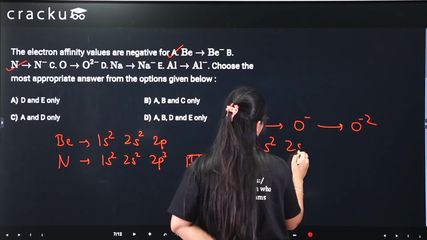
The electron affinity values are negative for A. $$\text{Be} \rightarrow \text{Be}^-$$ B. $$\text{N} \rightarrow \text{N}^-$$ C. $$\text{O} \rightarrow \text{O}^{2-}$$ D. $$\text{Na} \rightarrow \text{Na}^-$$ E. $$\text{Al} \rightarrow \text{Al}^-$$. Choose the most appropriate answer from the options given below :
We need to identify which processes have negative electron affinity (i.e., the process is endothermic when an electron is added).
Key Concept: Electron affinity (EA) is the energy change when an electron is added to a neutral gaseous atom. A negative electron affinity (in the convention where exothermic = positive EA) means the atom resists gaining an electron, i.e., energy must be supplied.
Elements with negative EA (endothermic electron gain) typically have either:
- Fully filled subshells (extra stability makes electron addition unfavourable)
- Half-filled subshells (extra stability due to exchange energy)
- Second electron additions (always endothermic due to electron-electron repulsion)
A. Be $$\rightarrow$$ Be$$^-$$:
Beryllium has configuration $$1s^2 2s^2$$ (completely filled 2s subshell). Adding an electron requires placing it in the higher-energy 2p orbital against the nuclear charge shielded by the filled 2s. This process is endothermic (negative EA). ✓
B. N $$\rightarrow$$ N$$^-$$:
Nitrogen has configuration $$1s^2 2s^2 2p^3$$ (half-filled 2p subshell). The half-filled 2p configuration is extra stable due to maximum exchange energy. Adding a fourth electron to the 2p shell would disrupt this stability and require pairing in an already occupied orbital. This process is endothermic (negative EA). ✓
C. O $$\rightarrow$$ O$$^{2-}$$:
This is a two-step process: O $$\rightarrow$$ O$$^-$$ $$\rightarrow$$ O$$^{2-}$$. While the first EA of oxygen is positive (exothermic), the second EA is always endothermic because adding an electron to an already negatively charged ion (O$$^-$$) requires overcoming strong electrostatic repulsion. The overall process of forming O$$^{2-}$$ is endothermic. ✓
D. Na $$\rightarrow$$ Na$$^-$$:
Sodium ($$1s^2 2s^2 2p^6 3s^1$$) can accept an electron to complete its 3s subshell ($$3s^2$$). This process is exothermic (positive EA), similar to how hydrogen gains an electron. ✗
E. Al $$\rightarrow$$ Al$$^-$$:
Aluminium ($$1s^2 2s^2 2p^6 3s^2 3p^1$$) can accept an electron into its 3p orbital. This process is exothermic (positive EA), as the 3p subshell is far from half-filled. ✗
Conclusion: Elements with negative electron affinity values are Be, N, and O (for the second electron addition). These correspond to A, B, and C.
The correct answer is Option 2: A, B and C only.
Was this solution helpful?
Click on the Email ☝️ to Watch the Video Solution
Create a FREE account and get:
_1.webp)

Educational materials for JEE preparation

Ask our AI anything

AI can make mistakes. Please verify important information.
AI can make mistakes. Please verify important information.
