
Join Our JEE Preparation Group
Prep with like-minded aspirants; Get access to free daily tests and study material.
Sign in
Please select an account to continue using cracku.in
↓ →
Join Our JEE Preparation Group
Prep with like-minded aspirants; Get access to free daily tests and study material.
We need to identify which of the given materials is not a semiconductor.
Analysing each material:
Option 1: Silicon (Si)
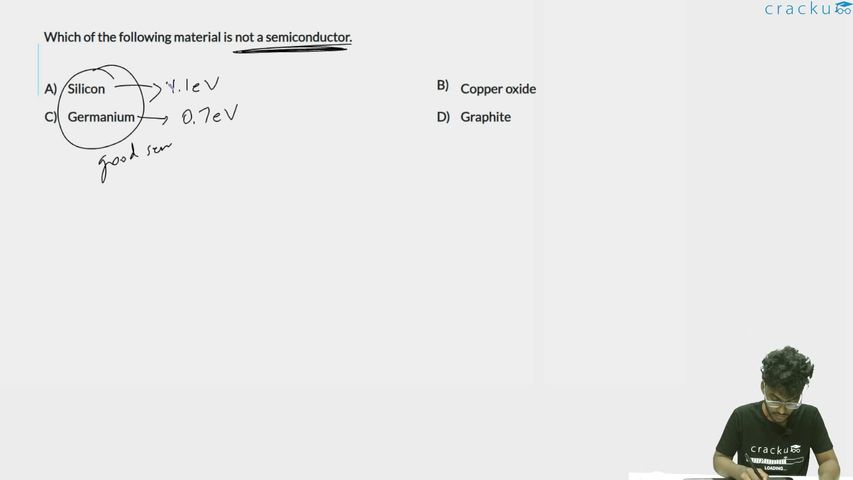
Silicon is one of the most widely used semiconductor materials. It has a band gap of approximately 1.1 eV at room temperature. It is the basis of modern electronics and integrated circuits. Silicon is a semiconductor.
Option 2: Copper oxide (Cu$$_2$$O / CuO)
Copper oxide is a p-type semiconductor. Historically, copper oxide rectifiers (based on Cu$$_2$$O) were among the first semiconductor devices used commercially. It has a band gap of about 1.2-2.0 eV depending on the form. Copper oxide is a semiconductor.
Option 3: Germanium (Ge)
Germanium is a classic semiconductor with a band gap of approximately 0.67 eV at room temperature. It was the first material used in transistors before being largely replaced by silicon. Germanium is a semiconductor.
Option 4: Graphite
Graphite is an allotrope of carbon with a layered structure. In each layer, carbon atoms are sp$$^2$$ hybridised, and the unhybridised p-orbitals form a delocalised $$\pi$$-electron system extending over the entire layer. These delocalised electrons are free to move within the layers, making graphite a good electrical conductor (resistivity $$\sim 3-60 \times 10^{-6}$$ ohm-m). Graphite is classified as a semimetal or conductor, not a semiconductor.
The correct answer is Option 4: Graphite.
Was this solution helpful?
Click on the Email ☝️ to Watch the Video Solution
Create a FREE account and get:
_1.webp)

Educational materials for JEE preparation

Ask our AI anything

AI can make mistakes. Please verify important information.
AI can make mistakes. Please verify important information.
