Join Our JEE Preparation Group
Prep with like-minded aspirants; Get access to free daily tests and study material.
Sign in
Please select an account to continue using cracku.in
↓ →
Join Our JEE Preparation Group
Prep with like-minded aspirants; Get access to free daily tests and study material.
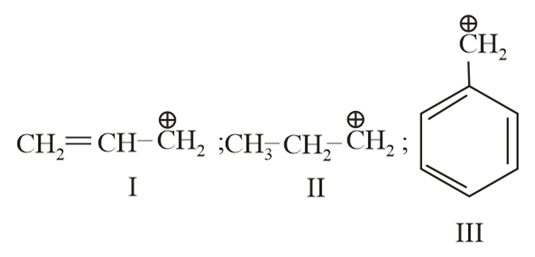
(III) Benzyl Carbocation ($$C_6H_5-\overset{+}{C}H_2$$)
The positive charge on the carbon atom is in conjugation with the $$\pi$$-electron system of the benzene ring. The charge is delocalized to the ortho and para positions of the ring. It has strong $$+M$$ (Resonance). It has 4 resonating structures in total. This extensive delocalization makes it highly stable.
(I) Allyl Carbocation ($$CH_2=CH-\overset{+}{C}H_2$$)
The positive charge is in conjugation with a single carbon-carbon double bond. It also has $$+M$$ (Resonance) and has 2 resonating structures.
While it is resonance-stabilized, the degree of delocalization is lower than that in the benzyl carbocation.
(II) n-Propyl Carbocation ($$CH_3-CH_2-\overset{+}{C}H_2$$)
This is a primary ($$1^\circ$$) alkyl carbocation. There is no resonance possible here. Hyperconjugation and $$+I$$ effects are present here from the ethyl group. It has 2 $$\alpha$$-hydrogens. Since resonance is a much stronger stabilizing factor than hyperconjugation, this is the least stable carbocation among the three.
Stability: Benzyl (III) > Allyl (I) > n-Propyl (II)
Was this solution helpful?
Create a FREE account and get:
_1.webp)

Educational materials for JEE preparation

Ask our AI anything

AI can make mistakes. Please verify important information.
AI can make mistakes. Please verify important information.