Join Our JEE Preparation Group
Prep with like-minded aspirants; Get access to free daily tests and study material.
Sign in
Please select an account to continue using cracku.in
↓ →
Join Our JEE Preparation Group
Prep with like-minded aspirants; Get access to free daily tests and study material.
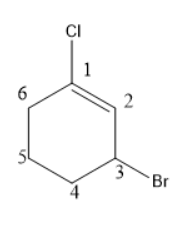
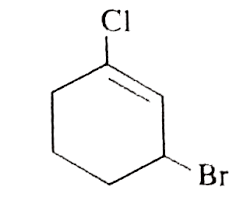
The given molecule is a six-membered ring that contains one $$C=C$$ double bond and two halo-substituents - one $$Cl$$ and one $$Br$$.
Step 1 Identify the parent chain.
Because the compound is cyclic and the longest chain that contains the double bond is the ring itself, the parent hydrocarbon is cyclohexene.
Step 2 Locate (number) the double bond.
According to IUPAC rule, the ring is numbered in the direction that gives the first carbon of the double bond the lowest possible locant, and the second carbon the next lowest. Hence we must place the double bond at positions 1 and 2, i.e. $$\text{cyclohex}{\bf ‑1-ene}$$.
Step 3 Choose the direction of numbering.
Starting from either carbon of the double bond as C-1 we have two choices for traversing the ring: clockwise or anticlockwise.
• Clockwise: $$Cl$$ sits on C-1 itself, $$Br$$ on C-3 ⇒ locant set = {1-chloro, 3-bromo}.
• Anticlockwise: $$Br$$ ends up on C-4, $$Cl$$ on C-6 ⇒ locant set = {4-bromo, 6-chloro}.
Between the two, the set {1, 3} is preferred over {4, 6} because it contains the lower number at the first point of difference (1 < 4). Therefore C-1 is the carbon bearing chlorine and numbering proceeds through the double bond in the clockwise sense.
Step 4 Arrange substituents alphabetically in the name.
Alphabetical order (ignoring the prefixes di-, tri-, etc.) puts bromo (B) before chloro (C). Hence the substituent portion reads “3-bromo-1-chloro”.
Step 5 Combine all parts.
Substituents + parent hydrocarbon give
$$\displaystyle \mathbf{3\text{-}bromo\text{-}1\text{-}chlorocyclohexene}$$
Step 6 Check against the options.
Option C exactly matches this systematic name.
Hence, the correct IUPAC name is
Option C which is: 3-bromo-1-chlorocyclohexene.
Was this solution helpful?
Create a FREE account and get:
_1.webp)

Educational materials for JEE preparation

Ask our AI anything

AI can make mistakes. Please verify important information.
AI can make mistakes. Please verify important information.