
Join Our JEE Preparation Group
Prep with like-minded aspirants; Get access to free daily tests and study material.
Sign in
Please select an account to continue using cracku.in
↓ →
Join Our JEE Preparation Group
Prep with like-minded aspirants; Get access to free daily tests and study material.
Initially, the root-mean-square (RMS) velocity of $$N_2$$ molecules at certain temperature is u. If this temperature is doubled and all the nitrogen molecules dissociate into nitrogen atoms, then the new RMS velocity will be:
We begin with the well-known expression for the root-mean-square (RMS) speed of an ideal-gas species:
$$u_{\text{rms}}=\sqrt{\dfrac{3RT}{M}}$$
Here $$R$$ is the universal gas constant, $$T$$ is the absolute temperature and $$M$$ is the molar mass of the gas whose molecules (or atoms) are moving.
For the given nitrogen gas $$N_2$$ at the initial temperature $$T$$, its RMS speed is stated to be $$u$$. Therefore, using the formula, we may write
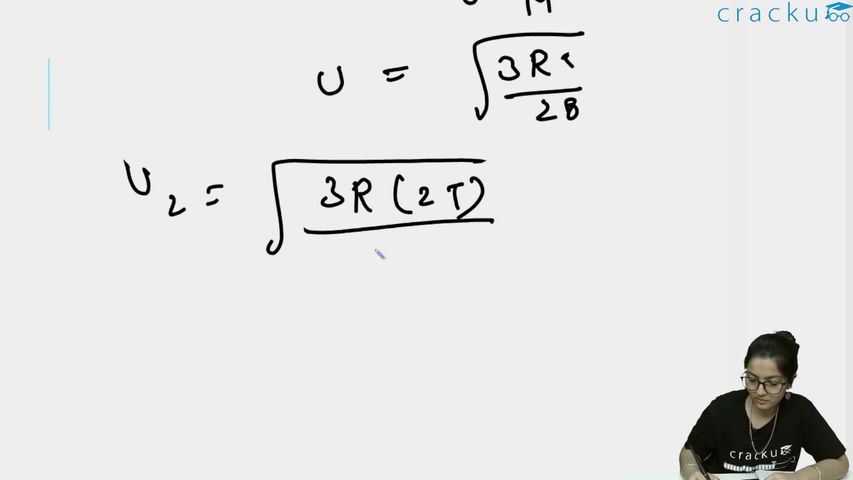
$$u=\sqrt{\dfrac{3RT}{M_1}}$$
where $$M_1$$ is the molar mass of molecular nitrogen. Molecular nitrogen contains two nitrogen atoms, each of atomic mass $$14\ \text{g mol}^{-1}$$, so
$$M_1=28\ \text{g mol}^{-1}=28\times10^{-3}\ \text{kg mol}^{-1}.$$
Now the temperature is doubled, so it becomes $$2T$$, and simultaneously every $$N_2$$ molecule dissociates completely into two separate nitrogen atoms. After dissociation we are dealing with atomic nitrogen, whose molar mass is
$$M_2=14\ \text{g mol}^{-1}=14\times10^{-3}\ \text{kg mol}^{-1}.$$
The RMS speed under the new conditions is therefore
$$u'=\sqrt{\dfrac{3R(2T)}{M_2}}.$$
To find the ratio of the new speed to the old speed we divide the two expressions:
$$\dfrac{u'}{u}=\dfrac{\sqrt{\dfrac{3R(2T)}{M_2}}}{\sqrt{\dfrac{3RT}{M_1}}}.$$
Because the common factor $$3R$$ appears under both radicals, it cancels out. Hence we simplify step by step:
$$\dfrac{u'}{u}=\sqrt{\dfrac{2T}{M_2}}\;\Bigg/\;\sqrt{\dfrac{T}{M_1}} =\sqrt{\dfrac{2T}{M_2}\times\dfrac{M_1}{T}} =\sqrt{\dfrac{2M_1}{M_2}}.$$
Now substitute the numerical molar masses:
$$\dfrac{u'}{u}=\sqrt{\dfrac{2\times28}{14}} =\sqrt{\dfrac{56}{14}} =\sqrt{4} =2.$$
Thus
$$u' = 2u.$$
Hence, the correct answer is Option A.
Was this solution helpful?
Click on the Email ☝️ to Watch the Video Solution
Create a FREE account and get:
_1.webp)

Educational materials for JEE preparation

Ask our AI anything

AI can make mistakes. Please verify important information.
AI can make mistakes. Please verify important information.
