
Join Our JEE Preparation Group
Prep with like-minded aspirants; Get access to free daily tests and study material.
Sign in
Please select an account to continue using cracku.in
↓ →
Join Our JEE Preparation Group
Prep with like-minded aspirants; Get access to free daily tests and study material.
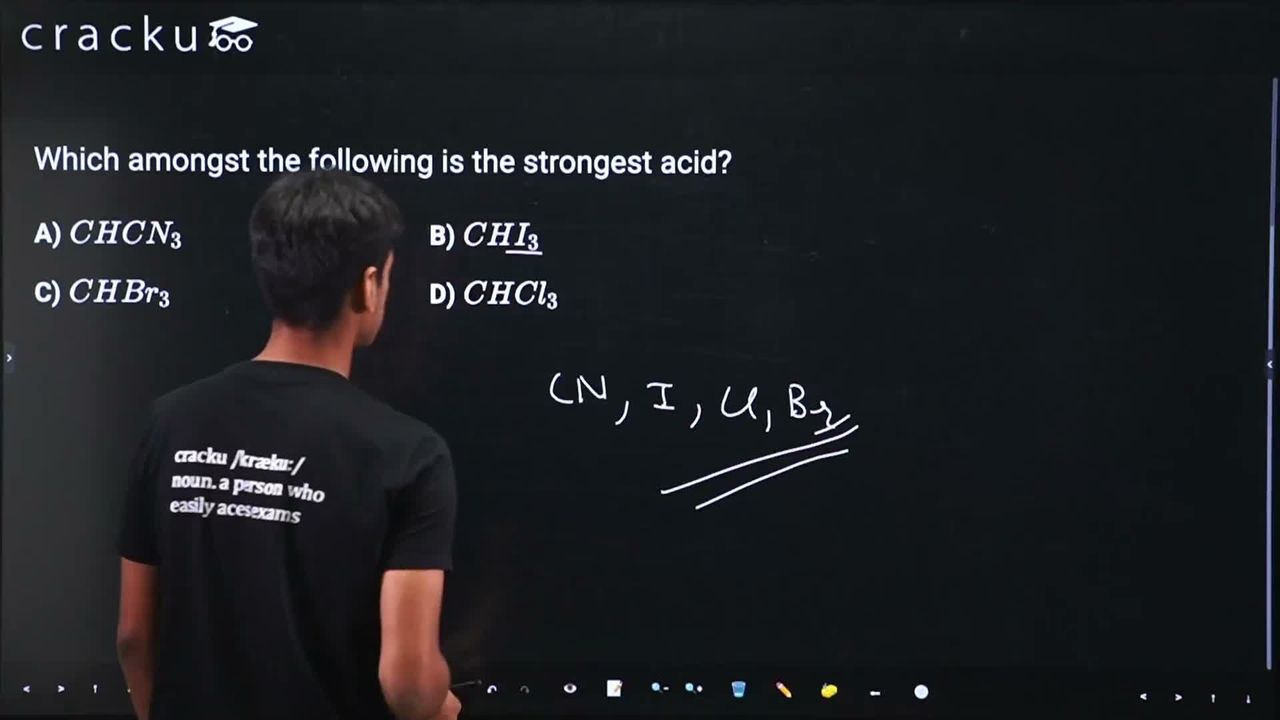
We have to compare the acid strengths of the four molecules $$CH(CN)_3$$, $$CHI_3$$, $$CHBr_3$$ and $$CHCl_3$$. In every case the acidic hydrogen is attached to the same kind of carbon framework, namely a $$-CHX_3$$ type group where the three substituents X are either $$CN$$, $$I$$, $$Br$$ or $$Cl$$. So the deciding factor is how strongly each group X withdraws electron density from the $$C-H$$ bond. A greater electron-withdrawing effect stabilises the conjugate base more, which in turn gives a stronger acid.
First, we recall the relationship between acid strength and the stability of its conjugate base. The acid-base equilibrium can be written as
$$\text{HA}\rightleftharpoons \text{H}^+ + \text{A}^-.$$
The equilibrium constant for this reaction is the acid-dissociation constant $$K_a$$, given by the formula
$$K_a=\dfrac{[\text{H}^+][\text{A}^-]}{[\text{HA}]}.$$
When the conjugate base $$\text{A}^-$$ is stabilised by any effect (inductive, resonance, hyperconjugation, etc.), the numerator becomes effectively larger, the value of $$K_a$$ increases and the acid is stronger (p$$K_a=-\log K_a$$ becomes smaller).
Now we analyse the nature of the groups:
• The $$CN$$ group exerts a very powerful −I (inductive) effect because the nitrogen is highly electronegative and is doubly bonded to carbon. Moreover, the $$CN$$ group also has a −M (electron-withdrawing resonance) effect because the $$\pi$$ electrons can delocalise toward the nitrogen. Both effects strongly pull electron density away from the central carbon, greatly stabilising the conjugate base $$C(CN)_3^-$$.
• The halogens $$I$$, $$Br$$ and $$Cl$$ also show a −I effect; however, their strengths decrease in the order $$Cl > Br > I$$ because inductive withdrawal becomes weaker as the atom becomes larger and less electronegative.
• None of the halogens can offer an additional strong −M effect toward a saturated carbon the way the $$CN$$ group does in this molecule, so their total withdrawing capacity is much less than that of $$CN$$.
So, to arrange the groups in order of total electron withdrawal we have
$$CN \;\; \gg \;\; Cl \; > \; Br \; > \; I.$$
Consequently, the conjugate base of $$CH(CN)_3$$ is the most stabilised, giving the largest $$K_a$$ and the smallest p$$K_a$$ value among the four acids. In other words, $$CH(CN)_3$$ is the strongest acid.
Therefore the order of acid strength is
$$CH(CN)_3 \; \text{(strongest)} \; > \; CHCl_3 \; > \; CHBr_3 \; > \; CHI_3 \; \text{(weakest)}.$$
Among the given options the molecule $$CH(CN)_3$$ corresponds to Option A.
Hence, the correct answer is Option A.
Was this solution helpful?
Click on the Email ☝️ to Watch the Video Solution
Create a FREE account and get:
_1.webp)

Educational materials for JEE preparation

Ask our AI anything

AI can make mistakes. Please verify important information.
AI can make mistakes. Please verify important information.
