Join WhatsApp Icon JEE WhatsApp Group
Question 41

Arrange the following amines in the decreasing order of basicity.
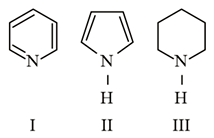
Evaluation of Each Compound

Compound III: Piperidine

  • Structure: It is a non-aromatic, completely saturated six-membered ring.
  • Nitrogen Hybridization: The nitrogen atom is sp3 hybridized.
  • Lone Pair Availability: The lone pair on the nitrogen atom resides in an sp3 orbital and is completely localized on the nitrogen atom. Because it does not participate in resonance and has lower s-character (25%), it is highly available for donation.
  • Result: Piperidine is the strongest base among the three.

Compound I: Pyridine

  • Structure: It is a six-membered aromatic ring.
  • Nitrogen Hybridization: The nitrogen atom is sp2 hybridized.
  • Lone Pair Availability: The lone pair occupies an sp2 hybrid orbital that lies in the plane of the ring. It is perpendicular to the pi-system, meaning it does not participate in the aromatic sextet and remains localized. However, an sp2 orbital has higher s-character (33.3%) than an sp3 orbital, making it more electronegative and holding the lone pair more tightly.
  • Result: Pyridine is less basic than piperidine but significantly more basic than pyrrole.

Compound II: Pyrrole

  • Structure: It is a five-membered aromatic ring.
  • Nitrogen Hybridization: The nitrogen atom is sp2 hybridized.
  • Lone Pair Availability: The lone pair of electrons on the nitrogen atom is an integral part of the aromatic pi-electron cloud (aromatic sextet). If pyrrole accepts a proton, its aromaticity is completely destroyed, which is highly energetically unfavorable.
  • Result: The lone pair is entirely unavailable for donation, making pyrrole an extremely weak base.

Get AI Help

Video Solution

video

Create a FREE account and get:

  • Free JEE Mains Previous Papers PDF
  • Take JEE Mains paper tests
Ask AI