Join WhatsApp Icon JEE WhatsApp Group

NTA JEE Main 2012 Offline

For the following questions answer them individually

Resistance of a given wire is obtained by measuring the current flowing in it and the voltage difference applied across it. If the percentage errors in the measurement of the current and the voltage difference are $$3\%$$ each, then error in the value of resistance of the wire is

A boy can throw a stone up to a maximum height of $$10$$ m. The maximum horizontal distance that the boy can throw the same stone up to will be

A particle of mass $$m$$ is at rest at the origin at time $$t=0$$. It is subjected to a force $$F(t) = F_0 e^{-bt}$$ in the $$x$$ direction. Its speed $$v(t)$$ is depicted by which of the following curves?

This question has statement 1 and statement 2. Of the four choices given after the statements, choose the one that best describes the two statements. If two springs $$S_1$$ and $$S_2$$ of force constants $$k_1$$ and $$k_2$$, respectively, are stretched by the same force, it is found that more work is done on spring $$S_1$$ than on spring $$S_2$$. Statement 1: If stretched by the same amount, work done on $$S_1$$, will be more than that on $$S_2$$. Statement 2: $$k_1 < k_2$$

Two cars of masses $$m_1$$ and $$m_2$$ are moving in circles of radii $$r_1$$ and $$r_2$$, respectively. Their speeds are such that they make complete circles in the same time $$t$$. The ratio of their centripetal acceleration is

The mass of a spaceship is $$1000$$ kg. It is to be launched from the earth's surface out into free space. The value of $$'g'$$ and $$'R'$$ (radius of earth) are $$10\ m/s^2$$ and $$6400$$ km respectively. The required energy for this work will be:

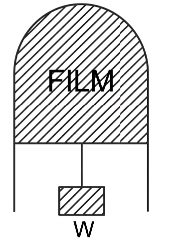
A thin liquid film formed between a U-shaped wire and a light slider supports a weight of $$1.5 \times 10^{-2}$$ N (see figure). The length of the slider is $$30$$ cm and its weight negligible. The surface tension of the liquid film is

image

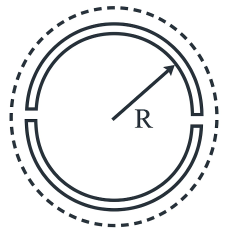
A wooden wheel of radius $$R$$ is made of two semicircular parts (see figure). The two parts are held together by a ring made of a metal strip of cross sectional area $$S$$ and length $$L$$. $$L$$ is slightly less than $$2\pi R$$. To fit the ring on the wheel, it is heated so that its temperature rises by $$\Delta T$$ and it just steps over the wheel. As it cools down to surrounding temperature, it presses the semicircular parts together. If the coefficient of linear expansion of the metal is $$\alpha$$, and its Young's modulus is $$Y$$, the force that one part of the wheel applies on the other part is :

image

A liquid in a beaker has temperature $$\theta(t)$$ at time $$t$$ and $$\theta_0$$ is temperature of surroundings, then according to Newton's law of cooling the correct graph between $$\log_e(\theta-\theta_0)$$ and $$t$$ is

Helium gas goes through a cycle $$ABCDA$$ (consisting of two isochoric and two isobaric lines) as shown in figure. Efficiency of this cycle is nearly: (Assume the gas to be close to ideal gas)

A Carnot engine, whose efficiency is $$40\%$$, takes in heat from a source maintained at a temperature of $$500\ K$$. It is desired to have an engine of efficiency $$60\%$$. Then, the intake temperature for the same exhaust (sink) temperature must be

If a simple pendulum has significant amplitude (up to a factor of $$1/e$$ of original) only in the period between $$t = 0s$$ to $$t = \tau s$$, then $$\tau$$ may be called the average life of the pendulum. When the spherical bob of the pendulum suffers a retardation (due to viscous drag) proportional to its velocity, with $$b$$ as the constant of proportionality, the average life time of the pendulum is (assuming damping is small) in seconds:

A cylindrical tube, open at both ends, has a fundamental frequency, $$f$$, in air. The tube is dipped vertically in water so that half of it is in water. The fundamental frequency of the air-column is now

In a uniformly charged sphere of total charge $$Q$$ and radius $$R$$, the electric field $$E$$ is plotted as a function of distance from the centre. The graph which would correspond to the above will be

This question has statement 1 and statement 2. Of the four choices given after the statements, choose the one that best describes the two statements. 

An insulating solid sphere of radius $$R$$ has a uniformly positive charge density $$\rho$$. As a result of this uniform charge distribution there is a finite value of electric potential at the centre of the sphere, at the surface of the sphere and also at a point out side the sphere. The electric potential at infinity is zero. 

Statement 1: When a charge $$q$$ is taken from the centre to the surface of the sphere, its potential energy changes by $$\frac{qP}{3\varepsilon_0}$$. 

Statement 2: The electric field at a distance $$r\ (r < R)$$ from the centre of the sphere is  $$\frac{\rho r}{3\varepsilon_0}$$

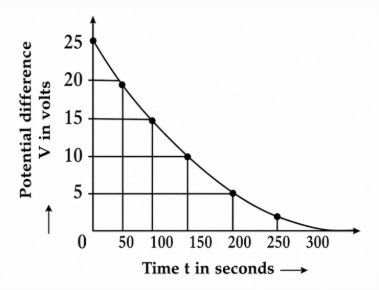
The figure shows an experimental plot for discharging of a capacitor in an $$R-C$$ circuit. The time constant $$\tau$$ of this circuit lies between:

image

Two electric bulbs marked $$25\ W - 220\ V$$ and $$100\ W - 220\ V$$ are connected in series to a $$440\ V$$ supply. Which of the bulbs will fuse?

A charge $$Q$$ is uniformly distributed over the surface of non conducting disc of radius $$R$$. The disc rotates about an axis perpendicular to its plane and passing through its centre with an angular velocity $$\omega$$. As a result of this rotation a magnetic field of induction $$B$$ is obtained at the centre of the disc. If we keep both the amount of charge placed on the disc and its angular velocity to be constant and vary the radius of the disc then the variation of the magnetic induction at the centre of the disc will be represented by the figure

Proton, Deuteron and alpha particle of the same kinetic energy are moving in circular trajectories in a constant magnetic field. The radii of proton, deuteron and alpha particle are respectively $$r_p, r_d$$ and $$r_\alpha$$. Which one of the following relations is correct?

A coil is suspended in a uniform magnetic field, with the plane of the coil parallel to the magnetic lines of force. When a current is passed through the coil it starts oscillating; it is very difficult to stop. But if an aluminium plate is placed near to the coil, it stops. This is due to :

An electromagnetic wave in vacuum has the electric and magnetic fields $$\vec{E}$$ and $$\vec{B}$$, which are always perpendicular to each other. The direction of polarization is given by $$\vec{X}$$ and that of wave propagation by $$\vec{k}$$. Then :

An object $$2.4$$ m in front of a lens forms a sharp image on a film $$12$$ cm behind the lens. A glass plate $$1$$ cm thick, of refractive index $$1.50$$ is interposed between lens and film with its plane faces parallel to film. At what distance (from lens) should object be shifted to be in sharp focus on film?

In Young's double slit experiment, one of the slit is wider than other, so that the amplitude of the light from one slit is double of that from other slit. If $$I_m$$ be the maximum intensity, the resultant intensity $$I$$ when they interfere at phase difference $$\phi$$ is given by

This question has statement 1 and statement 2. Of the four choices given after the statements, choose the one that best describes the two statements. Statement 1: Davisson-Germer experiment established the wave nature of electrons. Statement 2: If electrons have wave nature, they can interfere and show diffraction.

A diatomic molecule is made of two masses $$m_1$$ and $$m_2$$ which are separated by a distance $$r$$. If we calculate its rotational energy by applying Bohr's rule of angular momentum quantization, its energy will be given by ($$n$$ is an integer)

Assume that a neutron breaks into a proton and an electron. The energy released during this process is (Mass of neutron $$=1.6725 \times 10^{-27}$$ kg; mass of proton $$= 1.6725 \times 10^{-27}$$ kg; mass of electron $$= 9 \times 10^{-31}$$ kg)

A radar has a power of $$1\ Kw$$ and is operating at a frequency of $$10\ GHz$$. It is located on a mountain top of height $$500\ m$$. The maximum distance upto which it can detect object located on the surface of the earth (Radius of earth $$=6.4 \times 10^6$$ m) is

A spectrometer gives the following reading when used to measure the angle of a prism. Main scale reading: $$58.5$$ degree; Vernier scale reading: $$09$$ divisions. Given that $$1$$ division on main scale corresponds to $$0.5$$ degree. Total divisions on the vernier scale are $$30$$ and match with $$29$$ divisions of the main scale. The angle of the prism from the above data

The density of a solution prepared by dissolving $$120$$ g of urea (mol. mass $$=60u$$) in $$1000$$ g of water is $$1.15$$ g/mL. The molarity of this solution is :

The electrons identified by quantum numbers $$n$$ and $$l$$: (a) $$n=4, l=1$$ (b) $$n=4, l=0$$ (c) $$n=3, l=2$$ (d) $$n=3, l=1$$ Can be placed in order of increasing energy as:

The increasing order of the ionic radii of the given isoelectronic species is :

The incorrect expression among the following is :

The equilibrium constant ($$K_c$$) for the reaction $$N_2(g) + O_2(g) \rightarrow 2NO(g)$$ at temperature $$T$$ is $$4 \times 10^{-4}$$. The value of $$K_c$$ for the reaction, $$NO(g) \rightarrow \frac{1}{2}N_2(g) + \frac{1}{2}O_2(g)$$ at the same temperature is :

The pH of a $$0.1$$ molar solution of the acid $$HQ$$ is $$3$$. The value of the ionization constant, $$K_a$$ of this acid is :

Very pure hydrogen ($$99.9\%$$) can be made by which of the following processes?

Ortho-Nitrophenol is less soluble in water than $$p-$$ and $$m-$$ Nitrophenols because :

$$K_f$$ for water is $$1.86\ K\ kg\ mol^{-1}$$. If your automobile radiator holds $$1.0$$ kg of water, how many grams of ethylene glycol ($$C_2H_6O_2$$) must you add to get the freezing point of the solution lowered to $$-2.8^\circ C$$?

The standard reduction potentials for $$Zn^{2+}/Zn$$, $$Ni^{2+}/Ni$$, and $$Fe^{2+}/Fe$$ are $$-0.76$$, $$-0.23$$ and $$-0.44$$ V respectively. The reaction $$X + Y^{2+} \rightarrow X^{2+} + Y$$ will be spontaneous when:

For a first order reaction, $$(A) \rightarrow$$ products, the concentration of $$A$$ changes from $$0.1$$ M to $$0.025$$ M in $$40$$ minutes. The rate of reaction when the concentration of $$A$$ is $$0.01$$ M is :

According to Freundlich adsorption isotherm, which of the following is correct?

Which method of purification is represented by the following equation: $$Ti(s) + 2I_2(g) \xrightarrow{523\ K} TiI_4(g) \xrightarrow{1700\ K} Ti(s) + 2I_2(g)$$

Iron exhibits $$+2$$ and $$+3$$ oxidation states. Which of the following statements about iron is incorrect?

Which among the following will be named as dibromobis(ethylene diamine)chromium(III) bromide?

Which branched chain isomer of the hydrocarbon with molecular mass $$72\ u$$ gives only one isomer of mono substituted alkyl halide?

In the given transformation, which of the following is the most appropriate reagent?

Which one of the following statements is correct?

If $$z \neq 1$$ and $$\frac{z^2}{z-1}$$ is real, then the point represented by the complex number $$z$$ lies

Assuming the balls to be identical except for difference in colours, the number of ways in which one or more balls can be selected from $$10$$ white, $$9$$ green and $$7$$ black balls is

Let $$X = \{1, 2, 3, 4, 5\}$$. The number of different ordered pairs $$(Y, Z)$$ that can be formed such that $$Y \subseteq X$$, $$Z \subseteq X$$ and $$Y \cap Z$$ is empty, is

Statement 1: The sum of the series $$1 + (1+2+4) + (4+6+9) + (9+12+16) + \ldots + (361+380+400)$$ is $$8000$$. Statement 2: $$\sum_{k=1}^{n}(k^3 - (k-1)^3) = n^3$$ for any natural number $$n$$.

If $$100$$ times the $$100^{th}$$ term of an $$AP$$ with non zero common difference equals the $$50$$ times its $$50^{th}$$ term, then the $$150^{th}$$ term of this $$AP$$ is

If $$n$$ is a positive integer, then $$(\sqrt{3}+1)^{2n} - (\sqrt{3}-1)^{2n}$$ is

The equation $$e^{\sin x} - e^{-\sin x} - 4 = 0$$ has

If the line $$2x + y = k$$ passes through the point which divides the line segment joining the points $$(1, 1)$$ and $$(2, 4)$$ in the ratio $$3 : 2$$, then $$k$$ equals

A line is drawn through the point $$(1, 2)$$ to meet the coordinate axes at $$P$$ and $$Q$$ such that it forms a triangle $$OPQ$$, where $$O$$ is the origin. If the area of the triangle $$OPQ$$ is least, then the slope of the line $$PQ$$ is

The length of the diameter of the circle which touches the $$x$$-axis at the point $$(1, 0)$$ and passes through the point $$(2, 3)$$ is

Statement 1: An equation of a common tangent to the parabola $$y^2 = 16\sqrt{3}x$$ and the ellipse $$2x^2 + y^2 = 4$$ is $$y = 2x + 2\sqrt{3}$$. 

Statement 2: If the line $$y = mx + \frac{4\sqrt{3}}{m}$$, $$(m \neq 0)$$ is a common tangent to the parabola $$y^2 = 16\sqrt{3}x$$ and the ellipse $$2x^2 + y^2 = 4$$, then $$m$$ satisfies $$m^4 + 2m^2 = 24$$.

An ellipse is drawn by taking a diameter of the circle $$(x-1)^2 + y^2 = 1$$ as its semiminor axis and a diameter of the circle $$x^2 + (y-2)^2 = 4$$ as its semi-major axis. If the centre of the ellipse is the origin and its axes are the coordinate axes, then the equation of the ellipse is

The negation of the statement "If I become a teacher, then I will open a school" is

Let $$x_1, x_2, \ldots, x_n$$ be $$n$$ observations, and let $$\bar{x}$$ be their arithmetic mean and $$\sigma^2$$ be their variance. Statement 1: Variance of $$2x_1, 2x_2, \ldots, 2x_n$$ is $$4\sigma^2$$. Statement 2: Arithmetic mean of $$2x_1, 2x_2, \ldots, 2x_n$$ is $$4\bar{x}$$.

In a $$\Delta PQR$$, if $$3\sin P + 4\cos Q = 6$$ and $$4\sin Q + 3\cos P = 1$$, then the angle $$R$$ is equal to

Let $$A = \begin{pmatrix} 1 & 0 & 0 \\ 2 & 1 & 0 \\ 3 & 2 & 1 \end{pmatrix}$$. If $$u_1$$ and $$u_2$$ are column matrices such that $$Au_1 = \begin{pmatrix} 1 \\ 0 \\ 0 \end{pmatrix}$$ and $$Au_2 = \begin{pmatrix} 0 \\ 1 \\ 0 \end{pmatrix}$$, then $$u_1 + u_2$$ is equal to

If $$f: \mathbb{R} \rightarrow \mathbb{R}$$ is a function defined by $$f(x) = [x] \cos\left(\frac{2x-1}{2}\right)\pi$$, where $$[x]$$ denotes the greatest integer function, then $$f$$ is

Consider the function $$f(x) = |x-2| + |x-5|, x \in R$$. Statement 1: $$f'(4) = 0$$. Statement 2: $$f$$ is continuous in $$[2, 5]$$, differentiable in $$(2, 5)$$ and $$f(2) = f(5)$$.

A spherical balloon is filled with $$4500\pi$$ cubic meters of helium gas. If a leak in the balloon causes the gas to escape at the rate of $$72\pi$$ cubic meters per minute, then the rate (in meters per minute) at which the radius of the balloon decreases $$49$$ minutes after the leakage began is

Let $$a, b \in R$$ be such that the function $$f$$ given by $$f(x) = \ln|x| + bx^2 + ax, x \neq 0$$ has extreme values at $$x = -1$$ and $$x = 2$$. Statement 1: $$f$$ has local maximum at $$x = -1$$ and at $$x = 2$$. Statement 2: $$a = \frac{1}{2}$$ and $$b = \frac{-1}{4}$$.

If the integral $$\int \frac{5\tan x}{\tan x - 2}\, dx = x + a\ln|\sin x - 2\cos x| + k$$, then $$a$$ is equal to

If $$g(x) = \int_0^x \cos 4t\, dt$$, then $$g(x + \pi)$$ equals

The area bounded between the parabolas $$x^2 = \frac{y}{4}$$ and $$x^2 = 9y$$, and the straight line $$y = 2$$ is

The population $$p(t)$$ at time $$t$$ of a certain mouse species satisfies the differential equation $$\frac{dp(t)}{dt} = 0.5\, p(t) - 450$$. If $$p(0) = 850$$, then the time at which the population becomes zero is

Let $$\hat{a}$$ and $$\hat{b}$$ be two unit vectors. If the vectors $$\vec{c} = \hat{a} + 2\hat{b}$$ and $$\vec{d} = 5\hat{a} - 4\hat{b}$$ are perpendicular to each other, then the angle between $$\hat{a}$$ and $$\hat{b}$$ is

Let $$ABCD$$ be a parallelogram such that $$\vec{AB} = \vec{q}$$, $$\vec{AD} = \vec{p}$$ and $$\angle BAD$$ be an acute angle. If $$\vec{r}$$ is the vector that coincides with the altitude directed from the vertex $$B$$ to the side $$AD$$, then $$\vec{r}$$ is given by

An equation of a plane parallel to the plane $$x - 2y + 2z - 5 = 0$$ and at a unit distance from the origin is

If the lines $$\frac{x-1}{2} = \frac{y+1}{3} = \frac{z-1}{4}$$ and $$\frac{x-3}{1} = \frac{y-k}{2} = \frac{z}{1}$$ intersect, then $$k$$ is equal to

Three numbers are chosen at random without replacement from $$\{1, 2, 3, \ldots, 8\}$$. The probability that their minimum is $$3$$, given that their maximum is $$6$$, is