
Join Our JEE Preparation Group
Prep with like-minded aspirants; Get access to free daily tests and study material.
Sign in
Please select an account to continue using cracku.in
↓ →
Join Our JEE Preparation Group
Prep with like-minded aspirants; Get access to free daily tests and study material.
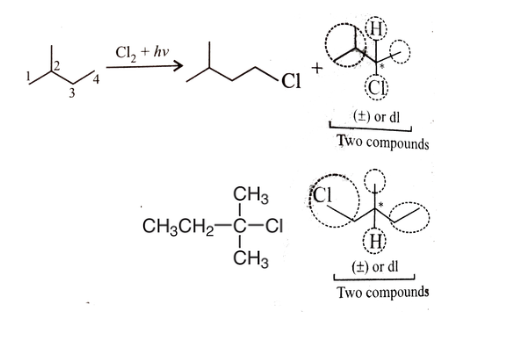
Substitution at Position (1): 1-Chloro-2-methylbutane
$$\text{ClCH}_2-\text{C}^* \text{H}(\text{CH}_3)-\text{CH}_2-\text{CH}_3$$Carbon-2 ($$\text{C}^*$$) is bonded to four different groups: $$-\text{CH}_2\text{Cl}$$, $$-\text{H}$$, $$-\text{CH}_3$$, and $$-\text{CH}_2\text{CH}_3$$. Therefore, it is a chiral center, generating a pair of enantiomers:
$$\rightarrow \mathbf{2 \text{ chiral compounds }} (d \text{ and } l)$$
Substitution at Position (2): 2-Chloro-2-methylbutane
$$\text{CH}_3-\text{C}(\text{Cl})(\text{CH}_3)-\text{CH}_2-\text{CH}_3$$Carbon-2 is bonded to two identical methyl ($-\text{CH}_3$) groups, making the molecule achiral.
$$\rightarrow 0 \text{ chiral compounds}$$
Substitution at Position (3): 2-Chloro-3-methylbutane
$$\text{CH}_3-\text{CH}(\text{CH}_3)-\text{C}^* \text{H}(\text{Cl})-\text{CH}_3$$Carbon-3 ($$\text{C}^*$$) is bonded to four different groups: $$-\text{CH}(\text{CH}_3)_2$$, $$-\text{H}$$, $$-\text{Cl}$$, and $$-\text{CH}_3$$. This creates a chiral center, giving rise to another pair of enantiomers:
$$\rightarrow \mathbf{2 \text{ chiral compounds }} (d \text{ and } l)$$
Substitution at Position (4): 1-Chloro-3-methylbutane
$$\text{CH}_3-\text{CH}(\text{CH}_3)-\text{CH}_2-\text{CH}_2\text{Cl}$$None of the carbon atoms in this molecule are bonded to four unique groups, making it entirely achiral.
$$\rightarrow 0 \text{ chiral compounds}$$
Summing up all the optically active stereo-isomeric forms produced:
$$\text{Total Chiral Compounds} = 2 \text{ (from 1-chloro-2-methylbutane)} + 2 \text{ (from 2-chloro-3-methylbutane)} = 4$$
Answer: Option C — 4
Was this solution helpful?
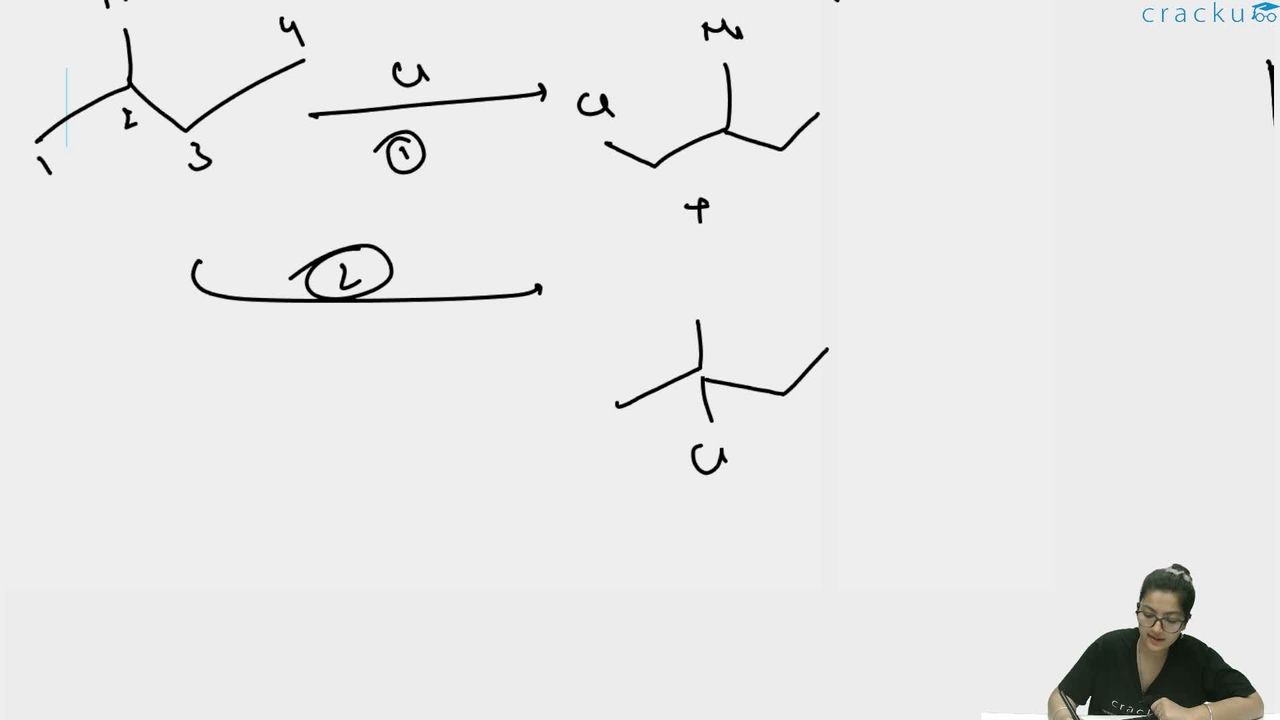
Click on the Email ☝️ to Watch the Video Solution
Create a FREE account and get:
_1.webp)

Educational materials for JEE preparation

Ask our AI anything

AI can make mistakes. Please verify important information.
AI can make mistakes. Please verify important information.
