
Join Our JEE Preparation Group
Prep with like-minded aspirants; Get access to free daily tests and study material.
Sign in
Please select an account to continue using cracku.in
↓ →
Join Our JEE Preparation Group
Prep with like-minded aspirants; Get access to free daily tests and study material.
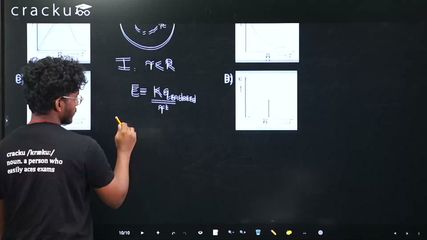
In a uniformly charged sphere of total charge $$Q$$ and radius $$R$$, the electric field $$E$$ is plotted as a function of distance from the centre. The graph which would correspond to the above will be
Consider a solid sphere of radius $$R$$ that carries a uniform volume charge density $$\rho$$. The total charge is $$Q = \rho \,\frac{4}{3}\pi R^{3}$$.
Case 1: Field at an interior point $$\bigl(r \lt R\bigr)$$
Choose a Gaussian surface—a concentric sphere of radius $$r$$. By Gauss’s law
$$\oint \mathbf{E}\cdot d\mathbf{A}= \frac{q_{\text{encl}}}{\varepsilon_0}$$
The left side gives $$E(4\pi r^{2})$$ because the field is radially outward and uniform over the Gaussian surface.
The enclosed charge is the charge of a smaller sphere of radius $$r$$:
$$q_{\text{encl}} = \rho \,\frac{4}{3}\pi r^{3}$$
Hence
$$E(4\pi r^{2}) = \frac{\rho \,\frac{4}{3}\pi r^{3}}{\varepsilon_0}$$
$$\Rightarrow\; E = \frac{\rho r}{3\varepsilon_0}$$
Using $$\rho = \dfrac{3Q}{4\pi R^{3}}$$, we can write
$$E = \frac{1}{4\pi\varepsilon_0}\,\frac{Q\,r}{R^{3}}$$
Therefore, inside the sphere $$E$$ is directly proportional to $$r$$. The graph is a straight line through the origin, reaching its maximum at the surface.
Case 2: Field at an exterior point $$\bigl(r \ge R\bigr)$$
For a Gaussian surface of radius $$r \gt R$$, the entire charge $$Q$$ is enclosed, so
$$E(4\pi r^{2}) = \frac{Q}{\varepsilon_0} \;\;\Longrightarrow\;\; E = \frac{1}{4\pi\varepsilon_0}\,\frac{Q}{r^{2}}$$
Outside the sphere $$E$$ falls off as $$1/r^{2}$$, exactly like the field of a point charge located at the centre.
Matching with the given graphs
Key features we have deduced:
1. From $$r=0$$ to $$r=R$$: a straight line of slope $$\dfrac{1}{4\pi\varepsilon_0}\dfrac{Q}{R^{3}}$$.
2. At $$r = R$$: the field value is $$E_R = \dfrac{1}{4\pi\varepsilon_0}\dfrac{Q}{R^{2}}$$.
3. For $$r \gt R$$: the curve switches smoothly into a $$1/r^{2}$$ decay, continuous (no jump) at $$r=R$$.
Among the four sketches, only Option C shows (i) a linear rise from the origin to $$r=R$$, and (ii) a smooth inverse-square drop beyond $$R$$ that starts from the same value attained at the surface. Hence Option C is the correct representation.
Final Answer: Option C which is: the graph that rises linearly inside the sphere and then decreases as $$1/r^{2}$$ outside.
Was this solution helpful?
Click on the Email ☝️ to Watch the Video Solution
Create a FREE account and get:
_1.webp)

Educational materials for JEE preparation

Ask our AI anything

AI can make mistakes. Please verify important information.
AI can make mistakes. Please verify important information.
