
Join Our JEE Preparation Group
Prep with like-minded aspirants; Get access to free daily tests and study material.
Sign in
Please select an account to continue using cracku.in
↓ →
Join Our JEE Preparation Group
Prep with like-minded aspirants; Get access to free daily tests and study material.
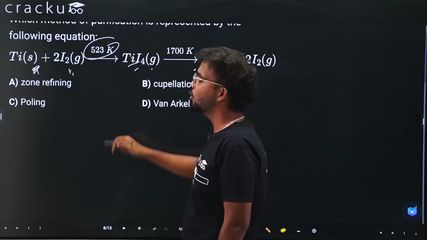
Which method of purification is represented by the following equation: $$Ti(s) + 2I_2(g) \xrightarrow{523\ K} TiI_4(g) \xrightarrow{1700\ K} Ti(s) + 2I_2(g)$$
The given process has two distinct temperature steps.
• At $$523\ \text{K}$$ the solid metal $$Ti$$ reacts with iodine vapour to form the volatile tetra-iodide $$TiI_4$$.
• At a much higher temperature, about $$1700\ \text{K}$$, the gaseous $$TiI_4$$ decomposes on a hot filament to redeposit ultra-pure $$Ti$$ while liberating $$I_2$$.
This two-stage conversion (metal → volatile metal iodide → pure metal) is the characteristic feature of the Van Arkel (also called the Van Arkel-de Boer) process. It is used to obtain high-purity samples of refractory metals such as $$Ti$$, $$Zr$$ and $$Hf$$.
Since none of the other listed techniques (zone refining, cupellation, poling) involves formation and thermal decomposition of a volatile iodide, the described sequence can only represent the Van Arkel process.
Hence, the correct choice is:
Option D which is: Van Arkel
Was this solution helpful?
Click on the Email ☝️ to Watch the Video Solution
Create a FREE account and get:
_1.webp)

Educational materials for JEE preparation

Ask our AI anything

AI can make mistakes. Please verify important information.
AI can make mistakes. Please verify important information.
