
Join Our JEE Preparation Group
Prep with like-minded aspirants; Get access to free daily tests and study material.
Sign in
Please select an account to continue using cracku.in
↓ →
Join Our JEE Preparation Group
Prep with like-minded aspirants; Get access to free daily tests and study material.
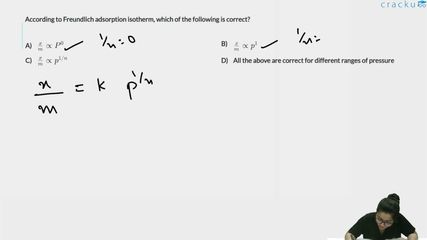
The Freundlich adsorption isotherm is an empirical relation that connects the amount of gas adsorbed per unit mass of a solid adsorbent ( $$\frac{x}{m}$$ ) with the equilibrium pressure $$p$$ of the gas at a constant temperature.
The general mathematical form is
$$\frac{x}{m}=k\,p^{1/n}, \qquad 0 \lt \frac{1}{n} \lt 1$$
This single equation successfully describes the adsorption behaviour over the entire pressure range because the exponent $$\frac{1}{n}$$ can effectively change with the region of pressure being considered. Let us examine the three limiting regions.
Case 1: Low-pressure region
When $$p$$ is very small, almost every gas molecule that strikes the surface gets adsorbed, so the surface is far from saturation. Experimentally it is found that $$\frac{1}{n} \approx 1$$ for this region. Hence
$$\frac{x}{m}=k\,p^{1}\quad\Longrightarrow\quad\frac{x}{m}\propto p$$
which matches Option B.
Case 2: High-pressure region
At very high pressures, the adsorbent surface becomes nearly saturated. Any further increase in $$p$$ does not bring a noticeable increase in adsorption, so $$\frac{x}{m}$$ becomes almost independent of $$p$$. Formally, $$\frac{1}{n}\approx 0$$, giving
$$\frac{x}{m}=k\,p^{0}=k\quad\Longrightarrow\quad\frac{x}{m}\propto p^{0}$$
which matches Option A.
Case 3: Intermediate-pressure region
For the wide middle range of pressures encountered in most practical situations, the experimentally determined exponent satisfies $$0 \lt \frac{1}{n} \lt 1$$. Thus one obtains the standard Freundlich form
$$\frac{x}{m}\propto p^{1/n}$$
which is precisely Option C.
Because Options A, B and C each describe the Freundlich behaviour in different pressure ranges, Option D—“All the above are correct for different ranges of pressure”—is the comprehensive and therefore correct statement.
Hence, the correct answer is:
Option D which is: All the above are correct for different ranges of pressure
Was this solution helpful?
Click on the Email ☝️ to Watch the Video Solution
Create a FREE account and get:
_1.webp)

Educational materials for JEE preparation

Ask our AI anything

AI can make mistakes. Please verify important information.
AI can make mistakes. Please verify important information.
