
Join Our JEE Preparation Group
Prep with like-minded aspirants; Get access to free daily tests and study material.
Sign in
Please select an account to continue using cracku.in
↓ →
Join Our JEE Preparation Group
Prep with like-minded aspirants; Get access to free daily tests and study material.
$$K_f$$ for water is $$1.86\ K\ kg\ mol^{-1}$$. If your automobile radiator holds $$1.0$$ kg of water, how many grams of ethylene glycol ($$C_2H_6O_2$$) must you add to get the freezing point of the solution lowered to $$-2.8^\circ C$$?
The depression in freezing point of a solution is given by the colligative-property relation
$$\Delta T_f = i\,K_f\,m$$
The solute ethylene glycol ($$C_2H_6O_2$$) is a nonelectrolyte, so its van’t Hoff factor is $$i = 1$$. Hence
$$\Delta T_f = K_f\,m \quad -(1)$$
Data for the problem:
• freezing-point depression desired, $$\Delta T_f = 2.8^{\circ} \text{C}$$ (difference between $$0^{\circ}$$C for pure water and $$-2.8^{\circ}$$C for the solution)
• cryoscopic constant of water, $$K_f = 1.86\;K\,kg\,mol^{-1}$$
From equation $$-(1)$$, the required molality is
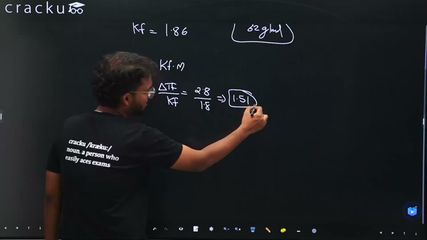
$$m = \frac{\Delta T_f}{K_f} = \frac{2.8}{1.86}\;mol\,kg^{-1} \approx 1.51\;mol\,kg^{-1}$$
The radiator contains $$1.0\;kg$$ of water, so the number of moles of ethylene glycol needed is
$$n = m \times (\text{mass of solvent in kg}) = 1.51 \times 1.0 \approx 1.51\;mol$$
Molar mass of ethylene glycol:
$$M = 2(12.01) + 6(1.008) + 2(16.00) \approx 62.1\;g\,mol^{-1}$$
Hence the mass of ethylene glycol required is
$$\text{mass} = nM \approx 1.51 \times 62.1 \;g \approx 93\;g$$
Therefore, the closest option is:
Option B which is: $$93\;g$$
Was this solution helpful?
Click on the Email ☝️ to Watch the Video Solution
Create a FREE account and get:
_1.webp)

Educational materials for JEE preparation

Ask our AI anything

AI can make mistakes. Please verify important information.
AI can make mistakes. Please verify important information.
