
Join Our JEE Preparation Group
Prep with like-minded aspirants; Get access to free daily tests and study material.
Sign in
Please select an account to continue using cracku.in
↓ →
Join Our JEE Preparation Group
Prep with like-minded aspirants; Get access to free daily tests and study material.
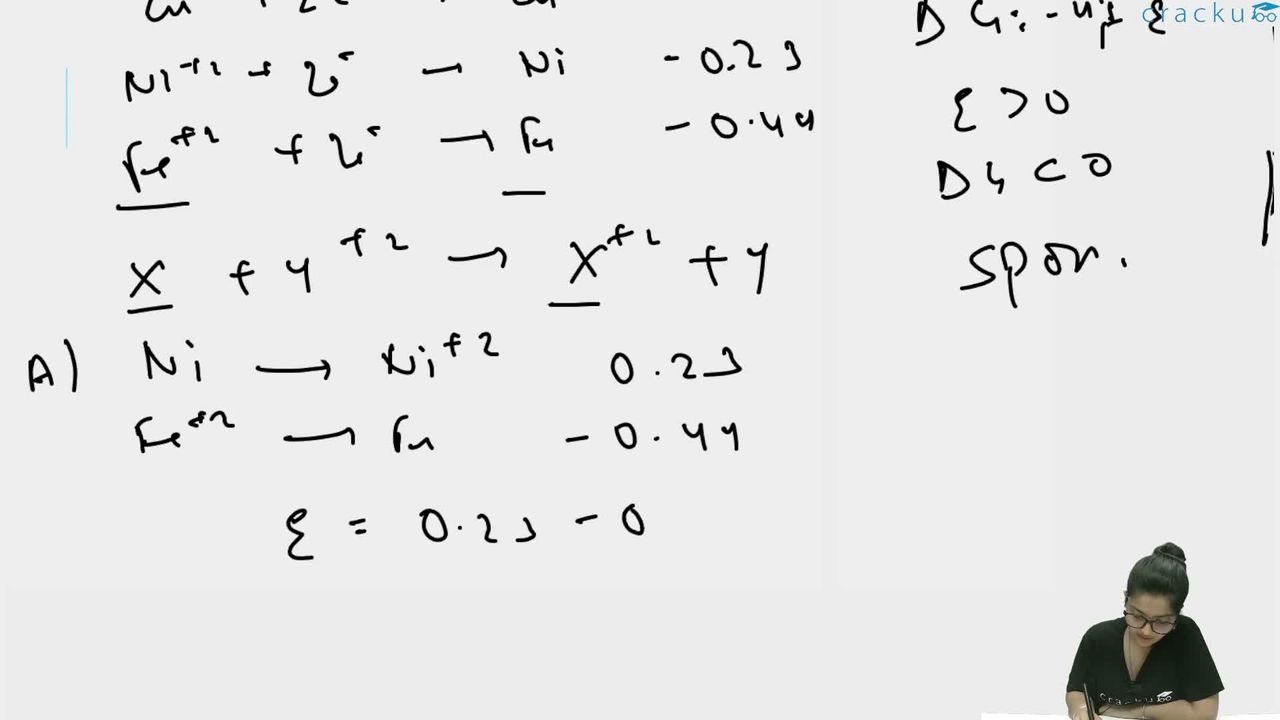
The standard reduction potentials for $$Zn^{2+}/Zn$$, $$Ni^{2+}/Ni$$, and $$Fe^{2+}/Fe$$ are $$-0.76$$, $$-0.23$$ and $$-0.44$$ V respectively. The reaction $$X + Y^{2+} \rightarrow X^{2+} + Y$$ will be spontaneous when:
The reaction given is $$X + Y^{2+} \rightarrow X^{2+} + Y$$.
Here, metal $$X$$ is getting oxidised (loses electrons) and serves as the anode, while the ion $$Y^{2+}$$ is getting reduced (gains electrons) and serves as the cathode.
For any electrochemical cell operated under standard conditions, the standard cell potential is
$$E^\circ_{\text{cell}} = E^\circ_{\text{cathode}} - E^\circ_{\text{anode}}$$
The process is spontaneous if and only if $$E^\circ_{\text{cell}} \gt 0$$.
The standard reduction potentials provided are
$$E^\circ(Zn^{2+}/Zn) = -0.76\text{ V}$$,
$$E^\circ(Fe^{2+}/Fe) = -0.44\text{ V}$$,
$$E^\circ(Ni^{2+}/Ni) = -0.23\text{ V}$$.
Because the cathode must have the higher (more positive) reduction potential, and the anode the lower (more negative) one, we arrange the three couples in increasing order:
$$Zn^{2+}/Zn\;(-0.76\text{ V}) \lt Fe^{2+}/Fe\;(-0.44\text{ V}) \lt Ni^{2+}/Ni\;(-0.23\text{ V})$$.
Thus, to make $$E^\circ_{\text{cell}}$$ positive we should choose
anode (X) = Zn and cathode (Y^{2+}) = Ni^{2+}.
Calculating to confirm:
Anode (oxidation): $$Zn \rightarrow Zn^{2+} + 2e^-$$, $$E^\circ_{\text{anode}} = -0.76\text{ V}$$.
Cathode (reduction): $$Ni^{2+} + 2e^- \rightarrow Ni$$, $$E^\circ_{\text{cathode}} = -0.23\text{ V}$$.
Therefore
$$E^\circ_{\text{cell}} = (-0.23) - (-0.76) = +0.53\text{ V} \gt 0,$$
which confirms spontaneity.
Only the pair $$X = Zn,\, Y = Ni$$ satisfies this condition. The remaining options give negative cell potentials and are non-spontaneous.
Hence, the correct choice is:
Option D which is: $$X = Zn, Y = Ni$$
Was this solution helpful?
Click on the Email ☝️ to Watch the Video Solution
Create a FREE account and get:
_1.webp)

Educational materials for JEE preparation

Ask our AI anything

AI can make mistakes. Please verify important information.
AI can make mistakes. Please verify important information.
