
Join Our JEE Preparation Group
Prep with like-minded aspirants; Get access to free daily tests and study material.
Sign in
Please select an account to continue using cracku.in
↓ →
Join Our JEE Preparation Group
Prep with like-minded aspirants; Get access to free daily tests and study material.
The compressibility factor $$Z$$ is defined as $$Z = \frac{PV}{RT}$$ for one mole of a gas.
For a real gas we use the van der Waals equation
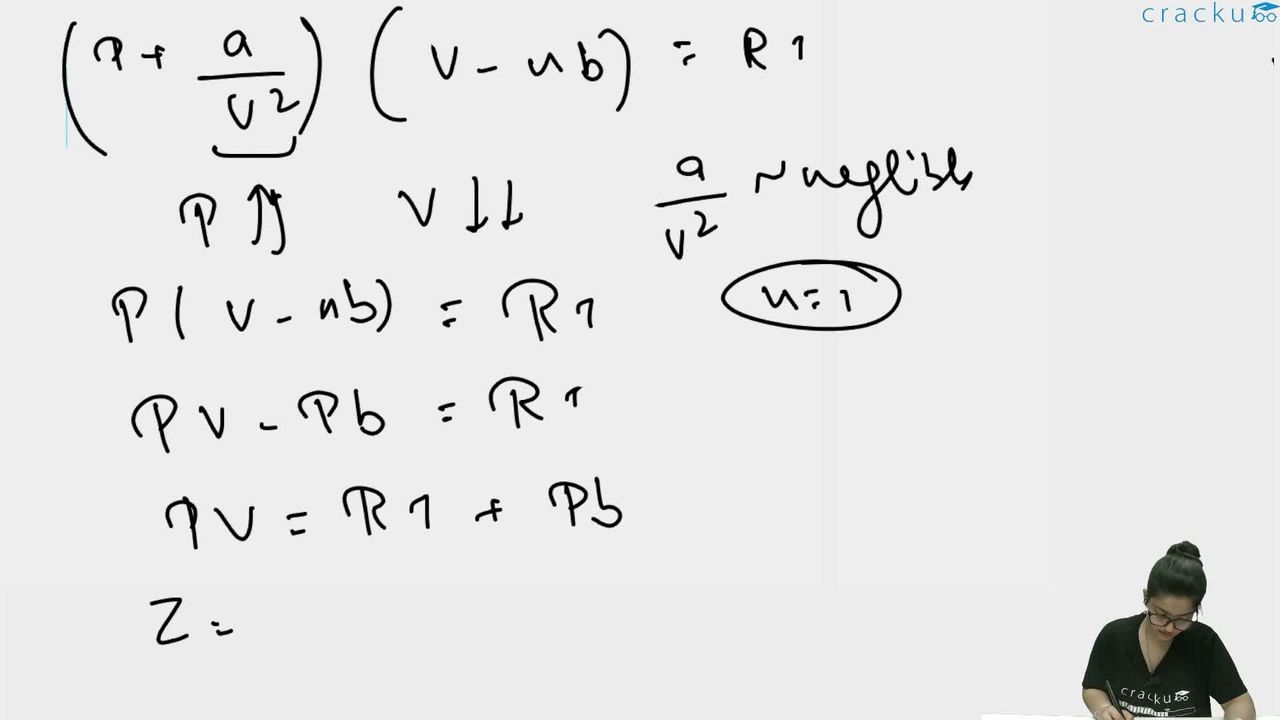
$$(P + \frac{a}{V^{2}})(V - b) = RT$$
At very high pressure the molar volume $$V$$ becomes very small, so the term $$\frac{a}{V^{2}}$$ (which accounts for intermolecular attractions) is negligible compared with $$P$$. Retaining only the finite-size correction, the equation simplifies to
$$P(V - b) \approx RT$$
Expanding: $$PV - Pb = RT$$ which gives
$$PV = RT + Pb$$
Divide by $$RT$$ to obtain the compressibility factor:
$$Z = \frac{PV}{RT} = 1 + \frac{Pb}{RT}$$
Thus, at high pressure the compressibility factor of a real gas exceeds unity by the amount $$\frac{Pb}{RT}$$.
Option C which is: $$1 + \frac{pb}{RT}$$
Was this solution helpful?
Click on the Email ☝️ to Watch the Video Solution
Create a FREE account and get:
_1.webp)

Educational materials for JEE preparation

Ask our AI anything

AI can make mistakes. Please verify important information.
AI can make mistakes. Please verify important information.
