
Join Our JEE Preparation Group
Prep with like-minded aspirants; Get access to free daily tests and study material.
Sign in
Please select an account to continue using cracku.in
↓ →
Join Our JEE Preparation Group
Prep with like-minded aspirants; Get access to free daily tests and study material.
A particle of mass $$m$$ is at rest at the origin at time $$t=0$$. It is subjected to a force $$F(t) = F_0 e^{-bt}$$ in the $$x$$ direction. Its speed $$v(t)$$ is depicted by which of the following curves?
The applied force varies with time as $$F(t)=F_0 e^{-bt}$$ along the $$+x$$-direction.
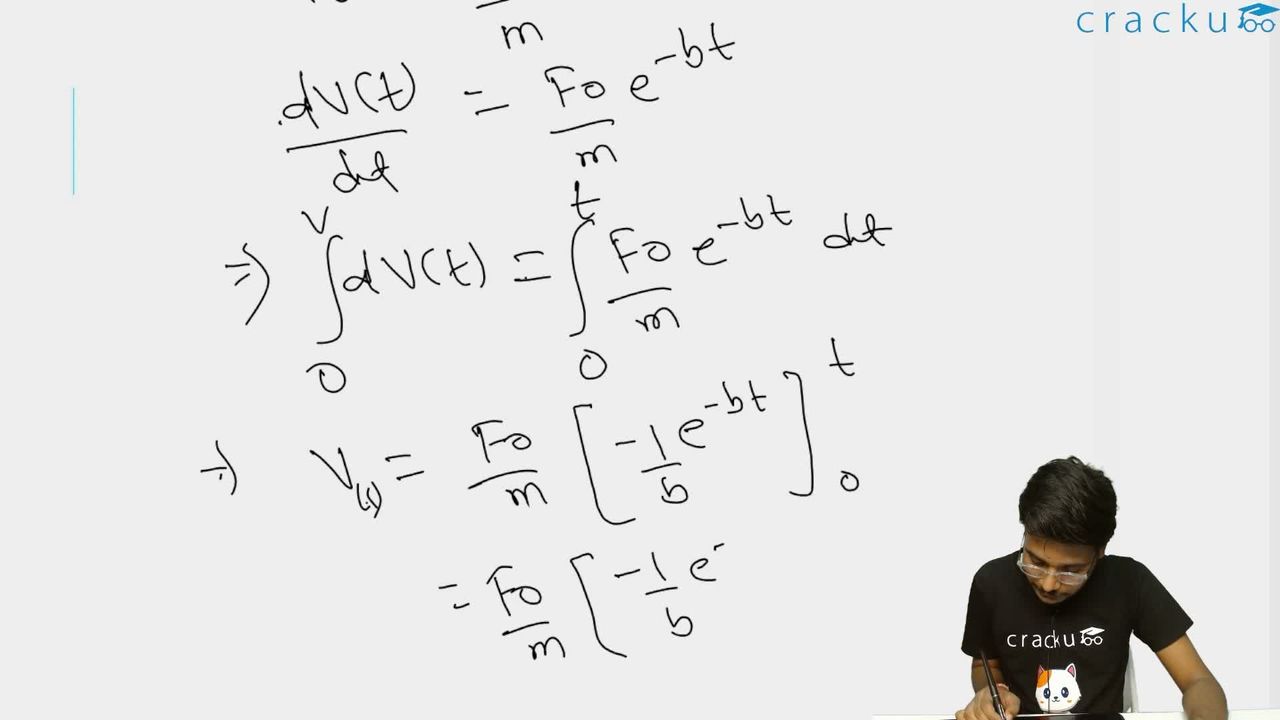
Newton’s second law gives instantaneous acceleration $$a(t)=\frac{F(t)}{m}=\frac{F_0}{m}\,e^{-bt}$$
The particle starts from rest, so $$v(0)=0$$. Speed at any later time is the time-integral of acceleration:
$$\begin{aligned} v(t)&=\int_{0}^{t} a(\tau)\,d\tau \\ &=\frac{F_0}{m}\int_{0}^{t} e^{-b\tau}\,d\tau \\ &=\frac{F_0}{m}\left[\,-\frac{1}{b}e^{-b\tau}\right]_{0}^{t}\\ &=\frac{F_0}{mb}\left(1-e^{-bt}\right) \end{aligned}$$
Key features of $$v(t)=\dfrac{F_0}{mb}\left(1-e^{-bt}\right)$$:
• At $$t=0$$, $$v(0)=0$$.
• $$v(t)$$ increases monotonically because $$dv/dt = (F_0/m)e^{-bt}\gt 0$$ for all $$t\gt0$$.
• As $$t\rightarrow\infty$$, the exponential term vanishes and the speed saturates at a finite limit
$$v_{\text{max}}=\dfrac{F_0}{mb}$$.
Thus the curve rises quickly at first and then levels off asymptotically.
Among the given sketches, the only one that starts from the origin, rises monotonically, and approaches a horizontal asymptote is the third plot.
Hence, Option C which is: the curve that climbs from $$0$$ to a constant terminal value asymptotically.
Was this solution helpful?
Click on the Email ☝️ to Watch the Video Solution
Create a FREE account and get:
_1.webp)

Educational materials for JEE preparation

Ask our AI anything

AI can make mistakes. Please verify important information.
AI can make mistakes. Please verify important information.
