
Join Our JEE Preparation Group
Prep with like-minded aspirants; Get access to free daily tests and study material.
Sign in
Please select an account to continue using cracku.in
↓ →
Join Our JEE Preparation Group
Prep with like-minded aspirants; Get access to free daily tests and study material.
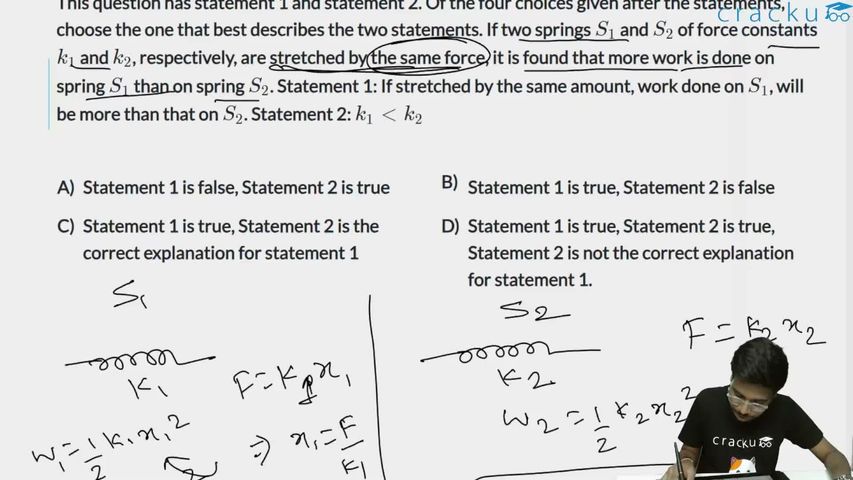
This question has statement 1 and statement 2. Of the four choices given after the statements, choose the one that best describes the two statements. If two springs $$S_1$$ and $$S_2$$ of force constants $$k_1$$ and $$k_2$$, respectively, are stretched by the same force, it is found that more work is done on spring $$S_1$$ than on spring $$S_2$$. Statement 1: If stretched by the same amount, work done on $$S_1$$, will be more than that on $$S_2$$. Statement 2: $$k_1 < k_2$$
The elastic potential energy (work done) stored in an ideal spring is given by
$$W = \tfrac12 k x^{2}$$
When the same external force $$F$$ is applied on two springs, the extensions become $$x_1 = \dfrac{F}{k_1}$$ and $$x_2 = \dfrac{F}{k_2}$$.
Substituting in the energy formula, the work done on each spring is
$$W_1 = \tfrac12 k_1 x_1^{2} = \tfrac12 k_1\left(\dfrac{F}{k_1}\right)^{2} = \dfrac{F^{2}}{2k_1}$$
$$W_2 = \dfrac{F^{2}}{2k_2}$$
Because $$W_1 \gt W_2$$ is given, we must have $$\dfrac{F^{2}}{2k_1} \gt \dfrac{F^{2}}{2k_2}\; \Rightarrow\; k_1 \lt k_2$$ so Statement 2 is true.
Next consider stretching each spring through the same extension $$x$$. The work done is directly proportional to the force constant: $$W = \tfrac12 k x^{2}$$ With $$k_1 \lt k_2$$ we would get $$W_1 \lt W_2$$, not more. Therefore Statement 1 is false.
Statement 2 is true while Statement 1 is false. Hence
Option A which is: Statement 1 is false, Statement 2 is true
Was this solution helpful?
Click on the Email ☝️ to Watch the Video Solution
Create a FREE account and get:
_1.webp)

Educational materials for JEE preparation

Ask our AI anything

AI can make mistakes. Please verify important information.
AI can make mistakes. Please verify important information.
