
Join Our JEE Preparation Group
Prep with like-minded aspirants; Get access to free daily tests and study material.
Sign in
Please select an account to continue using cracku.in
↓ →
Join Our JEE Preparation Group
Prep with like-minded aspirants; Get access to free daily tests and study material.
The given compounds are trichlorides of the group 15 (VA) elements: $$N,\, P,\, As,\, Sb$$.
All four molecules have the same steric formula $$AX_3E_1$$ (three bonded atoms $$X = Cl$$ and one lone pair $$E$$ on the central atom $$A$$) and therefore an $$sp^3$$ hybridised, pyramidal geometry.
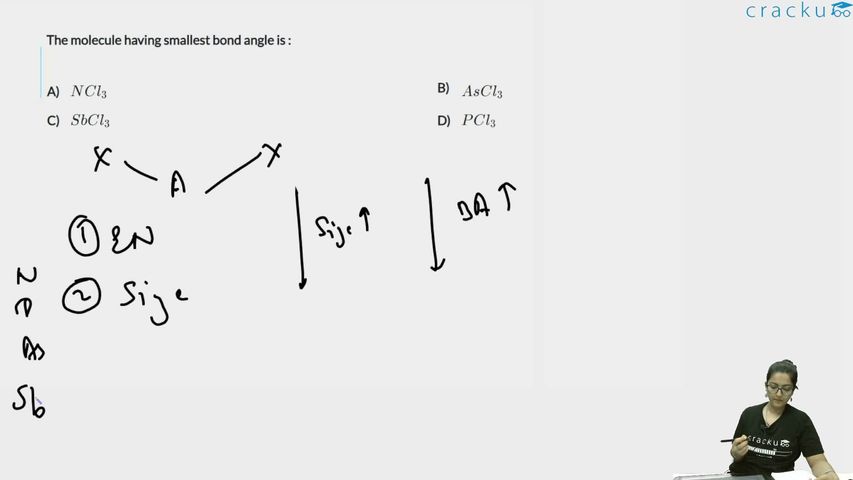
In an $$AX_3E_1$$ system, the $$X{-}A{-}X$$ bond angle depends mainly on two factors:
1. Electronegativity of the central atom (affects the pull on the bonding pair),
2. Size of the central atom (affects how far the bonding pairs can spread).
Down the group 15:
• Electronegativity decreases $$\big(N \gt P \gt As \gt Sb\big)$$, making the bonding pairs less attracted towards the central atom and hence closer to the outer atoms.
• Atomic size increases, allowing the three $$Cl$$ atoms to stay farther from the nucleus but also permitting the lone-pair cloud to expand and push the bond pairs together.
Both effects work in the same direction—down the group the $$X{-}A{-}X$$ bond angle decreases.
Typical bond angles are:
$$NH_3 \approx 107^\circ,\; PCl_3 \approx 100^\circ,\; AsCl_3 \approx 98^\circ,\; SbCl_3 \approx 90^\circ.$$
Among the choices, $$SbCl_3$$ has the largest central atom and the lowest electronegativity; therefore, it exhibits the smallest bond angle.
Hence, the correct option is:
Option C which is: $$SbCl_3$$
Was this solution helpful?
Click on the Email ☝️ to Watch the Video Solution
Create a FREE account and get:
_1.webp)

Educational materials for JEE preparation

Ask our AI anything

AI can make mistakes. Please verify important information.
AI can make mistakes. Please verify important information.
