
Join Our JEE Preparation Group
Prep with like-minded aspirants; Get access to free daily tests and study material.
Sign in
Please select an account to continue using cracku.in
↓ →
Join Our JEE Preparation Group
Prep with like-minded aspirants; Get access to free daily tests and study material.
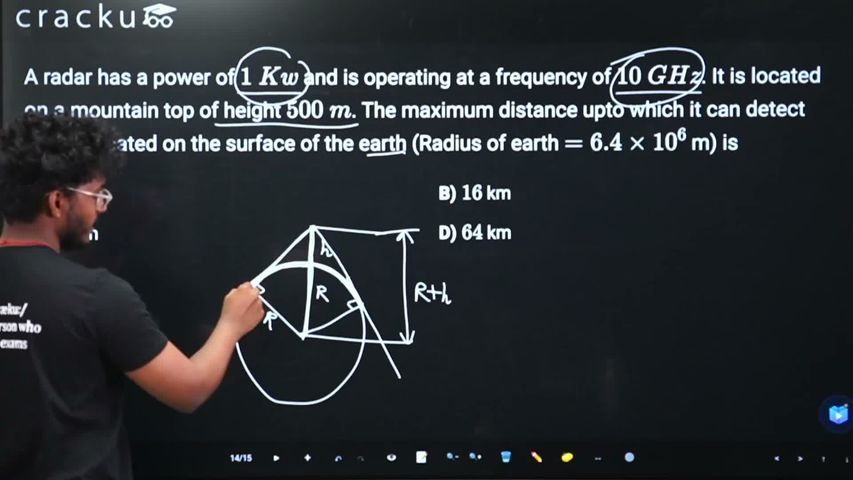
A radar has a power of $$1\ Kw$$ and is operating at a frequency of $$10\ GHz$$. It is located on a mountain top of height $$500\ m$$. The maximum distance upto which it can detect object located on the surface of the earth (Radius of earth $$=6.4 \times 10^6$$ m) is
The farthest an object on the Earth’s surface can be detected by a radar situated at height $$h$$ above the surface is limited by the line-of-sight (geometrical) horizon.
For an observer at height $$h$$ on a spherical Earth of radius $$R$$, the distance to the horizon is obtained from simple geometry:
Draw the radius $$R$$ from the centre of Earth to the object on the surface and another radius $$R+h$$ to the radar. Because the line of sight is tangent to Earth at the horizon point, one gets a right-angled triangle whose hypotenuse is $$R+h$$ and whose base is $$R$$. Using Pythagoras’ theorem:
$$ (R+h)^{2} = R^{2} + d^{2} $$
Solving for the surface distance $$d$$:
$$ d = \sqrt{(R+h)^{2} - R^{2}} = \sqrt{2Rh + h^{2}} $$
Since $$h \ll R$$, the $$h^{2}$$ term is negligible, giving the useful approximation
$$ d \approx \sqrt{2Rh} \quad -(1) $$
Insert the given numerical values:
$$ R = 6.4 \times 10^{6}\ \text{m}, \qquad h = 500\ \text{m} = 5 \times 10^{2}\ \text{m} $$
Using equation $$(1)$$:
$$ d = \sqrt{2 \times 6.4 \times 10^{6}\ \text{m} \times 5 \times 10^{2}\ \text{m}} $$
$$ d = \sqrt{64 \times 10^{8}\ \text{m}^{2}} $$
$$ d = \sqrt{6.4 \times 10^{9}}\ \text{m} $$
$$ d \approx 2.53 \times 10^{4.5}\ \text{m} = 2.53 \times 3.1623 \times 10^{4}\ \text{m} $$
$$ d \approx 8.0 \times 10^{4}\ \text{m} = 80\ \text{km} $$
Hence the maximum surface distance up to which the radar can detect an object is $$80\ \text{km}$$.
Option A which is: $$80$$ km
Was this solution helpful?
Click on the Email ☝️ to Watch the Video Solution
Create a FREE account and get:
_1.webp)

Educational materials for JEE preparation

Ask our AI anything

AI can make mistakes. Please verify important information.
AI can make mistakes. Please verify important information.
