
Join Our JEE Preparation Group
Prep with like-minded aspirants; Get access to free daily tests and study material.
Sign in
Please select an account to continue using cracku.in
↓ →
Join Our JEE Preparation Group
Prep with like-minded aspirants; Get access to free daily tests and study material.
The general structure of an α-amino acid is $$R{-}CH(NH_2)COOH$$. The central (α-) carbon will be chiral and therefore optically active if, and only if, it is bonded to four different groups.
For most naturally occurring α-amino acids the four groups attached to the α-carbon are:
1. $$NH_2$$ group
2. $$COOH$$ group
3. Side chain $$R$$ (different for each amino acid)
4. A hydrogen atom $$H$$
Because $$R$$ is different from $$H$$, these four groups are all different, giving a chiral centre and hence optical activity.
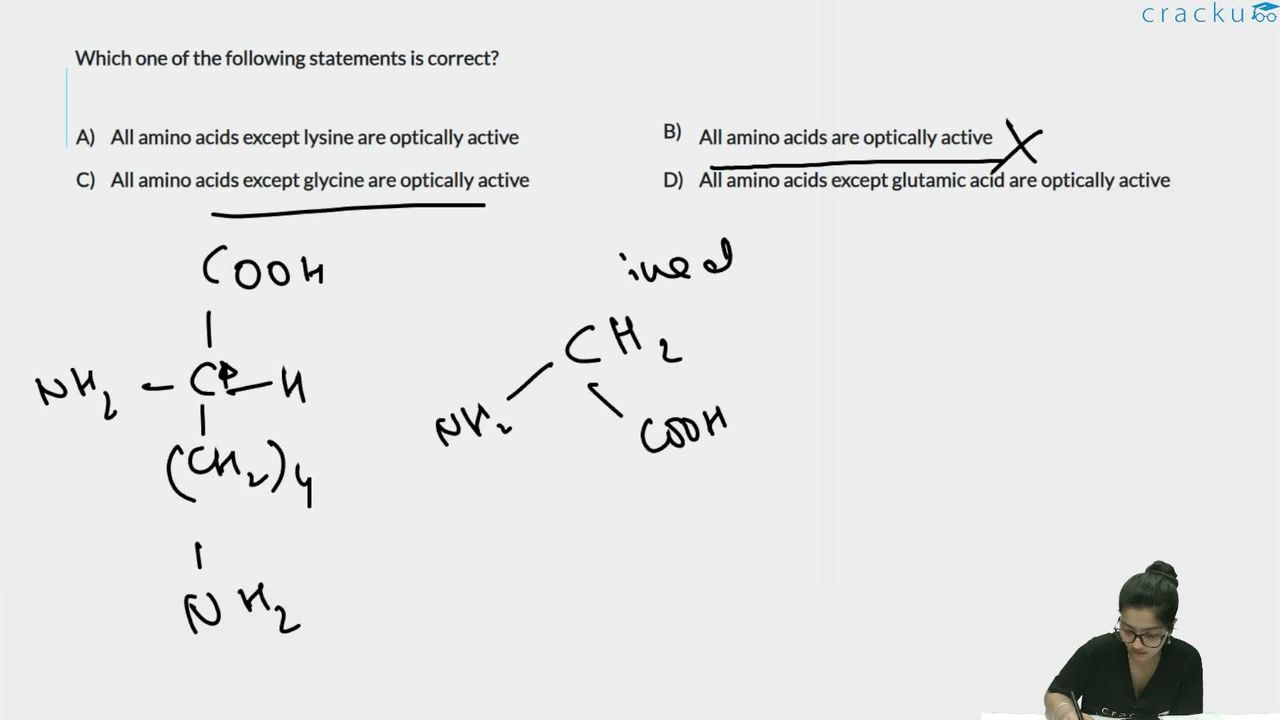
Glycine is the only exception. In glycine the side chain is $$R = H$$, so the α-carbon is attached to two identical groups (two hydrogens). Consequently, the α-carbon is achiral and glycine is optically inactive.
Now evaluate each option:
Option A - “All amino acids except lysine are optically active” is wrong; lysine has $$R = (CH_2)_4NH_2$$, giving four different groups around the α-carbon, so it is optically active.
Option B - “All amino acids are optically active” is wrong because glycine is not.
Option C - “All amino acids except glycine are optically active” is correct as explained above.
Option D - “All amino acids except glutamic acid are optically active” is wrong; glutamic acid has $$R = CH_2CH_2COOH$$, so it is optically active.
Hence, the correct choice is:
Option C which is: All amino acids except glycine are optically active.
Was this solution helpful?
Click on the Email ☝️ to Watch the Video Solution
Create a FREE account and get:
_1.webp)

Educational materials for JEE preparation

Ask our AI anything

AI can make mistakes. Please verify important information.
AI can make mistakes. Please verify important information.
