
Join Our JEE Preparation Group
Prep with like-minded aspirants; Get access to free daily tests and study material.
Sign in
Please select an account to continue using cracku.in
↓ →
Join Our JEE Preparation Group
Prep with like-minded aspirants; Get access to free daily tests and study material.
Which of the following on thermal decomposition yields a basic as well as an acidic oxide?
On heating a compound, if the products contain both a metal oxide that turns moist red litmus blue (basic oxide) and a non-metal oxide that turns moist blue litmus red (acidic oxide), the compound satisfies the given condition.
Case A: $$NaNO_3$$
$$2\,NaNO_3 \xrightarrow{\Delta} 2\,NaNO_2 + O_2$$
The products are $$NaNO_2$$ (a salt) and $$O_2$$ (elemental). No oxide of opposite nature is formed, so this option is ruled out.
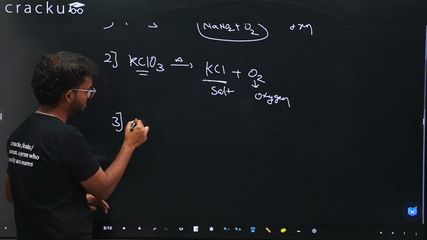
Case B: $$KClO_3$$
$$2\,KClO_3 \xrightarrow{\Delta,\,MnO_2} 2\,KCl + 3\,O_2$$
The products are $$KCl$$ (a salt) and $$O_2$$. Again, no pair of basic + acidic oxides appears, so this option is incorrect.
Case C: $$CaCO_3$$
$$CaCO_3 \xrightarrow{\Delta} CaO + CO_2$$
• $$CaO$$ is a strongly basic oxide because it reacts with water to give $$Ca(OH)_2$$.
• $$CO_2$$ is an acidic oxide because it dissolves in water to give carbonic acid, $$H_2CO_3$$.
Thus, this decomposition clearly furnishes both a basic oxide and an acidic oxide. This fits the requirement perfectly.
Case D: $$NH_4NO_3$$
$$NH_4NO_3 \xrightarrow{\Delta} N_2O + 2\,H_2O$$
$$N_2O$$ is a neutral oxide; water is neither acidic nor basic in the oxide sense required here. Hence this option is also unsuitable.
Therefore, the only compound whose thermal decomposition yields one basic oxide and one acidic oxide is $$CaCO_3$$.
Option C which is: $$CaCO_3$$
Was this solution helpful?
Click on the Email ☝️ to Watch the Video Solution
Create a FREE account and get:
_1.webp)

Educational materials for JEE preparation

Ask our AI anything

AI can make mistakes. Please verify important information.
AI can make mistakes. Please verify important information.
