
Join Our JEE Preparation Group
Prep with like-minded aspirants; Get access to free daily tests and study material.
Sign in
Please select an account to continue using cracku.in
↓ →
Join Our JEE Preparation Group
Prep with like-minded aspirants; Get access to free daily tests and study material.
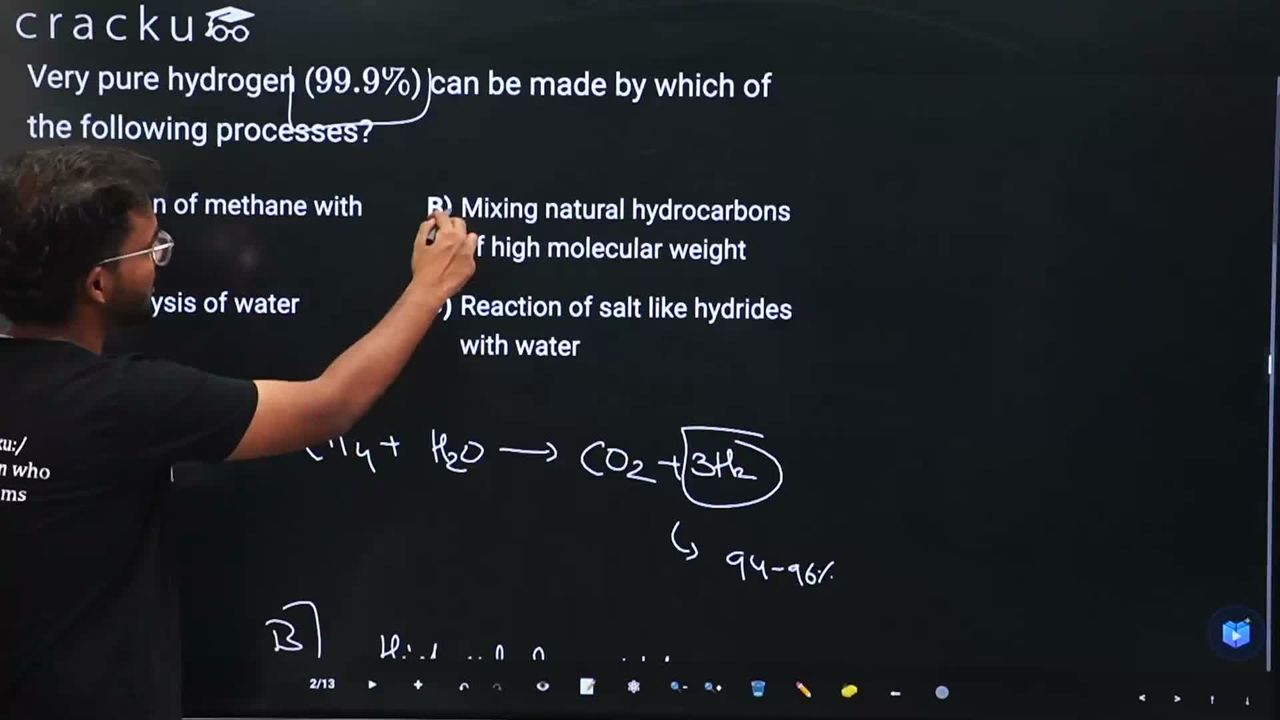
The commercial methods listed in the options differ in both scale and purity of the $$H_2$$ obtained.
Option A - Reaction of methane with steam
$$CH_4 + H_2O \;(\text{steam}) \rightarrow CO + 3H_2$$ (steam-reforming)
The product gas always contains $$CO$$, $$CO_2$$, unreacted $$CH_4$$, traces of $$H_2O$$, etc. Even after water-gas shift and purification, the purity seldom exceeds $$96\text{-}98\%$$. Hence it does not give $$99.9\%$$ pure hydrogen.
Option B - Mixing natural hydrocarbons of high molecular weight
Heavy hydrocarbons are cracked or reformed to generate a mixture containing $$H_2$$ along with many carbonaceous gases. The hydrogen obtained needs extensive purification and still does not reach $$99.9\%$$ purity.
Option C - Electrolysis of water
Electrolysis splits water according to
$$2H_2O(l) \rightarrow 2H_2(g) + O_2(g)$$
Only water and a small amount of electrolyte are present. The evolved hydrogen can be collected separately from oxygen, dried, and gives a purity easily exceeding $$99.9\%$$ without elaborate purification steps. Therefore this is the laboratory as well as industrial route for ultra-pure hydrogen.
Option D - Reaction of salt-like hydrides with water
For example,
$$NaH + H_2O \rightarrow NaOH + H_2$$
The hydrogen is contaminated with water vapour and possible traces of alkali; typical purity is lower than that obtained by electrolysis.
Thus, the only process among the given choices that consistently yields very pure ($$99.9\%$$) hydrogen is obtained by electrolysis of water.
Option C which is: Electrolysis of water
Was this solution helpful?
Click on the Email ☝️ to Watch the Video Solution
Create a FREE account and get:
_1.webp)

Educational materials for JEE preparation

Ask our AI anything

AI can make mistakes. Please verify important information.
AI can make mistakes. Please verify important information.
