
Join Our JEE Preparation Group
Prep with like-minded aspirants; Get access to free daily tests and study material.
Sign in
Please select an account to continue using cracku.in
↓ →
Join Our JEE Preparation Group
Prep with like-minded aspirants; Get access to free daily tests and study material.
Statement 1: The sum of the series $$1 + (1+2+4) + (4+6+9) + (9+12+16) + \ldots + (361+380+400)$$ is $$8000$$. Statement 2: $$\sum_{k=1}^{n}(k^3 - (k-1)^3) = n^3$$ for any natural number $$n$$.
The given series is
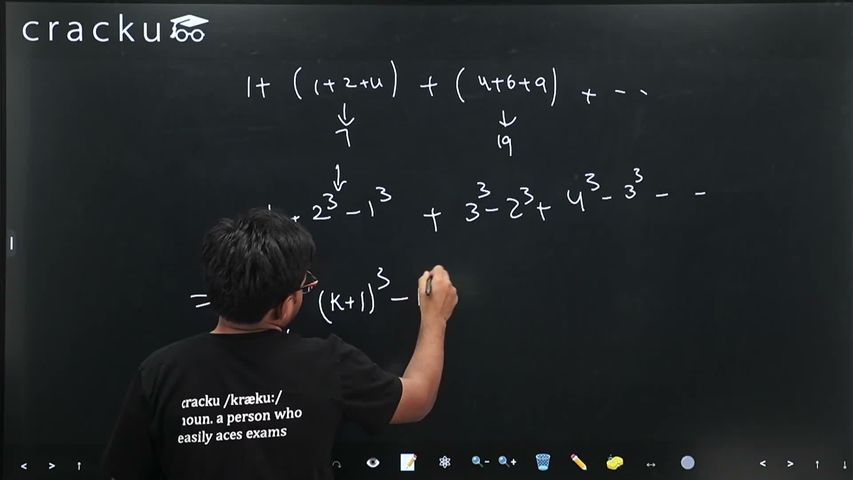
$$1 + (1+2+4) + (4+6+9) + (9+12+16) + \ldots + (361+380+400).$$
Write each bracketed block separately and look for a pattern:
$$1 = 1^3 - 0^3,$$
$$(1+2+4) = 7 = 2^3 - 1^3,$$
$$(4+6+9) = 19 = 3^3 - 2^3,$$
$$(9+12+16) = 37 = 4^3 - 3^3,$$
$$\ldots$$
$$(361+380+400) = 1141 = 20^3 - 19^3.$$
Thus the $$r^{\text{th}}$$ block (for $$r \ge 1$$) equals $$r^3 - (r-1)^3$$. Therefore the entire series can be rewritten as the telescoping sum
$$\sum_{r=1}^{20} \bigl[r^3 - (r-1)^3\bigr].$$
Using the identity stated in Statement 2, namely
$$\sum_{k=1}^{n}\bigl[k^3 - (k-1)^3\bigr] = n^3,$$
with $$n = 20$$ we get
$$\sum_{r=1}^{20} \bigl[r^3 - (r-1)^3\bigr] = 20^3 = 8000.$$
Hence the sum of the given series is $$8000$$, so Statement 1 is true.
Statement 2 is the general telescoping property that was applied verbatim above to evaluate the sum, so Statement 2 is also true and is the correct explanation for Statement 1.
Therefore, the correct option is:
Option B which is: Statement 1 is true, statement 2 is true; statement 2 is a correct explanation for statement 1.
Was this solution helpful?
Click on the Email ☝️ to Watch the Video Solution
Create a FREE account and get:
_1.webp)

Educational materials for JEE preparation

Ask our AI anything

AI can make mistakes. Please verify important information.
AI can make mistakes. Please verify important information.
