
Join Our JEE Preparation Group
Prep with like-minded aspirants; Get access to free daily tests and study material.
Sign in
Please select an account to continue using cracku.in
↓ →
Join Our JEE Preparation Group
Prep with like-minded aspirants; Get access to free daily tests and study material.
Assuming the balls to be identical except for difference in colours, the number of ways in which one or more balls can be selected from $$10$$ white, $$9$$ green and $$7$$ black balls is
For each colour we may choose any number of balls from $$0$$ up to the available stock. The choices for the three colours are therefore independent.
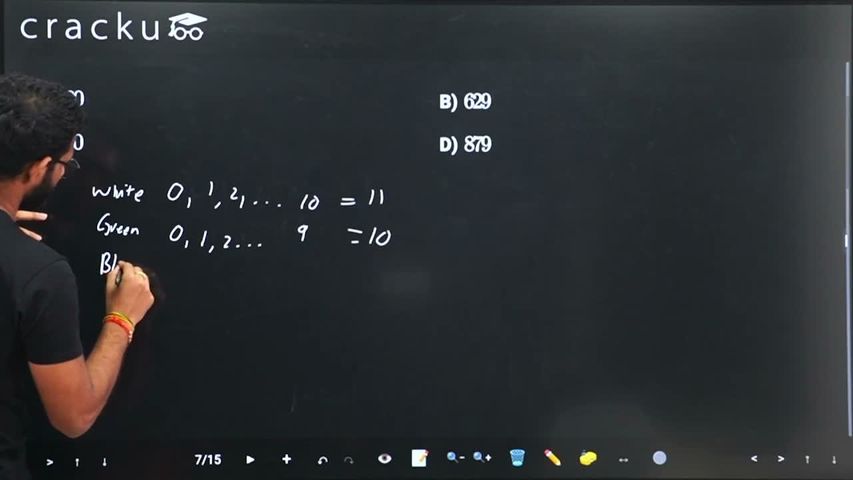
Number of choices for white balls: $$0,1,2,\dots ,10$$ ⇒ altogether $$10+1=11$$ possibilities.
Number of choices for green balls: $$0,1,2,\dots ,9$$ ⇒ altogether $$9+1=10$$ possibilities.
Number of choices for black balls: $$0,1,2,\dots ,7$$ ⇒ altogether $$7+1=8$$ possibilities.
Using the rule of product (multiplication principle), the total number of ordered triples $$(w,g,b)$$ that can be formed is
$$11 \times 10 \times 8 = 880.$$
Each triple represents a selection containing $$w$$ white, $$g$$ green and $$b$$ black balls.
The triple $$(0,0,0)$$ corresponds to selecting no ball at all, but the question asks for “one or more” balls. Hence we must exclude this single case.
Required number of selections:
$$880 - 1 = 879.$$
Option D which is: $$879$$
Was this solution helpful?
Click on the Email ☝️ to Watch the Video Solution
Create a FREE account and get:
_1.webp)

Educational materials for JEE preparation

Ask our AI anything

AI can make mistakes. Please verify important information.
AI can make mistakes. Please verify important information.
