
Join Our JEE Preparation Group
Prep with like-minded aspirants; Get access to free daily tests and study material.
Sign in
Please select an account to continue using cracku.in
↓ →
Join Our JEE Preparation Group
Prep with like-minded aspirants; Get access to free daily tests and study material.
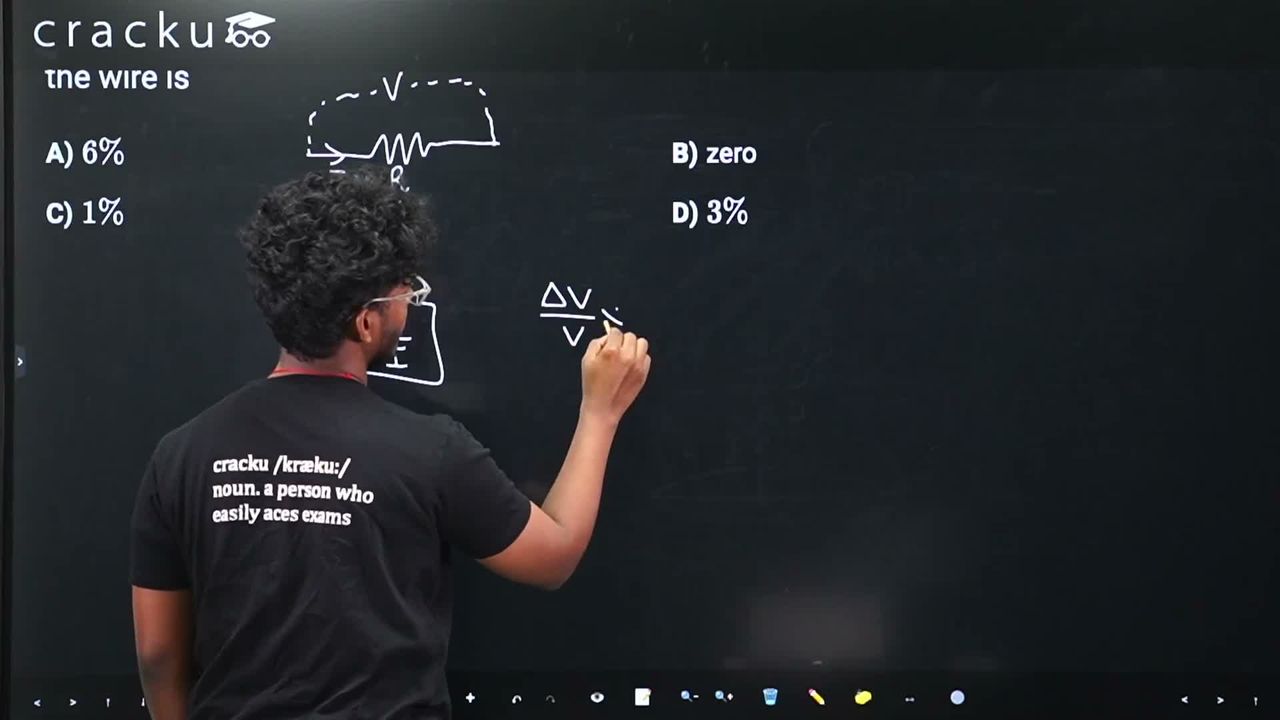
Resistance of a given wire is obtained by measuring the current flowing in it and the voltage difference applied across it. If the percentage errors in the measurement of the current and the voltage difference are $$3\%$$ each, then error in the value of resistance of the wire is
The resistance of the wire is calculated with Ohm’s law:
$$R = \frac{V}{I}$$
For a quantity that is a quotient or product of measured quantities, the percentage (or relative) error in the result is the algebraic sum of the percentage errors in the individual quantities.
Given percentage error in voltage, $$\frac{\Delta V}{V} \times 100 = 3\%$$
Given percentage error in current, $$\frac{\Delta I}{I} \times 100 = 3\%$$
Therefore, the percentage error in resistance is
$$\frac{\Delta R}{R} \times 100 = \frac{\Delta V}{V} \times 100 \;+\; \frac{\Delta I}{I} \times 100$$
$$= 3\% + 3\% = 6\%$$
Hence, the error in the calculated resistance of the wire is $$6\%$$.
Option A which is: $$6\%$$
Was this solution helpful?
Click on the Email ☝️ to Watch the Video Solution
Create a FREE account and get:
_1.webp)

Educational materials for JEE preparation

Ask our AI anything

AI can make mistakes. Please verify important information.
AI can make mistakes. Please verify important information.
