
Join Our JEE Preparation Group
Prep with like-minded aspirants; Get access to free daily tests and study material.
Sign in
Please select an account to continue using cracku.in
↓ →
Join Our JEE Preparation Group
Prep with like-minded aspirants; Get access to free daily tests and study material.
Three numbers are chosen at random without replacement from $$\{1, 2, 3, \ldots, 8\}$$. The probability that their minimum is $$3$$, given that their maximum is $$6$$, is
Let the sample space be all ways of choosing $$3$$ distinct numbers from $$\{1,2,3,\dots ,8\}$$. We work with combinations because order does not matter.
Define the events
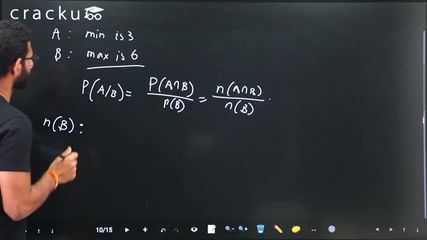
$$A$$ : the minimum of the three chosen numbers is $$3$$,
$$B$$ : the maximum of the three chosen numbers is $$6$$.
We need $$P(A\mid B) = \dfrac{P(A\cap B)}{P(B)}$$.
Step 1: Count the selections for event $$B$$ (maximum = 6).
If the maximum is exactly $$6$$, then
• the number $$6$$ must be in the set, and
• the other two numbers must be chosen from $$\{1,2,3,4,5\}$$ (all < 6).
Thus the required selections are obtained by fixing $$6$$ and choosing any $$2$$ numbers from the $$5$$ numbers $$\{1,2,3,4,5\}$$.
Number of such selections: $$\binom{5}{2}=10$$.
Step 2: Count the selections for event $$A\cap B$$ (minimum = 3 and maximum = 6).
Now the set must contain both $$3$$ (to make the minimum 3) and $$6$$ (to make the maximum 6).
The third number must lie between $$3$$ and $$6$$ so that the minimum stays $$3$$ and the maximum stays $$6$$. Hence the third number can be $$4$$ or $$5$$.
Number of such selections: $$2$$ (namely $$\{3,4,6\}$$ and $$\{3,5,6\}$$).
Step 3: Evaluate the conditional probability.
$$P(A\mid B)=\dfrac{|A\cap B|}{|B|}=\dfrac{2}{10}=\dfrac{1}{5}$$.
Therefore, the required probability is $$\frac{1}{5}$$.
Option B which is: $$\frac{1}{5}$$.
Was this solution helpful?
Click on the Email ☝️ to Watch the Video Solution
Create a FREE account and get:
_1.webp)

Educational materials for JEE preparation

Ask our AI anything

AI can make mistakes. Please verify important information.
AI can make mistakes. Please verify important information.
