Which of the following can be responsible for Emperor Penguins losing body heat?
 CAT WhatsApp Group
Sign in
Please select an account to continue using cracku.in
↓ →
CAT WhatsApp Group
Scientists recently discovered that Emperor Penguins—one of Antarctica’s most celebrated species—employ a particularly unusual technique for surviving the daily chill. As detailed in an article published today in the journal Biology Letters, the birds minimize heat loss by keeping
the outer surface of their plumage below the temperature of the surrounding air. At the same time, the penguins’ thick plumage insulates their body and keeps it toasty. . . .
The researchers analyzed thermographic images . . . taken over roughly a month during June 2008. During that period, the average air temperature was 0.32 degrees Fahrenheit. At the same time, the majority of the plumage covering the penguins’ bodies was even colder: the surface of their warmest body part, their feet, was an average 1.76 degrees Fahrenheit, but the plumage on their heads, chests and backs were -1.84, -7.24 and -9.76 degrees Fahrenheit respectively. Overall, nearly the entire outer surface of the penguins’ bodies was below freezing at all times, except for their eyes and beaks. The scientists also used a computer simulation to determine how much heat was lost or gained from each part of the
body - and discovered that by keeping their outer surface below air temperature, the birds might paradoxically be able to draw very slight amounts of heat from the air around them. The key to their trick is the difference between two different types of heat transfer: radiation and
convection.
The penguins do lose internal body heat to the surrounding air through thermal radiation, just as our bodies do on a cold day. Because their bodies (but not surface plumage) are warmer than the surrounding air, heat gradually radiates outward over time, moving from a warmer material to a colder one. To maintain body temperature while losing heat, penguins, like all warm-blooded animals, rely on the metabolism of food. The penguins, though, have an additional strategy. Since their outer plumage is even colder than the air, the simulation showed that they might gain back a little of this heat through thermal convection—the transfer of heat via the movement of a fluid (in this case, the air). As the cold Antarctic air cycles around their bodies, slightly warmer air comes into contact with the plumage and donates minute amounts of heat back to the penguins, then cycles away at a slightly colder temperature.
Most of this heat, the researchers note, probably doesn’t make it all the way through the plumage and back to the penguins’ bodies, but it could make a slight difference. At the very least, the method by which a penguin’s plumage wicks heat from the bitterly cold air that surrounds it helps to cancel out some of the heat that’s radiating from its interior. And given the Emperors’ unusually demanding breeding cycle, every bit of warmth counts. . . . Since [penguins trek as far as 75 miles to the coast to breed and male penguins] don’t eat anything during [the incubation period of 64 days], conserving calories by giving up as little heat as possible is absolutely crucial.
Which of the following can be responsible for Emperor Penguins losing body heat?
Option A: It has been mentioned that food metabolism is used to maintain body temperature. But it cannot be inferred that heat is lost due to food metabolism.
Option B: The colder temperature of plumage results in slight heat gain from the surrounding air. Hence this option is incorrect.
Option C: In the last paragraph of the passage, it has been mentioned that heat is very important for the breeding of Emperor Penguins. So it can be inferred that this conserved heat might be used in the reproductive process of Emperor Penguins. Hence C is the answer.
Option D: Consider the line: "Since their outer plumage is..........................thermal convection—the transfer of heat via the movement of a fluid (in this case, the air)." It is clear that the process of thermal convection is responsible for heat gain and not heat loss. Hence D is incorrect.
All of the following, if true, would negate the findings of the study reported in the passage EXCEPT:
The primary findings of the study conclude that Emperor Penguins reduce the heat loss by keeping the temperature of the outer surface of their plumage lower than the surrounding air. In fact, they gain a little heat from the surrounding air through thermal convection.
Option A: If the plumage did not allow thermal convection, it would contradict the findings of the study. Hence A is not the answer.
Option B: Since the transfer of heat takes place through the plumage, variation in the average temperature of feet will not affect the conclusions of the study. Hence B is the answer.
Option C: The average temperature of plumage should be lower than that of the air. It has been mentioned in the passage that the temperatures of the plumage on their heads, chests and backs were -1.84, -7.24 and -9.76 degrees Fahrenheit respectively. If the temperature of the air is -10 degrees Fahrenheit, Penguins would not be able to gain the heat. Hence, this will negate the study findings.
Option D: All the temperatures mentioned in this option are higher than the temperature of the air, but the study assumes the surrounding air temperature to be higher. This option will also negate the study findings.
Which of the following best explains the purpose of the word “paradoxically” as used by the author?
The word "paradoxically" has been used by the author to indicate the two contradictory characteristics mentioned in the statement.
Option A: This option states the exact opposite conclusion mentioned in the passage. As per the passage, penguins keep their plumage colder to keep their body warmer. Hence A is incorrect.
Option B: It has been mentioned that the penguins lose heat through radiation and gain heat through convection. Hence B is incorrect.
Option C: Although this statement is true, it does not contain self-contradictory parts. It has been mentioned that the heat loss and heat gain happen through the given processes but one has no relation to the other. Hence C is not the answer.
Option D: This statement combines two contradictory qualities. The penguins are keeping their plumage colder, which is responsible for the heat gain from the surrounding air and making their body warmer. Hence D is the answer.

In the last sentence of paragraph 3, “slightly warmer air” and “at a slightly colder temperature” refer to ______ AND ______ respectively:
Option A: Consider the sentence: "As the cold Antarctic air cycles around their bodies, slightly warmer air comes into contact with the plumage and donates minute amounts of heat back to the penguins, then cycles away at a slightly colder temperature." It has been mentioned in the passage that the plumage temperature is lower than the surrounding air temperature. Hence, "slightly warmer air" refers to the Antarctica air that surrounds the plumage and "at a slightly colder temperature" refers to the fall in temperature due to heat loss.
Option B: The process of convections and not radiation is involved in this case. Hence the first part of the option is incorrect. B is not the answer.
Option C: The passage does not mention air trapped in plumage. Hence this option is rejected.
Option D: "slightly warmer air" refers to the Antarctica air and not the air inside the penguins' bodies. Hence D is incorrect.
Contemporary internet shopping conjures a perfect storm of choice anxiety. Research has consistently held that people who are presented with a few options make better, easier decisions than those presented with many. . . . Helping consumers figure out what to buy amid an endless sea of choice online has become a cottage industry unto itself. Many brands and retailers now wield marketing buzzwords such as curation, differentiation, and discovery as they attempt to sell an assortment of stuff targeted to their ideal customer. Companies find such shoppers through the data gold mine of digital advertising, which can catalog people by gender, income level, personal interests, and more. Since Americans have lost the ability to sort through the sheer volume of the consumer choices available to them, a ghost now has to be in the retail machine, whether it’s an algorithm, an influencer, or some snazzy ad tech to help a product follow you around the internet. Indeed, choice fatigue is one reason so many people gravitate toward lifestyle influencers on Instagram—the relentlessly chic young moms and perpetually vacationing 20-somethings—who present an aspirational worldview, and then recommend the products and services that help achieve it. . . .
For a relatively new class of consumer-products start-ups, th ere’s another method entirely. Instead of making sense of a sea of existing stuff, these companies claim to disrupt stuff as Americans know it. Casper (mattresses), Glossier (makeup), Away (suitcases), and many others have sprouted up to offer consumers freedom from choice: The companies have a few aesthetically pleasing and supposedly highly functional options, usually at mid-range prices. They’re selling nice things, but maybe more importantly, they’re selling a confidence in those things, and an ability to opt out of the stuff rat race. . . .
One-thousand-dollar mattresses and $300 suitcases might solve choice anxiety for a certain tier of consumer, but the companies that sell them, along with those that attempt to massage the larger stuff economy into something navigable, are still just working within a consumer market that’s broken in systemic ways. The presence of so much stuff in America might be more valuable if it were more evenly distributed, but stuff’s creators tend to focus their energy on those who already have plenty. As options have expanded for people with disposable income, the opportunity to buy even basic things such as fresh food or quality diapers has contracted for much of America’s lower classes.
For start-ups that promise accessible simplicity, their very structure still might eventually push them toward overwhelming variety. Most of these companies are based on hundreds of millions of dollars of venture capital, the investors of which tend to expect a steep growth rate
that can’t be achieved by selling one great mattress or one great sneaker. Casper has expanded into bedroom furniture and bed linens. Glossier, after years of marketing itself as no-makeup makeup that requires little skill to apply, recently launched a full line of glittering color cosmetics. There may be no way to opt out of stuff by buying into the right thing.
Which one of the following best sums up the overall purpose of the examples of Casper and Glossier in the passage?
Option A: The startups Casper and Glossier are certainly breaking the trend of choice anxiety. Yet, the author argues that they are turning into something that they intended to disrupt. Hence, this does not capture the purpose of the author.
Option B: The author argues that even these startups are targeting select few mid-range customers rather than the lower classes. Hence, this option directly contradicts the author's claim.
Option C: These startups initially started as an exception to offering a wide variety of choices. Yet, due to limited customers, and want of steep growth, they might transform into a type of company that they intended to disrupt. Hence, this option correctly resounds the authors fear and captures his purpose of argument. Hence C is correct
Option D: This option is largely vague and can have multiple interpretations. One interpretation can be that these startups are targeting a selected band of customers and do not have offering for lower-class customers. Hence, there is no uniform distribution.
All of the following, IF TRUE, would weaken the author’s claims EXCEPT:
Option A: Paragraph 1 says "choice fatigue is one reason so many people gravitate toward lifestyle influencers on Instagram". Hence, as per the passage, a company with wide range of products and a lifestyle influencer is likely to perform better than a company with only wide range of products. Hence, this statement negates the claim of the author.
Option B: "As options have expanded for people with disposable income, the opportunity to buy even basic things such as fresh food or quality diapers has contracted for much of America’s lower classes." The author argues that variety of products are offered only for a certain class of consumers other than the lower class. If variety of options indeed helped the poor, then his argument is weakened.
Option C: "Research has consistently held that people who are presented with a few options make better, easier decisions than those presented with many". "Americans have lost the ability to sort through the sheer volume". Clearly, people are overwhelmed by options and prefer lesser variety. Hence, option C is contradictory.
Option D: This option is largely vague and leaves unanswered questions behind. Also, the author doesn't make any comparison between the growth of these two type of companies. The author only says that, as the company targets only few consumers, for the want of growth they are likely to expand to variety of products. As there is no information about their growths, this option neither strengthens nor weakens the claim.

Based on the passage, all of the following can be inferred about consumer behaviour EXCEPT that:
Option A: Paragraph 1 says "Since Americans have lost the ability to sort through the sheer volume of the consumer choices available to them" Since the product options are overwhelming, they are unable to sort through the options. Hence, option A can be inferred from the passage.
Option B: Paragraph 1 says "Research has consistently ..... industry unto itself." As people experience choice anxiety due to overwhelming options, they are unable to trust products while selecting. Hence, they look-out for celebrities and curators to make a decision.
Option C: There is no such comparison in the passage that shows people's preference towards products by startups. Hence, option C cannot be inferred.
Option D: Paragraph 1 says "a ghost now has to be in the retail machine, whether it’s an algorithm, an influencer, or some snazzy ad tech to help a product follow you around the internet". Due to our inability to sort, we depend on influencers or we are vulnerable to snazzy ads to purchase products. Hence, D can be inferred.
A new food brand plans to launch a series of products in the American market. Which of the following product plans is most likely to be supported by the author of the passage?
The author principally argues for lesser choices. He says that choice anxiety is overwhelming and people make better decisions with lesser choices.
He is also critical about companies targeting only certain band of well-off customers and critiques them for not offering products for consumers of lower classes.
Hence, a product group with lesser variety, and targeted to lower class customers would be most acceptable to the author.
Which of the following hypothetical statements would add the least depth to the author’s prediction of the fate of start-ups offering few product options?
By "Depth", the author suggests a scenario that adds value or supplies additional information which supports his claim.
Option A: If the startup products grow exponentially and are self-sufficient and do not expand to other products, this scenario directly contradicts the author's probable prediction of these companies. Hence, it would add the least depth to the author's argument. A is the correct answer.
Option B: Lets consider that startups with few product options already exist. In such a case, these startups are no exceptions. For the sake of steep growth and surviving, they might have to expand into different product categories. Hence it adds some depth to the author's prediction.
Option C: "There may be no way to opt-out of stuff by buying into the right thing." The author is clearly displeased with startups ending up with overwhelming variety. Losing regular customers for better growth further invigorates the author's claim against numerous choices. Hence, it adds some value to his criticism.
Option D: If the government doubles their tax rates, as these startups are dependent on select customers for income, they might have to venture into other products and varieties to accentuate their returns and keep the company afloat. Hence, their fate would likely end up the way author predicted it to be.

As defined by the geographer Yi-Fu Tuan, topophilia is the affective bond between people and place. His 1974 book set forth a wide-ranging exploration of how the emotive ties with the material environment vary greatly from person to person and in intensity, subtlety, and mode of expression. Factors influencing one’s depth of response to the environment include cultural background, gender, race, and historical circumstance, and Tuan also argued that there is a biological and sensory element. Topophilia might not be the strongest of human emotions—
indeed, many people feel utterly indifferent toward the environments that shape their lives - but when activated it has the power to elevate a place to become the carrier of emotionally charged events or to be perceived as a symbol.
Aesthetic appreciation is one way in which people respond to the environment. A brilliantly colored rainbow after gloomy afternoon showers, a busy city street alive with human interaction—one might experience the beauty of such landscapes that had seemed quite ordinary only moments before or that are being newly discovered. This is quite the opposite of a second topophilic bond, namely that of the acquired taste for certain landscapes and places that one knows well. When a place is home, or when a space has become the locus of memories or the means of gaining a livelihood, it frequently evokes a deeper set of attachments than those predicated purely on the visual. A third response to the environment
also depends on the human senses but may be tactile and olfactory, namely a delight in the feel and smell of air, water, and the earth.
Topophilia—and its very close conceptual twin, sense of place—is an experience that, however elusive, has inspired recent architects and planners. Most notably, new urbanism seeks to counter the perceived placelessness of modern suburbs and the decline of central cities through neo-traditional design motifs. Although motivated by good intentions, such attempts to create places rich in meaning are perhaps bound to disappoint. As Tuan noted, purely aesthetic responses often are suddenly revealed, but their intensity rarely is longlasting. Topophilia is difficult to design for and impossible to quantify, and its most articulate interpreters have been self-reflective philosophers such as Henry David Thoreau, evoking a marvelously intricate sense of place at Walden Pond, and Tuan, describing his deep affinity for the desert.
Topophilia connotes a positive relationship, but it often is useful to explore the darker affiliations between people and place. Patriotism, literally meaning the love of one’s terra patria or homeland, has long been cultivated by governing elites for a range of nationalist projects, including war preparation and ethnic cleansing. Residents of upscale residential developments have disclosed how important it is to maintain their community’s distinct identity, often by casting themselves in a superior social position and by reinforcing class and racial differences. And just as a beloved landscape is suddenly revealed, so too may landscapes of fear cast a dark shadow over a place that makes one feel a sense of dread or anxiety—or topophobia.
In the last paragraph, the author uses the example of “Residents of upscale residential developments” to illustrate the:
"Residents of upscale residential developments have disclosed how important it is to maintain their community’s distinct identity, often by casting themselves in a superior social position and by reinforcing class and racial differences."
Option A: The option implies that the clients are made to feel at home. While the phrase “Residents of upscale residential developments” is used to capture the intent of social dominance of a particular class. Hence this option is incorrect.
Option B: The option implies that jingoism of a certain class might lead to topophobia. The option is yet again unrelated.
Option C: Residents of upscale residential developments intend to promote their community by reinforcing sectarian differences. This exclusivism(Practice of being exclusive/important) is clearly captured in the option. Hence C is correct.
Option D: Sensitive response indicates a considerate response where other's sentiments are considered. While these residents are inconsiderate and consider themself superior. Also, the option doesn't capture the purpose clearly. Hence, incorrect
Which one of the following comes closest in meaning to the author’s understanding of topophilia?
Option A: The entire passage deals with "TOPOPHILIA" and "TOPOGRAPHY" is unrelated. Also, the author says that we experience topophilia in three forms and that we are not born with it.
Option C: An illustration of topophobia doesn't represent the author's view on topophilia
Option D: The option speaks about glossophilia(Love of language) and is unrelated to topophilia
Option B: "Topophilia connotes a positive relationship, but it often is useful to explore the darker affiliations between people and place. Patriotism, literally meaning the love of one’s terra patria or homeland".
Despite a negative tone, the author says that one form of topophilia is patriotism. Even though not wholesome, it comes "closest" to the author's understanding of topophilia among the given options. Hence B is correct.
Which one of the following best captures the meaning of the statement, “Topophilia is difficult to design for and impossible to quantify . . .”?
"As Tuan noted, purely aesthetic responses often are suddenly revealed, but their intensity rarely is longlasting. Topophilia is difficult to design for and impossible to quantify". The author says that people's response to aesthetics is shortlived and usually subsides overtime. Hence, it is difficult to design or quantify.
Option A: "Amomie" means lack of morals or ethics. It is unrelated to the passage.
Option B: An objective analysis by architects does not explain the reason as to why it is difficult to quantify topophilia.
Option C: This statement is in the form of an opinion and does not explain the above statement.
Option D: Since every person has different topophilic attractions and have different responses to aesthetics. Capturing topophilia in the form of design is impossible. This option elaborates and explains the reason for quantifying topophilia. Hence option D is correct.

The word “topophobia” in the passage is used:
"And just as a beloved landscape is suddenly revealed, so too may landscapes of fear cast a dark shadow over a place that makes one feel a sense of dread or anxiety—or topophobia."
Option B speaks about topography, while Option C speaks about dread towards people.
Option D is unrelated to topophobia. Hence, all of them are incorrect
Option A clearly captures the essence of the last sentence in the passage.
Which of the following statements, if true, could be seen as not contradicting the arguments in the passage?
Option A: "new urbanism seeks to... Although motivated by good intentions, such attempts to create places rich in meaning are perhaps bound to disappoint." The author says new urbanism that tries to induce sense of place is bound to fail. Since there is no mention of clients, irrespectively new urbanism is going to fail. Hence, it is contradicting the author.
Option B: "His 1974 book set forth a wide-ranging exploration of how the emotive ties with the material environment vary greatly from person to person and in intensity, subtlety, and mode of expression." This option is contradicting the passage yet again.
Option C: The author lists out three ways of experiencing topophilia but doesn't emphasize about any one way. Hence, even though not contradictory, this option is factually misquoting the passage.
Option D: "Topophilia connotes a positive relationship, but it often is useful to explore the darker affiliations between people and place. Patriotism, literally meaning the love of one’s terra patria or homeland.." Clearly, the author has a negative intonation when he says "darker affiliation". He presents patriotism as a darker manifestation of topophilia. Hence, this statement is correct and does not contradict the author. Hence option D is correct.
"Free of the taint of manufacture" - that phrase, in particular, is heavily loaded with the ideology of what the Victorian socialist William Morris called the "anti-scrape", or an anticapitalist conservationism (not conservatism) that solaced itself with the vision of a preindustrial golden age. In Britain, folk may often appear a cosy, fossilised form, but when you look more closely, the idea of folk - who has the right to sing it, dance it, invoke it, collect it, belong to it or appropriate it for political or cultural ends - has always been contested territory.
. . .
In our own time, though, the word "folk" . . . has achieved the rare distinction of occupying fashionable and unfashionable status simultaneously. Just as the effusive floral prints of the radical William Morris now cover genteel sofas, so the revolutionary intentions of many folk historians and revivalists have led to music that is commonly regarded as parochial and conservative. And yet - as newspaper columns periodically rejoice - folk is hip again, influencing artists, clothing and furniture designers, celebrated at music festivals, awards ceremonies and on TV, reissued on countless record labels. Folk is a sonic "shabby chic", containing elements of the uncanny and eerie, as well as an antique veneer, a whiff of Britain's heathen dark ages. The very obscurity and anonymity of folk music's origins open up space for rampant imaginative fancies. . . .
[Cecil Sharp, who wrote about this subject, believed that] folk songs existed in constant transformation, a living example of an art form in a perpetual state of renewal. "One man sings a song, and then others sing it after him, changing what they do not like" is the most concise summary of his conclusions on its origins. He compared each rendition of a ballad to an acorn falling from an oak tree; every subsequent iteration sows the song anew. But there is tension in newness. In the late 1960s, purists were suspicious of folk songs recast in rock idioms. Electrification, however, comes in many forms. For the early-20th-century composers such as Vaughan Williams and Holst, there were thunderbolts of inspiration from oriental mysticism, angular modernism and the body blow of the first world war, as well as input from the rediscovered folk tradition itself.
For the second wave of folk revivalists, such as Ewan MacColl and AL Lloyd, starting in the 40s, the vital spark was communism's dream of a post-revolutionary New Jerusalem. For their younger successors in the 60s, who thronged the folk clubs set up by the old guard, the lyrical
freedom of Dylan and the unchained melodies of psychedelia created the conditions for folkrock's own golden age, a brief Indian summer that lasted from about 1969 to 1971. . . . Four decades on, even that progressive period has become just one more era ripe for fashionable emulation and pastiche. The idea of a folk tradition being exclusively confined to oral transmission has become a much looser, less severely guarded concept. Recorded music and television, for today's metropolitan generation, are where the equivalent of folk memories are seeded. . . .
At a conference on folk forms, the author of the passage is least likely to agree with which one of the following views?
Cecil Sharp says "One man sings a song, and then others sing it after him, changing what they do not like". This signifies that folk music is constantly evolving. Hence, this adaptability contributes to its plurality. Hence the author is going to agree with option B
"Just as the effusive ..... on countless record labels" This indicates that - "Just as the radical views of Morris became popular and mainstream, similarly folk music which is considered parochial is becoming popular and conformist. This popularity is being rejoiced by media as "folk is hip again". Hence, option C correctly captures this sentiment.
"For the early-20th-century composers .... tradition itself." This line captures the idea that folk is also inspired by various philosophies and schools of thought. Hence, we can infer that folk is intellectually relevant in contemporary times. Option D is in coherence with the author's views.
Option A says that folk forms exhibit homogeneity. The author in the entire passage describes the diversity of folk and says it paves way for vivid imagination. "The very obscurity and anonymity of folk music's origins open up space for rampant imaginative fancies". Cecil Sharp cites an analogy of an oak tree to show the constant transformation of folk. Hence, this option is contradicting author's opinion and he is least likely to agree with it.

The primary purpose of the reference to William Morris and his floral prints is to show:
"Just as the effusive floral prints of the radical William Morris now cover genteel sofas, so the revolutionary intentions of many folk historians and revivalists have led to music that is commonly regarded as parochial and conservative.
Here the author compares two aspects. We know that William Morris is a radical conservationist as per para 1. (genteel refers to respectable/gentlemanly, genteel sofas refers to people in respectable place in life) As the footprints/views of William Morris becomes more popular i.e. as conservative folk forms once considered radical became more mainstream, similarly folk music which is considered parochial is now being revived by revivalists. The primary purpose is to show an analogy that a radical folk form became more mainstream/acceptable over time. This expression is best captured in option C
The author says that folk “may often appear a cosy, fossilised form” because:
"Free of the taint of manufacture" ...... been contested territory."
The phrase "Free of the taint of manufacture" is likely to have emerged post-industrialisation when conservationinsts(conserving status quo especially natural resources) fancied a pre-industrial age and expressed nostalgic attachment towards it. Hence the main point of the first paragraph can be summarised as "Conservationists envisioned a cosy folk form inspired by preindustrial times".
Hence option B is the correct answer
Which of the following statements about folk revivalism of the 1940s and 1960s cannot be inferred from the passage?
" In the late 1960s, purists were suspicious of folk songs recast in rock idioms." Purists oppose any altercation or adaptation of original folk from and they criticized the adaptations by rock too. Hence, option B can be inferred
Folk music was inspired by revolutionary intentions in 1940s, various philosophies and school of thoughts in 1960s, Freedom of expression(Bob dylan) and psychedalia.
This shows a constant transformation of folk reinforcing the beliefs of Cecil Sharp. Option C is correct.
Option D can be rightly inferred from the lyrical freedom of bob dylan and revolutionary intentions in 1940s.
Option A : "In the late 1960s, purists were suspicious of folk songs recast in rock idioms. Electrification, however, comes in many forms." Even though the electrification of folk by rock was rejected by purists, electrification came in many forms and not individually by Rock alone. Hence, electrification of folk music is not causated by rock alone. Hence option A cannot be inferred.

All of the following are causes for plurality and diversity within the British folk tradition EXCEPT:
Option A and option D both signifies the inspiration of folk music from two different times. Folk is not limited to immediate past or to any specific time-line. This contributes to the plurality of folk music.
Option C talks about "fluidity". Fluidity indicates flexibility or different modes of oral rendition. For example different vocal styles can be generated by pitch, rhythm, style of rendition. Hence, the variance in oral transmission of music can lead to various iterations of one original form. Hence, this again contributes to the diversity and plurality of folk music.
Option B: Popularity or unpopularity is an opinion. An opinion in no way contributes to the diversity of a folk form. It might be regarded as diverse opinions but does not inherently contribute to the diversity of folk itself. Hence, option B does not contribute to folk's plurality.
In the past, credit for telling the tale of Aladdin has often gone to Antoine Galland . . . the first European translator of . . . Arabian Nights [which] started as a series of translations of an incomplete manuscript of a medieval Arabic story collection. . . But, though those tales were of medieval origin, Aladdin may be a more recent invention. Scholars have not found a manuscript of the story that predates the version published in 1712 by Galland, who wrote in his diary that he first heard the tale from a Syrian storyteller from Aleppo named Hanna Diyab. . .
Despite the fantastical elements of the story, scholars now think the main character may actually be based on a real person’s real experiences. . . . Though Galland never credited Diyab in his published translations of the Arabian Nights stories, Diyab wrote something of his own: a travelogue penned in the mid-18th century. In it, he recalls telling Galland the story of Aladdin [and] describes his own hard-knocks upbringing and the way he marveled at the extravagance of Versailles. The descriptions he uses were very similar to the descriptions of the lavish palace that ended up in Galland’s version of the Aladdin story. [Therefore, author Paulo Lemos] Horta believes that “Aladdin might be the young Arab Maronite from Aleppo, marveling at the jewels and riches of Versailles.” . . .
For 300 years, scholars thought that the rags-to-riches story of Aladdin might have been inspired by the plots of French fairy tales that came out around the same time, or that the story was invented in that 18th century period as a byproduct of French Orientalism, a fascination with stereotypical exotic Middle Eastern luxuries that was prevalent then. The idea that Diyab might have based it on his own life — the experiences of a Middle Eastern man encountering the French, not vice-versa — flips the script. [According to Horta,] “Diyab was ideally placed to embody the overlapping world of East and West, blending the storytelling traditions of his homeland with his youthful observations of the wonder of 18th-century France.” . . .
To the scholars who study the tale, its narrative drama isn’t the only reason storytellers keep finding reason to return to Aladdin. It reflects not only “a history of the French and the Middle East, but also [a story about] Middle Easterners coming to Paris and that speaks to our world today,” as Horta puts it. “The day Diyab told the story of Aladdin to Galland, there were riots due to food shortages during the winter and spring of 1708 to 1709, and Diyab was sensitive to those people in a way that Galland is not. When you read this diary, you see this solidarity among the Arabs who were in Paris at the time. . . . There is little in the writings of Galland that would suggest that he was capable of developing a character like Aladdin with sympathy, but Diyab’s memoir reveals a narrator adept at capturing the distinctive psychology of a young protagonist, as well as recognizing the kinds of injustices and opportunities that can transform the path of any youthful adventurer.”
All of the following serve as evidence for the character of Aladdin being based on Hanna Diyab EXCEPT:
The passage says "describes his own hard-knocks upbringing and the way he marvelled at the extravagance of Versailles. The descriptions he uses were very similar to the descriptions of the lavish palace that ended up in Galland’s version of the Aladdin story."
Hence, option B and option C depicts the similarities of Hanna Diyab's life and Aladdin's character
Option D:“Diyab was ideally placed to embody the overlapping world of East and West, blending the storytelling traditions of his homeland with his youthful observations of the wonder of 18th-century France.”. Since Diyab is a middle eastern man who came to France, his cross-culture experience would make him ideal to embody the character of Aladdin. Hence, option D gives evidence for the claim aladdin is based on hana diyab's life.
Option A: Even though Diyab narrated the story, he might have read it somewhere or heard it from someone else, it doesn't necessarily give any insight about its relationship with his life.
Which of the following is the primary reason for why storytellers are still fascinated by the story of Aladdin?
It reflects not only “a history of the French and the Middle East, but also [a story about] Middle Easterners coming to Paris and that speaks to our world today,”
The above statement indicates that the primary reason for scholars to go back to aladdin is the intrigue about middle easteners coming to paris.
Option B and D have references from third paragragh which is unrelated to the context.
While option C is one of the reasons, the primary reason as per the author is option A(traveller's experience indicates midleeasteners experience in france).
Option A can be considered as one of primary importance as he says "that speaks to the world today" highlighting the importance of middle-easteners coming to paris.

Which of the following does not contribute to the passage’s claim about the authorship of Aladdin?
The narrative sensibility of Diyab’s travelogue indicates similarity in characters of Aladdin and Diyab in terms of sensibility, being considerate. Hence, option A strengthens the passage's claim about Aladdin's character having ties with that of Diyab
Option B, Galland's acknowledgement again indicates that Aladdin might be predated than 1712 and might have some roots associated with Diyab
Option D, The affluence in the story of Aladdin and Diyab's travelogue have major similarities. This suggests that Aladdin maybe based on Diyab's life experiences. Hence, it supports the passage's claim about authorship.
As per option C, the french fairy tales inform us about the probable cause/motive behind writing Aladdin but doesn't lead to information regarding its authorship.
The author of the passage is most likely to agree with which of the following explanations for the origins of the story of Aladdin?
'"Galland wrote in his diary that he first heard the tale from a Syrian storyteller from Aleppo named Hanna Diyab
Since he heard the story, option B is incorrect.
Also, the first paragraph implies that - While Arabian nights predates to medieval times, the earliest appearance of Aladdin is in 1712. Hence, option C and D are incorrect.
"Transmit" means passing from one person to another. This can imply that Diyab told it to Galland. Also, Aladdin is one of the stories of "Arabian Nights" (Others include Alibaba & 40 thieves, Sindbad). Hence option A is correct.
Which of the following, if true, would invalidate the inversion that the phrase “flips the script” refers to?
The second paragraph says that there are 2 possible motivations for writing the story of Aladdin, first being french fairy tales and second being French orientalism. He goes on to say, if aladdin is actually based on the life of hanna Diyab, then the idea of french orientalism is inversed.
"or that the story was invented in that 18th century period as a byproduct of French Orientalism, a fascination with stereotypical exotic Middle Eastern luxuries that was prevalent then. The idea that Diyab might have based it on his own life — the experiences of a Middle Eastern man encountering the French, not vice-versa — flips the script."
French Orientalism implies an intrigue of French towards Middle-eastern luxuries, while Diyab coming to france shows an interest of middle-easteners in France. Hence, the script is inversed if Aladdin's story is based on Hanna Diyab.
The question is looking for option which invalidates the inversion. This implies that the script shouldn't be inversed. This occurs when Aladdin's story is not based on Diyab.
Option C says that Diyab's travellogue doesn't bear any resemblance to Galland's Aladdin. This implies that Aladdin is not based on Diyab. Hence, the inversion of script doesn't occur/invalidated. None of the other options invalidate the script.
Hence, option C is correct

Five sentences related to a topic are given below in a jumbled order. Four of them form a coherent and unified paragraph. Identify the odd sentence that does not go with the four. Key in the number of the option that you choose.
1. ‘Stat’ signaled something measurable, while ‘matic’ advertised free labour; but ‘tron’, above all, indicated control.
2. It was a totem of high modernism, the intellectual and cultural mode that decreed no process or phenomenon was too complex to be grasped, managed and optimized.
3. Like the heraldic shields of ancient knights, these morphemes were painted onto the names of scientific technologies to proclaim one’s history and achievements to friends and enemies alike.
4. The historian Robert Proctor at Stanford University calls the suffix ‘-tron’, along with ‘-matic’ and ‘-stat’, embodied symbols.
5. To gain the suffix was to acquire a proud and optimistic emblem of the electronic and atomic age.
Option 4 and option 5 are related as both statement start with a suffix.
While option 3 is a continuation of the idea in option 5
Option 5 says that the suffix signifies pride, while option 3 elaborates on this and explains how it is displayed as pride to friends and families alike. Hence 53 is a logical block.
Among all the statements, 4 is the only one which doesn't have a pronoun or a tone indicating the presence of a preceding statement.
While 4 opens the statement, it must be succeeded by 1 as the terms cannot be explained at the end.
The logical coherence of this para jumble is 4(Introduction of terms)-1(Explanation of terms)-5(Consequence of terms(Pride))-3(Elaboration of consequence)
Statement 2 speaks about modernism and that every phenomenon can be easily grasped. It is unrelated to the context of the passage and a misfit.
Hence, option 2 is the odd one out
The four sentences (labelled 1, 2, 3, 4) given below, when properly sequenced would yield a coherent paragraph. Decide on the proper sequence of the order of the sentences and key in the sequence of the four numbers as your answer.
1. People with dyslexia have difficulty with print-reading, and people with autism spectrum disorder have difficulty with mind-reading.
2. An example of a lost cognitive instinct is mind-reading: our capacity to think of ourselves and others as having beliefs, desires, thoughts and feelings.
3. Mind-reading looks increasingly like literacy, a skill we know for sure is not in our genes, since scripts have been around for only 5,000-6,000 years.
4. Print-reading, like mind-reading varies across cultures, depends heavily on certain parts of the brain, and is subject to developmental disorders.
Statement 1 displays a contrast of 2 kinds of reading. Logically these reading types must be defined before their negatives are discussed. This indicates that both statement 2 and 4 necessarily precede statement 1
Statement 4 and 1 form a logical block as statement 4 introduces the idea of developmental disorders while statement 1 cites example of such disorders.
Statement 4 cannot be opening as it has a phrase "like mind reading". While, Statement 3 can neither be an opening nor closing statement.
Hence, statement 2 is a good introductory statement as it starts by describing mind reading and statement 3 extends the idea of mindreading. As 3 doesn't fit anywhere else, it has to necessarily follow statement 2
Hence, the correct order is 2341
The four sentences (labelled 1, 2, 3, 4) given below, when properly sequenced would yield a coherent paragraph. Decide on the proper sequence of the order of the sentences and key in the sequence of the four numbers as your answer.
1. Metaphors may map to similar meanings across languages, but their subtle differences can have a profound effect on our understanding of the world.
2. Latin scholars point out carpe diem is a horticultural metaphor that, particularly seen in the context of its source, is more accurately translated as “plucking the day,” evoking the plucking and gathering of ripening fruits or flowers, enjoying a moment that is rooted in the sensory experience of nature, unrelated to the force implied in seizing.
3. The phrase carpe diem, which is often translated as “seize the day and its accompanying philosophy, has gone on to inspire countless people in how they live their lives and motivates us to see the world a little differently from the norm
4. It’s an example of one of the more telling ways that we mistranslate metaphors from one language to another, revealing in the process our hidden assumptions about what we really value.
Statement 3 and 2 form a natural block. While statement 3 describes "carpe diem", statement 4 explains how every language has subtle differences in its essence and interpretation. Statement 4 says "its an example of" suggesting to the logical block 32 which shows misinterpretation of metaphor. Hence, 324 forms a block. While statement 1 can serve as both opening as concluding closing statement. Both the sequesnces 3241 and 1324 seem accurate. Although CAT 2019, considered 3241 as the final answer to this parajumble with statement 1 concluding the paragragh.

The four sentences (labelled 1, 2, 3, 4) given below, when properly sequenced would yield a coherent paragraph. Decide on the proper sequence of the order of the sentences and key in the sequence of the four numbers as your answer.
1. We’ll all live under mob rule until then, which doesn’t help anyone.
2. Perhaps we need to learn to condense the feedback we receive online so that 100 replies carry the same weight as just one.
3. As we grow more comfortable with social media conversations being part of the way we interact every day, we are going to have to learn how to deal with legitimate criticism.
4. A new norm will arise where it is considered unacceptable to reply with the same point that dozens of others have already.
Statement 1 suggests that we will live under mob-rule until a specific event occurs. Hence, it cannot be the opening statement.
Statement 2 is a suggestion to deal with criticism.
Statement 3 is a good opening statement as it sets the agenda for the passage.
Statement 4 says that in the upcoming future, repetitive criticism will not be permitted.
41 makes a logical block as statement 4 talks about a specific event, where mob frenzy attitude is curtailed by eliminating repetitive criticism. Until this occurs, we will live under mob-rule.
Statement 3 opens the passage that we need to learn to deal with criticism. While statement 2 extends the idea as to how one has to deal with criticism on a personal level. Then, the author speaks about curtailing mob culture by censoring repetitive criticism.
Hence, the correct logical order is 3241
The passage given below is followed by four alternate summaries. Choose the option that best captures the essence of the passage.
Vance Packard’s The Hidden Persuaders alerted the public to the psychoanalytical techniques used by the advertising industry. Its premise was that advertising agencies were using depth interviews to identify hidden consumer motivations, which were then used to entice consumers to buy goods. Critics and reporters often wrongly assumed that Packard was writing mainly about subliminal advertising. Packard never mentioned the word subliminal, however, and devoted very little space to discussions of “subthreshold” effects. Instead, his views largely aligned with the notion that individuals do not always have access to their conscious thoughts and can be persuaded by supraliminal messages without their knowledge.
In this context, "Psychoanalytical analytical technique" implies that the advertising agencies are adapting methods to tap into the unconscious mind of the consumers. They are conducting detailed interviews to identify hidden motivations.
Here, subliminal advertising represents some portion of the ad being difficult to comprehend or simply put, when one of the motives of the ad is so subtle that it is difficult to be understood by a layman.
While supraliminal advertising can be clearly conceived by most people.
Packard claims that the 'Hidden persuaders' use supraliminal advertising to entice customers by tapping into consumers without their knowledge. (....can be persuaded by supraliminal messages without their knowledge.)
Option B and D say that the method is subliminal, hence, it is incorrect
Option C says that people are well aware about being persuaded, hence incorrect.
Option A is a wholesome summary of the method of persuation.
The passage given below is followed by four alternate summaries. Choose the option that best captures the essence of the passage.
A distinguishing feature of language is our ability to refer to absent things, known as displaced reference. A speaker can bring distant referents to mind in the absence of any obvious stimuli. Thoughts, not limited to the here and now, can pop into our heads for unfathomable reasons. This ability to think about distant things necessarily precedes the ability to talk about them. Thought precedes meaningful referential communication. A prerequisite for the emergence of human-like meaningful symbols is that the mental categories they relate to can be invoked even in the absence of immediate stimuli.
The paragraph says that humans think about past occurrences suddenly without any immediate stimuli.
The author also says that thinking/thoughts about a certain distant past is a necessity before one can speak about it.
He says that thoughts are a pre-requisite before one talks about it. He also gives an example that various human-like symbols might have emerged without any immediate stimuli.
Option A and C: There is no mention of specificity to humans in the passage
Option B : "All speech acts" is a false generalisation. The passage says that speaking about distant past requires thinking about it first
Option D : It clearly captures the essence of the passage and says that one needs to think about distant past events before talking about them
Hence option D is correct.

The four sentences (labelled 1, 2, 3, 4) given below, when properly sequenced would yield a coherent paragraph. Decide on the proper sequence of the order of the sentences and key in the sequence of the four numbers as your answer.
1. If you’ve seen a little line of text on websites that says something like "customers who bought this also enjoyed that” you have experienced this collaborative filtering firsthand.
2. The problem with these algorithms is that they don’t take into account a host of nuances and circumstances that might interfere with their accuracy.
3. If you just bought a gardening book for your cousin, you might get a flurry of links to books about gardening, recommended just for you! - the algorithm has no way of knowing you hate gardening and only bought the book as a gift.
4. Collaborative filtering is a mathematical algorithm by which correlations and cooccurrences of behaviors are tracked and then used to make recommendations.
Statement 1 says "this collaborative filtering". Here "this" refers to a likely preceding statement which explains about collaborative filtering. While statement 1 is an example of collaborative filtering.
Statement 2 starts with "these algorithms". This doesn't look like an opening statement as it describes a certain algorithm ("these").
Statement 3 is explaining about the flaw in the algorithm
Statement 4 makes for a good opening statement
Statement 41 makes a logical block as the example in 1 refers to collaborative filtering of statement 4
Statement 2 must appear soon after the logical block of 41 as it contains the phrase "these algorithms". While statement 2 explains the problem in the algorithm, statement 3 extends the idea of the problem.
Statement 4 : Introduces collaborative filtering
Statement 1 : Given an example of collaborative filtering
Statement 2 : Speaks about the drawback in the algorithm
Statement 3 : Gives an example of the drawback
Hence the logically coherent order is 4123
Five sentences related to a topic are given below. Four of them can be put together to form a meaningful and coherent short paragraph. Identify the odd one out.
Choose its number as your answer and key it in.
1. His idea to use sign language was not a compl etely new idea as Native Americans used hand gestures to communicate with other tribes.
2. Ancient Greek philosopher Aristotle, for example, observed that men who are deaf are incapable of speech.
3. People who were born deaf were denied the right to sign a will as they were “presumed to understand nothing; because it is not possible that they have been able to learn to read or write.”
4. Pushback against this prejudice began in the 16th century when Pedro Ponce de León created a formal sign language for the hearing impaired.
5. For millennia, people with hearing impairments encountered marginalization because it was believed that language could only be learned by hearing the spoken word.
Statement 34 makes a logical block as statement 4 speaks about "this prejudice" against deaf people. While statement 3 highlights the prejudice by saying that they were considered to be dumb and not allowed to sign a will.
The idea of sign language is continued in statement 1 where the pronoun "he" refers to pedro and the statement discusses about the origin of the sign language.
Statement 5 is a good opening statement as it introduces the idea of discrimination against deaf and this idea is continued by an example in statement 3. Hence these statements can be arranged in the order 5341.
Statement 2 is a good standalone opening statement. Yet, this statement cannot be succeeded by any of the other statements as it is a misfit in the paragraph.
Hence statement 2 is the odd one out
The passage given below is followed by four alternate summaries. Choose the option that best captures the essence of the passage.
Physics is a pure science that seeks to understand the behavior of matter without regard to whether it will afford any practical benefit. Engineering is the correlative applied science in which physical theories are put to some specific use, such as building a bridge or a nuclear reactor. Engineers obviously rely heavily on the discoveries of physicists, but an engineer's knowledge of the world is not the same as the physicist's knowledge. In fact, an engineer's know-how will often depend on physical theories that, from the point of view of pure physics, are false. There are some reasons for this. First, theories that are false in the purest and strictest sense are still sometimes very good approximations to the true ones, and often have the added virtue of being much easier to work with. Second, sometimes the true theories apply only under highly idealized conditions which can only be created under controlled experimental situations. The engineer finds that in the real world, theories rejected by physicists yield more accurate predictions than the ones that they accept.
The passage says that pure science intends to discover without any end-goal in mind. While engineers use these benefits for practical applications. The author says that the science behind these practical applications are often considered false by pure science since they are approximated or not applied as per ideal conditions. In any case, even though they are rejected, these approximated science theories find lot of practical applications in everyday life.
Option A is correct. By diluting science, these theories are put into practical benefits. Hence, option A is correct
Option B is incorrect as no such implication can be drawn from the passage
Option C is incorrect. Linear relationship indicates that, if a certain theory is rejected by pure science, it is bound to be rejected by applied science too. This is clearly not the case as engineers use rejected theories for practical benefits.
Option D speaks only about engineers and has no reference to sciences or the main point of the paragraph. The paragraph intends to compare the functionalities of scientists and engineers while option D is specific to engineers and does not encapsulate the essence of the paragraph.
Hence, by way of elimination Option A is the most suitable summary

Five sentences related to a topic are given below. Four of them can be put together to form a meaningful and coherent short paragraph. Identify the odd one out. Choose its number as your answer and key it in.
1. One argument is that actors that do not fit within a single, well-defined category may suffer an “illegitimacy discount”.
2. Others believe that complex identities confuse audiences about an organization’s role or purpose.
3. Some organizations have complex and multidimensional identities that span or combine categories, while other organizations possess narrow identities.
4. Identity is one of the most important features of organizations, but there exist opposing views among sociologists about how identity affects organizational performance.
5. Those who think that complex identities are beneficial point to the strategic advantages of ambiguity, and organizations’ potential to differentiate themselves from competitors.
Statement 1 says that actors who do not fit within a certain category such as "humour", "action" etc will face certain difficulty
Statement 2 has a negative tone. It starts with "others" indicating that the preceding statement is likely to have a positive tone.
Statement 4 is a good opening statement as it sets the agenda for the passage by saying that there are opposing views with regard to effects of identities in organisations.
Statement 5 is a favourable view to complex identities, a positive tone. Hence 52 is a logical block.
Statement 3 cannot open the paragraph as the succeeding statement 4 will be disconnected to the central idea of statement 1. Statement 3 can neither be a conclusion as it is too generic. Hence, statement 3 can logically occur only after statement 4 and before the logical block 52.
4 - Idea of organisational identity introduced
3 - One of the features of organisational identities explained
52 - Two opposing views expressed
Statement 1 is unrelated to organisational identity as it speaks about stereotyping the actors.
Hence statement 1 is odd one out
A supermarket has to place 12 items (coded A to L) in shelves numbered 1 to 16. Five of these items are types of biscuits, three are types of candies and the rest are types of savouries. Only one item can be kept in a shelf. Items are to be placed such that all items of same type are clustered together with no empty shelf between items of the same type and at least one empty shelf between two different types of items. At most two empty shelves can have consecutive numbers.
The following additional facts are known.
1. A and B are to be placed in consecutively numbered shelves in increasing order.
2. I and J are to be placed in consecutively numbered shelves both higher numbered than the shelves in which A and B are kept.
3. D, E and F are savouries and are to be placed in consecutively numbered shelves in increasing order after all the biscuits and candies.
4. K is to be placed in shelf number 16.
5. L and J are items of the same type, while H is an item of a different type.
6. C is a candy and is to be placed in a shelf preceded by two empty shelves.
7. L is to be placed in a shelf preceded by exactly one empty shelf.
In how many different ways can the items be arranged on the shelves?
The total number of biscuits = 5, the total number of candies =3 and the total number of savouries = 12-(3+5)=4
Representing the candies as C, biscuits as B and savories as S. K is to be placed in shelf number 16. D, E and F are savouries and are to be placed in consecutively numbered shelves in increasing order after all the biscuits and candies. Since there is no empty shelf between the items of same type, D,E,F and K are savouries and placed at 13,14,15 and 16 respectively. This can be tabulated as follows:

The shelf 12 will be empty.
It is given that items are to be placed such that all items of same type are clustered together.
From 1, A and B are to be placed in consecutively numbered shelves in increasing order.
From 6, C is a candy and is to be placed in a shelf preceded by two empty shelves and from 7, L is to be placed in a shelf preceded by exactly one empty shelf.
Hence C and L are items of different types. Since C is a candy, L will be a biscuit.
From 5, L and J are items of the same type, while H is an item of a different type.
Since I and J are clustered together, I, J and L are biscuits and H is a candy.
So C,H are candies and I,J,L are biscuits. It is given that A, B are place consecutively. Hence A and B are items of same types. So A, B should be biscuits because if they are candies, there will be 4 candies.
Hence, I,J,L,A,B are biscuits and C,H and G are candies.
Now there are two empty shelves before C and exactly one empty shelf before L, then the different cases can be tabulated as follows:
Case 1:

Case 2:

The number of arrangements for the first case = 2*2=4
The number of arrangements for the second case = 2*2=4
The total number of arrangements = 4+4=8
Which of the following items is not a type of biscuit?
The total number of biscuits = 5, the total number of candies =3 and the total number of savouries = 12-(3+5)=4
Representing the candies as C, biscuits as B and savories as S. K is to be placed in shelf number 16. D, E and F are savouries and are to be placed in consecutively numbered shelves in increasing order after all the biscuits and candies. Since there is no empty shelf between the items of same type, D,E,F and K are savouries and placed at 13,14,15 and 16 respectively. This can be tabulated as follows:
The shelf 12 will be empty.
It is given that items are to be placed such that all items of same type are clustered together.
From 1, A and B are to be placed in consecutively numbered shelves in increasing order.
From 6, C is a candy and is to be placed in a shelf preceded by two empty shelves and from 7, L is to be placed in a shelf preceded by exactly one empty shelf.
Hence C and L are items of different types. Since C is a candy, L will be a biscuit.
From 5, L and J are items of the same type, while H is an item of a different type.
Since I and J are clustered together, I, J and L are biscuits and H is a candy.
So C,H are candies and I,J,L are biscuits. It is given that A, B are place consecutively. Hence A and B are items of same types. So A, B should be biscuits because if they are candies, there will be 4 candies.
Hence, I,J,L,A,B are biscuits and C,H and G are candies.
Now there are two empty shelves before C and exactly one empty shelf before L, then the different cases can be tabulated as follows:
Case 1:
Case 2:
G is a candy. Hence D is the answer.

Which of the following can represent the numbers of the empty shelves in a possible arrangement?
The total number of biscuits = 5, the total number of candies =3 and the total number of savouries = 12-(3+5)=4
Representing the candies as C, biscuits as B and savories as S. K is to be placed in shelf number 16. D, E and F are savouries and are to be placed in consecutively numbered shelves in increasing order after all the biscuits and candies. Since there is no empty shelf between the items of same type, D,E,F and K are savouries and placed at 13,14,15 and 16 respectively. This can be tabulated as follows:
The shelf 12 will be empty.
It is given that items are to be placed such that all items of same type are clustered together.
From 1, A and B are to be placed in consecutively numbered shelves in increasing order.
From 6, C is a candy and is to be placed in a shelf preceded by two empty shelves and from 7, L is to be placed in a shelf preceded by exactly one empty shelf.
Hence C and L are items of different types. Since C is a candy, L will be a biscuit.
From 5, L and J are items of the same type, while H is an item of a different type.
Since I and J are clustered together, I, J and L are biscuits and H is a candy.
So C,H are candies and I,J,L are biscuits. It is given that A, B are place consecutively. Hence A and B are items of same types. So A, B should be biscuits because if they are candies, there will be 4 candies.
Hence, I,J,L,A,B are biscuits and C,H and G are candies.
Now there are two empty shelves before C and exactly one empty shelf before L, then the different cases can be tabulated as follows:
Case 1:
Case 2:
From the table(case 2), only 1,2,6 and 12 are empty in the same arrangement. Hence, C is the answer.
Which of the following statements is necessarily true?
The total number of biscuits = 5, the total number of candies =3 and the total number of savouries = 12-(3+5)=4
Representing the candies as C, biscuits as B and savories as S. K is to be placed in shelf number 16. D, E and F are savouries and are to be placed in consecutively numbered shelves in increasing order after all the biscuits and candies. Since there is no empty shelf between the items of same type, D,E,F and K are savouries and placed at 13,14,15 and 16 respectively. This can be tabulated as follows:
The shelf 12 will be empty.
It is given that items are to be placed such that all items of same type are clustered together.
From 1, A and B are to be placed in consecutively numbered shelves in increasing order.
From 6, C is a candy and is to be placed in a shelf preceded by two empty shelves and from 7, L is to be placed in a shelf preceded by exactly one empty shelf.
Hence C and L are items of different types. Since C is a candy, L will be a biscuit.
From 5, L and J are items of the same type, while H is an item of a different type.
Since I and J are clustered together, I, J and L are biscuits and H is a candy.
So C,H are candies and I,J,L are biscuits. It is given that A, B are place consecutively. Hence A and B are items of same types. So A, B should be biscuits because if they are candies, there will be 4 candies.
Hence, I,J,L,A,B are biscuits and C,H and G are candies.
Now there are two empty shelves before C and exactly one empty shelf before L, then the different cases can be tabulated as follows:
Case 1:
Case 2:
Option A and C are wrong as candies can come before biscuits and vice versa. B is not necessarily true as there can be one empty shelf too as shown in the table. Option D is true as there are at least 4 shelves between B and C. Hence D is the answer.
Six players - Tanzi, Umeza, Wangdu, Xyla, Yonita and Zeneca competed in an archery tournament. The tournament had three compulsory rounds, Rounds 1 to 3. In each round every player shot an arrow at a target. Hitting the centre of the target (called bull’s eye) fetched the highest score of 5. The only other possible scores that a player could achieve were 4, 3, 2 and 1. Every bull’s eye score in the first three rounds gave a player one additional chance to shoot in the bonus rounds, Rounds 4 to 6. The possible scores in Rounds 4 to 6 were identical to the first three.
A player’s total score in the tournament was the sum of his/her scores in all rounds played by him/her. The table below presents partial information on points scored by the players after completion of the tournament. In the table, NP means that the player did not participate in that round, while a hyphen means that the player participated in that round and the score information is missing.

The following facts are also known.
1.Tanzi, Umeza and Yonita had the same total score.
2.Total scores for all players, except one, were in multiples of three.
3.The highest total score was one more than double of the lowest total score.
4.The number of players hitting bull’s eye in Round 2 was double of that in Round 3.
5.Tanzi and Zeneca had the same score in Round 1 but different scores in Round 3.
What was the highest total score?

It is given that every bull’s eye score in the first three rounds gave a player one additional chance to shoot in the bonus rounds, Rounds 4 to 6, which means Tanzi scored Bull's eye only once in the first 3 rounds because she participated only once in round 4 to 6. Similarly, Umeza scored Bull's eye exactly 2 times in the first 3 rounds. Wangdu did not score Bull's eye in the first three rounds and so on.
Now from 1, Tanzi, Umeza and Yonita had the same total score.
So, Total score of Tanzi will be 4+5+5+a=14+a, (She scored Bull's eye(a score of 5) in exactly one round and a is the unknown score)
Total score of Umeza = 1+2+5+5+b = 13+b (She scored Bull's eye(a score of 5) in exactly 2 rounds and b is the unknown score)
Total score of Yonita = 3+5+5+c=13+c (She scored Bull's eye(a score of 5) in exactly one round and c is the unknown score)
Now 14+a=13+b=13+c,
Also it is given that total scores for all players, except one, were in multiples of three, so these three will have to be a multiple of 3.
So, (a,b,c) can be either (1,2,2) or (4,5,5) in the same order. But the value (5,5) for b and c is not possible. (Umeza scored Bull's eye in exactly 2 rounds and Yonita in exactly 1 round)
Hence, a=1,b=2 and c=2. So each of Tanzi, Umeza and Yonita had total score of 15.
Tabulating the data, we have

From 5, Tanzi and Zeneca had the same score in Round 1 but different scores in Round 3.
Zeneca score Bull's eye 2 times in round 1 to 3. If Tanzi scored 1 in round 1, then Zeneca also has to score 1 in round 1, which means both Tanzi and Zeneca scores in round 3 will be 5, which violates 5. Hence Tanzi scored 5 in round 1 and Zeneca also scored the same in round 1.So the new table is:

From 4, the number of players hitting bull’s eye in Round 2 was double of that in Round 3.
So, in round 3 either 1 or 2 Bull's eye can be scored and in round 2, 2 or 4 Bull's eye can be scored.
Case 1: If only 1 Bull's eye is scored in the round 3, then in round 3 Umeza will score 2 and Zeneca will score 2/3/4 in round 3, which means both will score 5 in round 2. So minimum Bull's eye in round 2 will be 3. (Umeza, Zeneca and Xyla)
Hence this case is rejected.
Case 2: 2 Bull's eye were scored in round 3 and 4 Bull's eye were scored in round 2. So in round 2 Umeza, Yonita and Zeneca scored 5. This can be tabulated as:

In round 3, 2 Bull's eye can only be scored by Xyla and Umeza.

The highest scorer can be either Xyla or Zeneca. The lowest scorer will be Wangdu.
1.Consider Zeneca is the highest scorer.
From 3, the highest total score was one more than double of the lowest total score. So the only possible score for Zeneca is 23 and that for Wangdu is 11. (11*2+1=23)
But this will violate condition 2, since both Zeneca and Wangdu do not have their scores as multiples of three in this case.
Hence, Xyla will be the highest scorer. The only possible total score for Xyla will be 25, and that for Wangdu is 12(4+4+4). (12*2+1=25)
Since Xyla already has non-multiple of 3 as total score. Zeneca will have 24 as the total score. The complete table is:

The highest score is 25.

What was Zeneca's total score?
It is given that every bull’s eye score in the first three rounds gave a player one additional chance to shoot in the bonus rounds, Rounds 4 to 6, which means Tanzi scored Bull's eye only once in the first 3 rounds because she participated only once in round 4 to 6. Similarly, Umeza scored Bull's eye exactly 2 times in the first 3 rounds. Wangdu did not score Bull's eye in the first three rounds and so on.
Now from 1, Tanzi, Umeza and Yonita had the same total score.
So, Total score of Tanzi will be 4+5+5+a=14+a, (She scored Bull's eye(a score of 5) in exactly one round and a is the unknown score)
Total score of Umeza = 1+2+5+5+b = 13+b (She scored Bull's eye(a score of 5) in exactly 2 rounds and b is the unknown score)
Total score of Yonita = 3+5+5+c=13+c (She scored Bull's eye(a score of 5) in exactly one round and c is the unknown score)
Now 14+a=13+b=13+c,
Also it is given that total scores for all players, except one, were in multiples of three, so these three will have to be a multiple of 3.
So, (a,b,c) can be either (1,2,2) or (4,5,5) in the same order. But the value (5,5) for b and c is not possible. (Umeza scored Bull's eye in exactly 2 rounds and Yonita in exactly 1 round)
Hence, a=1,b=2 and c=2. So each of Tanzi, Umeza and Yonita had total score of 15.
Tabulating the data, we have
From 5, Tanzi and Zeneca had the same score in Round 1 but different scores in Round 3.
Zeneca score Bull's eye 2 times in round 1 to 3. If Tanzi scored 1 in round 1, then Zeneca also has to score 1 in round 1, which means both Tanzi and Zeneca scores in round 3 will be 5, which violates 5. Hence Tanzi scored 5 in round 1 and Zeneca also scored the same in round 1.So the new table is:
From 4, the number of players hitting bull’s eye in Round 2 was double of that in Round 3.
So, in round 3 either 1 or 2 Bull's eye can be scored and in round 2, 2 or 4 Bull's eye can be scored.
Case 1: If only 1 Bull's eye is scored in the round 3, then in round 3 Umeza will score 2 and Zeneca will score 2/3/4 in round 3, which means both will score 5 in round 2. So minimum Bull's eye in round 2 will be 3. (Umeza, Zeneca and Xyla)
Hence this case is rejected.
Case 2: 2 Bull's eye were scored in round 3 and 4 Bull's eye were scored in round 2. So in round 2 Umeza, Yonita and Zeneca scored 5. This can be tabulated as:
In round 3, 2 Bull's eye can only be scored by Xyla and Umeza.
The highest scorer can be either Xyla or Zeneca. The lowest scorer will be Wangdu.
1.Consider Zeneca is the highest scorer.
From 3, the highest total score was one more than double of the lowest total score. So the only possible score for Zeneca is 23 and that for Wangdu is 11. (11*2+1=23)
But this will violate condition 2, since both Zeneca and Wangdu do not have their scores as multiples of three in this case.
Hence, Xyla will be the highest scorer. The only possible total score for Xyla will be 25, and that for Wangdu is 12(4+4+4). (12*2+1=25)
Since Xyla already has non-multiple of 3 as total score. Zeneca will have 24 as the total score. The complete table is:
Zeneca total score is 24.
Which of the following statements is true?
It is given that every bull’s eye score in the first three rounds gave a player one additional chance to shoot in the bonus rounds, Rounds 4 to 6, which means Tanzi scored Bull's eye only once in the first 3 rounds because she participated only once in round 4 to 6. Similarly, Umeza scored Bull's eye exactly 2 times in the first 3 rounds. Wangdu did not score Bull's eye in the first three rounds and so on.
Now from 1, Tanzi, Umeza and Yonita had the same total score.
So, Total score of Tanzi will be 4+5+5+a=14+a, (She scored Bull's eye(a score of 5) in exactly one round and a is the unknown score)
Total score of Umeza = 1+2+5+5+b = 13+b (She scored Bull's eye(a score of 5) in exactly 2 rounds and b is the unknown score)
Total score of Yonita = 3+5+5+c=13+c (She scored Bull's eye(a score of 5) in exactly one round and c is the unknown score)
Now 14+a=13+b=13+c,
Also it is given that total scores for all players, except one, were in multiples of three, so these three will have to be a multiple of 3.
So, (a,b,c) can be either (1,2,2) or (4,5,5) in the same order. But the value (5,5) for b and c is not possible. (Umeza scored Bull's eye in exactly 2 rounds and Yonita in exactly 1 round)
Hence, a=1,b=2 and c=2. So each of Tanzi, Umeza and Yonita had total score of 15.
Tabulating the data, we have
From 5, Tanzi and Zeneca had the same score in Round 1 but different scores in Round 3.
Zeneca score Bull's eye 2 times in round 1 to 3. If Tanzi scored 1 in round 1, then Zeneca also has to score 1 in round 1, which means both Tanzi and Zeneca scores in round 3 will be 5, which violates 5. Hence Tanzi scored 5 in round 1 and Zeneca also scored the same in round 1.So the new table is:
From 4, the number of players hitting bull’s eye in Round 2 was double of that in Round 3.
So, in round 3 either 1 or 2 Bull's eye can be scored and in round 2, 2 or 4 Bull's eye can be scored.
Case 1: If only 1 Bull's eye is scored in the round 3, then in round 3 Umeza will score 2 and Zeneca will score 2/3/4 in round 3, which means both will score 5 in round 2. So minimum Bull's eye in round 2 will be 3. (Umeza, Zeneca and Xyla)
Hence this case is rejected.
Case 2: 2 Bull's eye were scored in round 3 and 4 Bull's eye were scored in round 2. So in round 2 Umeza, Yonita and Zeneca scored 5. This can be tabulated as:
In round 3, 2 Bull's eye can only be scored by Xyla and Umeza.
The highest scorer can be either Xyla or Zeneca. The lowest scorer will be Wangdu.
1.Consider Zeneca is the highest scorer.
From 3, the highest total score was one more than double of the lowest total score. So the only possible score for Zeneca is 23 and that for Wangdu is 11. (11*2+1=23)
But this will violate condition 2, since both Zeneca and Wangdu do not have their scores as multiples of three in this case.
Hence, Xyla will be the highest scorer. The only possible total score for Xyla will be 25, and that for Wangdu is 12(4+4+4). (12*2+1=25)
Since Xyla already has non-multiple of 3 as total score. Zeneca will have 24 as the total score. The complete table is:
Xyla was the highest scorer.
What was Tanzi's score in Round 3?
It is given that every bull’s eye score in the first three rounds gave a player one additional chance to shoot in the bonus rounds, Rounds 4 to 6, which means Tanzi scored Bull's eye only once in the first 3 rounds because she participated only once in round 4 to 6. Similarly, Umeza scored Bull's eye exactly 2 times in the first 3 rounds. Wangdu did not score Bull's eye in the first three rounds and so on.
Now from 1, Tanzi, Umeza and Yonita had the same total score.
So, Total score of Tanzi will be 4+5+5+a=14+a, (She scored Bull's eye(a score of 5) in exactly one round and a is the unknown score)
Total score of Umeza = 1+2+5+5+b = 13+b (She scored Bull's eye(a score of 5) in exactly 2 rounds and b is the unknown score)
Total score of Yonita = 3+5+5+c=13+c (She scored Bull's eye(a score of 5) in exactly one round and c is the unknown score)
Now 14+a=13+b=13+c,
Also it is given that total scores for all players, except one, were in multiples of three, so these three will have to be a multiple of 3.
So, (a,b,c) can be either (1,2,2) or (4,5,5) in the same order. But the value (5,5) for b and c is not possible. (Umeza scored Bull's eye in exactly 2 rounds and Yonita in exactly 1 round)
Hence, a=1,b=2 and c=2. So each of Tanzi, Umeza and Yonita had total score of 15.
Tabulating the data, we have
From 5, Tanzi and Zeneca had the same score in Round 1 but different scores in Round 3.
Zeneca score Bull's eye 2 times in round 1 to 3. If Tanzi scored 1 in round 1, then Zeneca also has to score 1 in round 1, which means both Tanzi and Zeneca scores in round 3 will be 5, which violates 5. Hence Tanzi scored 5 in round 1 and Zeneca also scored the same in round 1.So the new table is:
From 4, the number of players hitting bull’s eye in Round 2 was double of that in Round 3.
So, in round 3 either 1 or 2 Bull's eye can be scored and in round 2, 2 or 4 Bull's eye can be scored.
Case 1: If only 1 Bull's eye is scored in the round 3, then in round 3 Umeza will score 2 and Zeneca will score 2/3/4 in round 3, which means both will score 5 in round 2. So minimum Bull's eye in round 2 will be 3. (Umeza, Zeneca and Xyla)
Hence this case is rejected.
Case 2: 2 Bull's eye were scored in round 3 and 4 Bull's eye were scored in round 2. So in round 2 Umeza, Yonita and Zeneca scored 5. This can be tabulated as:
In round 3, 2 Bull's eye can only be scored by Xyla and Umeza.
The highest scorer can be either Xyla or Zeneca. The lowest scorer will be Wangdu.
1.Consider Zeneca is the highest scorer.
From 3, the highest total score was one more than double of the lowest total score. So the only possible score for Zeneca is 23 and that for Wangdu is 11. (11*2+1=23)
But this will violate condition 2, since both Zeneca and Wangdu do not have their scores as multiples of three in this case.
Hence, Xyla will be the highest scorer. The only possible total score for Xyla will be 25, and that for Wangdu is 12(4+4+4). (12*2+1=25)
Since Xyla already has non-multiple of 3 as total score. Zeneca will have 24 as the total score. The complete table is:
Tanzi scored 1 in round 3.

The following table represents addition of two six-digit numbers given in the first and the second rows, while the sum is given in the third row. In the representation, each of the digits 0, 1, 2, 3, 4, 5, 6, 7, 8, 9 has been coded with one letter among A, B, C, D, E, F, G, H, J, K, with distinct letters representing distinct digits.

Which digit does the letter A represent?

The value of F can only be 0 as F+F=F can only hold if F=0.
Also, A can only be 1(in the second column) because to get a carry of more than 1, B has to be a double-digit number which is not possible. (A carry is a digit that is transferred from one column of digits to another column of more significant digits.)
So the data can be tabulated as follows:

Since the last row in the third column is 0, the carry to the second column must have been 1, Hence B+1+1=11 => B=9
In the 4th column, H+H = 10 since a carry 1 has gone to the 3rd column. Hence H=5.
G+K must be 11 and the carry 1 goes to the next column, so C=1+1=2.
Now, G,K can take values (3,8), (4,7) and (5,6) in any order.
From 5th column G=J+1 => J=G-1
Case: G=3 and K=8, here J =2 which is not possible as C =2
Case: G=8 and K=3, J=7, a possible case.
Case: G=4 and K=7, J=3 possible
Case: G=7 and K=4, J=6 possible
Case: G=5 and K=6, J=4 not possible as H =5.
Case: G=6 and K=5, J=5 both J and K are same, not possible.
Hence the cases can be tabulated as follows:



The letter A represents 1.
Which digit does the letter B represent?
The value of F can only be 0 as F+F=F can only hold if F=0.
Also, A can only be 1(in the second column) because to get a carry of more than 1, B has to be a double-digit number which is not possible. (A carry is a digit that is transferred from one column of digits to another column of more significant digits.)
So the data can be tabulated as follows:
Since the last row in the third column is 0, the carry to the second column must have been 1, Hence B+1+1=11 => B=9
In the 4th column, H+H = 10 since a carry 1 has gone to the 3rd column. Hence H=5.
G+K must be 11 and the carry 1 goes to the next column, so C=1+1=2.
Now, G,K can take values (3,8), (4,7) and (5,6) in any order.
From 5th column G=J+1 => J=G-1
Case: G=3 and K=8, here J =2 which is not possible as C =2
Case: G=8 and K=3, J=7, a possible case.
Case: G=4 and K=7, J=3 possible
Case: G=7 and K=4, J=6 possible
Case: G=5 and K=6, J=4 not possible as H =5.
Case: G=6 and K=5, J=5 both J and K are same, not possible.
Hence the cases can be tabulated as follows:
The letter B represents 9.
Which among the digits 3, 4, 6 and 7 cannot be represented by the letter D?
The value of F can only be 0 as F+F=F can only hold if F=0.
Also, A can only be 1(in the second column) because to get a carry of more than 1, B has to be a double-digit number which is not possible. (A carry is a digit that is transferred from one column of digits to another column of more significant digits.)
So the data can be tabulated as follows:
Since the last row in the third column is 0, the carry to the second column must have been 1, Hence B+1+1=11 => B=9
In the 4th column, H+H = 10 since a carry 1 has gone to the 3rd column. Hence H=5.
G+K must be 11 and the carry 1 goes to the next column, so C=1+1=2.
Now, G,K can take values (3,8), (4,7) and (5,6) in any order.
From 5th column G=J+1 => J=G-1
Case: G=3 and K=8, here J =2 which is not possible as C =2
Case: G=8 and K=3, J=7, a possible case.
Case: G=4 and K=7, J=3 possible
Case: G=7 and K=4, J=6 possible
Case: G=5 and K=6, J=4 not possible as H =5.
Case: G=6 and K=5, J=5 both J and K are same, not possible.
Hence the cases can be tabulated as follows:
In all possible cases 7 is already represented by a letter other than D. Hence 7 is the answer.

Which among the digits 4, 6, 7 and 8 cannot be represented by the letter G?
The value of F can only be 0 as F+F=F can only hold if F=0.
Also, A can only be 1(in the second column) because to get a carry of more than 1, B has to be a double-digit number which is not possible. (A carry is a digit that is transferred from one column of digits to another column of more significant digits.)
So the data can be tabulated as follows:
Since the last row in the third column is 0, the carry to the second column must have been 1, Hence B+1+1=11 => B=9
In the 4th column, H+H = 10 since a carry 1 has gone to the 3rd column. Hence H=5.
G+K must be 11 and the carry 1 goes to the next column, so C=1+1=2.
Now, G,K can take values (3,8), (4,7) and (5,6) in any order.
From 5th column G=J+1 => J=G-1
Case: G=3 and K=8, here J =2 which is not possible as C =2
Case: G=8 and K=3, J=7, a possible case.
Case: G=4 and K=7, J=3 possible
Case: G=7 and K=4, J=6 possible
Case: G=5 and K=6, J=4 not possible as H =5.
Case: G=6 and K=5, J=5 both J and K are same, not possible.
Hence the cases can be tabulated as follows:
From the table it is clear that 6 cannot be represented by G.
Five vendors are being considered for a service. The evaluation committee evaluated each vendor on six aspects - Cost, Customer Service,Features, Quality, Reach, and Reliability. Each of these evaluations are on a scale of 0 (worst) to 100 (perfect). The evaluation scores on these aspects are shown in the radar chart. For example, Vendor 1 obtains a score of 52 on Reliability, Vendor 2 obtains a score of 45 on Features and Vendor 3 obtains a score of 90 on Cost.

On which aspect is the median score of the five vendors the least?
The data can be tabulated as follows(approximately):

Customer Services: 28,41,50,55,70 (The median is 50)
Cost: 50,71,77,81,90 (The median is 77)
Reliability: 26, 40, 52, 60, 75 (The median is 52)
Quality: 40, 48, 62, 69, 72 (The median is 62)
Features: 40, 45, 56, 75, 90 (The median is 56)
Reach: 46, 58, 63, 70, 80 (The median is 63)
Hence the customer services has the lowest median.
A vendor's final score is the average of their scores on all six aspects. Which vendor has the highest final score?
The data can be tabulated as follows(approximately):

The average of the vendor will be highest which has highest total score. Hence vendor 3 has the highest average.

List of all the vendors who are among the top two scorers on the maximum number of aspects is:
The data can be tabulated as follows(approximately):
Top 3 on Reliability: Vendor 3, Vendor 5
Top 3 on Reach: Vendor 1, Vendor 5
Top 3 on Quality: Vendor 1, Vendor 2
Top 3 on Features: Vendor 4, Vendor 5
Top 3 on Customer Services: Vendor 4, Vendor 1
Top 3 on Cost: Vendor 3, Vendor 2
Vendor 1: 3 times Vendor 2: Only once Vendor 3: 2 times Vendor 4: 2 times Vendor 5: 3 times
Here 1 and 5 comes 3 times. Hence B is the answer.
List of all the vendors who are among the top three vendors on all six aspects is:
The data can be tabulated as follows(approximately):
Top 3 on Reliability: Vendor 3, Vendor 5, Vendor 1
Top 3 on Reach: Vendor 1, Vendor 5, Vendor 3
Top 3 on Quality: Vendor 1, Vendor 2, Vendor 3
Top 3 on Features: Vendor 4, Vendor 5, Vendor 3
Top 3 on Customer Services: Vendor 4, Vendor 1, Vendor 3
Top 3 on Cost: Vendor 3, Vendor 2, Vendor 1
Only Vendor 3 ranks among top 3 in all the six parameters.
The Ministry of Home Affairs is analysing crimes committed by foreigners in different states and union territories (UT) of India. All cases refer to the ones registered against foreigners in 2016.
The number of cases - classified into three categories: IPC crimes, SLL crimes and other crimes - for nine states/UTs are shown in the figure below. These nine belong to the top ten states/UTs in terms of the total number of cases registered. The remaining state (among top ten) is West Bengal, where all the 520 cases registered were SLL crimes.
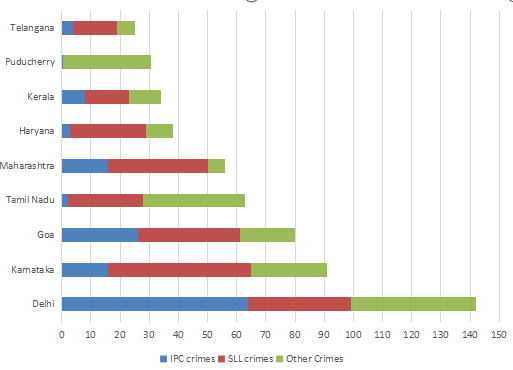
The table below shows the ranks of the ten states/UTs mentioned above among ALL states/UTs of India in terms of the number of cases registered in each of the three category of crimes. A state/UT is given rank r for a category of crimes if there are (r‐1) states/UTs having a larger number of cases registered in that category of crimes. For example, if two states have the same number of cases in a category, and exactly three other states/UTs have larger numbers of cases registered in the same category, then both the states are given rank 4 in that category. Missing ranks in the table are denoted by *.
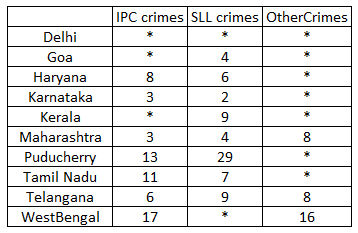
What is the rank of Kerala in the ‘IPC crimes’ category?
The data can be tabulated as follows(approximately):
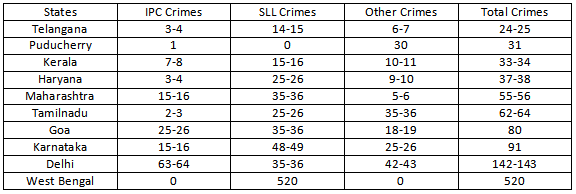
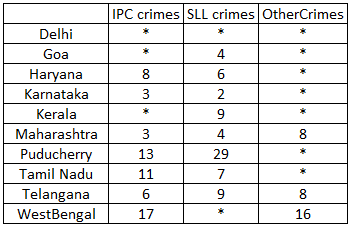
Rank of Delhi in IPC crimes category = 1, The rank of Karnataka and Maharashtra is 3(from table), then the rank of Goa can only be 2.
The rank of Telangana is 6 which has less |IPC crimes than Kerala, which means the rank of Kerala can be less than or equal to 5.
Now, there are two states with 3 ranks, so there will be no rank 4, there can only be rank 5 which is Kerala.

In the two states where the highest total number of cases are registered, the ratio of the total number of cases in IPC crimes to the total number in SLL crimes is closest to
The data can be tabulated as follows(approximately):
The highest cases are registered in West Bengal and Delhi.
The total number of IPC crimes = 63-64
The total number of SLL crimes = 520+35-36 = 555-556
Hence the ratio = (63-64)/(555-556) = 0.11 (Approximately) = 1:9
Which of the following is DEFINITELY true about the ranks of states/UT in the ‘other crimes’ category?
i) Tamil Nadu: 2
ii) Puducherry: 3
The data can be tabulated as follows(approximately):
From the table, the rank of Tamilnadu in other crimes is 2. The states which are not in the table will have crimes less than Telangana(i.e 24-25)
From the table the rank of Pudducherry in other crimes is 3.
What is the sum of the ranks of Delhi in the three categories of crimes?
The data can be tabulated as follows(approximately):
The data can be tabulated as follows(approximately):
The rank of Delhi in IPC crimes should be 1 because the states which are not in table cannot crime more than that of Telangana which is 24-25.
Similarly Delhi Rank in Other crimes will be 1.
Now in SLL crimes clearly West Bengal has rank 1. It is given that Karnataka has rank 2. The rank 3 can go to either Goa, Delhi and Maharashtra but Goa and Maharashtra already have rank 4. So Delhi will have rank 3. Also no state outside of the table can be ranked 3 in SLL crimes as maximum number of crime should be less than that of Telangana(24-25). Here the number of SLL crimes is 35-36.
Hence the sum of the ranks = 1+3+1=5

The figure below shows the street map for a certain region with the street intersections marked from a through l. A person standing at an intersection can see along straight lines to other intersections that are in her line of sight and all other people standing at these intersections. For example, a person standing at intersection g can see all people standing at intersections b, c, e, f, h, and k. In particular, the person standing at intersection g can see the person standing at intersection e irrespective of whether there is a person standing at intersection f.
Six people U, V, W, X, Y, and Z, are standing at different intersections. No two people are standing at the same intersection.
The following additional facts are known.
1. X, U, and Z are standing at the three corners of a triangle formed by three street segments.
2. X can see only U and Z.
3. Y can see only U and W.
4. U sees V standing in the next intersection behind Z.
5. W cannot see V or Z.
6. No one among the six is standing at intersection d.
Who is standing at intersection a?
From 1, X, U, and Z are standing at the three corners of a triangle formed by three street segments.
From 2, X can see only U and Z.
From 4, U sees V standing in the next intersection behind Z. Also, no one among the six is standing at intersection d.
Only cases possible are:
1.
W cannot see V or Z. So W can only be at the intersection a. Since Y can see only U and W, Y can only be at c where X can see him. Hence this case is rejected.
2.
Y can only see U and W. Y cannot be placed anywhere. Hence this case is also rejected.
3.
Y can only see U and W. Y cannot be placed anywhere. Hence this case is also rejected.
4.
W cannot see V or Z. W can only be placed at i. Y can see only U and W. Y can only be placed at j or e, where he can see more people than U and W. Hence this case is also rejected.
5.
W cannot see V or Z. Y can only see U and W. Hence W and Y can only be placed as shown:
No one is standing at the intersection A. Hence C is the answer.
Who can V see?
From 1, X, U, and Z are standing at the three corners of a triangle formed by three street segments.
From 2, X can see only U and Z.
From 4, U sees V standing in the next intersection behind Z. Also, no one among the six is standing at intersection d.
Only cases possible are:
1.
W cannot see V or Z. So W can only be at the intersection a. Since Y can see only U and W, Y can only be at c where X can see him. Hence this case is rejected.
2.
Y can only see U and W. Y cannot be placed anywhere. Hence this case is also rejected.
3.
Y can only see U and W. Y cannot be placed anywhere. Hence this case is also rejected.
4.
W cannot see V or Z. W can only be placed at i. Y can see only U and W. Y can only be placed at j or e, where he can see more people than U and W. Hence this case is also rejected.
5.
W cannot see V or Z. Y can only see U and W. Hence W and Y can only be placed as shown:
V can see U and Z only. Hence C is the answer.
What is the minimum number of street segments that X must cross to reach Y?
From 1, X, U, and Z are standing at the three corners of a triangle formed by three street segments.
From 2, X can see only U and Z.
From 4, U sees V standing in the next intersection behind Z. Also, no one among the six is standing at intersection d.
Only cases possible are:
1.
W cannot see V or Z. So W can only be at the intersection a. Since Y can see only U and W, Y can only be at c where X can see him. Hence this case is rejected.
2.
Y can only see U and W. Y cannot be placed anywhere. Hence this case is also rejected.
3.
Y can only see U and W. Y cannot be placed anywhere. Hence this case is also rejected.
4.
W cannot see V or Z. W can only be placed at i. Y can see only U and W. Y can only be placed at j or e, where he can see more people than U and W. Hence this case is also rejected.
5.
W cannot see V or Z. Y can only see U and W. Hence W and Y can only be placed as shown:
To reach Y, X has to go from b to g and g to k, i.e. 2 streets.

Should a new person stand at intersection d, who among the six would she see?
From 1, X, U, and Z are standing at the three corners of a triangle formed by three street segments.
From 2, X can see only U and Z.
From 4, U sees V standing in the next intersection behind Z. Also, no one among the six is standing at intersection d.
Only cases possible are:
1.
W cannot see V or Z. So W can only be at the intersection a. Since Y can see only U and W, Y can only be at c where X can see him. Hence this case is rejected.
2.
Y can only see U and W. Y cannot be placed anywhere. Hence this case is also rejected.
3.
Y can only see U and W. Y cannot be placed anywhere. Hence this case is also rejected.
4.
W cannot see V or Z. W can only be placed at i. Y can see only U and W. Y can only be placed at j or e, where he can see more people than U and W. Hence this case is also rejected.
5.
W cannot see V or Z. Y can only see U and W. Hence W and Y can only be placed as shown:
If a new person stands at d(left down corner), they can see W and X only. Hence A is the answer.
Princess, Queen, Rani and Samragni were the four finalists in a dance competition. Ashman, Badal, Gagan and Dyu were the four music composers who individually assigned items to the dancers. Each dancer had to individually perform in two dance items assigned by the different composers. The first items performed by the four dancers were all assigned by different music composers. No dancer performed her second item before the performance of the first item by any other dancers. The dancers performed their second items in the same sequence of their performance of their first items.
The following additional facts are known.
i) No composer who assigned item to Princess, assigned any item to Queen.
ii) No composer who assigned item to Rani, assigned any item to Samragni.
iii) The first performance was by Princess; this item was assigned by Badal.
iv) The last performance was by Rani; this item was assigned by Gagan.
v) The items assigned by Ashman were performed consecutively. The number of performances between items assigned by each of the remaining composers was the same.
Which of the following is true?

Since the dancers performed their second items in the same sequence of their performance of their first items. The table will be as follows:

The items assigned by Ashman were performed consecutively. The number of performances between items assigned by each of the remaining composers was the same.
Also, the first items performed by the four dancers were all assigned by different music composers. Badal can come only at the place as shown in the table.

Then Ashman can only compose for the following performances.

Hence Dyu will compose for the following performances:

From (i) No composer who assigned item to Princess, assigned any item to Queen.
From (ii) No composer who assigned item to Rani, assigned any item to Samragni.
Hence Dyu will compose for Samragni 1st Performance and Gagan will compose for Queen 1st Performance. Also, Badal will compose for Samragni 2nd Performance and Dyu will compose for Queens 2nd Performance.
Hence, the complete table is as follows:

The second performance was composed by Dyu. Hence A is the answer.
Which of the following is FALSE?
Since the dancers performed their second items in the same sequence of their performance of their first items. The table will be as follows:
The items assigned by Ashman were performed consecutively. The number of performances between items assigned by each of the remaining composers was the same.
Also, the first items performed by the four dancers were all assigned by different music composers. Badal can come only at the place as shown in the table.
Then Ashman can only compose for the following performances.
Hence Dyu will compose for the following performances:
From (i) No composer who assigned item to Princess, assigned any item to Queen.
From (ii) No composer who assigned item to Rani, assigned any item to Samragni.
Hence Dyu will compose for Samragni 1st Performance and Gagan will compose for Queen 1st Performance. Also, Badal will compose for Samragni 2nd Performance and Dyu will compose for Queens 2nd Performance.
Hence, the complete table is as follows:
Option A: Samragni did not perform in any item composed by Ashman. This statement is true.
Option B: Princess did not perform in any item composed by Dyu. This is also true.
Option C: Rani did not perform in any item composed by Badal. This statement is true.
Option D: Queen did not perform in any item composed by Gagan. This statement is false.
Hence D is the answer.

The sixth performance was composed by:
Since the dancers performed their second items in the same sequence of their performance of their first items. The table will be as follows:
The items assigned by Ashman were performed consecutively. The number of performances between items assigned by each of the remaining composers was the same.
Also, the first items performed by the four dancers were all assigned by different music composers. Badal can come only at the place as shown in the table.
Then Ashman can only compose for the following performances.
Hence Dyu will compose for the following performances:
From (i) No composer who assigned item to Princess, assigned any item to Queen.
From (ii) No composer who assigned item to Rani, assigned any item to Samragni.
Hence Dyu will compose for Samragni 1st Performance and Gagan will compose for Queen 1st Performance. Also, Badal will compose for Samragni 2nd Performance and Dyu will compose for Queens 2nd Performance.
Hence, the complete table is as follows:
The sixth performance was composed by Badal. Hence C is the answer.
Which pair of performances were composed by the same composer?
Since the dancers performed their second items in the same sequence of their performance of their first items. The table will be as follows:
The items assigned by Ashman were performed consecutively. The number of performances between items assigned by each of the remaining composers was the same.
Also, the first items performed by the four dancers were all assigned by different music composers. Badal can come only at the place as shown in the table.
Then Ashman can only compose for the following performances.
Hence Dyu will compose for the following performances:
From (i) No composer who assigned item to Princess, assigned any item to Queen.
From (ii) No composer who assigned item to Rani, assigned any item to Samragni.
Hence Dyu will compose for Samragni 1st Performance and Gagan will compose for Queen 1st Performance. Also, Badal will compose for Samragni 2nd Performance and Dyu will compose for Queens 2nd Performance.
Hence, the complete table is as follows:
The first and the sixth items were composed by Badal. Hence D is the answer.
A new game show on TV has 100 boxes numbered 1, 2, . . . , 100 in a row, each containing a mystery prize. The prizes are items of different types, a, b, c, . . . , in decreasing order of value. The most expensive item is of type a, a diamond ring, and there is exactly one of these. You are told that the number of items at least doubles as you move to the next type. For example, there would be at least twice as many items of type b as of type a, at least twice as many items of type c as of type b and so on. There is no particular order in which the prizes are placed in the boxes.
What is the minimum possible number of different types of prizes?
It is given that the most expensive item is a diamond ring of type a and there is exactly one of these. Since the item b should be at least twice. The minimum number of items will be obtained when a=1 and b=99, which means there are only two different types of items.
What is the maximum possible number of different types of prizes?
It is given that the most expensive item is a diamond ring of type a and there is exactly one of these. Since the number of items of type b should be at least twice of that of a and the number of items of type c should be at least twice of that of b and so on. So the maximum number of different types of items of a, b and c will be obtained when a=1, b=2, c=4, d=8, e=16, f=69. Hence the maximum number of different types of items will be 6.
If the number of items is 7, then the minimum number of prizes should be 1+2+4+8+16+32+64=127 which is more than 100.
Hence 6 is the answer.
Which of the following is not possible?
Option A: There are exactly 75 items of type e.
a=1,b=2,c=4,d=8, e=85. Here the maximum value of e= 85. Hence it can take the value 75.
An example of such case is a=1,b=2,c=4,d=18, e=75
Option B: There are exactly 30 items of type b.
a=1 b=30 and c=69. Hence this case is also possible.
Option C: There are exactly 45 items of type c.
Since the value of d should be at least 90, it means that d is not present because 45+90 will be more than 100(maximum number of items). Only a,b and c are present.
The maximum value of b = 22 and a =1, but 45+22+1=68, which is less than 100. So this case is not possible.
Option D: There are exactly 60 items of type d.
d=60, c=30, b=9 and a=1. a+b+c+d=100. Hence this case is possible.
C is the answer.
You ask for the type of item in box 45. Instead of being given a direct answer, you are told that there are 31 items of the same type as box 45 in boxes 1 to 44 and 43 items of the same type as box 45 in boxes 46 to 100.
What is the maximum possible number of different types of items?
The total number of items from 1 to 100, which are of same type as in box 45 = 31+1+43=75
Now to maximize the number of items, a=1, b=2, c=4, d=18 and e=75(given)
There can be maximum 5 types of items.
If we consider number of items to be 6, then minimum number of items of 5th type will be 16, 1+2+4+8+16+75=106 which is more than 100.
Two cars travel the same distance starting at 10:00 am and 11:00 am, respectively, on the same day. They reach their common destination at the same point of time. If the first car travelled for at least 6 hours, then the highest possible value of the percentage by which the speed of the second car could exceed that of the first car is
Let the speed of cars be a and b and the distance =d
Minimum time taken by 1st car = 6 hours,
For maximum difference in time taken by both of them, car 1 has to start at 10:00 AM and car 2 has to start at 11:00 AM.
Hence, car 2 will take 5 hours.
Hence a= $$\ \frac{\ d}{6}$$ and b = $$\ \frac{\ d}{5}$$
Hence the speed of car 2 will exceed the speed of car 1 by $$\ \dfrac{\ \ \frac{\ d}{5}-\ \frac{\ d}{6}}{\ \frac{\ d}{6}}\times\ 100$$ = $$\ \dfrac{\ \ \frac{\ d}{30}}{\ \frac{\ d}{6}}\times\ 100$$ = 20
If $$a_1, a_2, ......$$ are in A.P., then, $$\frac{1}{\sqrt{a_1} + \sqrt{a_2}} + \frac{1}{\sqrt{a_2} + \sqrt{a_3}} + ....... + \frac{1}{\sqrt{a_n} + \sqrt{a_{n + 1}}}$$ is equal to
We have, $$\frac{1}{\sqrt{a_1} + \sqrt{a_2}} + \frac{1}{\sqrt{a_2} + \sqrt{a_3}} + ....... + \frac{1}{\sqrt{a_n} + \sqrt{a_{n + 1}}}$$
Now, $$\frac{1}{\sqrt{a_1} + \sqrt{a_2}}$$ = $$\frac{\sqrt{a_2} - \sqrt{a_1}}{(\sqrt{a_2} + \sqrt{a_1})(\sqrt{a_2} - \sqrt{a_1})}$$ (Multiplying numerator and denominator by $$\sqrt{a_2} - \sqrt{a_1}$$)
= $$\frac{\sqrt{a_2} - \sqrt{a_1}}{({a_2} - {a_1}}$$
=$$\frac{\sqrt{a_2} - \sqrt{a_1}}{d}$$ (where d is the common difference)
Similarly, $$ \frac{1}{\sqrt{a_2} + \sqrt{a_3}}$$ = $$\frac{\sqrt{a_3} - \sqrt{a_2}}{d}$$ and so on.
Then the expression $$\frac{1}{\sqrt{a_1} + \sqrt{a_2}} + \frac{1}{\sqrt{a_2} + \sqrt{a_3}} + ....... + \frac{1}{\sqrt{a_n} + \sqrt{a_{n + 1}}}$$
can be written as $$\ \frac{\ 1}{d}(\sqrt{a_2}-\sqrt{a_1}+\sqrt{a_3}-\sqrt{a_3}+..........................\sqrt{a_{n+1}} - \sqrt{a_{n}}$$
= $$\ \frac{\ n}{nd}(\sqrt{a_{n+1}}-\sqrt{a_1})$$ (Multiplying both numerator and denominator by n)
= $$\ \frac{n(\sqrt{a_{n+1}}-\sqrt{a_1})}{{a_{n+1}} - {a_1}}$$ $$(a_{n+1} - {a_1} =nd)$$
= $$\frac{n}{\sqrt{a_1} + \sqrt{a_{n + 1}}}$$
AB is a diameter of a circle of radius 5 cm. Let P and Q be two points on the circle so that the length of PB is 6 cm, and the length of AP is twice that of AQ. Then the length, in cm, of QB is nearest to
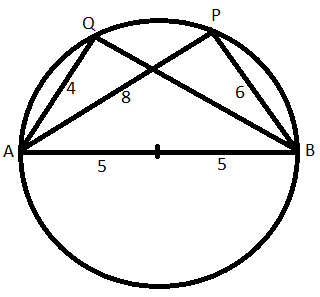
Since AB is a diameter, AQB and APB will right angles.
In right triangle APB, AP = $$\sqrt{10^2-6^2}=8$$
Now, 2AQ=AP => AQ= 8/2=4
In right triangle AQB, AP = $$\sqrt{10^2-4^2}=9.165$$ =9.1 (Approx)
If $$(5.55)^x = (0.555)^y = 1000$$, then the value of $$\frac{1}{x} - \frac{1}{y}$$ is
We have, $$(5.55)^x = (0.555)^y = 1000$$
Taking log in base 10 on both sides,
x($$\log_{10}555$$-2) = y($$\log_{10}555$$-3) = 3
Then, x($$\log_{10}555$$-2) = 3.....(1)
y($$\log_{10}555$$-3) = 3 .....(2)
From (1) and (2)
=> $$\log_{10}555$$=$$\ \frac{\ 3}{x}$$+2=$$\ \frac{\ 3}{y}+3$$
=> $$\frac{1}{x} - \frac{1}{y}$$ = $$\frac{1}{3}$$
The income of Amala is 20% more than that of Bimala and 20% less than that of Kamala. If Kamala's income goes down by 4% and Bimala's goes up by 10%, then the percentage by which Kamala's income would exceed Bimala's is nearest to
Assuming the income of Bimla = 100a, then the income of Amala will be 120a.
And the income of Kamala will be 120a*100/80=150a
If Kamala's income goes down by 4%, then new income of Kamala = 150a-150a(4/100) = 150a-6a=144a
If Bimla's income goes up by 10 percent, her new income will be 100a+100a(10/100)=110a
=> Hence the Kamala income will exceed Bimla income by (144a-110a)*100/110a=31
The wheels of bicycles A and B have radii 30 cm and 40 cm, respectively. While traveling a certain distance, each wheel of A required 5000 more revolutions than each wheel of B. If bicycle B traveled this distance in 45 minutes, then its speed, in km per hour, was
Distance covered by A in 1 revolution = 2$$\pi\ $$*30 = 60$$\pi\ $$
Distance covered by B in 1 revolution = 2$$\pi\ $$*40 = 80$$\pi\ $$
Now, (5000+n)60$$\pi\ $$ = 80$$\pi\ $$n
=> 15000= 4n-3n =>n=15000
Then distance travelled by B = 15000*80$$\pi\ $$ cm = 12$$\pi\ $$ km
Hence, the speed = $$\ \frac{\ 12\pi\times\ 60\ }{45}$$ = 16$$\pi\ $$
The product of the distinct roots of $$\mid x^2 - x - 6 \mid = x + 2$$ is
We have, $$\mid x^2 - x - 6 \mid = x + 2$$
=> |(x-3)(x+2)|=x+2
For x<-2, (3-x)(-x-2)=x+2
=> x-3=1 =>x=4 (Rejected as x<-2)
For -2$$\le\ $$x<3, (3-x)(x+2)=x+2 =>x=2,-2
For x$$\ge\ $$3, (x-3)(x+2)=x+2 =>x=4
Hence the product =4*-2*2=-16
In a race of three horses, the first beat the second by 11 metres and the third by 90 metres. If the second beat the third by 80 metres, what was the length, in metres, of the racecourse?
Assuming the length of race course = x and the speed of three horses be a,b and c respectively.
Hence, $$\ \frac{\ x}{a}=\ \frac{\ x-11}{b}$$......(1)
and $$\ \frac{\ x}{a}=\ \frac{\ x-90}{c}$$......(2)
Also, $$\ \frac{\ x}{b}=\ \frac{\ x-80}{c}$$......(3)
From 1 and 2, we get, $$\ \frac{\ x-11}{b}=\ \frac{\ x-90}{c}$$ .....(4)
Dividing (3) by (4), we get, $$\ \frac{\ x-11}{x}=\ \frac{\ x-90}{x-80}$$
=> (x-11)(x-80)=x(x-90)
=> 91x-90x=880 => x=880
If the population of a town is p in the beginning of any year then it becomes 3 + 2p in the beginning of the next year. If the population in the beginning of 2019 is 1000, then the population in the beginning of 2034 will be
The population of town at the beginning of 1st year = p
The population of town at the beginning of 2nd year = 3+2p
The population of town at the beginning of 3rd year = 2(3+2p)+3 = 2*2p+2*3+3 =4p+3(1+2)
The population of town at the beginning of 4th year = 2(2*2p+2*3+3)+3 = 8p+3(1+2+4)
Similarly population at the beginning of the nth year = $$2^{n-1}$$p+3($$2^{n-1}-1$$) = $$2^{n-1}\left(p+3\right)$$-3
The population in the beginning of 2019 is 1000, then the population in the beginning of 2034 will be $$(2^{2034-2019})\left(1000+3\right)$$-3 = $$2^{15}\left(1003\right)$$-3
Consider a function f satisfying f (x + y) = f (x) f (y) where x,y are positive integers, and f(1) = 2. If f(a + 1) +f (a + 2) + ... + f(a + n) = 16 (2$$^n$$ - 1) then a is equal to
f (x + y) = f (x) f (y)
Hence, f(2)=f(1+1)=f(1)*f(1)=2*2=4
f(3)=f(2+1)=f(2)*f(1)=4*2=8
f(4)=f(3+1)=f(3)*f(1)=8*2=16
.......=> f(x)=$$2^x$$
Now, f(a + 1) +f (a + 2) + ... + f(a + n) = 16 (2$$^n$$ - 1)
On putting n=1 in the equation we get, f(a+1)=16 => f(a)*f(1)=16 (It is given that f (x + y) = f (x) f (y))
=> $$2^a$$*2=16
=> a=3
Amala, Bina, and Gouri invest money in the ratio 3 : 4 : 5 in fixed deposits having respective annual interest rates in the ratio 6 : 5 : 4. What is their total interest income (in Rs) after a year, if Bina's interest income exceeds Amala's by Rs 250?
Assuming the investment of Amala, Bina, and Gouri be 300x, 400x and 500x, hence the interest incomes will be 300x*6/100=18x, 400x*5/100=20x and 500x*4/100 = 20x
Given, Bina's interest income exceeds Amala by 20x-18x=2x=250 => x=125
Now, total interest income = 18x+20x+20x=58x = 58*125 = 7250
For any positive integer n, let f(n) = n(n + 1) if n is even, and f(n) = n + 3 if n is odd. If m is a positive integer such that 8f(m + 1) - f(m) = 2, then m equals
Assuming m is even, then 8f(m+1)-f(m)=2
m+1 will be odd
So, 8(m+1+3)-m(m+1)=2
=> 8m+32-$$m^2-m$$=2
=> $$m^2-7m-30=0$$
=> m=10,-3
Rejecting the negative value, we get m=10
Assuming m is odd, m+1 will be even.
then, 8(m+1)(m+2)-m-3=2
=> 8($$m^2+3m+2$$)-m-3=2
=> $$8m^2+23m+11=0$$
Solving this, m = -2.26 and -0.60
Hence, the value of m is not integral. Hence this case will be rejected.
The product of two positive numbers is 616. If the ratio of the difference of their cubes to the cube of their difference is 157:3, then the sum of the two numbers is
Assume the numbers are a and b, then ab=616
We have, $$\ \ \frac{\ a^3-b^3}{\left(a-b\right)^3}$$ = $$\ \frac{\ 157}{3}$$
=> $$\ 3\left(a^3-b^3\right)\ =\ 157\left(a^3-b^3+3ab\left(b-a\right)\right)$$
=> $$154\left(a^3-b^3\right)+3*157*ab\left(b-a\right)$$ = 0
=> $$154\left(a^3-b^3\right)+3*616*157\left(b-a\right)$$ = 0 (ab=616)
=>$$a^3-b^3+\left(3\times\ 4\times\ 157\left(b-a\right)\right)$$ (154*4=616)
=> $$\left(a-b\right)\left(a^2+b^2+ab\right)\ =\ 3\times\ 4\times\ 157\left(a-b\right)$$
=> $$a^2+b^2+ab\ =\ 3\times\ 4\times\ 157$$
Adding ab=616 on both sides, we get
$$a^2+b^2+ab\ +ab=\ 3\times\ 4\times\ 157+616$$
=> $$\left(a+b\right)^2=\ 3\times\ 4\times\ 157+616$$ = 2500
=> a+b=50
One can use three different transports which move at 10, 20, and 30 kmph, respectively to reach from A to B. Amal took each mode of transport for $$\frac{1}{3}^{rd}$$ of his total journey time, while Bimal took each mode of transport for $$\frac{1}{3}^{rd}$$ of the total distance. The percentage by which Bimal’s travel time exceeds Amal’s travel time is nearest to
Assume the total distance between A and B as d and time taken by Amal = t
Since Amal travelled $$\frac{1}{3}^{rd}$$ of his total journey time in different speeds
d = $$\ \frac{\ t}{3}\times\ 10+\ \frac{\ t}{3}\times\ 20+\frac{\ t}{3}\times\ 30\ \ =\ 20t$$
$$\text{Total time taken by Bimal} = \ \frac{d_1}{s_1}+\frac{d_2}{s_2}+\frac{d_3}{s_3}$$
$$=\ \frac{20t}{3}\times\ \frac{1}{10}+\frac{20t}{3}\times\ \frac{1}{20}+\frac{20t}{3}\times\ \frac{1}{30}\ \ =\frac{20t\left(6+3+2\right)}{3\ \times30}\ =\frac{11}{9}t$$
Hence, the ratio of time taken by Bimal to time taken by Amal = $$\frac{\frac{11t}{9}}{t}=\frac{11}{9}$$
Therefore, Bimal will exceed Amal's time by $$\ \ \ \frac{\ \ \frac{\ 11t}{9}-t}{t}\times\ 100 = 22.22%$$
Meena scores 40% in an examination and after review, even though her score is increased by 50%, she fails by 35 marks. If her post-review score is increased by 20%, she will have 7 marks more than the passing score. The percentage score needed for passing the examination is
Assuming the maximum marks =100a, then Meena got 40a
After increasing her score by 50%, she will get 40a(1+50/100)=60a
Passing score = 60a+35
Post review score after 20% increase = 60a*1.2=72a
=>Hence, 60a+35+7=72a
=>12a=42 =>a=3.5
=> maximum marks = 350 and passing marks = 210+35=245
=> Passing percentage = 245*100/350 = 70
A person invested a total amount of Rs 15 lakh. A part of it was invested in a fixed deposit earning 6% annual interest, and the remaining amount was invested in two other deposits in the ratio 2 : 1, earning annual interest at the rates of 4% and 3%, respectively. If the total annual interest income is Rs 76000 then the amount (in Rs lakh) invested in the fixed deposit was
Assuming the amount invested in the ratio 2:1 was 200x and 100x, then the fixed deposit investment = 1500000-300x
Hence, the interest = 200x*4/100 = 8x and 100x*3/100=3x
Interest from the fixed deposit = (1500000-300x)*6/100 = 90000-18x
Hence the total interest = 90000-18x+8x+3x=90000-7x =76000
=> 7x=14000 => x=2000
Hence, the fixed deposit investment = 1500000-300*2000 = 900000 = 9 lakhs
A club has 256 members of whom 144 can play football, 123 can play tennis, and 132 can play cricket. Moreover, 58 members can play both football and tennis, 25 can play both cricket and tennis, while 63 can play both football and cricket. If every member can play at least one game, then the number of members who can play only tennis is
Assume the number of members who can play exactly 1 game = I
The number of members who can play exactly 2 game = II
The number of members who can play exactly 3 game = III
I+2II+3III=144+123+132=399....(1)
I+II+III=256......(2)
subtracting (1) from (2), we get
=> II+2III=143.....(3)
Also, II+3III=58+25+63=146 ......(4)
subtracting (3) from (4), we get
=> III = 3 (From 3 and 4)
=> II =137
=> I = 116
The members who play only tennis = 123-58-25+3 = 43
If $$a_1 + a_2 + a_3 + .... + a_n = 3(2^{n + 1} - 2)$$, for every $$n \geq 1$$, then $$a_{11}$$ equals
11th term of series = $$a_{11}$$ = Sum of 11 terms - Sum of 10 terms = $$3(2^{11 + 1} - 2)$$-3$$(2^{10 + 1} - 2)$$
= 3$$(2^{12} - 2-2^{11} +2)$$=3$$(2^{11})(2-1)$$= 3*$$2^{11}$$ = 6144
The number of the real roots of the equation $$2 \cos (x(x + 1)) = 2^x + 2^{-x}$$ is
$$2 \cos (x(x + 1)) = 2^x + 2^{-x}$$
The maximum value of LHS is 2 when $$\cos (x(x + 1))$$ is 1 and the minimum value of RHS is 2 using AM $$\geq$$ GM
Hence LHS and RHS can only be equal when both sides are 2. For LHS, cosx(x+1)=1 => x(x+1)=0 => x=0,-1
For RHS minimum value, x=0
Hence only one solution x=0
At their usual efficiency levels, A and B together finish a task in 12 days. If A had worked half as efficiently as she usually does, and B had worked thrice as efficiently as he usually does, the task would have been completed in 9 days. How many days would A take to finish the task if she works alone at her usual efficiency?
Assuming A completes a units of work in a day and B completes B units of work in a day and the total work = 1 unit
Hence, 12(a+b)=1.........(1)
Also, 9($$\ \frac{\ a}{2}$$+3b)=1 .........(2)
Using both equations, we get, 12(a+b)= 9($$\ \frac{\ a}{2}$$+3b)
=> 4a+4b=$$\ \frac{\ 3a}{2}$$+9b
=> $$\ \frac{\ 5a}{2}$$=5b
=> a=2b
Substituting the value of b in equation (1),
12($$\ \frac{\ 3a}{2}$$)=1
=> a=$$\ \frac{\ 1}{18}$$
Hence, the number of days required = 1/($$\ \frac{\ 1}{18}$$)=18
In a class, 60% of the students are girls and the rest are boys. There are 30 more girls than boys. If 68% of the students, including 30 boys, pass an examination, the percentage of the girls who do not pass is
Assuming the number of students =100x
Hence, the number of girls = 60x and the number of boys = 40x
We have, 60x-40x=30 => x=1.5
The number of girls = 60*1.5=90
Number of girls that pass = 68x-30=68*1.5-30 = 102-30=72
The number of girls who do not pass = 90-72=18
Hence the percentage of girls who do not pass = 1800/90=20
In a circle of radius 11 cm, CD is a diameter and AB is a chord of length 20.5 cm. If AB and CD intersect at a point E inside the circle and CE has length 7 cm, then the difference of the lengths of BE and AE, in cm, is
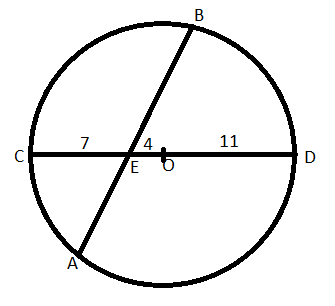
In figure AE*BE=CE*DE (The intersecting chords theorem)
=> 7*15= x(20.5-x) (Assuming AE=x)
=> 210=x(41-2x)
=> $$2x^2$$-41x+210=0
=> x=10 or x=10.5 => AE=10 or AE=10.5 Hence BE = 20.5-10=10.5 or BE = 20.5-10.5=10
Required difference= 10.5-10=0.5
On selling a pen at 5% loss and a book at 15% gain, Karim gains Rs. 7. If he sells the pen at 5% gain and the book at 10% gain, he gains Rs. 13. What is the cost price of the book in Rupees?
Assuming the cost price of pen = 100p and the cost price of book = 100b
So, on selling a pen at 5% loss and a book at 15% gain, net gain = -5p+15b = 7 ....1
On selling the pen at 5% gain and the book at 10% gain, net gain = 5p+10b = 13 .....2
Adding 1 and 2 we get, 25b=20
Hence 100b= 20*4=80,
C is the answer.
A chemist mixes two liquids 1 and 2. One litre of liquid 1 weighs 1 kg and one litre of liquid 2 weighs 800 gm. If half litre of the mixture weighs 480 gm, then the percentage of liquid 1 in the mixture, in terms of volume, is
The weight/volume(g/L) for liquid 1 = 1000
The weight/volume(g/L) for liquid 2 = 800
The weight/volume(g/L) of the mixture = 480/(1/2) = 960
Using alligation the ratio of liquid 1 and liquid 2 in the mixture = (960-800)/(1000-960) = 160/40 = 4:1
Hence the percentage of liquid 1 in the mixture = 4*100/(4+1)=80
Ramesh and Gautam are among 22 students who write an examination. Ramesh scores 82.5. The average score of the 21 students other than Gautam is 62. The average score of all the 22 students is one more than the average score of the 21 students other than Ramesh. The score of Gautam is
Assume the average of 21 students other than Ramesh = a
Sum of the scores of 21 students other than Ramesh = 21a
Hence the average of 22 students = a+1
Sum of the scores of all 22 students = 22(a+1)
The score of Ramesh = Sum of scores of all 22 students - Sum of the scores of 21 students other than Ramesh = 22(a+1)-21a=a+22 = 82.5 (Given)
=> a = 60.5
Hence, sum of the scores of all 22 students = 22(a+1) = 22*61.5 = 1353
Now the sum of the scores of students other than Gautam = 21*62 = 1302
Hence the score of Gautam = 1353-1302=51
If m and n are integers such that $$(\surd2)^{19} 3^4 4^2 9^m 8^n = 3^n 16^m (\sqrt[4]{64})$$ then m is
We have, $$(\surd2)^{19} 3^4 4^2 9^m 8^n = 3^n 16^m (\sqrt[4]{64})$$
Converting both sides in powers of 2 and 3, we get
$$2^{\ \frac{19\ }{2}}3^42^43^{2m}2^{3n}$$ = $$3^n2^{4m}2^{\frac{\ 6}{4}}$$
Comparing the power of 2 we get, $$\ \frac{\ 19}{2}+4+3n\ =4m+\frac{\ 6}{4}\ $$
=> 4m=3n+12 .....(1)
Comparing the power of 3 we get, $$4+2m=n$$
Substituting the value of n in (1), we get
4m=3(4+2m)+12
=> m=-12
Three men and eight machines can finish a job in half the time taken by three machines and eight men to finish the same job. If two machines can finish the job in 13 days, then how many men can finish the job in 13 days?
Consider the work done by a man in a day = a and that by a machine = b
Since, three men and eight machines can finish a job in half the time taken by three machines and eight men to finish the same job, hence the efficiency will be double.
=> 3a+8b = 2(3b+8a)
=> 13a=2b
Hence work done by 13 men in a day = work done by 2 machines in a day.
=> If two machines can finish the job in 13 days, then same work will be done 13 men in 13 days.
Hence the required number of men = 13
Corners are cut off from an equilateral triangle T to produce a regular hexagon H. Then, the ratio of the area of H to the area of T is
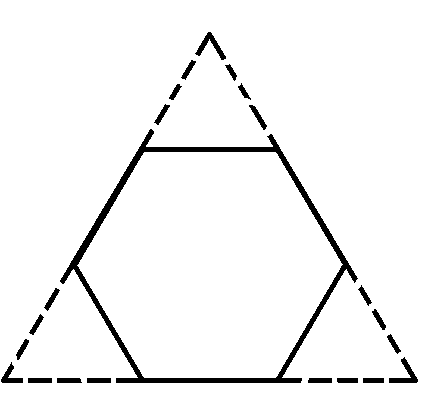
The given figure can be divided into 9 regions or equilateral triangles of equal areas as shown below,
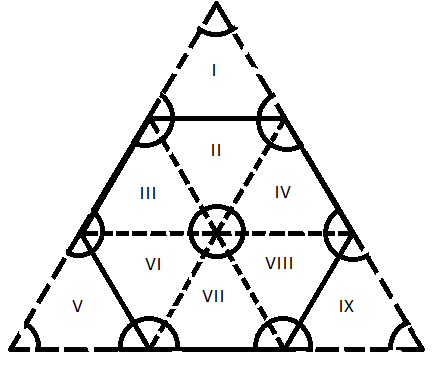
Now the hexagon consists of 6 regions and the triangle consists of 9 regions.
Hence the ratio of areas = 6/9 =2:3
Let x and y be positive real numbers such that
$$\log_{5}{(x + y)} + \log_{5}{(x - y)} = 3,$$ and $$\log_{2}{y} - \log_{2}{x} = 1 - \log_{2}{3}$$. Then $$xy$$ equals
We have, $$\log_{5}{(x + y)} + \log_{5}{(x - y)} = 3$$
=> $$x^2-y^2=125$$......(1)
$$\log_{2}{y} - \log_{2}{x} = 1 - \log_{2}{3}$$
=>$$\ \frac{\ y}{x}$$ = $$\ \frac{\ 2}{3}$$
=> 2x=3y => x=$$\ \frac{\ 3y}{2}$$
On substituting the value of x in 1, we get
$$\ \frac{\ 5x^2}{4}$$=125
=>y=10, x=15
Hence xy=150
Let S be the set of all points (x, y) in the x-y plane such that $$\mid x \mid + \mid y \mid \leq 2$$ and $$\mid x \mid \geq 1.$$ Then, the area, in square units, of the region represented by S equals
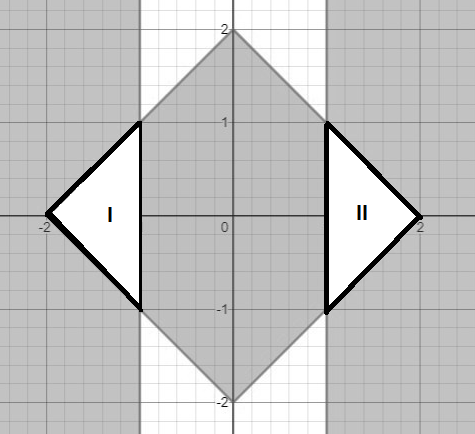
Sum of the area of region I and II is the required area.
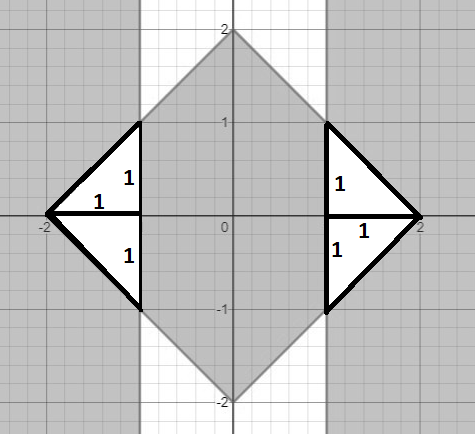
Now, required area = $$\ 4\times\frac{\ 1}{2}\times\ 1\times\ 1$$ = 2
With rectangular axes of coordinates, the number of paths from (1, 1) to (8, 10) via (4, 6), where each step from any point (x, y) is either to (x, y+1) or to (x+1, y), is
The number of paths from (1, 1) to (8, 10) via (4, 6) = The number of paths from (1,1) to (4,6) * The number of paths from (4,6) to (8,10)
To calculate the number of paths from (1,1) to (4,6), 4-1 =3 steps in x-directions and 6-1=5 steps in y direction
Hence the number of paths from (1,1) to (4,6) = $$^{(3+5)}C_3$$ = 56
To calculate the number of paths from (4,6) to (8,10), 8-4 =4 steps in x-directions and 10-6=4 steps in y direction
Hence the number of paths from (4,6) to (8,10) = $$^{(4+4)}C_4$$ = 70
The number of paths from (1, 1) to (8, 10) via (4, 6) = 56*70=3920
If the rectangular faces of a brick have their diagonals in the ratio $$3 : 2 \surd3 : \surd{15}$$, then the ratio of the length of the shortest edge of the brick to that of its longest edge is
Assuming the dimensions of the brick are a, b and c and the diagonals are 3, 2 $$\surd3$$ and $$\surd{15}$$
Hence, $$a^{2\ }+\ b^2$$ = $$3^2$$ ......(1)
$$b^{2\ }+\ c^2$$ = $$(2\sqrt{3})^2$$ ......(2)
$$c^{2\ }+\ a^2$$ = $$(\sqrt{15})^2$$ ......(3)
Adding the three equations, 2($$a^2+b^2+c^2$$) = 9+12+15=36
=>$$a^2+b^2+c^2$$ = 18......(4)
Subtracting (1) from (4), we get $$c^2$$ = 9 =>c=3
Subtracting (2) from (4), we get $$a^2$$ = 6 =>a=$$\sqrt{6}$$
Subtracting (3) from (4), we get $$b^2$$ = 3 =>b=$$\sqrt{3}$$
The ratio of the length of the shortest edge of the brick to that of its longest edge is = $$\ \frac{\ \sqrt{3}}{3}$$ = $$1 : \sqrt{3}$$
The number of solutions to the equation $$\mid x \mid (6x^2 + 1) = 5x^2$$ is
For x <0, -x($$6x^2+1$$) = $$5x^2$$
=> ($$6x^2+1$$) = -5x
=> ($$6x^2 + 5x+ 1$$) = 0
=>($$6x^2 + 3x+2x+ 1$$) = 0
=> (3x+1)(2x+1)=0 =>x=$$\ -\frac{\ 1}{3}$$ or x=$$\ -\frac{\ 1}{2}$$
For x=0, LHS=RHS=0 (Hence, 1 solution)
For x >0, x($$6x^2+1$$) = $$5x^2$$
=> ($$6x^2 - 5x+ 1$$) = 0
=>(3x-1)(2x-1)=0 =>x=$$\ \frac{\ 1}{3}$$ or x=$$\ \frac{\ 1}{2}$$
Hence, the total number of solutions = 5
Let T be the triangle formed by the straight line 3x + 5y - 45 = 0 and the coordinate axes. Let the circumcircle of T have radius of length L, measured in the same unit as the coordinate axes. Then, the integer closest to L is
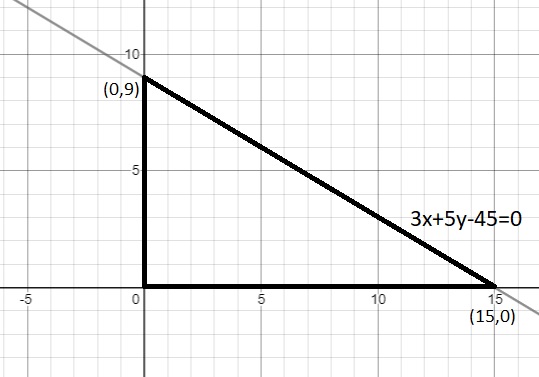
In any right triangle, the circumradius is half of the hypotenuse. Here,L=$$\ \frac{\ 1}{2}\ $$* the length of the hypotenuse = $$\ \frac{\ 1}{2}$$($$\sqrt{\ 15^2+9^2}$$) = $$\ \frac{\ 1}{2}\ $$*$$\sqrt{\ 306}$$ = $$\ \frac{\ 1}{\ 2}\times\ $$17.49 = 8.74
Hence, the integer close to L = 9

Educational materials for CAT preparation
 Share
Share