91- 6303239042


 Group
Group


 Preferred Source

 Google Discover

Top 100 XAT 2026 DM Questions PDF
Our Top 100 XAT 2026 Decision Making (DM) Questions PDF is a simple and helpful resource to improve your DM preparation. The DM section checks your clear thinking, logical reasoning, ethical judgment, and ability to choose the best solution in real-life situations. This PDF includes all major types of XAT DM caselets ethical issues, business problems, HR situations, conflicts, resource decisions, and public policy scenarios—so you can practice every important question type.
Each caselet is designed at the actual XAT difficulty level and comes with easy, step-by-step explanations. Whether you are building your basics or aiming for a 99+ percentile, these 100 questions will help you improve accuracy, decision-making skills, and confidence for XAT 2026.
Why Practice with Our Top 100 DM Questions for XAT 2026?
The XAT DM section tests your analytical thinking, judgment ability, ethics, and practical decision-making skills. Practicing high-quality DM caselets with proper explanations helps you:
-
Understand different types of real-world decision-making scenarios
-
Learn the correct approach to ethical and business dilemmas
-
Improve your ability to evaluate multiple options logically
-
Build accuracy by knowing what XAT considers the “best” choice
-
Gain confidence to handle long and tricky caselets in the exam
With the XAT 2026 Decision Making PDF, you can revise faster, avoid common traps, and consistently improve your performance in one of the most unique and scoring sections of the exam.
List of XAT DM Questions
Read the following case and choose the best alternative Guruji's guidance
Bhola, an avid nature lover, wanted to be an entrepreneur. He dreamt of establishing a chain of huts in Chatpur region to cater to tourists, who came attracted by the beauty and splendour of the Himalayas.
However, he was appalled by current degradation of the Himalayan environment. He remembered the early times when everything was so green, clean and peaceful. Now, greenery was replaced by buildings, peace was shattered by honking of vehicles and flocking of tourists, and cleanliness was replaced by heaps of plastics.
Bhola had a strong sense of right and wrong. On speaking to few locals about the issue, he realized that the locals were aware of these issues. However, they pointed out the benefits of development: pucca houses for locals, higher disposable income and with that, ability to send their children to better schools and colleges, better road connectivity, and access to latest technology in agriculture. Most locals wanted the development to continue.
Saddened by the lack of support from the locals, Bhola took up the issue with the government. He met the chief minister of the state to find out if government could regulate the developmental activities to prevent environmental degradation. However, the chief minister told Bhola that such an action would slow down the economic progress. That also meant loss of substantial tax revenues for the government.
Bhola needed to resolve the dilemma. Bhola always wanted to be an entrepreneur, who could contribute to the society and earn money as well. However, his business would also be responsible for destroying environment. If he did not set up His business, he would not be able to earn money and contribute to the society.
After mulling over the issues, he went to his mentor "Guruji". Guruji realized that it was really a difficult puzzle: if one saves the environment, there seems to be no development and if the people and the government sought development, the environment and hence future of this planet and human beings was at stake. After careful thought, he felt that the dilemma could be resolved. He fixed up a meeting with Bhola to answer Bhola's queries.
Question 1
Should Bhola still think of doing business?
correct answer:- 3
Read the following case and choose the best alternative Guruji's guidance
Bhola, an avid nature lover, wanted to be an entrepreneur. He dreamt of establishing a chain of huts in Chatpur region to cater to tourists, who came attracted by the beauty and splendour of the Himalayas.
However, he was appalled by current degradation of the Himalayan environment. He remembered the early times when everything was so green, clean and peaceful. Now, greenery was replaced by buildings, peace was shattered by honking of vehicles and flocking of tourists, and cleanliness was replaced by heaps of plastics.
Bhola had a strong sense of right and wrong. On speaking to few locals about the issue, he realized that the locals were aware of these issues. However, they pointed out the benefits of development: pucca houses for locals, higher disposable income and with that, ability to send their children to better schools and colleges, better road connectivity, and access to latest technology in agriculture. Most locals wanted the development to continue.
Saddened by the lack of support from the locals, Bhola took up the issue with the government. He met the chief minister of the state to find out if government could regulate the developmental activities to prevent environmental degradation. However, the chief minister told Bhola that such an action would slow down the economic progress. That also meant loss of substantial tax revenues for the government.
Bhola needed to resolve the dilemma. Bhola always wanted to be an entrepreneur, who could contribute to the society and earn money as well. However, his business would also be responsible for destroying environment. If he did not set up His business, he would not be able to earn money and contribute to the society.
After mulling over the issues, he went to his mentor "Guruji". Guruji realized that it was really a difficult puzzle: if one saves the environment, there seems to be no development and if the people and the government sought development, the environment and hence future of this planet and human beings was at stake. After careful thought, he felt that the dilemma could be resolved. He fixed up a meeting with Bhola to answer Bhola's queries.
Question 2
Bhola wanted to advise the government about the new tourism policy. Bhola had developed a few alternatives as given below. Choose the best alternative.
correct answer:- 4
Read the following case and choose the best alternative Guruji's guidance
Bhola, an avid nature lover, wanted to be an entrepreneur. He dreamt of establishing a chain of huts in Chatpur region to cater to tourists, who came attracted by the beauty and splendour of the Himalayas.
However, he was appalled by current degradation of the Himalayan environment. He remembered the early times when everything was so green, clean and peaceful. Now, greenery was replaced by buildings, peace was shattered by honking of vehicles and flocking of tourists, and cleanliness was replaced by heaps of plastics.
Bhola had a strong sense of right and wrong. On speaking to few locals about the issue, he realized that the locals were aware of these issues. However, they pointed out the benefits of development: pucca houses for locals, higher disposable income and with that, ability to send their children to better schools and colleges, better road connectivity, and access to latest technology in agriculture. Most locals wanted the development to continue.
Saddened by the lack of support from the locals, Bhola took up the issue with the government. He met the chief minister of the state to find out if government could regulate the developmental activities to prevent environmental degradation. However, the chief minister told Bhola that such an action would slow down the economic progress. That also meant loss of substantial tax revenues for the government.
Bhola needed to resolve the dilemma. Bhola always wanted to be an entrepreneur, who could contribute to the society and earn money as well. However, his business would also be responsible for destroying environment. If he did not set up His business, he would not be able to earn money and contribute to the society.
After mulling over the issues, he went to his mentor "Guruji". Guruji realized that it was really a difficult puzzle: if one saves the environment, there seems to be no development and if the people and the government sought development, the environment and hence future of this planet and human beings was at stake. After careful thought, he felt that the dilemma could be resolved. He fixed up a meeting with Bhola to answer Bhola's queries.
Question 3
Bhola wished he was heading the government. He had listed down five concrete measures he would take if he were to head the government. Choose the best alternative.
correct answer:- 2
Read the following case and choose the best alternative Guruji's guidance
Bhola, an avid nature lover, wanted to be an entrepreneur. He dreamt of establishing a chain of huts in Chatpur region to cater to tourists, who came attracted by the beauty and splendour of the Himalayas.
However, he was appalled by current degradation of the Himalayan environment. He remembered the early times when everything was so green, clean and peaceful. Now, greenery was replaced by buildings, peace was shattered by honking of vehicles and flocking of tourists, and cleanliness was replaced by heaps of plastics.
Bhola had a strong sense of right and wrong. On speaking to few locals about the issue, he realized that the locals were aware of these issues. However, they pointed out the benefits of development: pucca houses for locals, higher disposable income and with that, ability to send their children to better schools and colleges, better road connectivity, and access to latest technology in agriculture. Most locals wanted the development to continue.
Saddened by the lack of support from the locals, Bhola took up the issue with the government. He met the chief minister of the state to find out if government could regulate the developmental activities to prevent environmental degradation. However, the chief minister told Bhola that such an action would slow down the economic progress. That also meant loss of substantial tax revenues for the government.
Bhola needed to resolve the dilemma. Bhola always wanted to be an entrepreneur, who could contribute to the society and earn money as well. However, his business would also be responsible for destroying environment. If he did not set up His business, he would not be able to earn money and contribute to the society.
After mulling over the issues, he went to his mentor "Guruji". Guruji realized that it was really a difficult puzzle: if one saves the environment, there seems to be no development and if the people and the government sought development, the environment and hence future of this planet and human beings was at stake. After careful thought, he felt that the dilemma could be resolved. He fixed up a meeting with Bhola to answer Bhola's queries.
Question 4
Visualising he was heading the state government, Bhola thought of a likely problematic situation. Five years have passed. In these five years, Bhola has initiated a lot of pro-environment steps, including making people aware of the fact that it was this pristine environment which brought in tourists in the first place. Now he faced state elections. The opposition accused him of stopping development and causing unemployment under the guise of environment protection. If Bhola were to consider this accusation as a short-term battle, which option would Guruji suggest to Bhola to score a quick win?
correct answer:- 3
Question 5
Some environmentalists tired of waiting for ‘green economics’ to catch up with the society at large, have adopted their own strategies for tipping the financial calculation in favour of the land. In the forest surrounding Vancouver, where trees are being felled for paper to print philosophy books (well, maybe one or two, but it’s worth it), groups have used metal spikes hidden in trees to prevent the chainsaws from operating safely, pushing up the price of harvesting the trees. In Phoenix, Arizona, where mountain nature reserves have been encroached on by new houses, hooded vigilantes have burnt down the new residences .The arsonists, according to the local paper, pray before they burn down a house that no one will get hurt, thinking primarily of the fire-fighters - the new houses are burned while still empty. ‘We don’t pray for ourselves not to get caught - that’s God’s will.’ one is quoted as saying.
As per the activists, all aforementioned activities seem clearly very principled. But is it ethical?
correct answer:- 2

Read the following case and choose the best alternative.
Ranjan Tuglak, the youngest cabinet minister of the newly elected coalition, glanced through the notes prepared by his secretary regarding the recent controversies on racket, the most popular game of the country. While International Racket Association (IRC) has agreed to implement Drug Testing Code (DTC) promoted by World Athletic and Gamer Federation, Racket Club which controls the entire racket related activities (unlike any other sports and games of the country) had some reservations regarding the initiative. Majority of the citizens waited for the international competitions eagerly and were fanatical about their country's participation in them. As a result of the popularity of the game, 70% of the total revenue associated with the game originates from the country. Hence Racket Club has high bargaining power with IRC and can change any decision that is not aligned with its interests. Three most popular and senior players, including the captain, are against the application of DTC citing security reasons. A decision against the interests of these players may result in law and order problems throughout the country. Other players support the decision of their senior colleagues and if Racket Club refuses to agree, players may support Counter Racket Club, a new national level initiative. Counter Racket Club may threaten the monopoly of Racket Club, if it succeeds to attract some popular racket players.
Ranjan's father had been forced to resign from politics due to alleged corruption charges. Ranjan had completed his entire education from abroad before returning to join politics. He is a great soccer player and has major reservations against racket. According to him, racket has negative influence on the country's youth and diverts their attention from productive work. He also considers drug testing as an essential feature for any sports and games across the world. As the new cabinet minister for Youth and Sports he needs to take some important decisions on this controversial issue.
Question 6
If the objective of Ranjan is to
(i) create a good image of himself as a politician and
(ii) create a long lasting positive impact, the best decision he should take is :
correct answer:- 2
Read the following case and choose the best alternative.
Ranjan Tuglak, the youngest cabinet minister of the newly elected coalition, glanced through the notes prepared by his secretary regarding the recent controversies on racket, the most popular game of the country. While International Racket Association (IRC) has agreed to implement Drug Testing Code (DTC) promoted by World Athletic and Gamer Federation, Racket Club which controls the entire racket related activities (unlike any other sports and games of the country) had some reservations regarding the initiative. Majority of the citizens waited for the international competitions eagerly and were fanatical about their country's participation in them. As a result of the popularity of the game, 70% of the total revenue associated with the game originates from the country. Hence Racket Club has high bargaining power with IRC and can change any decision that is not aligned with its interests. Three most popular and senior players, including the captain, are against the application of DTC citing security reasons. A decision against the interests of these players may result in law and order problems throughout the country. Other players support the decision of their senior colleagues and if Racket Club refuses to agree, players may support Counter Racket Club, a new national level initiative. Counter Racket Club may threaten the monopoly of Racket Club, if it succeeds to attract some popular racket players.
Ranjan's father had been forced to resign from politics due to alleged corruption charges. Ranjan had completed his entire education from abroad before returning to join politics. He is a great soccer player and has major reservations against racket. According to him, racket has negative influence on the country's youth and diverts their attention from productive work. He also considers drug testing as an essential feature for any sports and games across the world. As the new cabinet minister for Youth and Sports he needs to take some important decisions on this controversial issue.
Question 7
Identify the best rationale that may force Ranjan as a politician to take a decision in favour of IRC.
correct answer:- 2
Read the following case and choose the best alternative.
Ranjan Tuglak, the youngest cabinet minister of the newly elected coalition, glanced through the notes prepared by his secretary regarding the recent controversies on racket, the most popular game of the country. While International Racket Association (IRC) has agreed to implement Drug Testing Code (DTC) promoted by World Athletic and Gamer Federation, Racket Club which controls the entire racket related activities (unlike any other sports and games of the country) had some reservations regarding the initiative. Majority of the citizens waited for the international competitions eagerly and were fanatical about their country's participation in them. As a result of the popularity of the game, 70% of the total revenue associated with the game originates from the country. Hence Racket Club has high bargaining power with IRC and can change any decision that is not aligned with its interests. Three most popular and senior players, including the captain, are against the application of DTC citing security reasons. A decision against the interests of these players may result in law and order problems throughout the country. Other players support the decision of their senior colleagues and if Racket Club refuses to agree, players may support Counter Racket Club, a new national level initiative. Counter Racket Club may threaten the monopoly of Racket Club, if it succeeds to attract some popular racket players.
Ranjan's father had been forced to resign from politics due to alleged corruption charges. Ranjan had completed his entire education from abroad before returning to join politics. He is a great soccer player and has major reservations against racket. According to him, racket has negative influence on the country's youth and diverts their attention from productive work. He also considers drug testing as an essential feature for any sports and games across the world. As the new cabinet minister for Youth and Sports he needs to take some important decisions on this controversial issue.
Question 8
According to DTC, each athlete/sportsperson need to submit a schedule for three months (in advance) that specifies an hour each day when they can be randomly tested for drugs. DTC also assured the confidentiality of the submitted schedule by
(i) limiting the access of player-supplied information to two senior officers,
(ii) these officers will have the internet based access only to the schedule of those sports persons who are randomly selected for testing (and not of everyone) and
(iii) introducing similar security features for DTC database as in case of financial institutions. Top three popular players realize that no reason other than security can help them to get a favourable decision from Ranjan. Hence during discussions they should focus on all options except
correct answer:- 4
Analyse the following caselet and answer the questions that follow:
Indian Institute of Research is a Government-established body to promote research. In addition to helping in policy making, it also provides free online access to all the articles to the public. It has a mission of publishing high quality research articles. Till 2010, the publication of articles was very slow because there was no incentive for researchers to publish. Researchers stuck to the mandatory one article a year. Most of the researchers engaged in offering consultancy and earned extra income. Since its inception, the institute was considered the best place for cutting edge research. The new director of the institute was not happy with the work done by researchers in silo and came out with a new research policy in 2013 to increase research output and improve collaboration among researchers. It was decided that extra benefits would be offered to researchers with new publications. As a result, the number of research articles increased fourfold in 2014. At the 2015 annual audit, an objection was raised against increased expenses towards remuneration for researchers. Further, the Government opined that the publication was itself a reward and hence researchers need be paid nothing extra. The director tried to defend his policy but the response from the government was not encouraging.
l. Note: Auditors role is to verify accounts.
Question 9
The following facts were observed by an analytics team hired by the government to study the extant situation.
1. There was a four-fold increase in the number of researchers leaving the organization in 2014.
2. A researcher died while on duty.
3. The quality of articles published declined substantially.
4. The average number of people accessing an article decreased by 2%.
Which of the following options would justify the government’s intention to DISCONTINUE the scheme?
correct answer:- 3
Analyse the following caselet and answer the questions that follow:
Indian Institute of Research is a Government-established body to promote research. In addition to helping in policy making, it also provides free online access to all the articles to the public. It has a mission of publishing high quality research articles. Till 2010, the publication of articles was very slow because there was no incentive for researchers to publish. Researchers stuck to the mandatory one article a year. Most of the researchers engaged in offering consultancy and earned extra income. Since its inception, the institute was considered the best place for cutting edge research. The new director of the institute was not happy with the work done by researchers in silo and came out with a new research policy in 2013 to increase research output and improve collaboration among researchers. It was decided that extra benefits would be offered to researchers with new publications. As a result, the number of research articles increased fourfold in 2014. At the 2015 annual audit, an objection was raised against increased expenses towards remuneration for researchers. Further, the Government opined that the publication was itself a reward and hence researchers need be paid nothing extra. The director tried to defend his policy but the response from the government was not encouraging.
l. Note: Auditors role is to verify accounts.
Question 10
The director still wanted to persuade the government to review its stand. He had framed the following arguments:
1. Most famous researchers in the world are also the highest paid.
2. American institute of research gives extra benefits to its scientists.
3. This year’s highest paid researcher had won the Noble Prize last year.
Considering the Government to be reasonable which of the following options is UNLIKELY to convince the Government?
correct answer:- 5

Analyse the following caselet and answer the questions that follow:
Indian Institute of Research is a Government-established body to promote research. In addition to helping in policy making, it also provides free online access to all the articles to the public. It has a mission of publishing high quality research articles. Till 2010, the publication of articles was very slow because there was no incentive for researchers to publish. Researchers stuck to the mandatory one article a year. Most of the researchers engaged in offering consultancy and earned extra income. Since its inception, the institute was considered the best place for cutting edge research. The new director of the institute was not happy with the work done by researchers in silo and came out with a new research policy in 2013 to increase research output and improve collaboration among researchers. It was decided that extra benefits would be offered to researchers with new publications. As a result, the number of research articles increased fourfold in 2014. At the 2015 annual audit, an objection was raised against increased expenses towards remuneration for researchers. Further, the Government opined that the publication was itself a reward and hence researchers need be paid nothing extra. The director tried to defend his policy but the response from the government was not encouraging.
l. Note: Auditors role is to verify accounts.
Question 11
The director wanted to promote good decision making at Indian Institute of Research. A few trusted colleagues offered the following suggestions:
1. Auditors need not be allowed to object to extra benefits schemes.
2. Auditors need not pin-point sudden increase in expenditure.
3. Auditors need not be consulted before taking any policy level decision.
Which of the following combination of options should the director agree THE MOST with?
correct answer:- 4
Analyse the following caselet and answer the questions that follow:
Kamal Chinnappa, Vimal Rao, Ganesh Krishnan and Dinesh Kumar own a saloon each on the Barbil street. They are the only hairdressers on that street. Each of them offered three services viz. haircut, shaving and hair-dye. One evening, all four of them met in a nearby tea-stall and agreed to charge Rs. 100 for any of the three services (haircut, shave and hair-dye) on weekdays. They also agreed to increase this rate to Rs. 115 on weekends and holidays. All verbally decided to implement the agreement.
Question 12
The following day Kamal, being the most competent hairdresser on the street, was contemplating charging higher than agreed upon price.
Which of the following would enable him to charge more with minimal violation of the agreement?
correct answer:- 1
Analyse the following caselet and answer the questions that follow:
Kamal Chinnappa, Vimal Rao, Ganesh Krishnan and Dinesh Kumar own a saloon each on the Barbil street. They are the only hairdressers on that street. Each of them offered three services viz. haircut, shaving and hair-dye. One evening, all four of them met in a nearby tea-stall and agreed to charge Rs. 100 for any of the three services (haircut, shave and hair-dye) on weekdays. They also agreed to increase this rate to Rs. 115 on weekends and holidays. All verbally decided to implement the agreement.
Question 13
Vimal relies heavily on a bunch of loyal customers. He is concerned about retaining them.
Which of the following options should he choose if he does not want to violate the agreement?
correct answer:- 5
Analyse the following caselet and answer the questions that follow:
The City of Yashmund is served by licensed taxis operating on officially sanctioned metered rates and driven by licensed drivers who do not own the taxis but pay a monthly rent to the taxi-owners. Shailesh Nair, the mayor of Yashmund, perceived that most of these taxis do not offer sufficient comfort and safety to passengers.
Question 14
The Mayor wants the owners and drivers to care about comfort.
Which of the following decisions, IF TAKEN, is MOST LIKELY to increase the comfort levels of passengers?
correct answer:- 4
Analyse the following caselet and answer the questions that follow:
The City of Yashmund is served by licensed taxis operating on officially sanctioned metered rates and driven by licensed drivers who do not own the taxis but pay a monthly rent to the taxi-owners. Shailesh Nair, the mayor of Yashmund, perceived that most of these taxis do not offer sufficient comfort and safety to passengers.
Question 15
The mayor wants to involve the car owners in finding a solution to the problem of comfort and safety. He is concerned that the customers may not be willing to pay more for safety.
Which of the options below is MOST LIKELY to convince the owners?
correct answer:- 4

Analyse the following caselet and answer the question that follow:
Chatterjee, the MLA of Trikathapur, owes his election success to his close friend and businessman Ghosh. The victory had appeared unlikely for Chatterjee after the arrival of Bhowmick, a budding politician with hordes of money. However, his clean image along with Ghosh’s money ensured Chatterjee’s resounding victory.
Question 16
After the elections, Ghosh requested Chatterjee to sanction the land adjoining his factory, for expansion. However, the requested government land was a green belt reducing harmful pollution from the factory.
Which of the following is the BEST option for Chatterjee in these circumstances?
correct answer:- 1
Analyse the following caselet and answer the question that follow:
Chatterjee, the MLA of Trikathapur, owes his election success to his close friend and businessman Ghosh. The victory had appeared unlikely for Chatterjee after the arrival of Bhowmick, a budding politician with hordes of money. However, his clean image along with Ghosh’s money ensured Chatterjee’s resounding victory.
Question 17
Inspired by Bhowmick’s manifesto, Chatterjee is contemplating a green policy which can adversely affect Ghosh’s business interest.
Which of the following actions from Ghosh is likely to convince Chatterjee NOT to pursue this policy?
correct answer:- 2
Analyse the following caselet and answer the question that follow:
Nicky, Manoj and Benita are graduates from a top ranked B-school. They joined ABC corporation a year ago. ABC is known for its performance oriented culture. This is the first time the organization recruited from a top ranked B-school. They are part of a five member team with two others from lower ranked B-schools. Nicky, Manoj and Benita draw 40 percent higher salaries than other team members. This team reports to Amelia Ganeshmurthi, a senior Executive.
Question 18
Amelia is disappointed with the performance of Nicky, Manoj and Benita. She came to know that ABC was not their first choice and they had spent the first ten months applying to other organizations. However, they have now started liking ABC and promised to do their best henceforth. Amelia has to rate their annual performance and decide about their future. She has the following choices:
1. Fire them from ABC for insincerity and save the organization’s time and money.
2. Given them average ratings with a year to prove their worth and fire them from ABC if they fail to show significant progress.
3. Impose a pay-cut of 15% since they have not delivered on the promise, but give them relatively high ratings.
4. Given them relatively poor ratings with one year time to improve and fire them from ABC if they fail to show significant progress.
5. Give them high ratings and give them a second chance to prove their worth.
Which of the following options rank the above choices in the order of MOST APPROPRIATE to LEAST APPROPRIATE?
correct answer:- 3
Analyse the following caselet and answer the question that follow:
Nicky, Manoj and Benita are graduates from a top ranked B-school. They joined ABC corporation a year ago. ABC is known for its performance oriented culture. This is the first time the organization recruited from a top ranked B-school. They are part of a five member team with two others from lower ranked B-schools. Nicky, Manoj and Benita draw 40 percent higher salaries than other team members. This team reports to Amelia Ganeshmurthi, a senior Executive.
Question 19
Recruiting Nicky, Manoj and Benita was part of a larger initiative to make the organization attractive to prospective employees. Recently Amelia’s boss informally told her that the trio’s perception of the organization might influence future recruitment from top B-schools. However, the trio had already expressed their unhappiness about the organization to Amelia. She suspected that her promotion due next year might depend on the trio!
Which of the following is the BEST way for Amelia to deal with this situation?
correct answer:- 5
Analyse the following caselet and answer the question that follow:
Nicky, Manoj and Benita are graduates from a top ranked B-school. They joined ABC corporation a year ago. ABC is known for its performance oriented culture. This is the first time the organization recruited from a top ranked B-school. They are part of a five member team with two others from lower ranked B-schools. Nicky, Manoj and Benita draw 40 percent higher salaries than other team members. This team reports to Amelia Ganeshmurthi, a senior Executive.
Question 20
Nicky’s performance on the job is disappointing though she is considered a very helpful person outside the workplace helping her teammates and others in the organization with their personal needs e.g. finding a place to rent, a good place to get homely food etc. On the other hand, Manoj and Benita are performing well in their respective jobs and are perceived by their teammates as important to the team. But they are not interested in helping outside the workplace. Amelia has to decide the future of the trio. She has the following options:
1. Inform the higher authorities about Nicky’s poor performance and ask them to take a call.
2. Send Nicky for a one month training earmarked for top performing employees.
3. Serve Nicky an ultimatum to improve within the next six months or get fired.
4. Even though they performed well, give Manoj and Benita average ratings because of their disinterest in helping outside workplace.
5. Give Manoj and Benita high ratings based on their performance.
Which of the following combination of above options will be the MOST APPROPRIATE?
correct answer:- 5

Analyse the following caselet and answer the questions that follow:
Recently a private food testing agency reported the presence of a harmful chemical in Crunchy Chips, a product of a fast moving consumer goods giant. The report sparked a nationwide Outcry.
Question 21
Rajan Shekhawat, the CEO of the company, feared this incident might affect the company’s image among consumers. Rajan had the following options:
1. Apologizing publicly for this inconvenience and immediately withdrawing the products from all stores.
2. Communicate ‘the correct findings’ to the public.
3. Hire a reputed independent testing agency to verify the claims of the report.
4. Establish internal mechanisms to prevent repetition of such incidences in future.
5. Give higher incentives to distributors and retailers for selling the company brands.
Which of the following would be the MOST APPROPRIATE ORDER of options for Rajan, starting from the immediate?
correct answer:- 2
Analyse the following caselet and answer the questions that follow:
Recently a private food testing agency reported the presence of a harmful chemical in Crunchy Chips, a product of a fast moving consumer goods giant. The report sparked a nationwide Outcry.
Question 22
Mukesh Routray, a shopkeeper in a remote village was surprised to read in the newspaper, his only source of information, about harmful chemicals in Crunchy Chips. He had stocked a large quantity of Crunchy Chips for the forthcoming festive season. He also realized that people in his village are completely unaware of this controversy. He had the following options:
1. Sell the entire stock at a discount before the news spreads.
2. Destroy the entire stock and advise customers not to buy this product from other shops as well.
3. Donate the entire stock of Crunchy Chips to a local orphanage.
4. Inform customers about the controversy but understate its seriousness.
5. Ignore the news and sell the stock at the forthcoming festive season as planned.
6. Explore the veracity of the report and then take decision
If arranged from ethical to unethical which of the following is DEFINITELY the WRONG order?
correct answer:- 2
Analyse the following caselet and answer the questions that follow:
Recently a private food testing agency reported the presence of a harmful chemical in Crunchy Chips, a product of a fast moving consumer goods giant. The report sparked a nationwide Outcry.
Question 23
An independent and trustworthy confidante of Rajan Shekhawat, the CEO of the company, informed him that one of their main competitors had bribed the food testing agency to manipulate the report.
Which of the following actions will BEST help Crunchy Chips to bounce back?
correct answer:- 3
Analyse the following caselet and answer the question that follow:
Purushottam Bhatnagar own and operates a sweetshop Puru and Sons. He is about 60 years old is eager to hand over the business to his sons Ratan and Pramod. He however, fears that his sons, fresh from college may not understand the tricks of the trade.
Question 24
Purushottam sends a batch of sweets to the police station across the street every day. Ratan construed it as a bribe and wanted to stop this practice.
Which of the following arguments, IF TRUE, would BEST convince Ratan NOT to given up this practice?
correct answer:- 4
Analyse the following caselet and answer the question that follow:
Purushottam Bhatnagar own and operates a sweetshop Puru and Sons. He is about 60 years old is eager to hand over the business to his sons Ratan and Pramod. He however, fears that his sons, fresh from college may not understand the tricks of the trade.
Question 25
Purushottam’s eldest son discovered that the shop repackaged sweets that were close to expiry and sold them at a discount under different names. These sweets usually get sold very fast. But his son was concerned about the possible consequences of this practice. Purushottam was thinking of the following arguments to convince his son.
1. These sweets are consumed the same day and therefore there is no cause for worry.
2. Reduced prices give enough indication about the sweets to the customers.
3. These products are preferred by those who cannot afford full price and in a way, this is a service done to them.
4. In the past 30 years not a single person has reported ill because of consumption of these sweets.
5. Repacking and selling sweets is a common practice.
Which combination of arguments below is MOST LIKELY to convince Ratan?
correct answer:- 2

Analyse the following caselet and answer the question that follow:
Purushottam Bhatnagar own and operates a sweetshop Puru and Sons. He is about 60 years old is eager to hand over the business to his sons Ratan and Pramod. He however, fears that his sons, fresh from college may not understand the tricks of the trade.
Question 26
Purushottam’s younger son Pramod discovered that 10% of their customers whom Purushottam called privileged customers purchased sweets at prices fixed 10 years ago (which is significantly lower than the current prices). Purushottam told him, “This 10% are my core and loyal customers with whom I have personal connect and therefore they deserve this privilege”. Pramod refuted his father’s argument citing the following Information.
1. These customers are from the top 20% of the income bracket of the city.
2. These customers frequently purchase from other sweetshops at market prices.
3. None of them recognises and greets Purushottam at the shop or at anywhere else.
4. None of them was present at Pramod’s marriage.
5. These customers actually buy sweets at Puru and sons for others not part of the core and loyal customer group.
Which of the following combination of the above will MOST LIKELY convince Purushottam to charge market price to all?
correct answer:- 3
Analyse the following caselet and answer the questions that follow:
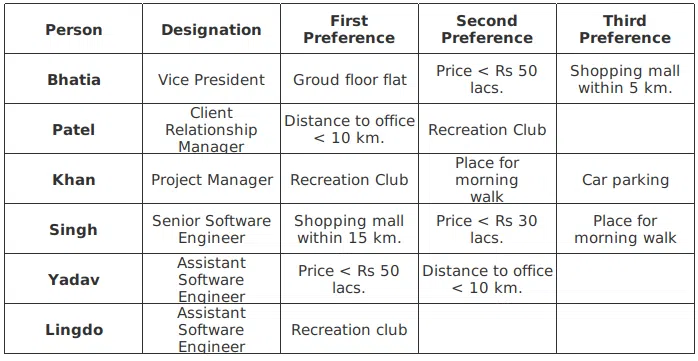
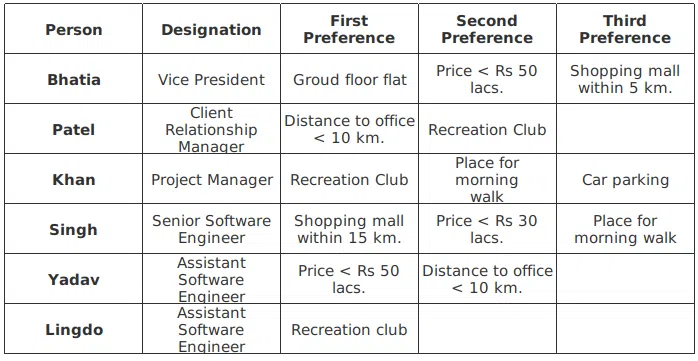
Six people working at the Bengaluru office of Simsys are planning to buy flats at a real estate project at Whitefield. Their preferences are listed below:
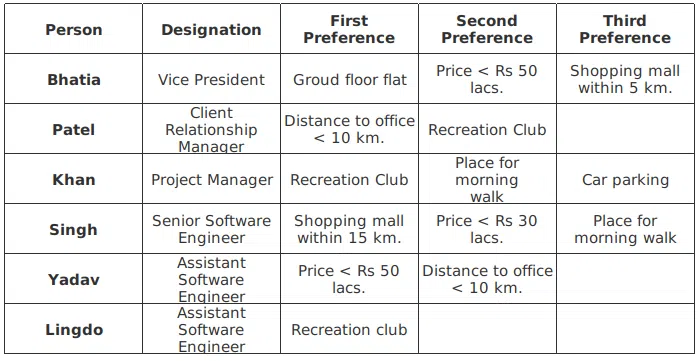
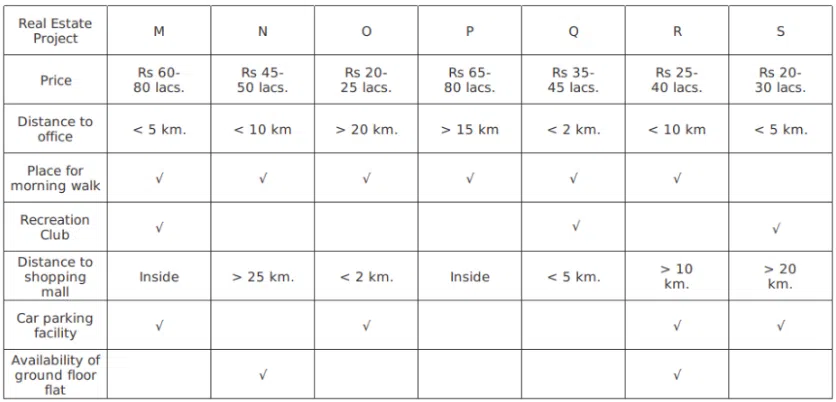
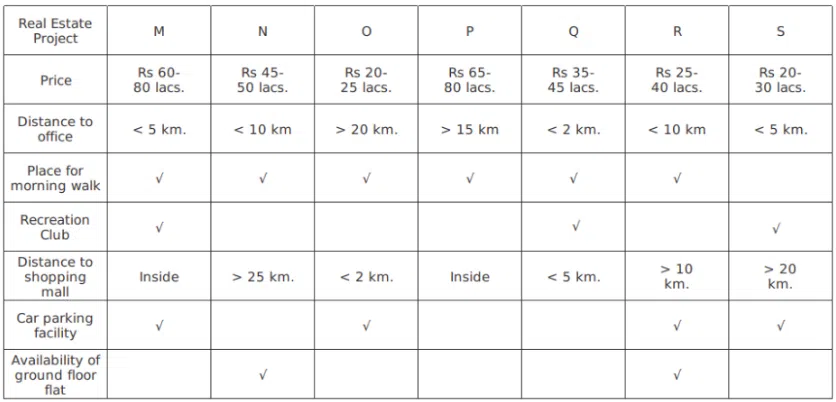
They have identified 7 real estate projects with following facilities available (marked with √):
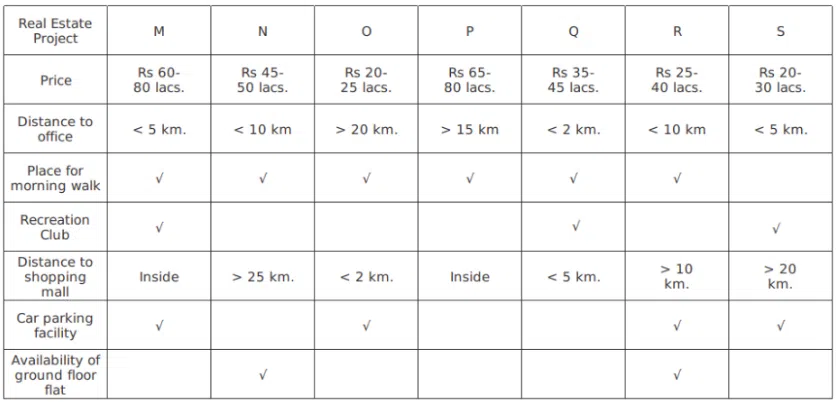
A person is ‘satisfied’ if a project meets all three preferences.
Question 27
Identify the project(s) where NONE of the 6 persons will be ‘satisfied’.
correct answer:- 3
Analyse the following caselet and answer the questions that follow:
Six people working at the Bengaluru office of Simsys are planning to buy flats at a real estate project at Whitefield. Their preferences are listed below:
They have identified 7 real estate projects with following facilities available (marked with √):
A person is ‘satisfied’ if a project meets all three preferences.
Question 28
Identify the project(s), where AT LEAST 3 of the persons will be ‘satisfied’.
correct answer:- 4
Analyse the following caselet and answer the questions that follow:
Six people working at the Bengaluru office of Simsys are planning to buy flats at a real estate project at Whitefield. Their preferences are listed below:
They have identified 7 real estate projects with following facilities available (marked with √):
A person is ‘satisfied’ if a project meets all three preferences.
Question 29
The marketing managers of all the six projects have agreed to add a recreation club and a car parking facility to the projects. In this changed scenario identify projects where AT MOST 2 of the 6 persons will NOT be ‘satisfied’.
correct answer:- 1
Analyse the following caselet and answer the questions that follow:
Geetha Gawde can cultivate up to 6 crops a year. Crop A and B are ready for harvest in 2 months; crop C and D in 3 months, and crop E and F in 4 months. Crop A can be cultivated from January to June; crop B can be cultivated from April to September; crop C can be cultivated from May to December; crops D as well as E can be cultivated from August to December, and crop F from November to May. If Geetha plans a change of crop the soil should be left fallow for one month; however, if the same crop is sown no fallow time is needed. Sowing takes place only at the beginning of a month. Geetha can only harvest a maximum of 1000 units of any crop at any point in time. The production cost per unit (incurred at the time of sowing) and price per unit of crop are as follows:
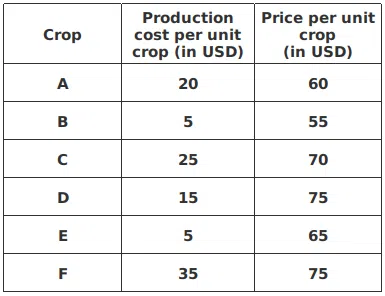
For Geetha soil preparation does not incur any cost. If a crop is abandoned before the scheduled harvesting, she gets no money. Geetha is preparing a cropping schedule to maximize her annual profits (i.e. price – cost). She plans to replicate the schedule in the coming years.
Question 30
Which of the following would DEFINITELY be a part of the ideal schedule?
correct answer:- 3

Analyse the following caselet and answer the questions that follow:
Geetha Gawde can cultivate up to 6 crops a year. Crop A and B are ready for harvest in 2 months; crop C and D in 3 months, and crop E and F in 4 months. Crop A can be cultivated from January to June; crop B can be cultivated from April to September; crop C can be cultivated from May to December; crops D as well as E can be cultivated from August to December, and crop F from November to May. If Geetha plans a change of crop the soil should be left fallow for one month; however, if the same crop is sown no fallow time is needed. Sowing takes place only at the beginning of a month. Geetha can only harvest a maximum of 1000 units of any crop at any point in time. The production cost per unit (incurred at the time of sowing) and price per unit of crop are as follows:
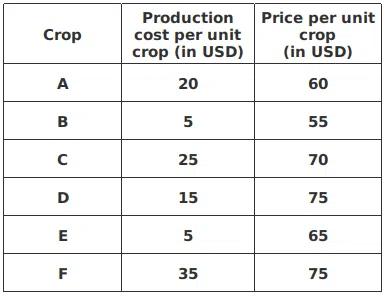
For Geetha soil preparation does not incur any cost. If a crop is abandoned before the scheduled harvesting, she gets no money. Geetha is preparing a cropping schedule to maximize her annual profits (i.e. price – cost). She plans to replicate the schedule in the coming years.
Question 31
Which of the following schedules would maximize her annual profit while minimizing the costs, if Geetha decides NOT to repeat a crop in a calendar year?
correct answer:- 1
Answer questions on the basis of information given in the following case.
The Disciplinary Committee of Nation Political Party (NPP) is meeting today to decide on the future of two of their party members, Mr. Loyal and his son Mr. Prodigal. Mr. Prodigal is the prime accused in the brutal murder of Mr. Victim, an opposition party leader. Mr. Prodigal is in police custody and his appeal for bail has got rejected. Mr. Loyal claims that his son is innocent and Mr. Victim’s death was the result of internal rivalry in the opposition party. Though Mr. Loyal is not accused in this case, his weakness for his son is well known. The media is blaming him for influencing key witnesses to protect his son. Severe criticism of his father - son duo, both by the media and some social activists, is damaging the image of the party. However, Mr. Loyal has significant followers within the party and is considered an asset to the party. Any harsh
decision against Mr. Loyal would adversely affect the future of NPP and could even lead to a split in the party. This would benefit the opposition.
Question 32
Which of the following actions would adversely affect both NPP and Mr. Loyal, the most?
correct answer:- 3
Answer questions on the basis of information given in the following case.
The Disciplinary Committee of Nation Political Party (NPP) is meeting today to decide on the future of two of their party members, Mr. Loyal and his son Mr. Prodigal. Mr. Prodigal is the prime accused in the brutal murder of Mr. Victim, an opposition party leader. Mr. Prodigal is in police custody and his appeal for bail has got rejected. Mr. Loyal claims that his son is innocent and Mr. Victim’s death was the result of internal rivalry in the opposition party. Though Mr. Loyal is not accused in this case, his weakness for his son is well known. The media is blaming him for influencing key witnesses to protect his son. Severe criticism of his father - son duo, both by the media and some social activists, is damaging the image of the party. However, Mr. Loyal has significant followers within the party and is considered an asset to the party. Any harsh
decision against Mr. Loyal would adversely affect the future of NPP and could even lead to a split in the party. This would benefit the opposition.
Question 33
At the Disciplinary Committee meeting, members came up with the following suggestions. Which of the following suggestions would harm the party, the least?
correct answer:- 4
Answer questions on the basis of information given in the following case.
The Disciplinary Committee of Nation Political Party (NPP) is meeting today to decide on the future of two of their party members, Mr. Loyal and his son Mr. Prodigal. Mr. Prodigal is the prime accused in the brutal murder of Mr. Victim, an opposition party leader. Mr. Prodigal is in police custody and his appeal for bail has got rejected. Mr. Loyal claims that his son is innocent and Mr. Victim’s death was the result of internal rivalry in the opposition party. Though Mr. Loyal is not accused in this case, his weakness for his son is well known. The media is blaming him for influencing key witnesses to protect his son. Severe criticism of his father - son duo, both by the media and some social activists, is damaging the image of the party. However, Mr. Loyal has significant followers within the party and is considered an asset to the party. Any harsh
decision against Mr. Loyal would adversely affect the future of NPP and could even lead to a split in the party. This would benefit the opposition.
Question 34
Mr. Opportunist, a veteran member of NPP, stakes his claims to be nominated as an NPP candidate in the upcoming election. Mr. Opportunist presented the following arguments in favour of his candidature to the NPP Executive Committee.
I. Mr. Loyal’s candidature in the upcoming election will adversely impact NPP’s chances. Hence, the party should not nominate him.
II. The party should call a press conference to disown Mr. Loyal. This would enhance the party’s image.
III. The party would not be able to take any strong disciplinary action against Mr. Loyal, if he gets re - elected.
IV. I have a lot of goodwill and significant followers in the constituency,
V. None of my close relatives are into active politics.
Which of the following combinations would best strengthen the claim of Mr.Opportunist?
correct answer:- 2
Answer questions on the basis of information given in the following case.
The Disciplinary Committee of Nation Political Party (NPP) is meeting today to decide on the future of two of their party members, Mr. Loyal and his son Mr. Prodigal. Mr. Prodigal is the prime accused in the brutal murder of Mr. Victim, an opposition party leader. Mr. Prodigal is in police custody and his appeal for bail has got rejected. Mr. Loyal claims that his son is innocent and Mr. Victim’s death was the result of internal rivalry in the opposition party. Though Mr. Loyal is not accused in this case, his weakness for his son is well known. The media is blaming him for influencing key witnesses to protect his son. Severe criticism of his father - son duo, both by the media and some social activists, is damaging the image of the party. However, Mr. Loyal has significant followers within the party and is considered an asset to the party. Any harsh
decision against Mr. Loyal would adversely affect the future of NPP and could even lead to a split in the party. This would benefit the opposition.
Question 35
The Disciplinary Committee has decided to suspend Mr. Loyal from the party because they felt he was influencing the judicial process. However, Mr. Loyal feels that the committee is biased and he is being framed. Now, election has been announced. The last time. Mr. Loyal had won with a majority on account of his good work.
Which of the following options is most likely to resurrect Mr. Loyal’s immediate political career?
correct answer:- 1

Answer questions on the basis of information given in the following case.
Bright Engineering College (BEC) has listed 20 elective courses for the next term and students have to choose any 7 of them. Simran, a student of BEC, notices that there are three categories of electives: Job - oriented (J), Quantitative - oriented (Q) and Grade - oriented (G). Among these 20 electives, some electives are both Job and Grade - oriented but are not Quantitative - oriented (JG type). QJ type electives are both job and Quantitative - oriented but are not Grade - oriented and QG type electives are both Quantitative and Grade - oriented but are not Job - oriented. Simran also notes that the total number of QJ type electives is 2 less than QG type electives. Similarly, the total number of QG type electives is 2 less than JG type and there is only 1 common elective (JQG) across three categories. Furthermore, the number of only Quantitative - oriented electives is same as only Job - oriented electives, but less than the number of only Grade - oriented electives. Each elective has at least one registration and there is at least one elective in each category, or combinations of categories.
Question 36
On her way back Simran met her friend Raj and shared the above information. Raj is preparing for XAT and is only interested in Grade - oriented (G) electives. He wanted to know the number of G - type electives being offered. Simran replied, “You have all the information. Calculate the number of G - type electives yourself. It would help your XAT preparation”. Raj calculates correctly and says that there can be _______ possible answers. Which of the following options would b est fit the blank above?
correct answer:- 2
Answer questions on the basis of information given in the following case.
Bright Engineering College (BEC) has listed 20 elective courses for the next term and students have to choose any 7 of them. Simran, a student of BEC, notices that there are three categories of electives: Job - oriented (J), Quantitative - oriented (Q) and Grade - oriented (G). Among these 20 electives, some electives are both Job and Grade - oriented but are not Quantitative - oriented (JG type). QJ type electives are both job and Quantitative - oriented but are not Grade - oriented and QG type electives are both Quantitative and Grade - oriented but are not Job - oriented. Simran also notes that the total number of QJ type electives is 2 less than QG type electives. Similarly, the total number of QG type electives is 2 less than JG type and there is only 1 common elective (JQG) across three categories. Furthermore, the number of only Quantitative - oriented electives is same as only Job - oriented electives, but less than the number of only Grade - oriented electives. Each elective has at least one registration and there is at least one elective in each category, or combinations of categories.
Question 37
Simran prefers J - type electives and wants to avoid Q - type electives. She noted that the number of only J - type electives is 3. Raj’s preference is G - type electives followed by Q - type electives. However, they want to take as many common electives as possible. What is the maximum number of electives that can be common between them, without compromising their preferences?
correct answer:- 3
Answer questions on the basis of information given in the following case.
Bright Engineering College (BEC) has listed 20 elective courses for the next term and students have to choose any 7 of them. Simran, a student of BEC, notices that there are three categories of electives: Job - oriented (J), Quantitative - oriented (Q) and Grade - oriented (G). Among these 20 electives, some electives are both Job and Grade - oriented but are not Quantitative - oriented (JG type). QJ type electives are both job and Quantitative - oriented but are not Grade - oriented and QG type electives are both Quantitative and Grade - oriented but are not Job - oriented. Simran also notes that the total number of QJ type electives is 2 less than QG type electives. Similarly, the total number of QG type electives is 2 less than JG type and there is only 1 common elective (JQG) across three categories. Furthermore, the number of only Quantitative - oriented electives is same as only Job - oriented electives, but less than the number of only Grade - oriented electives. Each elective has at least one registration and there is at least one elective in each category, or combinations of categories.
Question 38
Vijay and Raj want to avoid each other. Vijay is interested in J - type electives and wants to avoid Q - type electives. Raj’s preference is G - type electives followed by Q - type electives. Raj noted that the number of only G - type electives is 2. Is there a possibility that they would not share any common electives(s)?
correct answer:- 1
Answer questions on the basis of information given in the following case.
Mr. Dipangshu Barua, a young IT professional, came early to office to assist his boss in the preparation for an important client presentation. When be switched on his computer, he saw an email from Mr. Patel. The email was as follows:
Dear Mr. Barua,
This email serves as a follow - up of my conversation with you on December 1, 2014. I have already conveyed need for improvement in your behaviour as desired as desired by your project leader and colleagues. They are yet to notice any visible improvements. I am apprehensive that your failure to act may warrant further action leading to dismissal. I will continue to monitor and assess your performance over the next three months to determine whether improvements meet the expectations. At the same time, I would like to re - affirm that you are very valuable for our organization.
Best Wishes,
Mr. A. Patel
HR Director
Question 39
Initially, the e - mail distracted Dipangshu but he decided to focus on the job. Which of the following options might best explain his decision to do so?
correct answer:- 5
Answer questions on the basis of information given in the following case.
Mr. Dipangshu Barua, a young IT professional, came early to office to assist his boss in the preparation for an important client presentation. When be switched on his computer, he saw an email from Mr. Patel. The email was as follows:
Dear Mr. Barua,
This email serves as a follow - up of my conversation with you on December 1, 2014. I have already conveyed need for improvement in your behaviour as desired as desired by your project leader and colleagues. They are yet to notice any visible improvements. I am apprehensive that your failure to act may warrant further action leading to dismissal. I will continue to monitor and assess your performance over the next three months to determine whether improvements meet the expectations. At the same time, I would like to re - affirm that you are very valuable for our organization.
Best Wishes,
Mr. A. Patel
HR Director
Question 40
The scheduled presentation went off smoothly. Back in his cabin, Dipangshu read Mr. Patel’s e - mail once more and pondered over it. During the last meeting he tried hard to put forward his explanation but Mr. Patel had not allowed him to speak. Dipangshu was thinking of meeting Mr. Patel once again but was doubtful that would help. Incidentally, he had a job offer from a start - up with a comparable salary. If Dipangshu was to join the new job, he had to accept the offer within the next two weeks. However, he cannot think of a life without a job. Dipangshu was confused!
Which of the following options would be the best move for Dipangshu?
correct answer:- 5
.webp)
Answer questions on the basis of information given in the following case.
Mr. Dipangshu Barua, a young IT professional, came early to office to assist his boss in the preparation for an important client presentation. When be switched on his computer, he saw an email from Mr. Patel. The email was as follows:
Dear Mr. Barua,
This email serves as a follow - up of my conversation with you on December 1, 2014. I have already conveyed need for improvement in your behaviour as desired as desired by your project leader and colleagues. They are yet to notice any visible improvements. I am apprehensive that your failure to act may warrant further action leading to dismissal. I will continue to monitor and assess your performance over the next three months to determine whether improvements meet the expectations. At the same time, I would like to re - affirm that you are very valuable for our organization.
Best Wishes,
Mr. A. Patel
HR Director
Question 41
After a couple of weeks, Mr. Patel came to know that Dipangshu’s project leader Mr. John, a very competent senior executive, may have wil fully influenced his team members to file a wrong complaint against Dipangshu. Mr. John may have done it because Dipangshu has refused to tow John’s line. Mr. Patel also came to know that Dipangshu was thinking of quitting this job. He felt regretful about his letter to Dipangshu. He wanted to resolve the complicated situation. He was contemplating following five actions in his mind.
I. Talk to Mr. John about Dipangshu and convey to him that losing a bright employee would cost the organization dearly.
II. Catch up with Mr. John during coffee break and convey that Dipangshu has a very good track record.
III. Chat with Dipangshu during coffee break.
IV. Catch up with Dipangshu during coffee break and convey that the organization values him.
V. Arrange a meeting among Mr. John, Dipangshu and himself to sort out the difference.
Which of the following is the best sequence of actions for resolving the problem?
correct answer:- 4
Answer questions on the basis of information given in the following case.
A few years back Mr. Arbit and Mr. Boring started an oil refinery business. Their annual earing is currently just 50,000 million rupees. They are now exploring various options to improve the business. Mr. Xanadu, a salesperson from Innovative Technology Solutions (ITS), is trying to sell a new oil refinery technology to Mr. Arbit and Mr. Boring. This technology could potentially enhance their annual earning to 150,000 million rupees within a year. But they have to make one - time investment of 100,000 million rupees to implement the technology. If the technology is not successful, the investment would be lost. Mr. Arbit and Mr. Boring are discussing about possible risks of the investment.
Question 42
Mr. Arbit is enthusiastic about this investment idea but Mr. Boring is a little sceptical. This impasse makes them approach a consultant. The consultant makes some observations. Which of the following observations, made by the consultant, might reduce Mr. Arbit’s enthusiasm for the new investment idea?
correct answer:- 1
Answer questions on the basis of information given in the following case.
A few years back Mr. Arbit and Mr. Boring started an oil refinery business. Their annual earing is currently just 50,000 million rupees. They are now exploring various options to improve the business. Mr. Xanadu, a salesperson from Innovative Technology Solutions (ITS), is trying to sell a new oil refinery technology to Mr. Arbit and Mr. Boring. This technology could potentially enhance their annual earning to 150,000 million rupees within a year. But they have to make one - time investment of 100,000 million rupees to implement the technology. If the technology is not successful, the investment would be lost. Mr. Arbit and Mr. Boring are discussing about possible risks of the investment.
Question 43
In order to sell the technology to Mr. Arbit and Mr. Boring, Mr. Xanadu is thinking of five possible sales pitches. Which of the following sales pitches would reduce uncertainties the most for Mr. Arbit and Mr. Boring?
correct answer:- 3
Answer questions on the basis of information given in the following case.
A few years back Mr. Arbit and Mr. Boring started an oil refinery business. Their annual earing is currently just 50,000 million rupees. They are now exploring various options to improve the business. Mr. Xanadu, a salesperson from Innovative Technology Solutions (ITS), is trying to sell a new oil refinery technology to Mr. Arbit and Mr. Boring. This technology could potentially enhance their annual earning to 150,000 million rupees within a year. But they have to make one - time investment of 100,000 million rupees to implement the technology. If the technology is not successful, the investment would be lost. Mr. Arbit and Mr. Boring are discussing about possible risks of the investment.
Question 44
Mr. Arbit and Mr. Boring did not invest in the new technology, but the new technology is a big success. Repentant, they are now estimating the additional amount they would have earned ( i.e. forgone earnings) had they invested in the new technology. However, the two owners differed on expected lifespan of the new technology. Mr. Arbit expected lifespan to be 5 years, whereas, Mr. Boring expected it to be 2 years. After the technology gets out - dated, the earnings from the business would drop back to 50,000 million rupees. What would be the difference between two expected foregone earnings after 5 years of the technology investment, if yearly earnings are deposited in a bank @10%, compounded annually?
Note: Forgone Earnings = (Earnings from business with new technology) - (Earnings from business without new technology)
correct answer:- 2
Answer questions on the basis of information given in the following case.
Life saving Pharmaceuticals ( LSP) is India - based Pharmaceuticals Company. Their business mostly revolves around a couple of generic drugs and a few patented drugs. LSP operates in 30 odd countries and more than 50% of their sales volume is from outside India.
Question 45
If more than 50% of their sales volume is from generic drugs, which of the following options is definitely correct?
(Note : All percentages figures are with respect to total sales volume)
correct answer:- 4

Answer questions on the basis of information given in the following case.
Life saving Pharmaceuticals ( LSP) is India - based Pharmaceuticals Company. Their business mostly revolves around a couple of generic drugs and a few patented drugs. LSP operates in 30 odd countries and more than 50% of their sales volume is from outside India.
Question 46
Mr. Sinha, a senior executive of LSP, observes that their business in India is not vibrant. LSP faces stiff competition from Indian and global players, except in rural areas. Interestingly, most of their sales in the rural area are from cough syrup, used as sedatives by teenagers. Mr. Sinha is planning the following actions to improve business in the long run.
I. Invest in development of new drugs.
II. Increase sales of cough syrup in the rural markets.
III. Try and cut costs.
IV. Recruit more medical representatives in the rural areas.
Which of the following sequences is best arranged in the descending order of appropriateness?
correct answer:- 1
Answer questions on the basis of information given in the following case.
Life saving Pharmaceuticals ( LSP) is India - based Pharmaceuticals Company. Their business mostly revolves around a couple of generic drugs and a few patented drugs. LSP operates in 30 odd countries and more than 50% of their sales volume is from outside India.
Question 47
Mr. Rastogi, HR head of LSP, is contemplating of transferring MR. Jose, from India to their Luxembourg office. Mr. Jose’s wife is also with the HR department of LSP. The couple is expecting their first child within next four months and hence they want to be together. Mr. Rastogi is wondering whether Mr.Jose would accept the transfer. If he doesn’t, Mr. Rastogi would have to send a less competent person for this job as early as possible. The office in Luxembourg is very important for the company’s future. It is at its nascent stage and does not yet have an HR department. Hence, it is not possible to transfer Mrs. Jose to Luxembourg.
Which of the following options would be most appropriate, from the organization’s perspective, to resolve the issue?
correct answer:- 2
Answer questions on the basis of information given in the following case.
Life saving Pharmaceuticals ( LSP) is India - based Pharmaceuticals Company. Their business mostly revolves around a couple of generic drugs and a few patented drugs. LSP operates in 30 odd countries and more than 50% of their sales volume is from outside India.
Question 48
Mr. Khan used to work as the Vice President of LSP India. However, he had resigned from LSP India for a better job in New York. In the meantime, his wife was promoted to head the HR of LSP India. Mrs. Khan had struggled hard to reach this position and was quite popular and respected within the organization. Mrs. Khan was contemplating whether she should give up her career and join him in New York. Mrs. Khan is considering the following actions:
I. Take a break for the time being and focus on personal life. Given her reputation, she can always get back to the same job, if required.
II. Go to New York, on leave without pay for two months to help Mr. Khan settle down. After that she can come back and resume her responsibility in LSP India.
III. Request Mr. Khan to look for an equivalent job in India.
IV. Resign form LSP India, join Mr. Khan in New York, and look for a similar job there.
V. Request LSP India for a similar position in LSP USA and follow Mr. Khan to New York.
Which of the following sequence of actions can be immediately taken by Mrs. Khan to
maintain her work - life balance?
correct answer:- 4
Answer questions on the basis of information given in the following case.
Mohan’s was a popular fast - food joint at Connaught Place, Delhi. Initially Mohan handled his business alone. His sons, Ram and Kishan, joined the business after graduation from college. Ram was entrepreneurial in nature. Subsequently, another branch of Mohan’s was opened in Panipat. Mohan had chosen Ram to head the Panipat branch. Though Ram increased sales in short time, he had stopped using premium quality organic vegetables, the speciality of Mohan’s. Mohan and Kishan were not happy with his way of doing business.
Now, the foremost challenge for Mohan was to sort out this issue with Ram. Mohan knew that replacing Ram with Kishan was difficult as Kishan did not want to leave Delhi. However, giving a freehand to Ram might have long term negative consequences. Mohan was confused about the future of course of actions.
Question 49
Mohan sought the help of five consultants, who give the following opinions:
I. Organic vegetables might be a big success at Connaught place but awareness about organic vegetables is low among Panipat customers.
II. The Connaught place model can be implemented in Panipat provided the business is prepared to face the consequences.
III. Many high end restaurants in Panipat use organic vegetables. So, using organic vegetables will not be a differentiating factor.
IV. Selling prices of their dishes in Panipat are significantly lower. Using organic vegetables will bring down profits.
V. Premium quality organic vegetables are not easily available in Panipat.
Which of the following set of options would support Ram’s argument of not using organic vegetables?
correct answer:- 3
Answer questions on the basis of information given in the following case.
Mohan’s was a popular fast - food joint at Connaught Place, Delhi. Initially Mohan handled his business alone. His sons, Ram and Kishan, joined the business after graduation from college. Ram was entrepreneurial in nature. Subsequently, another branch of Mohan’s was opened in Panipat. Mohan had chosen Ram to head the Panipat branch. Though Ram increased sales in short time, he had stopped using premium quality organic vegetables, the speciality of Mohan’s. Mohan and Kishan were not happy with his way of doing business.
Now, the foremost challenge for Mohan was to sort out this issue with Ram. Mohan knew that replacing Ram with Kishan was difficult as Kishan did not want to leave Delhi. However, giving a freehand to Ram might have long term negative consequences. Mohan was confused about the future of course of actions.
Question 50
Mohan sought feedback from a few of his businessmen friends, who were familiar with both the branches. Here is what they said:
- Businessman 1 : Customers of Connaught place and Panipat are very different.
- Businessman 2 : Customers in Panipat are extremely happy with Ram’s behaviour.
- Businessman 3 : Panipat branch does not use the same quality of ingredients but maintains good hygiene and taste.
- Businessman 4 : Who knows, tomorrow the customers of Panipat might also appreciate what Connaught place customers appreciate today!
If Mohan thinks all these are valid concerns, which of the following actions would be best for the business?
correct answer:- 4
Answer questions on the basis of information given in the following case.
Mohan’s was a popular fast - food joint at Connaught Place, Delhi. Initially Mohan handled his business alone. His sons, Ram and Kishan, joined the business after graduation from college. Ram was entrepreneurial in nature. Subsequently, another branch of Mohan’s was opened in Panipat. Mohan had chosen Ram to head the Panipat branch. Though Ram increased sales in short time, he had stopped using premium quality organic vegetables, the speciality of Mohan’s. Mohan and Kishan were not happy with his way of doing business.
Now, the foremost challenge for Mohan was to sort out this issue with Ram. Mohan knew that replacing Ram with Kishan was difficult as Kishan did not want to leave Delhi. However, giving a freehand to Ram might have long term negative consequences. Mohan was confused about the future of course of actions.
Question 51
After discussing with a few customers, Mohan realised that compromising on the quality of ingredients at Panipat branch may not be good idea but at the same time he also realised that Panipat branch had grown fast. He was contemplating following five actions. Which of the following actions would be the best for the future of his business?
correct answer:- 2
Answer questions on the basis of information given in the following case.
MBA entrance examination comprises two types of problems: formula - based problems and application - based problem. From the analysis of past data, Interesting School of Management (ISM) observes that students good at solving application - based problems are entrepreneurial in nature. Coaching institutes for MBA entrance exams train them to spot formula - based problems and answer them correctly, so as to obtain the required overall cut - off percentile. Thus students, in general, shy away from application - based problem and even those with entrepreneurial mind - set target formula - based problems.
Half of a mark is deducted for every wrong answer.
Question 52
ISM wants more students with entrepreneurial mind - set in the next batch. To achieve this, ISM is considering following proposals:
I. Preparing a question paper of two parts, Parts A and Part B of duration of one hour each. Part A and Part B would consist of formula - based problems and application - based problems, respectively. After taking away Part A, Part B would be distributed. The qualifying cut - off percentile would be calculated on the combined scores of two parts.
II. Preparing a question paper comprising Part A and Part B. While Part A would comprise formula - based problems, Part B would comprise application - based problems, each having a separate qualifying cut - off percentile.
III. Assigning one mark for formula - based problems and two marks for application based problems as an incentive for attempting application - based problems.
IV. Allotting one mark for formula - based problems and three marks for application - based problem, without mentioning this is the question paper.
Which of the following proposal (or combination of proposals) is likely to identify students with best entrepreneurial mind - set?
correct answer:- 4
Answer questions on the basis of information given in the following case.
MBA entrance examination comprises two types of problems: formula - based problems and application - based problem. From the analysis of past data, Interesting School of Management (ISM) observes that students good at solving application - based problems are entrepreneurial in nature. Coaching institutes for MBA entrance exams train them to spot formula - based problems and answer them correctly, so as to obtain the required overall cut - off percentile. Thus students, in general, shy away from application - based problem and even those with entrepreneurial mind - set target formula - based problems.
Half of a mark is deducted for every wrong answer.
Question 53
ISM conducts a common entrance examination every year. This year, the question paper would comprise 60 questions with an equal mix of formula - based problems and application - based problems. All questions would carry equal marks. Balaji is appearing for the examination. Before, appearing for the examination he gets the following information from coaching institutes:
I. Application - oriented problems take more time to solve in an examination hall.
II. Chances of silly mistakes would be low in application - based problems.
III. ISM would assist the students with bank loans to start a new venture.
IV. Options are generally con fusing for formula - based problems.
V.‘Practice makes a man perfect’ can apply only to formula - based problems.
VI. Students get very good campus jobs.
Based on above information, which of the following options would help him to be better
prepared for the examination?
correct answer:- 5
Question 54
Answer question on the basis of information given in the following case.
Innovative Institute of Business (IIB) has decided to be the first green campus in India. IIB Administration has advised all campus residents to reduce carbon footprints. IIB faculty members did a brainstorming and came up with the following suggestions:
I. Replacing electricity source for street lights with solar panels.
II. Replacing the existing buildings with environment friendly buildings.
III. Organizing a seminar on ‘Towards a Sustainable Future’ involving all students, staff, and experts from around the country.
IV. Introducing a compulsory course on sustainability to increase awareness among students.
V. Conducting an initial energy audit to explore where IIB can reduce carbon footprints.
Which of the following options would be the most preferred sequence of actions to reduce carbon footprints on campus?
correct answer:- 3
Answer questions based on information that is provided.
Question 55
The main issues of interpretation arising from the work of professionally trained anthropologists are that they are late in colonial/post - colonial trajectories, because professional training shapes their interpretations. However, within field of interest and training, their works are most thorough and systematic
The best conclusion drawn from the above paragraph is analogous to:
correct answer:- 1
Answer questions based on information that is provided.
Question 56
Consider merit pay for teachers. Schools face constant pressure to change their management approaches to improve performance, which is usually assessed by standardized reading, math, and science scores. In most school teacher’s pay is determined by seniority, years of total teaching experience, and credentials. Pay is rarely based on performance, which is contrary to the belief among parents and private sector. Parents and business leaders lament that there are no carrots/sticks used to motivate teachers.
Consequently, there has been greater push to implement some form of merit pay to improve
the motivation. Which of the following statements will disapprove the claim of the parents and business leaders?
correct answer:- 1
Answer questions based on information that is provided.
Question 57
Read the following newspaper report: In a new study by Harvard School of Public Health (HSPH), researchers explored how caffeine can serve as a “mild anti - depressant”. They concluded that “drinking
several cups of coffee daily appears to reduce the risk of suicide”. Data pulled in from three large studies in the US showed that the suicide risk of those who drank two to four cups of caffeinated coffee a day was
about half of those who drank decaffeinated coffee or very little or no coffee. In the studies, a respondent’s caffeine consumption was assessed every four years through a questionnaire. The respondents were all adults, and the study was published online. The authors, however, cautioned the public from increasing coffee intake as it could result in “unpleasant side effects”. “Overall, our results suggest that there is
little further benefit for consumption above two to three cups/day or 400 mg of caffeine/day,” wrote the researchers. The authors observed that there` was no major difference in suicide risk for adults who drank two to three cups a day from those who drank four cups or more.
Which of the following shaped graph would best capture the above paragraph(x - axis represents “coffee intake” and “Y - axis represents “suicidal tendency”)?
correct answer:- 5
Answer questions based on information that is provided.
Question 58
A group of nine runners will finish the 400 meters race in a certain order. The runners are:
Ashok, Benjamin, Chetan, Divya, Eshant, Girish, Himani, and Irravaty. They all finish at different times, and their finishing order is as follow:
1.Faneesh finishes before Ashok
2.Divya finishes before Benjamin and Eshant
3.Irravaty finishes after Chetan
4.Girish finishes after Ashok
Which is the best position Girish can finish?
correct answer:- 3
Read the following case – let and answer the that follow
Ms. Banerjee, class teacher for 12th standard, wants to send teams (based on past performance) of three students each to district, state, national, and international competition in mathematics.Till now, every student of the class has appeared in 100 school level tests. The students had following distribution of marks in the tests, in terms of “average” and “number of times a student scored cent per cent marks”.
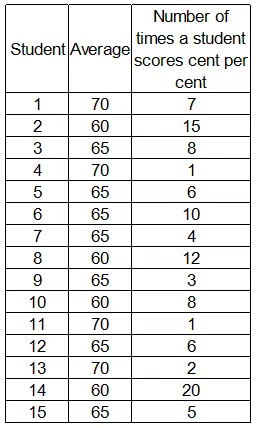
Ms. Banerjee has carefully studied chances of her school winning each of the competitions. Based on in - depth calculations, she realized that her school is quite likely to win district level competition but has low chances of winning the
internation
al competition
. She listed down the following probabilities of wins for different competitions. Prize was highest for international competition and lowest for district level competition (in that order).
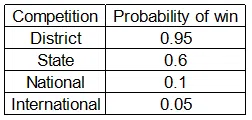
All the students are studying in the school for last twelve years. She wanted to select the best team for all four competitions (Ms. Banerjee had no other information to select students).
Question 59
Which of three members should form the team for the International competition?
correct answer:- 2
Read the following case – let and answer the that follow
Ms. Banerjee, class teacher for 12th standard, wants to send teams (based on past performance) of three students each to district, state, national, and international competition in mathematics.Till now, every student of the class has appeared in 100 school level tests. The students had following distribution of marks in the tests, in terms of “average” and “number of times a student scored cent per cent marks”.
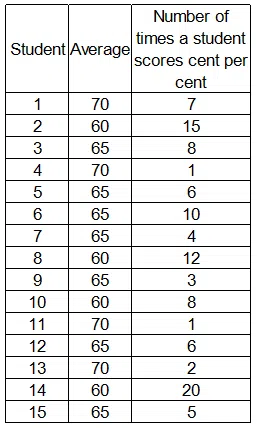
Ms. Banerjee has carefully studied chances of her school winning each of the competitions. Based on in - depth calculations, she realized that her school is quite likely to win district level competition but has low chances of winning the
internation
al competition
. She listed down the following probabilities of wins for different competitions. Prize was highest for international competition and lowest for district level competition (in that order).
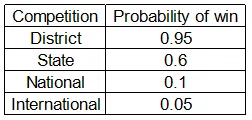
All the students are studying in the school for last twelve years. She wanted to select the best team for all four competitions (Ms. Banerjee had no other information to select students).
Question 60
Which of the following members should constitute the team for the district level competition?
correct answer:- 4
Read the following case – let and answer the that follow
Ms. Banerjee, class teacher for 12th standard, wants to send teams (based on past performance) of three students each to district, state, national, and international competition in mathematics.Till now, every student of the class has appeared in 100 school level tests. The students had following distribution of marks in the tests, in terms of “average” and “number of times a student scored cent per cent marks”.
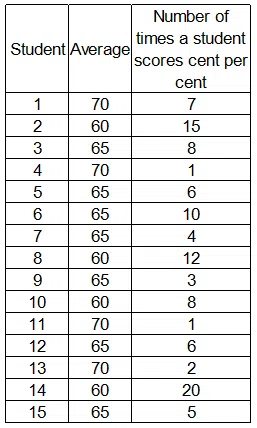
Ms. Banerjee has carefully studied chances of her school winning each of the competitions. Based on in - depth calculations, she realized that her school is quite likely to win district level competition but has low chances of winning the
internation
al competition
. She listed down the following probabilities of wins for different competitions. Prize was highest for international competition and lowest for district level competition (in that order).
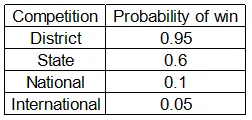
All the students are studying in the school for last twelve years. She wanted to select the best team for all four competitions (Ms. Banerjee had no other information to select students).
Question 61
Ms. Banerjee has to select the team for national competition after she has selected the team for
international competition. A student selected for international competition cannot be a part of national competition. Which is the best team for the national competition?
correct answer:- 4
Read the following case - let and answer the question that follow
Krishna Reddy was the head of a pharmaceutical company that was trying to develop a new product. Reddy, along with his friend Prabhakar Rao, assessed that such products had mixed success. Reddy and Rao realized that if a new product (a drug) was a success, it may result in sales of 100 crores but if it is unsuccessful, the sales may be only 20 crores. They further assessed that a new drug was likely to be successful 50% of times. Cost of launching the new drug was likely to be 50 crores.
Question 62
How much profit can the company expect to earn if it launches the new drug(suppose there are no additional costs)?
correct answer:- 2
Read the following case - let and answer the question that follow
Krishna Reddy was the head of a pharmaceutical company that was trying to develop a new product. Reddy, along with his friend Prabhakar Rao, assessed that such products had mixed success. Reddy and Rao realized that if a new product (a drug) was a success, it may result in sales of 100 crores but if it is unsuccessful, the sales may be only 20 crores. They further assessed that a new drug was likely to be successful 50% of times. Cost of launching the new drug was likely to be 50 crores.
Question 63
Now, Reddy and Rao were in a quandary whether the company should go ahead and market the drug. They
contacted Raj Adduri, a common friend for advice. Adduri was of the opinion that given the risky nature of the launch, it may be a better idea to test the market. Rao and Reddy realized test marketing would cost 10
crores. Adduri told them the previous test marketing results have been favourable 70% of times and success rate of products favourably tested was 80%. Further, when test marketing results were unfavourable; the products have been successful 30% of the times.
How much profit can the company expect to make if the product is launched after favourable test marketing results(assume there are no additional costs)?
correct answer:- 5
Read the following case - let and answer the question that follow
Krishna Reddy was the head of a pharmaceutical company that was trying to develop a new product. Reddy, along with his friend Prabhakar Rao, assessed that such products had mixed success. Reddy and Rao realized that if a new product (a drug) was a success, it may result in sales of 100 crores but if it is unsuccessful, the sales may be only 20 crores. They further assessed that a new drug was likely to be successful 50% of times. Cost of launching the new drug was likely to be 50 crores.
Question 64
Now, Reddy and Rao were in a quandary whether the company should go ahead and market the drug. They
contacted Raj Adduri, a common friend for advice. Adduri was of the opinion that given the risky nature of launch, it may be a better idea to test the market. Rao and Reddy realized test marketing would cost 10
crores. Adduri told them the previous test marketing results have been favorable 70% of times and success
rate of products favorably tested was 80%.Further, when test marketing results were unfavorable; the products have been successful 30% of the times.
What is the probability of product failure if Reddy and Rao decide to test market it?
correct answer:- 2
Read the following case - let and answer the question that follow
Krishna Reddy was the head of a pharmaceutical company that was trying to develop a new product. Reddy, along with his friend Prabhakar Rao, assessed that such products had mixed success. Reddy and Rao realized that if a new product (a drug) was a success, it may result in sales of 100 crores but if it is unsuccessful, the sales may be only 20 crores. They further assessed that a new drug was likely to be successful 50% of times. Cost of launching the new drug was likely to be 50 crores.
Question 65
Now, Reddy and Rao were in a quandary whether the company should go ahead and market the drug. They
contacted Raj Adduri, a common friend for advice. Adduri was of the opinion that given the risky nature of launch, it may be a better idea to test the market. Rao and Reddy realized test marketing would cost 10
crores. Adduri told them the previous test marketing results have been favorable 70% of times and success
rate of products favorably tested was 80%.Further, when test marketing results were unfavorable; the products have been successful 30% of the times.
If Rao and Reddy decide to launch the product despite unfavourable test marketing, how much profit can the company expect to earn?
correct answer:- 4
Please read the three reports (newspaper articles) on ranking of different players and products in smart phones industry and answer the questions that follow.
Report 1: (Feb, 2013)
Apple nabs crown as current top US mobile phone vendor
Apple’s reign may not be long, as Samsung is poised to overtake Apple in April, 2013. For the first time since Apple entered the mobile phone market in 2007, it has been ranked the top mobile phone vendor in the US. For the latter quarter of 2012, sales of its iPhone accounted for 34 percent of all mobile phone sales in the US - including feature phones - according to the latest data from Strategy Analytics.
While the iPhone has consistently been ranked the top smartphone sold in the US, market research firm NPD noted that feature phone sales have fallen off a cliff recently, to the point where 8 out of every 10 mobile phones sold in the US are now smartphones. That ratio is up considerably from the end of 2011, when smartphones had just cracked the 50 percent mark. Given this fact it’s no surprise that Apple, which only sells smartphones, has been able to reach the top of the overall mobile phone market domestically. For the fourth quarter of 2012, Apple ranked number one with 34 percent of the US mobile market, up from 25.6 percent year over year. Samsung grew similarly, up to 32.3 percent from 26.9 percent - but not enough to keep from slipping to second place. LG dropped to 9 percent from 13.7 percent, holding its third place spot. It should be noted that Samsung and LG both sell a variety of feature phones in addition to smartphones. Looking only at smartphones, the ranking is a little different according to NPD. Apple holds the top spot with 39 percent of the US smartphone market, while Samsung again sits at number two with 30 percent. Motorola manages to rank third with 7 percent, while HTC dropped to fourth with 6 percent. In the US smartphone market, LG is fifth with 6 percent. Note how the percentages aren’t all that different from overall mobile phone market share - for all intents and purposes, the smartphone market is the mobile phone market in the US going forward. Still, Samsung was the top mobile phone vendor overall for 2012, and Strategy Analytics expects Samsung to be back on top soon. “Samsung had been the number one mobile phone vendor in the US since 2008, and it will surely be keen to recapture that title in 2013 by launching improved new models such as the rumored Galaxy S4”. And while Apple is the top vendor overall among smartphones, its iOS platform is still second to the Android platform overall. Samsung is the largest vendor selling Android-based smartphones, but Motorola, HTC, LG, and others also sell Android devices, giving the platform a clear advantage over iOS both domestically and globally.
Report 2: Reader’s Response (2013, Feb)
I don’t actually believe the numbers for Samsung. Ever since the debacle in early 2011, when Lenovo called into question the numbers Samsung was touting for tablet shipments, stating that Samsung had only sold 20,000 of the 1.5 million tablets they shipped into the US the last quarter of 2010, Samsung (who had no response to Lenovo) has refused to supply quarterly sales numbers for smartphones or tablets. That’s an indication that their sales aren’t what analysts are saying. We can look to several things to help understand why. In the lawsuit between Apple and Samsung here last year, both were required to supply real sales numbers for devices under contention. The phones listed turned out to have sales between one third and one half of what had been guessed by IDC and others. Tablet sales were even worse. Of the 1.5 million tablets supposedly shipped to the US during that time, only 38,000 were sold. Then we have the usage numbers. Samsung tablets have only a 1.5% usage rate, where the iPad has over 90%. Not as much a difference with the phones but it’s still overwhelmingly in favor of iPhone. The problem is that with Apple’s sales, we have actual numbers to go by. The companies who estimate can calibrate what they do after those numbers come out. But with Samsung and many others, they can’t ever calibrate their methods, as there are no confirming numbers released from the firms. A few quarters ago, as a result, we saw iSupply estimate Samsung’s smartphone sales for the quarter at 32 million, with estimates from others all over the place up to 50 million. Each time some other company reported a higher number for that same quarter, the press dutifully used that higher number as THE ONE. But none of them was the one. Without accurate self-reporting of actual sales to the end users, none of these market share charts are worth a damn!
Report 3: Contradictory survey (Feb, 2013)
iPhone5 Ranks Fifth In U.S. Customer Satisfaction Survey inShare. The iPhone5 ranks fifth in customer satisfaction according to the results of a recent survey from OnDevice Research, a mobile device research group. In the poll, they asked 320,000 smartphone and tablet users from six different countries, how satisfied they were with their devices. According to 93,825 people from the US, Motorola Atrix HD is the most satisfying and Motorola’s Droid Razr took second spot. HTC Corp (TPE : 2498)’s Rezound 4G and Samsung Galaxy Note 2 took third and fourth spots, while Apple’s iPhone5 landed in fifth spot. It appears that Apple may be lagging in consumer interest. OnDevice Research, Sarah Quinn explained, “Although Apple created one of the most revolutionary devices of the past decade, other manufactures have caught up, with some Android powered devices now commanding higher levels of user satisfaction.” Despite the lower rankings, things aren’t looking too bad for Apple Inc. (NASDAQ:AAPL) elsewhere. In the United Kingdom, they ranked second place, right after HTC One X. Interesting enough, Apple did take top spot for overall satisfaction of mobile device, whereas Google Inc. (NASDAQ:GOOG) ranked second. Motorola Mobility Holdings Inc. (NYSE:NOK) took third, fourth, and fifth places respectively, while Sony Ericsson trailed behind at sixth place. The survey sampled mobile device users in the following countries: United States, United Kingdom, France, Germany, Japan, and Indonesia. Although OnDevice didn’t share the full list of devices mentioned in the survey, it does show some insight to what customers want. Unfortunately, there were still many questions regarding the survey that were left unanswered. Everyone wants to know why Google Inc. (NASDAQ:GOOG) was on the list when they are not an actual smartphone maker and why was Samsung Electronics Co., Ltd. (LON:BC94) on the bottom of the satisfaction list when the brand is leading elsewhere.
Source: 92.825 US mobile users, July 2012 - January 2013
Fortunately, those questions were answered by OnDevice Research’s representative. He explained that the survey was conducted on mobile web where the survey software could detect the taker’s device and since user’s rate their satisfaction levels on a 1 to 10 scale, thanks to the Nexus device, Google was included.
Question 66
If you analyze the three reports above, which of the following statements would be the best inference?
correct answer:- 3
Please read the three reports (newspaper articles) on ranking of different players and products in smart phones industry and answer the questions that follow.
Report 1: (Feb, 2013)
Apple nabs crown as current top US mobile phone vendor
Apple’s reign may not be long, as Samsung is poised to overtake Apple in April, 2013. For the first time since Apple entered the mobile phone market in 2007, it has been ranked the top mobile phone vendor in the US. For the latter quarter of 2012, sales of its iPhone accounted for 34 percent of all mobile phone sales in the US - including feature phones - according to the latest data from Strategy Analytics.
While the iPhone has consistently been ranked the top smartphone sold in the US, market research firm NPD noted that feature phone sales have fallen off a cliff recently, to the point where 8 out of every 10 mobile phones sold in the US are now smartphones. That ratio is up considerably from the end of 2011, when smartphones had just cracked the 50 percent mark. Given this fact it’s no surprise that Apple, which only sells smartphones, has been able to reach the top of the overall mobile phone market domestically. For the fourth quarter of 2012, Apple ranked number one with 34 percent of the US mobile market, up from 25.6 percent year over year. Samsung grew similarly, up to 32.3 percent from 26.9 percent - but not enough to keep from slipping to second place. LG dropped to 9 percent from 13.7 percent, holding its third place spot. It should be noted that Samsung and LG both sell a variety of feature phones in addition to smartphones. Looking only at smartphones, the ranking is a little different according to NPD. Apple holds the top spot with 39 percent of the US smartphone market, while Samsung again sits at number two with 30 percent. Motorola manages to rank third with 7 percent, while HTC dropped to fourth with 6 percent. In the US smartphone market, LG is fifth with 6 percent. Note how the percentages aren’t all that different from overall mobile phone market share - for all intents and purposes, the smartphone market is the mobile phone market in the US going forward. Still, Samsung was the top mobile phone vendor overall for 2012, and Strategy Analytics expects Samsung to be back on top soon. “Samsung had been the number one mobile phone vendor in the US since 2008, and it will surely be keen to recapture that title in 2013 by launching improved new models such as the rumored Galaxy S4”. And while Apple is the top vendor overall among smartphones, its iOS platform is still second to the Android platform overall. Samsung is the largest vendor selling Android-based smartphones, but Motorola, HTC, LG, and others also sell Android devices, giving the platform a clear advantage over iOS both domestically and globally.
Report 2: Reader’s Response (2013, Feb)
I don’t actually believe the numbers for Samsung. Ever since the debacle in early 2011, when Lenovo called into question the numbers Samsung was touting for tablet shipments, stating that Samsung had only sold 20,000 of the 1.5 million tablets they shipped into the US the last quarter of 2010, Samsung (who had no response to Lenovo) has refused to supply quarterly sales numbers for smartphones or tablets. That’s an indication that their sales aren’t what analysts are saying. We can look to several things to help understand why. In the lawsuit between Apple and Samsung here last year, both were required to supply real sales numbers for devices under contention. The phones listed turned out to have sales between one third and one half of what had been guessed by IDC and others. Tablet sales were even worse. Of the 1.5 million tablets supposedly shipped to the US during that time, only 38,000 were sold. Then we have the usage numbers. Samsung tablets have only a 1.5% usage rate, where the iPad has over 90%. Not as much a difference with the phones but it’s still overwhelmingly in favor of iPhone. The problem is that with Apple’s sales, we have actual numbers to go by. The companies who estimate can calibrate what they do after those numbers come out. But with Samsung and many others, they can’t ever calibrate their methods, as there are no confirming numbers released from the firms. A few quarters ago, as a result, we saw iSupply estimate Samsung’s smartphone sales for the quarter at 32 million, with estimates from others all over the place up to 50 million. Each time some other company reported a higher number for that same quarter, the press dutifully used that higher number as THE ONE. But none of them was the one. Without accurate self-reporting of actual sales to the end users, none of these market share charts are worth a damn!
Report 3: Contradictory survey (Feb, 2013)
iPhone5 Ranks Fifth In U.S. Customer Satisfaction Survey inShare. The iPhone5 ranks fifth in customer satisfaction according to the results of a recent survey from OnDevice Research, a mobile device research group. In the poll, they asked 320,000 smartphone and tablet users from six different countries, how satisfied they were with their devices. According to 93,825 people from the US, Motorola Atrix HD is the most satisfying and Motorola’s Droid Razr took second spot. HTC Corp (TPE : 2498)’s Rezound 4G and Samsung Galaxy Note 2 took third and fourth spots, while Apple’s iPhone5 landed in fifth spot. It appears that Apple may be lagging in consumer interest. OnDevice Research, Sarah Quinn explained, “Although Apple created one of the most revolutionary devices of the past decade, other manufactures have caught up, with some Android powered devices now commanding higher levels of user satisfaction.” Despite the lower rankings, things aren’t looking too bad for Apple Inc. (NASDAQ:AAPL) elsewhere. In the United Kingdom, they ranked second place, right after HTC One X. Interesting enough, Apple did take top spot for overall satisfaction of mobile device, whereas Google Inc. (NASDAQ:GOOG) ranked second. Motorola Mobility Holdings Inc. (NYSE:NOK) took third, fourth, and fifth places respectively, while Sony Ericsson trailed behind at sixth place. The survey sampled mobile device users in the following countries: United States, United Kingdom, France, Germany, Japan, and Indonesia. Although OnDevice didn’t share the full list of devices mentioned in the survey, it does show some insight to what customers want. Unfortunately, there were still many questions regarding the survey that were left unanswered. Everyone wants to know why Google Inc. (NASDAQ:GOOG) was on the list when they are not an actual smartphone maker and why was Samsung Electronics Co., Ltd. (LON:BC94) on the bottom of the satisfaction list when the brand is leading elsewhere.
Source: 92.825 US mobile users, July 2012 - January 2013
Fortunately, those questions were answered by OnDevice Research’s representative. He explained that the survey was conducted on mobile web where the survey software could detect the taker’s device and since user’s rate their satisfaction levels on a 1 to 10 scale, thanks to the Nexus device, Google was included.
Question 67
Assume report1 and report3 are both correct, which of the following can be a reason for seemingly divergent ranks of different companies and their products?
correct answer:- 5
Please read the three reports (newspaper articles) on ranking of different players and products in smart phones industry and answer the questions that follow.
Report 1: (Feb, 2013)
Apple nabs crown as current top US mobile phone vendor
Apple’s reign may not be long, as Samsung is poised to overtake Apple in April, 2013. For the first time since Apple entered the mobile phone market in 2007, it has been ranked the top mobile phone vendor in the US. For the latter quarter of 2012, sales of its iPhone accounted for 34 percent of all mobile phone sales in the US - including feature phones - according to the latest data from Strategy Analytics.
While the iPhone has consistently been ranked the top smartphone sold in the US, market research firm NPD noted that feature phone sales have fallen off a cliff recently, to the point where 8 out of every 10 mobile phones sold in the US are now smartphones. That ratio is up considerably from the end of 2011, when smartphones had just cracked the 50 percent mark. Given this fact it’s no surprise that Apple, which only sells smartphones, has been able to reach the top of the overall mobile phone market domestically. For the fourth quarter of 2012, Apple ranked number one with 34 percent of the US mobile market, up from 25.6 percent year over year. Samsung grew similarly, up to 32.3 percent from 26.9 percent - but not enough to keep from slipping to second place. LG dropped to 9 percent from 13.7 percent, holding its third place spot. It should be noted that Samsung and LG both sell a variety of feature phones in addition to smartphones. Looking only at smartphones, the ranking is a little different according to NPD. Apple holds the top spot with 39 percent of the US smartphone market, while Samsung again sits at number two with 30 percent. Motorola manages to rank third with 7 percent, while HTC dropped to fourth with 6 percent. In the US smartphone market, LG is fifth with 6 percent. Note how the percentages aren’t all that different from overall mobile phone market share - for all intents and purposes, the smartphone market is the mobile phone market in the US going forward. Still, Samsung was the top mobile phone vendor overall for 2012, and Strategy Analytics expects Samsung to be back on top soon. “Samsung had been the number one mobile phone vendor in the US since 2008, and it will surely be keen to recapture that title in 2013 by launching improved new models such as the rumored Galaxy S4”. And while Apple is the top vendor overall among smartphones, its iOS platform is still second to the Android platform overall. Samsung is the largest vendor selling Android-based smartphones, but Motorola, HTC, LG, and others also sell Android devices, giving the platform a clear advantage over iOS both domestically and globally.
Report 2: Reader’s Response (2013, Feb)
I don’t actually believe the numbers for Samsung. Ever since the debacle in early 2011, when Lenovo called into question the numbers Samsung was touting for tablet shipments, stating that Samsung had only sold 20,000 of the 1.5 million tablets they shipped into the US the last quarter of 2010, Samsung (who had no response to Lenovo) has refused to supply quarterly sales numbers for smartphones or tablets. That’s an indication that their sales aren’t what analysts are saying. We can look to several things to help understand why. In the lawsuit between Apple and Samsung here last year, both were required to supply real sales numbers for devices under contention. The phones listed turned out to have sales between one third and one half of what had been guessed by IDC and others. Tablet sales were even worse. Of the 1.5 million tablets supposedly shipped to the US during that time, only 38,000 were sold. Then we have the usage numbers. Samsung tablets have only a 1.5% usage rate, where the iPad has over 90%. Not as much a difference with the phones but it’s still overwhelmingly in favor of iPhone. The problem is that with Apple’s sales, we have actual numbers to go by. The companies who estimate can calibrate what they do after those numbers come out. But with Samsung and many others, they can’t ever calibrate their methods, as there are no confirming numbers released from the firms. A few quarters ago, as a result, we saw iSupply estimate Samsung’s smartphone sales for the quarter at 32 million, with estimates from others all over the place up to 50 million. Each time some other company reported a higher number for that same quarter, the press dutifully used that higher number as THE ONE. But none of them was the one. Without accurate self-reporting of actual sales to the end users, none of these market share charts are worth a damn!
Report 3: Contradictory survey (Feb, 2013)
iPhone5 Ranks Fifth In U.S. Customer Satisfaction Survey inShare. The iPhone5 ranks fifth in customer satisfaction according to the results of a recent survey from OnDevice Research, a mobile device research group. In the poll, they asked 320,000 smartphone and tablet users from six different countries, how satisfied they were with their devices. According to 93,825 people from the US, Motorola Atrix HD is the most satisfying and Motorola’s Droid Razr took second spot. HTC Corp (TPE : 2498)’s Rezound 4G and Samsung Galaxy Note 2 took third and fourth spots, while Apple’s iPhone5 landed in fifth spot. It appears that Apple may be lagging in consumer interest. OnDevice Research, Sarah Quinn explained, “Although Apple created one of the most revolutionary devices of the past decade, other manufactures have caught up, with some Android powered devices now commanding higher levels of user satisfaction.” Despite the lower rankings, things aren’t looking too bad for Apple Inc. (NASDAQ:AAPL) elsewhere. In the United Kingdom, they ranked second place, right after HTC One X. Interesting enough, Apple did take top spot for overall satisfaction of mobile device, whereas Google Inc. (NASDAQ:GOOG) ranked second. Motorola Mobility Holdings Inc. (NYSE:NOK) took third, fourth, and fifth places respectively, while Sony Ericsson trailed behind at sixth place. The survey sampled mobile device users in the following countries: United States, United Kingdom, France, Germany, Japan, and Indonesia. Although OnDevice didn’t share the full list of devices mentioned in the survey, it does show some insight to what customers want. Unfortunately, there were still many questions regarding the survey that were left unanswered. Everyone wants to know why Google Inc. (NASDAQ:GOOG) was on the list when they are not an actual smartphone maker and why was Samsung Electronics Co., Ltd. (LON:BC94) on the bottom of the satisfaction list when the brand is leading elsewhere.
Source: 92.825 US mobile users, July 2012 - January 2013
Fortunately, those questions were answered by OnDevice Research’s representative. He explained that the survey was conducted on mobile web where the survey software could detect the taker’s device and since user’s rate their satisfaction levels on a 1 to 10 scale, thanks to the Nexus device, Google was included.
Question 68
If report1 and report3 are both correct, which of the following can be a reason for seemingly divergent ranks reported for different companies and their products?
correct answer:- 4
Please read the three reports (newspaper articles) on ranking of different players and products in smart phones industry and answer the questions that follow.
Report 1: (Feb, 2013)
Apple nabs crown as current top US mobile phone vendor
Apple’s reign may not be long, as Samsung is poised to overtake Apple in April, 2013. For the first time since Apple entered the mobile phone market in 2007, it has been ranked the top mobile phone vendor in the US. For the latter quarter of 2012, sales of its iPhone accounted for 34 percent of all mobile phone sales in the US - including feature phones - according to the latest data from Strategy Analytics.
While the iPhone has consistently been ranked the top smartphone sold in the US, market research firm NPD noted that feature phone sales have fallen off a cliff recently, to the point where 8 out of every 10 mobile phones sold in the US are now smartphones. That ratio is up considerably from the end of 2011, when smartphones had just cracked the 50 percent mark. Given this fact it’s no surprise that Apple, which only sells smartphones, has been able to reach the top of the overall mobile phone market domestically. For the fourth quarter of 2012, Apple ranked number one with 34 percent of the US mobile market, up from 25.6 percent year over year. Samsung grew similarly, up to 32.3 percent from 26.9 percent - but not enough to keep from slipping to second place. LG dropped to 9 percent from 13.7 percent, holding its third place spot. It should be noted that Samsung and LG both sell a variety of feature phones in addition to smartphones. Looking only at smartphones, the ranking is a little different according to NPD. Apple holds the top spot with 39 percent of the US smartphone market, while Samsung again sits at number two with 30 percent. Motorola manages to rank third with 7 percent, while HTC dropped to fourth with 6 percent. In the US smartphone market, LG is fifth with 6 percent. Note how the percentages aren’t all that different from overall mobile phone market share - for all intents and purposes, the smartphone market is the mobile phone market in the US going forward. Still, Samsung was the top mobile phone vendor overall for 2012, and Strategy Analytics expects Samsung to be back on top soon. “Samsung had been the number one mobile phone vendor in the US since 2008, and it will surely be keen to recapture that title in 2013 by launching improved new models such as the rumored Galaxy S4”. And while Apple is the top vendor overall among smartphones, its iOS platform is still second to the Android platform overall. Samsung is the largest vendor selling Android-based smartphones, but Motorola, HTC, LG, and others also sell Android devices, giving the platform a clear advantage over iOS both domestically and globally.
Report 2: Reader’s Response (2013, Feb)
I don’t actually believe the numbers for Samsung. Ever since the debacle in early 2011, when Lenovo called into question the numbers Samsung was touting for tablet shipments, stating that Samsung had only sold 20,000 of the 1.5 million tablets they shipped into the US the last quarter of 2010, Samsung (who had no response to Lenovo) has refused to supply quarterly sales numbers for smartphones or tablets. That’s an indication that their sales aren’t what analysts are saying. We can look to several things to help understand why. In the lawsuit between Apple and Samsung here last year, both were required to supply real sales numbers for devices under contention. The phones listed turned out to have sales between one third and one half of what had been guessed by IDC and others. Tablet sales were even worse. Of the 1.5 million tablets supposedly shipped to the US during that time, only 38,000 were sold. Then we have the usage numbers. Samsung tablets have only a 1.5% usage rate, where the iPad has over 90%. Not as much a difference with the phones but it’s still overwhelmingly in favor of iPhone. The problem is that with Apple’s sales, we have actual numbers to go by. The companies who estimate can calibrate what they do after those numbers come out. But with Samsung and many others, they can’t ever calibrate their methods, as there are no confirming numbers released from the firms. A few quarters ago, as a result, we saw iSupply estimate Samsung’s smartphone sales for the quarter at 32 million, with estimates from others all over the place up to 50 million. Each time some other company reported a higher number for that same quarter, the press dutifully used that higher number as THE ONE. But none of them was the one. Without accurate self-reporting of actual sales to the end users, none of these market share charts are worth a damn!
Report 3: Contradictory survey (Feb, 2013)
iPhone5 Ranks Fifth In U.S. Customer Satisfaction Survey inShare. The iPhone5 ranks fifth in customer satisfaction according to the results of a recent survey from OnDevice Research, a mobile device research group. In the poll, they asked 320,000 smartphone and tablet users from six different countries, how satisfied they were with their devices. According to 93,825 people from the US, Motorola Atrix HD is the most satisfying and Motorola’s Droid Razr took second spot. HTC Corp (TPE : 2498)’s Rezound 4G and Samsung Galaxy Note 2 took third and fourth spots, while Apple’s iPhone5 landed in fifth spot. It appears that Apple may be lagging in consumer interest. OnDevice Research, Sarah Quinn explained, “Although Apple created one of the most revolutionary devices of the past decade, other manufactures have caught up, with some Android powered devices now commanding higher levels of user satisfaction.” Despite the lower rankings, things aren’t looking too bad for Apple Inc. (NASDAQ:AAPL) elsewhere. In the United Kingdom, they ranked second place, right after HTC One X. Interesting enough, Apple did take top spot for overall satisfaction of mobile device, whereas Google Inc. (NASDAQ:GOOG) ranked second. Motorola Mobility Holdings Inc. (NYSE:NOK) took third, fourth, and fifth places respectively, while Sony Ericsson trailed behind at sixth place. The survey sampled mobile device users in the following countries: United States, United Kingdom, France, Germany, Japan, and Indonesia. Although OnDevice didn’t share the full list of devices mentioned in the survey, it does show some insight to what customers want. Unfortunately, there were still many questions regarding the survey that were left unanswered. Everyone wants to know why Google Inc. (NASDAQ:GOOG) was on the list when they are not an actual smartphone maker and why was Samsung Electronics Co., Ltd. (LON:BC94) on the bottom of the satisfaction list when the brand is leading elsewhere.
Source: 92.825 US mobile users, July 2012 - January 2013
Fortunately, those questions were answered by OnDevice Research’s representative. He explained that the survey was conducted on mobile web where the survey software could detect the taker’s device and since user’s rate their satisfaction levels on a 1 to 10 scale, thanks to the Nexus device, Google was included.
Question 69
Which of the following is more likely to be a correct conclusion about the respondent/reader in report2?
correct answer:- 5
Read the following case-let and choose the best alternative for the questions that follow.
Ajay was thinking deeply about a problem that his organization, a business consulting company, faced. Globalization had affected his company like many other companies. Despite the downturn, the current revenues remained healthy. However, Ajay knew it was inevitable that the company could not do business the same way. The complexity of managing the business had increased with time. Consultants were under pressure to deliver good and innovative solutions. The organization had consultants from different age groups having a good mix of domain and industry expertise. It was a flat organization with three levels. The biggest challenge for Ajay was to have consultants with latest knowledge who would also earn revenues. Getting additional business was a challenge as all the consultants were busy and it was very difficult to hire new consultants.
Question 70
Some of the consultants were adept at applying old solutions to new problems. Ajay was not very
sure if this would work for long. Some of the clients had complained about the performance of
old and reputed consultants. Ajay was mulling over the following five solutions to tackle this problem.
1.Decrease time spent on client interaction and increase time spent for generating solutions.
2.Increase support staff to help consultants to remain updated.
3.Decrease the number of simultaneous projects handled by consultants.
4.Make it compulsory for consultants to work on inter-industry and inter-domain problems.
5.Recruit more consultants.
Which of the following would be the best sequence of decisions taken by Ajay (starting from immediate to distant)?
correct answer:- 2
Read the following case-let and choose the best alternative for the questions that follow.
Ajay was thinking deeply about a problem that his organization, a business consulting company, faced. Globalization had affected his company like many other companies. Despite the downturn, the current revenues remained healthy. However, Ajay knew it was inevitable that the company could not do business the same way. The complexity of managing the business had increased with time. Consultants were under pressure to deliver good and innovative solutions. The organization had consultants from different age groups having a good mix of domain and industry expertise. It was a flat organization with three levels. The biggest challenge for Ajay was to have consultants with latest knowledge who would also earn revenues. Getting additional business was a challenge as all the consultants were busy and it was very difficult to hire new consultants.
Question 71
After Ajay implemented some of the steps mentioned above, consultants wanted to renegotiate their contract with the organization. It seems that the organization had never mentioned that consultants have to work across industries and domains. Some of the old consultants were reluctant to change their ways,
while many of the younger consultants were willing to follow Ajay’s advice. Which of the following decision can be taken by Ajay to handle this situation?
correct answer:- 5
Read the following case-let and choose the best alternative for the questions that follow.
Ajay was thinking deeply about a problem that his organization, a business consulting company, faced. Globalization had affected his company like many other companies. Despite the downturn, the current revenues remained healthy. However, Ajay knew it was inevitable that the company could not do business the same way. The complexity of managing the business had increased with time. Consultants were under pressure to deliver good and innovative solutions. The organization had consultants from different age groups having a good mix of domain and industry expertise. It was a flat organization with three levels. The biggest challenge for Ajay was to have consultants with latest knowledge who would also earn revenues. Getting additional business was a challenge as all the consultants were busy and it was very difficult to hire new consultants.
Question 72
Ajay was to retire in five years and he wanted to leave behind a legacy. Order the following
activities, from the most important to the least important, that Ajay should undertake in next five year:
1.Do nothing.
2.Set a future direction for the organization in these challenging times.
3.Benchmark performance with respect to the best consulting company in industry.
4.Empower senior consultants and at the same time seek opinion of all others for handling future challenges.
5.Infuse fresh thinking by hiring outsiders.
Choose the best option from the following sequences
correct answer:- 2
Read the following case - let and answer the questions that follow
Intercontinental Business Manufacturing (IBM) was doing a roaring business. Demand of the products was high and supply of raw - material was abundant. IBM was manufacturing three different products. Some customers bought two types of products and some bought only one. The three products were “quickie - quick”, “run - of - the - mill”, and “maxi - max”. Customers were not complaining loudly. Ram, the product manager, was confused! Demand for “quickie - quick “was increasing .Raw material suppliers wanted to supply lower quality at cheaper price. It was profitable for the company to increase production .Quality department was not happy with the product. Ram met Rahim, the CEO, who, as always, wanted higher profits. He said that IBM will set up a committee for improving the quality.
Question 73
What must not be done by Ram?
correct answer:- 1
Read the following case - let and answer the questions that follow
Intercontinental Business Manufacturing (IBM) was doing a roaring business. Demand of the products was high and supply of raw - material was abundant. IBM was manufacturing three different products. Some customers bought two types of products and some bought only one. The three products were “quickie - quick”, “run - of - the - mill”, and “maxi - max”. Customers were not complaining loudly. Ram, the product manager, was confused! Demand for “quickie - quick “was increasing .Raw material suppliers wanted to supply lower quality at cheaper price. It was profitable for the company to increase production .Quality department was not happy with the product. Ram met Rahim, the CEO, who, as always, wanted higher profits. He said that IBM will set up a committee for improving the quality.
Question 74
Rahim set up a “brand” committee comprising of a few selected managers, headed by Robert. The
committee proposed that IBM should continue to manufacture the three differently branded products. It also proposed to recruit a new brand manager for improving brand image of the products. It agreed with Rahim that the company should increase the price. Rocket Singh, head of sales, was confused because he realized that customers were miffed with “run - of - the - mill” and “maxi - max”.
What should Rocket Singh do?
correct answer:- 5
Read the following case - let and answer the questions that follow
Intercontinental Business Manufacturing (IBM) was doing a roaring business. Demand of the products was high and supply of raw - material was abundant. IBM was manufacturing three different products. Some customers bought two types of products and some bought only one. The three products were “quickie - quick”, “run - of - the - mill”, and “maxi - max”. Customers were not complaining loudly. Ram, the product manager, was confused! Demand for “quickie - quick “was increasing .Raw material suppliers wanted to supply lower quality at cheaper price. It was profitable for the company to increase production .Quality department was not happy with the product. Ram met Rahim, the CEO, who, as always, wanted higher profits. He said that IBM will set up a committee for improving the quality.
Question 75
Some of the managers in production department were discussing the problems faced in shipping
products in time. They complained that they had to undertake responsibility of creating financial and marketing plans in addition to responsibility of production planning. At the same time, finance
and marketing managers were to be involved in preparing production plans. It was expected that
this will reduce customer complaints. It was rumored that these changes were initiated by the managers educated in the U.S.
Which of the following is the best possible course of action available to the affected managers?
correct answer:- 3
Read the following case-let and answer the questions that follow
Rajinder Singh was 32 years old from the small town of Bhathinda, Punjab. Most of the families living there had middle class incomes, with about 10% of the population living below the poverty level. The population consisted of 10 percent small traders, 30 percent farmers, besides others. Rajinder liked growing up in Bhathinda, where people knew and cared about each other.
Even as a youngster it was clear that Rajinder was smart and ambitious. Neighbors would often say, “Someday you’re going to make us proud!” He always had a job growing up at Singh’s General Store - Uncle Balwant’s store. Balwant was a well-intentioned person. Rajinder loved being at the store and not just because Balwant paid him well. He liked helping customers, most of who were known by the nicknames. Setting up displays and changing the merchandise for different seasons and holidays was always exciting. Uncle Balwant had one child and off late, his interest in business had declined. But he had taught Rajinder ‘the ins and outs of retailing’. He had taught Rajinder everything, including ordering merchandise, putting on a sale, customer relations, and keeping the books.
The best part about working at the store was Balwant himself. Balwant loved the store as much as Rajinder did. Balwant had set up the store with a mission to make sure his neighbors got everything they needed at a fair price. He carried a wide variety of goods, based on the needs of the community. If you needed a snow shovel or piece of jewelry for your wife, it was no problem - Singh’s had it all. Rajinder was impressed by Balwant’s way of handling and caring for customers. If somebody was going through “hard times”, Balwant somehow knew it. When they came into the store, Balwant would make them feel comfortable, and say something like, “you know Jaswant, let’s put everything on credit today”. This kind of generosity made it easy to understand why Balwant was loved and respected throughout the community.
Rajinder grew up and went to school and college in Bhathinda. Later on, he made it to an MBA program in Delhi. Rajinder did well in the MBA course and was goal oriented. After first year of his MBA, the career advisor and Balwant advised Rajinder for an internship at Bigmart. That summer, Rajinder was amazed by the breadth and comprehensiveness of the internship experience. Rajinder got inspired by the life story of the founder of Bigmart, and the value the founder held. Bigmart was one of the best companies in the world.
The people that Rajinder worked for at Bigmart during the internship noticed Rajinder’s work ethic, knowledge, and enthusiasm for the business. Before the summer ended, Rajinder had been offered a job as a Management Trainee by Bigmart, to start upon graduation. Balwant was happy to see Rajinder succeed. Even for Rajinder, this was a dream job - holding the opportunity to move up the ranks in a big company. Rajinder did indeed move up the ranks quickly, from management trainee, to assistant store manager, to supervising manager of three stores, to the present position - Real Estate Manager, North India. This job involved locating new sites within targeted locations and community relations.
One day Rajinder was eagerly looking forward to the next assignment. When he received email for the same, his world came crashing down. He was asked to identify next site in Bhathinda. It was not that Rajinder didn’t believe in Bigmart’s explanation. What was printed in the popular press,especially the business press, only reinforced Rajinder’s belief in Bigmart. An executive viewed as one of the wisest business persons in the world was quoted as saying, “Bigmart had been a major force in improving the quality of life for the average consumer around the world offering great prices on good, giving them one stop solution for almost everything.” Many big farmers also benefitted through low prices, as middlemen were removed. At the same time, Rajinder knew that opening a new Bigmart could disrupt small business in Bhathinda. Some local stores in small towns went out of business within a year of the Bigmart’s opening.
In Bhathinda, one of the local stores Singh’s,now run by Balwant’s son, although Balwant still came in every day to “straighten out the merchandise.” As Rajinder thought about this assignment, depression set in, and the nightmares followed. Rajinder was frozen in time and space. Rajinder’s nightmares involved Balwant screaming something- although Rajinder could not make out what Balwant was saying. This especially troubled Rajinder, since Balwant never raised his voice.
Rajinder didn’t know what to do - who might be helpful? Rajinder’s spouse, who was a housewife? Maybe talking it through could lead to some positive course of action. Rajinder’s boss?Would Bigmart understand? Could Rajinder really disclose the conflict without fear? Uncle Balwant? Should Rajinder really disclose the situation and ask for advise? He wanted a solution that would make all satkeholders happy.
Question 76
Who is the best person for Rajinder to talk to?
correct answer:- 4
Read the following case-let and answer the questions that follow
Rajinder Singh was 32 years old from the small town of Bhathinda, Punjab. Most of the families living there had middle class incomes, with about 10% of the population living below the poverty level. The population consisted of 10 percent small traders, 30 percent farmers, besides others. Rajinder liked growing up in Bhathinda, where people knew and cared about each other.
Even as a youngster it was clear that Rajinder was smart and ambitious. Neighbors would often say, “Someday you’re going to make us proud!” He always had a job growing up at Singh’s General Store - Uncle Balwant’s store. Balwant was a well-intentioned person. Rajinder loved being at the store and not just because Balwant paid him well. He liked helping customers, most of who were known by the nicknames. Setting up displays and changing the merchandise for different seasons and holidays was always exciting. Uncle Balwant had one child and off late, his interest in business had declined. But he had taught Rajinder ‘the ins and outs of retailing’. He had taught Rajinder everything, including ordering merchandise, putting on a sale, customer relations, and keeping the books.
The best part about working at the store was Balwant himself. Balwant loved the store as much as Rajinder did. Balwant had set up the store with a mission to make sure his neighbors got everything they needed at a fair price. He carried a wide variety of goods, based on the needs of the community. If you needed a snow shovel or piece of jewelry for your wife, it was no problem - Singh’s had it all. Rajinder was impressed by Balwant’s way of handling and caring for customers. If somebody was going through “hard times”, Balwant somehow knew it. When they came into the store, Balwant would make them feel comfortable, and say something like, “you know Jaswant, let’s put everything on credit today”. This kind of generosity made it easy to understand why Balwant was loved and respected throughout the community.
Rajinder grew up and went to school and college in Bhathinda. Later on, he made it to an MBA program in Delhi. Rajinder did well in the MBA course and was goal oriented. After first year of his MBA, the career advisor and Balwant advised Rajinder for an internship at Bigmart. That summer, Rajinder was amazed by the breadth and comprehensiveness of the internship experience. Rajinder got inspired by the life story of the founder of Bigmart, and the value the founder held. Bigmart was one of the best companies in the world.
The people that Rajinder worked for at Bigmart during the internship noticed Rajinder’s work ethic, knowledge, and enthusiasm for the business. Before the summer ended, Rajinder had been offered a job as a Management Trainee by Bigmart, to start upon graduation. Balwant was happy to see Rajinder succeed. Even for Rajinder, this was a dream job - holding the opportunity to move up the ranks in a big company. Rajinder did indeed move up the ranks quickly, from management trainee, to assistant store manager, to supervising manager of three stores, to the present position - Real Estate Manager, North India. This job involved locating new sites within targeted locations and community relations.
One day Rajinder was eagerly looking forward to the next assignment. When he received email for the same, his world came crashing down. He was asked to identify next site in Bhathinda. It was not that Rajinder didn’t believe in Bigmart’s explanation. What was printed in the popular press,especially the business press, only reinforced Rajinder’s belief in Bigmart. An executive viewed as one of the wisest business persons in the world was quoted as saying, “Bigmart had been a major force in improving the quality of life for the average consumer around the world offering great prices on good, giving them one stop solution for almost everything.” Many big farmers also benefitted through low prices, as middlemen were removed. At the same time, Rajinder knew that opening a new Bigmart could disrupt small business in Bhathinda. Some local stores in small towns went out of business within a year of the Bigmart’s opening.
In Bhathinda, one of the local stores Singh’s,now run by Balwant’s son, although Balwant still came in every day to “straighten out the merchandise.” As Rajinder thought about this assignment, depression set in, and the nightmares followed. Rajinder was frozen in time and space. Rajinder’s nightmares involved Balwant screaming something- although Rajinder could not make out what Balwant was saying. This especially troubled Rajinder, since Balwant never raised his voice.
Rajinder didn’t know what to do - who might be helpful? Rajinder’s spouse, who was a housewife? Maybe talking it through could lead to some positive course of action. Rajinder’s boss?Would Bigmart understand? Could Rajinder really disclose the conflict without fear? Uncle Balwant? Should Rajinder really disclose the situation and ask for advise? He wanted a solution that would make all satkeholders happy.
Question 77
After delibertation with many people and a lot of research, Rajinder came across a study published
in leading journal, which stated that most local farmers benefited because Bigmart bought agricultural produce directly from the farmers.
Which of the following actions would you prefer Rajinder to take, after he got this fresh information?
correct answer:- 3
Read the following case-let and answer the questions that follow
Rajinder Singh was 32 years old from the small town of Bhathinda, Punjab. Most of the families living there had middle class incomes, with about 10% of the population living below the poverty level. The population consisted of 10 percent small traders, 30 percent farmers, besides others. Rajinder liked growing up in Bhathinda, where people knew and cared about each other.
Even as a youngster it was clear that Rajinder was smart and ambitious. Neighbors would often say, “Someday you’re going to make us proud!” He always had a job growing up at Singh’s General Store - Uncle Balwant’s store. Balwant was a well-intentioned person. Rajinder loved being at the store and not just because Balwant paid him well. He liked helping customers, most of who were known by the nicknames. Setting up displays and changing the merchandise for different seasons and holidays was always exciting. Uncle Balwant had one child and off late, his interest in business had declined. But he had taught Rajinder ‘the ins and outs of retailing’. He had taught Rajinder everything, including ordering merchandise, putting on a sale, customer relations, and keeping the books.
The best part about working at the store was Balwant himself. Balwant loved the store as much as Rajinder did. Balwant had set up the store with a mission to make sure his neighbors got everything they needed at a fair price. He carried a wide variety of goods, based on the needs of the community. If you needed a snow shovel or piece of jewelry for your wife, it was no problem - Singh’s had it all. Rajinder was impressed by Balwant’s way of handling and caring for customers. If somebody was going through “hard times”, Balwant somehow knew it. When they came into the store, Balwant would make them feel comfortable, and say something like, “you know Jaswant, let’s put everything on credit today”. This kind of generosity made it easy to understand why Balwant was loved and respected throughout the community.
Rajinder grew up and went to school and college in Bhathinda. Later on, he made it to an MBA program in Delhi. Rajinder did well in the MBA course and was goal oriented. After first year of his MBA, the career advisor and Balwant advised Rajinder for an internship at Bigmart. That summer, Rajinder was amazed by the breadth and comprehensiveness of the internship experience. Rajinder got inspired by the life story of the founder of Bigmart, and the value the founder held. Bigmart was one of the best companies in the world.
The people that Rajinder worked for at Bigmart during the internship noticed Rajinder’s work ethic, knowledge, and enthusiasm for the business. Before the summer ended, Rajinder had been offered a job as a Management Trainee by Bigmart, to start upon graduation. Balwant was happy to see Rajinder succeed. Even for Rajinder, this was a dream job - holding the opportunity to move up the ranks in a big company. Rajinder did indeed move up the ranks quickly, from management trainee, to assistant store manager, to supervising manager of three stores, to the present position - Real Estate Manager, North India. This job involved locating new sites within targeted locations and community relations.
One day Rajinder was eagerly looking forward to the next assignment. When he received email for the same, his world came crashing down. He was asked to identify next site in Bhathinda. It was not that Rajinder didn’t believe in Bigmart’s explanation. What was printed in the popular press,especially the business press, only reinforced Rajinder’s belief in Bigmart. An executive viewed as one of the wisest business persons in the world was quoted as saying, “Bigmart had been a major force in improving the quality of life for the average consumer around the world offering great prices on good, giving them one stop solution for almost everything.” Many big farmers also benefitted through low prices, as middlemen were removed. At the same time, Rajinder knew that opening a new Bigmart could disrupt small business in Bhathinda. Some local stores in small towns went out of business within a year of the Bigmart’s opening.
In Bhathinda, one of the local stores Singh’s,now run by Balwant’s son, although Balwant still came in every day to “straighten out the merchandise.” As Rajinder thought about this assignment, depression set in, and the nightmares followed. Rajinder was frozen in time and space. Rajinder’s nightmares involved Balwant screaming something- although Rajinder could not make out what Balwant was saying. This especially troubled Rajinder, since Balwant never raised his voice.
Rajinder didn’t know what to do - who might be helpful? Rajinder’s spouse, who was a housewife? Maybe talking it through could lead to some positive course of action. Rajinder’s boss?Would Bigmart understand? Could Rajinder really disclose the conflict without fear? Uncle Balwant? Should Rajinder really disclose the situation and ask for advise? He wanted a solution that would make all satkeholders happy.
Question 78
Which is the right ascending order, in terms of proportion of population, benefitting from Bigmart, in and around Bhathinda?
correct answer:- 3
on the basis of the following letter.
To the Chairman:
Dear Mr. Sailesh,
At the December 3, 2011 meeting, it was decided that no two officers would hold positions on the same committee. It has recently come to my attention that both Chaitanya Rao and Ajit Singh will be serving in
some capacity on the Cultural Committee, and both have been nominated for officer status. As you know,
this is in direct disregard for the rules as voted by the Members Council last December 3, 2011. I would
hope that sufficient action be taken by the Disciplinary Committee (on which committee both of the above are members) so that this problem will be remedied.
Sincerely,
Arvind Singh
Question 79
Which of the following is an essential flaw that the writer of the letter overlooked?
correct answer:- 4
on the basis of the following letter.
To the Chairman:
Dear Mr. Sailesh,
At the December 3, 2011 meeting, it was decided that no two officers would hold positions on the same committee. It has recently come to my attention that both Chaitanya Rao and Ajit Singh will be serving in
some capacity on the Cultural Committee, and both have been nominated for officer status. As you know,
this is in direct disregard for the rules as voted by the Members Council last December 3, 2011. I would
hope that sufficient action be taken by the Disciplinary Committee (on which committee both of the above are members) so that this problem will be remedied.
Sincerely,
Arvind Singh
Question 80
If both the nominations are confirmed, which of the following exhaustively and reasonably, describes actions that may occur in the near future?
correct answer:- 5
on the basis of the information given in the following case.
Due to increased competition, Ginger Automobiles, the Indian subsidiary of Pepper Automobile Company (PAC) reported lower sales and profits. PAC expects its new model Limo, developed especially for value conscious customers of India and China, would revive its fortunes. In order to prevent customers from uying competing products, PAC announced the launch of Limo six months before schedule. Due to unrest in its Indian supplier’s plant, deliveries of essential components for its main plant was hampered, and hence it decided to launch Limo in China only as per the original plan. Within a short span of time, Limo captured 30% market share in China, which was 200% higher than expected. Indian customers who had looked forward to purchasing Limo were becoming increasingly unhappy to the non-availability of Limo in India. Ginger’s dealers were worried about loss of business from the customers who might switch to other cars.
Question 81
Statement I: In the Chinese market, Baft, and Hebe, are competing models in Limo’s target
market. Due to increase in sales of Limo by 200%, Baft and Hebe saw their market share decline by 10%.
Statement II: Baft and Hebe were not desired by the customers due to their new features.
Which of the following conclusions can be most justifiably made?
correct answer:- 4
on the basis of the information given in the following case.
Due to increased competition, Ginger Automobiles, the Indian subsidiary of Pepper Automobile Company (PAC) reported lower sales and profits. PAC expects its new model Limo, developed especially for value conscious customers of India and China, would revive its fortunes. In order to prevent customers from uying competing products, PAC announced the launch of Limo six months before schedule. Due to unrest in its Indian supplier’s plant, deliveries of essential components for its main plant was hampered, and hence it decided to launch Limo in China only as per the original plan. Within a short span of time, Limo captured 30% market share in China, which was 200% higher than expected. Indian customers who had looked forward to purchasing Limo were becoming increasingly unhappy to the non-availability of Limo in India. Ginger’s dealers were worried about loss of business from the customers who might switch to other cars.
Question 82
Unhappy customers will not only leave the company, but also spread negative publicity about the company. The best way, among the options below, to deal with customers is
correct answer:- 2
on the basis of the information given in the following case.
Due to increased competition, Ginger Automobiles, the Indian subsidiary of Pepper Automobile Company (PAC) reported lower sales and profits. PAC expects its new model Limo, developed especially for value conscious customers of India and China, would revive its fortunes. In order to prevent customers from uying competing products, PAC announced the launch of Limo six months before schedule. Due to unrest in its Indian supplier’s plant, deliveries of essential components for its main plant was hampered, and hence it decided to launch Limo in China only as per the original plan. Within a short span of time, Limo captured 30% market share in China, which was 200% higher than expected. Indian customers who had looked forward to purchasing Limo were becoming increasingly unhappy to the non-availability of Limo in India. Ginger’s dealers were worried about loss of business from the customers who might switch to other cars.
Question 83
Mr. Murugan from Chennai experienced the comfort of Limo during his visit to China. He was willing to deposit an approximate price of Limo to buy the first available unit from Mr. Ahmed, a dealer in Chennai, known for fair dealing. Ginger Automobile is yet to announce the actual price, and the process for allocation of the vehicles. In order to maximise his cash flow, Mr. Ahmed should
correct answer:- 3
On the basis of the information given in the following case.
Tina a blast furnace expert, who works as a technology trouble-shooter stays in Jamshedpur. She has got an important assignment in Delhi, which requires six hours to complete. The work is so critical that she has to start working the moment she reaches the client’s premises. She is considering various options for her onward and return journey between Jamshedpur to Delhi.A quick search revealed that ticket from Jamshedpur to Delhi is available in two trains. Trains 12801 and 12443 depart from Jamshedpur station at 06:45 hrs and 15.55 hrs and reach Delhi next day at 04:50 hrs and 10:35 hrs respectively. Trains 12444 and 12802 start from Delhi at 17:20 hrs and 22:20 hrs and reach Jamshedpur next day at 10:35 hrs and 20:05 hrs respectively. Another option is to reach Ranchi by a three hour road trip and take a flight to Delhi from Ranchi. The distance between Ranchi and Delhi is covered in 105 minutes both-ways by any of the scheduled flights. Air India operates two flights, AI 9810 and AI 810, which depart Ranchi at 8:00 hrs and 15:25 hrs respectively. Flight number IT-3348 operated by Kingfisher Airlines departs Ranchi at 19:20 hrs. Return flights operated by Air India, AI 9809 and AI 809, depart Delhi at 5:50 hrs and 11:00 hrs respectively. Flight number IT-3347 operated by Kingfisher Airlines departs Delhi at 17:10 hrs.From Tina’s home Jamshedpur railway station is five minutes drive, and her destination at Delhi is 90 minutes and 30 minutes drive from airport and railway station respectively. One has to reach the airport at least one hour before the scheduled departure to complete the boarding procedure. At every railway station she loses five minutes in navigating through the crowd.
Question 84
If Tina wants to minimize the total time out of Jamshedpur, the best option for her, from the options given below, is:
correct answer:- 2
On the basis of the information given in the following case.
Tina a blast furnace expert, who works as a technology trouble-shooter stays in Jamshedpur. She has got an important assignment in Delhi, which requires six hours to complete. The work is so critical that she has to start working the moment she reaches the client’s premises. She is considering various options for her onward and return journey between Jamshedpur to Delhi.A quick search revealed that ticket from Jamshedpur to Delhi is available in two trains. Trains 12801 and 12443 depart from Jamshedpur station at 06:45 hrs and 15.55 hrs and reach Delhi next day at 04:50 hrs and 10:35 hrs respectively. Trains 12444 and 12802 start from Delhi at 17:20 hrs and 22:20 hrs and reach Jamshedpur next day at 10:35 hrs and 20:05 hrs respectively. Another option is to reach Ranchi by a three hour road trip and take a flight to Delhi from Ranchi. The distance between Ranchi and Delhi is covered in 105 minutes both-ways by any of the scheduled flights. Air India operates two flights, AI 9810 and AI 810, which depart Ranchi at 8:00 hrs and 15:25 hrs respectively. Flight number IT-3348 operated by Kingfisher Airlines departs Ranchi at 19:20 hrs. Return flights operated by Air India, AI 9809 and AI 809, depart Delhi at 5:50 hrs and 11:00 hrs respectively. Flight number IT-3347 operated by Kingfisher Airlines departs Delhi at 17:10 hrs.From Tina’s home Jamshedpur railway station is five minutes drive, and her destination at Delhi is 90 minutes and 30 minutes drive from airport and railway station respectively. One has to reach the airport at least one hour before the scheduled departure to complete the boarding procedure. At every railway station she loses five minutes in navigating through the crowd.
Question 85
Tina gets a message that her work has to be completed between 9:00 hrs. and 17:00 hrs. If
she wants minimize the total time out of Jamshedpur, the best option, from the options given below, for her among the following is to go by
correct answer:- 4
On the basis of the information given in the following case.
Tina a blast furnace expert, who works as a technology trouble-shooter stays in Jamshedpur. She has got an important assignment in Delhi, which requires six hours to complete. The work is so critical that she has to start working the moment she reaches the client’s premises. She is considering various options for her onward and return journey between Jamshedpur to Delhi.A quick search revealed that ticket from Jamshedpur to Delhi is available in two trains. Trains 12801 and 12443 depart from Jamshedpur station at 06:45 hrs and 15.55 hrs and reach Delhi next day at 04:50 hrs and 10:35 hrs respectively. Trains 12444 and 12802 start from Delhi at 17:20 hrs and 22:20 hrs and reach Jamshedpur next day at 10:35 hrs and 20:05 hrs respectively. Another option is to reach Ranchi by a three hour road trip and take a flight to Delhi from Ranchi. The distance between Ranchi and Delhi is covered in 105 minutes both-ways by any of the scheduled flights. Air India operates two flights, AI 9810 and AI 810, which depart Ranchi at 8:00 hrs and 15:25 hrs respectively. Flight number IT-3348 operated by Kingfisher Airlines departs Ranchi at 19:20 hrs. Return flights operated by Air India, AI 9809 and AI 809, depart Delhi at 5:50 hrs and 11:00 hrs respectively. Flight number IT-3347 operated by Kingfisher Airlines departs Delhi at 17:10 hrs.From Tina’s home Jamshedpur railway station is five minutes drive, and her destination at Delhi is 90 minutes and 30 minutes drive from airport and railway station respectively. One has to reach the airport at least one hour before the scheduled departure to complete the boarding procedure. At every railway station she loses five minutes in navigating through the crowd.
Question 86
Tina has to appear for an exam on 8 th of January in Jamshedpur and she can start from her
residence in Jamshedpur only after 16:00 hrs of the same day. Choose the option, from the options given below, that will help her to minimize the total time out of Jamshedpur.
correct answer:- 5
On the basis of the information given in the following case.
Tina a blast furnace expert, who works as a technology trouble-shooter stays in Jamshedpur. She has got an important assignment in Delhi, which requires six hours to complete. The work is so critical that she has to start working the moment she reaches the client’s premises. She is considering various options for her onward and return journey between Jamshedpur to Delhi.A quick search revealed that ticket from Jamshedpur to Delhi is available in two trains. Trains 12801 and 12443 depart from Jamshedpur station at 06:45 hrs and 15.55 hrs and reach Delhi next day at 04:50 hrs and 10:35 hrs respectively. Trains 12444 and 12802 start from Delhi at 17:20 hrs and 22:20 hrs and reach Jamshedpur next day at 10:35 hrs and 20:05 hrs respectively. Another option is to reach Ranchi by a three hour road trip and take a flight to Delhi from Ranchi. The distance between Ranchi and Delhi is covered in 105 minutes both-ways by any of the scheduled flights. Air India operates two flights, AI 9810 and AI 810, which depart Ranchi at 8:00 hrs and 15:25 hrs respectively. Flight number IT-3348 operated by Kingfisher Airlines departs Ranchi at 19:20 hrs. Return flights operated by Air India, AI 9809 and AI 809, depart Delhi at 5:50 hrs and 11:00 hrs respectively. Flight number IT-3347 operated by Kingfisher Airlines departs Delhi at 17:10 hrs.From Tina’s home Jamshedpur railway station is five minutes drive, and her destination at Delhi is 90 minutes and 30 minutes drive from airport and railway station respectively. One has to reach the airport at least one hour before the scheduled departure to complete the boarding procedure. At every railway station she loses five minutes in navigating through the crowd.
Question 87
If Tina decides to minimize the in-between waiting period, the option that she should choose from the options given below, will be:
correct answer:- 1
on the basis of the information given in the following case.
Teknik Group of industries had businesses in different sectors ranging from manufacturing, construction, fish farming and hotels. These different businesses operated as semi-independent units managed by the unit level managers. Teknik’s management had an internal consultancy group called as Business Advisory Group (known internally as BAG). The 15 experts in BAG were hired personally by Mr. Teknikwala, the owner of Teknik, who wanted this core group of experts to help his organization grow fast without facing the typical growth hurdles. Most of them were specialists in fields like law, information technology, human resource management, and operations management. Almost all of them had experience spanning decades in the industry. Whenever any of the units faced any significant all units and it represented an extra work for those who were involved. This coordination was required to understand the different work processes and the users’ requirements. This coordination activity was being extensively managed by the old timers as they were familiar with internal processes and people in the different units. An external consultant was also hired for customization and implementation After two months, BAG teams had to fortnightly present their progress to Ms. Teknikwali’s team. In the last meeting Ms. Teknikwali was dissatisfied. She explained her thinking that since ERP impacted every aspect of the business, the roll out had to be done faster. She wanted Mr. Shiv to get the implementation completed ahead of schedule. In the meeting she asked Mr. Shiv to get the people in IT team to be more productive. Not willing to disagree, Mr. Shiv committed to a roll-out schedule of complete ERP system in 6 months instead of earlier decided 14 months. Next day, Mr. Shiv presented the revised project milestone to BAG members. He told them that in order to meet the deadline, the members were expected to work on week-ends till the completion of the project. Along with that, they were also expected to maintain their earlier standards of delivery time and quality for the normal trouble-shooting and internal advisory work. Mr. Shiv also pointed out that anyone whose performance did not meet the expectations would be subjected to formal disciplinary action. The meeting ended without any member commenting on Shiv’s ideas, although Mr. Shiv heard a lot of mumbling in the corridor. Over the week, Shiv noticed that the members seemed to avoid him and he had to make extra effort to get ideas from them. After a fortnight Shiv reviewed the attendance register and found the Mr. Lal, an old time member, had not come during the week-ends and certain decisions were held up due to lack of inputs from Mr. Lal. Mr. Shiv issued a written reprimand to Mr. Lal. He was speechless on receiving the reprimand but kept silent. It has been three days since that incident. Some of the senior members had put in request for transfer to other business units. It was rumoured that four problems, the unit level managers would put up a request for help to BAG. The problems ranged from installation of internal MIS systems, to financial advice related to leasing of equipment, to handling of employee grievances. Over a period of 20 years, Teknik’s revenues grew from 100 crore 10,000 crore with guidance of BAG and due to Mr. Tekinwala’s vision. Given its reputation in the industry, many people wanted to start their careers in BAG. Often young MBAs fresh out of business schools would apply. However their applications used to be rejected by Mr. Teknikwala, who had a preference for people with extensive industry experience. Things changed after the unfortunate demise of Mr. Teknikwala. His daughter Miss. Teknikwali took up the family business. She was an MBA from one of the premier business schools, and was working in a different company when Mr. Tekinwala passed away. She preferred that BAG developed new ideas and therefore inducted freshly graduated MBAs from premier business schools. She personally supervised the recruitment and selection process. Now the entire group constituted of 50 specialists, out of which 35 were the old time members. She also changed the reporting relationships in the BAG group with some of the older members being made to report to the new members. In IT team, Mr. Shiv, a newly recruited MBA, was made in-charge. For the older members it was a shock. However, as most of them were on the verge of retirement, and it would be challenging to search for new jobs while competing with younger professionals, they decided to play along. After one month, all business units were caught up in the ERP fever. This was an idea pushed by Ms. Teknikwali who the need the need to replace the old legacy systems with latest ERP system integrating all the units of Teknik. This was heavily influenced by her experience in the previous where an ERP system was already up and running. Therefore she was not aware of the difference between installing an ERP system and working on an already installed one. The ERP mplementation in Teknik Group required extensive coordination with senior level managers of senior legal experts had agreed to an offer from a law firm. Other senior members would sporadically come in late to work, citing health reasons. Almost all senior members now wanted a weekly work-routine to be prepared and given to them in advance so that they could deliver as per the schedule. This insistence on written communication was a problem as urgent problems or ad-hoc requests could not be foreseen and included. Also normal services to other business units were being unattended to, and there were complaints coming from the unit heads.
Question 88
Which of the following could have been a better response of Mr. Shiv to Ms. Teknikwali’s request
to re-schedule the ERP implementation?
correct answer:- 5
on the basis of the information given in the following case.
Teknik Group of industries had businesses in different sectors ranging from manufacturing, construction, fish farming and hotels. These different businesses operated as semi-independent units managed by the unit level managers. Teknik’s management had an internal consultancy group called as Business Advisory Group (known internally as BAG). The 15 experts in BAG were hired personally by Mr. Teknikwala, the owner of Teknik, who wanted this core group of experts to help his organization grow fast without facing the typical growth hurdles. Most of them were specialists in fields like law, information technology, human resource management, and operations management. Almost all of them had experience spanning decades in the industry. Whenever any of the units faced any significant all units and it represented an extra work for those who were involved. This coordination was required to understand the different work processes and the users’ requirements. This coordination activity was being extensively managed by the old timers as they were familiar with internal processes and people in the different units. An external consultant was also hired for customization and implementation After two months, BAG teams had to fortnightly present their progress to Ms. Teknikwali’s team. In the last meeting Ms. Teknikwali was dissatisfied. She explained her thinking that since ERP impacted every aspect of the business, the roll out had to be done faster. She wanted Mr. Shiv to get the implementation completed ahead of schedule. In the meeting she asked Mr. Shiv to get the people in IT team to be more productive. Not willing to disagree, Mr. Shiv committed to a roll-out schedule of complete ERP system in 6 months instead of earlier decided 14 months. Next day, Mr. Shiv presented the revised project milestone to BAG members. He told them that in order to meet the deadline, the members were expected to work on week-ends till the completion of the project. Along with that, they were also expected to maintain their earlier standards of delivery time and quality for the normal trouble-shooting and internal advisory work. Mr. Shiv also pointed out that anyone whose performance did not meet the expectations would be subjected to formal disciplinary action. The meeting ended without any member commenting on Shiv’s ideas, although Mr. Shiv heard a lot of mumbling in the corridor. Over the week, Shiv noticed that the members seemed to avoid him and he had to make extra effort to get ideas from them. After a fortnight Shiv reviewed the attendance register and found the Mr. Lal, an old time member, had not come during the week-ends and certain decisions were held up due to lack of inputs from Mr. Lal. Mr. Shiv issued a written reprimand to Mr. Lal. He was speechless on receiving the reprimand but kept silent. It has been three days since that incident. Some of the senior members had put in request for transfer to other business units. It was rumoured that four problems, the unit level managers would put up a request for help to BAG. The problems ranged from installation of internal MIS systems, to financial advice related to leasing of equipment, to handling of employee grievances. Over a period of 20 years, Teknik’s revenues grew from 100 crore 10,000 crore with guidance of BAG and due to Mr. Tekinwala’s vision. Given its reputation in the industry, many people wanted to start their careers in BAG. Often young MBAs fresh out of business schools would apply. However their applications used to be rejected by Mr. Teknikwala, who had a preference for people with extensive industry experience. Things changed after the unfortunate demise of Mr. Teknikwala. His daughter Miss. Teknikwali took up the family business. She was an MBA from one of the premier business schools, and was working in a different company when Mr. Tekinwala passed away. She preferred that BAG developed new ideas and therefore inducted freshly graduated MBAs from premier business schools. She personally supervised the recruitment and selection process. Now the entire group constituted of 50 specialists, out of which 35 were the old time members. She also changed the reporting relationships in the BAG group with some of the older members being made to report to the new members. In IT team, Mr. Shiv, a newly recruited MBA, was made in-charge. For the older members it was a shock. However, as most of them were on the verge of retirement, and it would be challenging to search for new jobs while competing with younger professionals, they decided to play along. After one month, all business units were caught up in the ERP fever. This was an idea pushed by Ms. Teknikwali who the need the need to replace the old legacy systems with latest ERP system integrating all the units of Teknik. This was heavily influenced by her experience in the previous where an ERP system was already up and running. Therefore she was not aware of the difference between installing an ERP system and working on an already installed one. The ERP mplementation in Teknik Group required extensive coordination with senior level managers of senior legal experts had agreed to an offer from a law firm. Other senior members would sporadically come in late to work, citing health reasons. Almost all senior members now wanted a weekly work-routine to be prepared and given to them in advance so that they could deliver as per the schedule. This insistence on written communication was a problem as urgent problems or ad-hoc requests could not be foreseen and included. Also normal services to other business units were being unattended to, and there were complaints coming from the unit heads.
Question 89
Which of the following can be identified as the immediate cause for the problems in BAG?
correct answer:- 5
on the basis of the information given in the following case.
Teknik Group of industries had businesses in different sectors ranging from manufacturing, construction, fish farming and hotels. These different businesses operated as semi-independent units managed by the unit level managers. Teknik’s management had an internal consultancy group called as Business Advisory Group (known internally as BAG). The 15 experts in BAG were hired personally by Mr. Teknikwala, the owner of Teknik, who wanted this core group of experts to help his organization grow fast without facing the typical growth hurdles. Most of them were specialists in fields like law, information technology, human resource management, and operations management. Almost all of them had experience spanning decades in the industry. Whenever any of the units faced any significant all units and it represented an extra work for those who were involved. This coordination was required to understand the different work processes and the users’ requirements. This coordination activity was being extensively managed by the old timers as they were familiar with internal processes and people in the different units. An external consultant was also hired for customization and implementation After two months, BAG teams had to fortnightly present their progress to Ms. Teknikwali’s team. In the last meeting Ms. Teknikwali was dissatisfied. She explained her thinking that since ERP impacted every aspect of the business, the roll out had to be done faster. She wanted Mr. Shiv to get the implementation completed ahead of schedule. In the meeting she asked Mr. Shiv to get the people in IT team to be more productive. Not willing to disagree, Mr. Shiv committed to a roll-out schedule of complete ERP system in 6 months instead of earlier decided 14 months. Next day, Mr. Shiv presented the revised project milestone to BAG members. He told them that in order to meet the deadline, the members were expected to work on week-ends till the completion of the project. Along with that, they were also expected to maintain their earlier standards of delivery time and quality for the normal trouble-shooting and internal advisory work. Mr. Shiv also pointed out that anyone whose performance did not meet the expectations would be subjected to formal disciplinary action. The meeting ended without any member commenting on Shiv’s ideas, although Mr. Shiv heard a lot of mumbling in the corridor. Over the week, Shiv noticed that the members seemed to avoid him and he had to make extra effort to get ideas from them. After a fortnight Shiv reviewed the attendance register and found the Mr. Lal, an old time member, had not come during the week-ends and certain decisions were held up due to lack of inputs from Mr. Lal. Mr. Shiv issued a written reprimand to Mr. Lal. He was speechless on receiving the reprimand but kept silent. It has been three days since that incident. Some of the senior members had put in request for transfer to other business units. It was rumoured that four problems, the unit level managers would put up a request for help to BAG. The problems ranged from installation of internal MIS systems, to financial advice related to leasing of equipment, to handling of employee grievances. Over a period of 20 years, Teknik’s revenues grew from 100 crore 10,000 crore with guidance of BAG and due to Mr. Tekinwala’s vision. Given its reputation in the industry, many people wanted to start their careers in BAG. Often young MBAs fresh out of business schools would apply. However their applications used to be rejected by Mr. Teknikwala, who had a preference for people with extensive industry experience. Things changed after the unfortunate demise of Mr. Teknikwala. His daughter Miss. Teknikwali took up the family business. She was an MBA from one of the premier business schools, and was working in a different company when Mr. Tekinwala passed away. She preferred that BAG developed new ideas and therefore inducted freshly graduated MBAs from premier business schools. She personally supervised the recruitment and selection process. Now the entire group constituted of 50 specialists, out of which 35 were the old time members. She also changed the reporting relationships in the BAG group with some of the older members being made to report to the new members. In IT team, Mr. Shiv, a newly recruited MBA, was made in-charge. For the older members it was a shock. However, as most of them were on the verge of retirement, and it would be challenging to search for new jobs while competing with younger professionals, they decided to play along. After one month, all business units were caught up in the ERP fever. This was an idea pushed by Ms. Teknikwali who the need the need to replace the old legacy systems with latest ERP system integrating all the units of Teknik. This was heavily influenced by her experience in the previous where an ERP system was already up and running. Therefore she was not aware of the difference between installing an ERP system and working on an already installed one. The ERP mplementation in Teknik Group required extensive coordination with senior level managers of senior legal experts had agreed to an offer from a law firm. Other senior members would sporadically come in late to work, citing health reasons. Almost all senior members now wanted a weekly work-routine to be prepared and given to them in advance so that they could deliver as per the schedule. This insistence on written communication was a problem as urgent problems or ad-hoc requests could not be foreseen and included. Also normal services to other business units were being unattended to, and there were complaints coming from the unit heads.
Question 90
How should Mr. Shiv cope with the situation now? Choose the best option, considering Mr. Shiv’s career would be at stake if the ERP project fails, and assuming that for carrying out the options, he has the necessary authority to do so.
correct answer:- 4
on the basis of the information given in the following case.
Teknik Group of industries had businesses in different sectors ranging from manufacturing, construction, fish farming and hotels. These different businesses operated as semi-independent units managed by the unit level managers. Teknik’s management had an internal consultancy group called as Business Advisory Group (known internally as BAG). The 15 experts in BAG were hired personally by Mr. Teknikwala, the owner of Teknik, who wanted this core group of experts to help his organization grow fast without facing the typical growth hurdles. Most of them were specialists in fields like law, information technology, human resource management, and operations management. Almost all of them had experience spanning decades in the industry. Whenever any of the units faced any significant all units and it represented an extra work for those who were involved. This coordination was required to understand the different work processes and the users’ requirements. This coordination activity was being extensively managed by the old timers as they were familiar with internal processes and people in the different units. An external consultant was also hired for customization and implementation After two months, BAG teams had to fortnightly present their progress to Ms. Teknikwali’s team. In the last meeting Ms. Teknikwali was dissatisfied. She explained her thinking that since ERP impacted every aspect of the business, the roll out had to be done faster. She wanted Mr. Shiv to get the implementation completed ahead of schedule. In the meeting she asked Mr. Shiv to get the people in IT team to be more productive. Not willing to disagree, Mr. Shiv committed to a roll-out schedule of complete ERP system in 6 months instead of earlier decided 14 months. Next day, Mr. Shiv presented the revised project milestone to BAG members. He told them that in order to meet the deadline, the members were expected to work on week-ends till the completion of the project. Along with that, they were also expected to maintain their earlier standards of delivery time and quality for the normal trouble-shooting and internal advisory work. Mr. Shiv also pointed out that anyone whose performance did not meet the expectations would be subjected to formal disciplinary action. The meeting ended without any member commenting on Shiv’s ideas, although Mr. Shiv heard a lot of mumbling in the corridor. Over the week, Shiv noticed that the members seemed to avoid him and he had to make extra effort to get ideas from them. After a fortnight Shiv reviewed the attendance register and found the Mr. Lal, an old time member, had not come during the week-ends and certain decisions were held up due to lack of inputs from Mr. Lal. Mr. Shiv issued a written reprimand to Mr. Lal. He was speechless on receiving the reprimand but kept silent. It has been three days since that incident. Some of the senior members had put in request for transfer to other business units. It was rumoured that four problems, the unit level managers would put up a request for help to BAG. The problems ranged from installation of internal MIS systems, to financial advice related to leasing of equipment, to handling of employee grievances. Over a period of 20 years, Teknik’s revenues grew from 100 crore 10,000 crore with guidance of BAG and due to Mr. Tekinwala’s vision. Given its reputation in the industry, many people wanted to start their careers in BAG. Often young MBAs fresh out of business schools would apply. However their applications used to be rejected by Mr. Teknikwala, who had a preference for people with extensive industry experience. Things changed after the unfortunate demise of Mr. Teknikwala. His daughter Miss. Teknikwali took up the family business. She was an MBA from one of the premier business schools, and was working in a different company when Mr. Tekinwala passed away. She preferred that BAG developed new ideas and therefore inducted freshly graduated MBAs from premier business schools. She personally supervised the recruitment and selection process. Now the entire group constituted of 50 specialists, out of which 35 were the old time members. She also changed the reporting relationships in the BAG group with some of the older members being made to report to the new members. In IT team, Mr. Shiv, a newly recruited MBA, was made in-charge. For the older members it was a shock. However, as most of them were on the verge of retirement, and it would be challenging to search for new jobs while competing with younger professionals, they decided to play along. After one month, all business units were caught up in the ERP fever. This was an idea pushed by Ms. Teknikwali who the need the need to replace the old legacy systems with latest ERP system integrating all the units of Teknik. This was heavily influenced by her experience in the previous where an ERP system was already up and running. Therefore she was not aware of the difference between installing an ERP system and working on an already installed one. The ERP mplementation in Teknik Group required extensive coordination with senior level managers of senior legal experts had agreed to an offer from a law firm. Other senior members would sporadically come in late to work, citing health reasons. Almost all senior members now wanted a weekly work-routine to be prepared and given to them in advance so that they could deliver as per the schedule. This insistence on written communication was a problem as urgent problems or ad-hoc requests could not be foreseen and included. Also normal services to other business units were being unattended to, and there were complaints coming from the unit heads.
Question 91
Of all the problems being faced in BAG, which of the following is neither discussed nor hinted at?
correct answer:- 2
on the basis of the information given in the following case.
Teknik Group of industries had businesses in different sectors ranging from manufacturing, construction, fish farming and hotels. These different businesses operated as semi-independent units managed by the unit level managers. Teknik’s management had an internal consultancy group called as Business Advisory Group (known internally as BAG). The 15 experts in BAG were hired personally by Mr. Teknikwala, the owner of Teknik, who wanted this core group of experts to help his organization grow fast without facing the typical growth hurdles. Most of them were specialists in fields like law, information technology, human resource management, and operations management. Almost all of them had experience spanning decades in the industry. Whenever any of the units faced any significant all units and it represented an extra work for those who were involved. This coordination was required to understand the different work processes and the users’ requirements. This coordination activity was being extensively managed by the old timers as they were familiar with internal processes and people in the different units. An external consultant was also hired for customization and implementation After two months, BAG teams had to fortnightly present their progress to Ms. Teknikwali’s team. In the last meeting Ms. Teknikwali was dissatisfied. She explained her thinking that since ERP impacted every aspect of the business, the roll out had to be done faster. She wanted Mr. Shiv to get the implementation completed ahead of schedule. In the meeting she asked Mr. Shiv to get the people in IT team to be more productive. Not willing to disagree, Mr. Shiv committed to a roll-out schedule of complete ERP system in 6 months instead of earlier decided 14 months. Next day, Mr. Shiv presented the revised project milestone to BAG members. He told them that in order to meet the deadline, the members were expected to work on week-ends till the completion of the project. Along with that, they were also expected to maintain their earlier standards of delivery time and quality for the normal trouble-shooting and internal advisory work. Mr. Shiv also pointed out that anyone whose performance did not meet the expectations would be subjected to formal disciplinary action. The meeting ended without any member commenting on Shiv’s ideas, although Mr. Shiv heard a lot of mumbling in the corridor. Over the week, Shiv noticed that the members seemed to avoid him and he had to make extra effort to get ideas from them. After a fortnight Shiv reviewed the attendance register and found the Mr. Lal, an old time member, had not come during the week-ends and certain decisions were held up due to lack of inputs from Mr. Lal. Mr. Shiv issued a written reprimand to Mr. Lal. He was speechless on receiving the reprimand but kept silent. It has been three days since that incident. Some of the senior members had put in request for transfer to other business units. It was rumoured that four problems, the unit level managers would put up a request for help to BAG. The problems ranged from installation of internal MIS systems, to financial advice related to leasing of equipment, to handling of employee grievances. Over a period of 20 years, Teknik’s revenues grew from 100 crore 10,000 crore with guidance of BAG and due to Mr. Tekinwala’s vision. Given its reputation in the industry, many people wanted to start their careers in BAG. Often young MBAs fresh out of business schools would apply. However their applications used to be rejected by Mr. Teknikwala, who had a preference for people with extensive industry experience. Things changed after the unfortunate demise of Mr. Teknikwala. His daughter Miss. Teknikwali took up the family business. She was an MBA from one of the premier business schools, and was working in a different company when Mr. Tekinwala passed away. She preferred that BAG developed new ideas and therefore inducted freshly graduated MBAs from premier business schools. She personally supervised the recruitment and selection process. Now the entire group constituted of 50 specialists, out of which 35 were the old time members. She also changed the reporting relationships in the BAG group with some of the older members being made to report to the new members. In IT team, Mr. Shiv, a newly recruited MBA, was made in-charge. For the older members it was a shock. However, as most of them were on the verge of retirement, and it would be challenging to search for new jobs while competing with younger professionals, they decided to play along. After one month, all business units were caught up in the ERP fever. This was an idea pushed by Ms. Teknikwali who the need the need to replace the old legacy systems with latest ERP system integrating all the units of Teknik. This was heavily influenced by her experience in the previous where an ERP system was already up and running. Therefore she was not aware of the difference between installing an ERP system and working on an already installed one. The ERP mplementation in Teknik Group required extensive coordination with senior level managers of senior legal experts had agreed to an offer from a law firm. Other senior members would sporadically come in late to work, citing health reasons. Almost all senior members now wanted a weekly work-routine to be prepared and given to them in advance so that they could deliver as per the schedule. This insistence on written communication was a problem as urgent problems or ad-hoc requests could not be foreseen and included. Also normal services to other business units were being unattended to, and there were complaints coming from the unit heads.
Question 92
After her father’s demise, the best way Ms. Teknikwali could have gone about dealing with BAG group would have been to:
correct answer:- 1
on the basis of the information given in the following case.
Teknik Group of industries had businesses in different sectors ranging from manufacturing, construction, fish farming and hotels. These different businesses operated as semi-independent units managed by the unit level managers. Teknik’s management had an internal consultancy group called as Business Advisory Group (known internally as BAG). The 15 experts in BAG were hired personally by Mr. Teknikwala, the owner of Teknik, who wanted this core group of experts to help his organization grow fast without facing the typical growth hurdles. Most of them were specialists in fields like law, information technology, human resource management, and operations management. Almost all of them had experience spanning decades in the industry. Whenever any of the units faced any significant all units and it represented an extra work for those who were involved. This coordination was required to understand the different work processes and the users’ requirements. This coordination activity was being extensively managed by the old timers as they were familiar with internal processes and people in the different units. An external consultant was also hired for customization and implementation After two months, BAG teams had to fortnightly present their progress to Ms. Teknikwali’s team. In the last meeting Ms. Teknikwali was dissatisfied. She explained her thinking that since ERP impacted every aspect of the business, the roll out had to be done faster. She wanted Mr. Shiv to get the implementation completed ahead of schedule. In the meeting she asked Mr. Shiv to get the people in IT team to be more productive. Not willing to disagree, Mr. Shiv committed to a roll-out schedule of complete ERP system in 6 months instead of earlier decided 14 months. Next day, Mr. Shiv presented the revised project milestone to BAG members. He told them that in order to meet the deadline, the members were expected to work on week-ends till the completion of the project. Along with that, they were also expected to maintain their earlier standards of delivery time and quality for the normal trouble-shooting and internal advisory work. Mr. Shiv also pointed out that anyone whose performance did not meet the expectations would be subjected to formal disciplinary action. The meeting ended without any member commenting on Shiv’s ideas, although Mr. Shiv heard a lot of mumbling in the corridor. Over the week, Shiv noticed that the members seemed to avoid him and he had to make extra effort to get ideas from them. After a fortnight Shiv reviewed the attendance register and found the Mr. Lal, an old time member, had not come during the week-ends and certain decisions were held up due to lack of inputs from Mr. Lal. Mr. Shiv issued a written reprimand to Mr. Lal. He was speechless on receiving the reprimand but kept silent. It has been three days since that incident. Some of the senior members had put in request for transfer to other business units. It was rumoured that four problems, the unit level managers would put up a request for help to BAG. The problems ranged from installation of internal MIS systems, to financial advice related to leasing of equipment, to handling of employee grievances. Over a period of 20 years, Teknik’s revenues grew from 100 crore 10,000 crore with guidance of BAG and due to Mr. Tekinwala’s vision. Given its reputation in the industry, many people wanted to start their careers in BAG. Often young MBAs fresh out of business schools would apply. However their applications used to be rejected by Mr. Teknikwala, who had a preference for people with extensive industry experience. Things changed after the unfortunate demise of Mr. Teknikwala. His daughter Miss. Teknikwali took up the family business. She was an MBA from one of the premier business schools, and was working in a different company when Mr. Tekinwala passed away. She preferred that BAG developed new ideas and therefore inducted freshly graduated MBAs from premier business schools. She personally supervised the recruitment and selection process. Now the entire group constituted of 50 specialists, out of which 35 were the old time members. She also changed the reporting relationships in the BAG group with some of the older members being made to report to the new members. In IT team, Mr. Shiv, a newly recruited MBA, was made in-charge. For the older members it was a shock. However, as most of them were on the verge of retirement, and it would be challenging to search for new jobs while competing with younger professionals, they decided to play along. After one month, all business units were caught up in the ERP fever. This was an idea pushed by Ms. Teknikwali who the need the need to replace the old legacy systems with latest ERP system integrating all the units of Teknik. This was heavily influenced by her experience in the previous where an ERP system was already up and running. Therefore she was not aware of the difference between installing an ERP system and working on an already installed one. The ERP mplementation in Teknik Group required extensive coordination with senior level managers of senior legal experts had agreed to an offer from a law firm. Other senior members would sporadically come in late to work, citing health reasons. Almost all senior members now wanted a weekly work-routine to be prepared and given to them in advance so that they could deliver as per the schedule. This insistence on written communication was a problem as urgent problems or ad-hoc requests could not be foreseen and included. Also normal services to other business units were being unattended to, and there were complaints coming from the unit heads.
Question 93
It can be inferred from the above case that implementation of an ERP package in an organization requires creation of a team that has:
correct answer:- 4
on the basis of the information given in the following case.
Vivekananda Memorial Elocution Competition (VMEC) in Viswavijay Public School (VPS) has a history of forty years. Apart from the founder’s day and annual day celebrations, it is the most important event of the school.
In recent times, due to the increased popularity of reality shows on television channels, and for various other reasons, the elocution competition lost its appeal. Interest of both students and parents has been eroding over a period of time. To ensure sufficient audience, Mr. Ivan, Head of English Department, introduced choral recitation for junior section as a part of elocution competition. Three classes, each consisting of forty students, get short- listed for the final performance of choral singing on the day of VMEC. Most of the parents and family members of these students attend the function to encourage them. This initiative increased the number of people attending the elocution competition. Some teachers are unhappy with the emphasis given on the elocution competition, since they are expected to be present at the school on the day of competition,
which normally happens on a weekend to accommodate the working parents. The teachers were not granted leave on the day of VMEC and they used to be unhappy regarding this aspect.
Question 94
Ms Shabina, the principal of VPS, is aware that some of her teachers are unhappy. She wants to
be seen as fair and just. Which option is the best one that she should exercise?
correct answer:- 2
on the basis of the information given in the following case.
Vivekananda Memorial Elocution Competition (VMEC) in Viswavijay Public School (VPS) has a history of forty years. Apart from the founder’s day and annual day celebrations, it is the most important event of the school.
In recent times, due to the increased popularity of reality shows on television channels, and for various other reasons, the elocution competition lost its appeal. Interest of both students and parents has been eroding over a period of time. To ensure sufficient audience, Mr. Ivan, Head of English Department, introduced choral recitation for junior section as a part of elocution competition. Three classes, each consisting of forty students, get short- listed for the final performance of choral singing on the day of VMEC. Most of the parents and family members of these students attend the function to encourage them. This initiative increased the number of people attending the elocution competition. Some teachers are unhappy with the emphasis given on the elocution competition, since they are expected to be present at the school on the day of competition,
which normally happens on a weekend to accommodate the working parents. The teachers were not granted leave on the day of VMEC and they used to be unhappy regarding this aspect.
Question 95
A group of unhappy teachers have come up with a list of action plans for the consideration of their
colleagues. The action plans are listed below.
I. Exposing Mr. Ivan’s intentions behind the inclusion of choral recitation.
II. Conduct an open house discussion to gauge the unhappiness and to identify possible solutions.
III. Introduce music and dance competition in same format as elocution competition
IV. Demand compensation for their work on the day of VMEC.
Mr. Zacharia, one of the senior teachers and a well wisher of VPS, is asked to go through the action plans and make recommendations that benefits VPS the most. He would recommend:
correct answer:- 2
Answer the questions on the basis of the information given in the following case.
Dev Anand, CEO of a construction company, recently escaped a potentially fatal accident. Dev had failed to notice a red light while driving his car and attending to his phone calls. His well-wishers advised him to get
a suitable replacement for the previous driver Ram Singh, who had resigned three months back. Ram Singh was not just a driver, but also a trusted lieutenant for Dev Anand for the last five years. Ram
used to interact with other drivers and gathered critical information that helped Dev in successfully bidding for different contracts. His inputs also helped Dev to identify some dishonest employees, and to
retain crucial employees who were considering attractive offers from his competitors. Some of the senior employees did not like the informal influence of Ram and made it difficult for him to continue in the
firm. Dev provided him an alternative job with one of his relatives. During the last three months Dev has considered different candidates for the post. The backgrounds of the candidates are given in the table below.
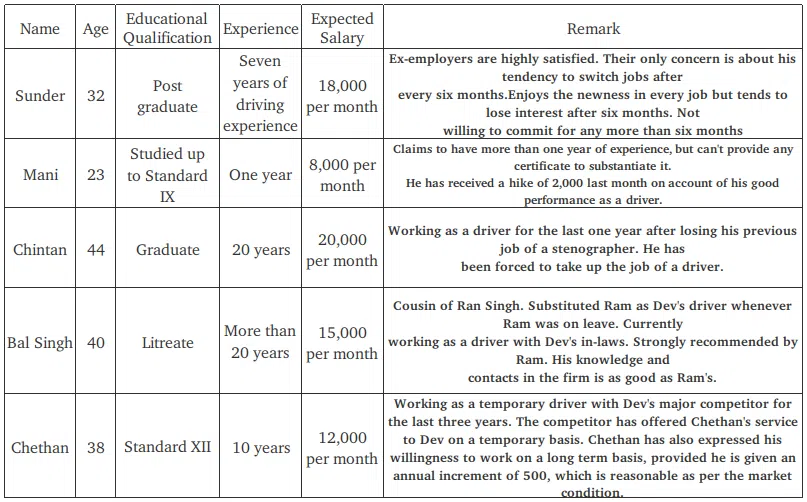
Dev is primarily looking for a stable and trustworthy driver, who can be a suitable replacement for Ram. His family members do not want Dev to appoint a young driver, as most of them are inexperienced. Dev’s driver is an employee of the firm and hence the appointment has to be routed through the HR manager of the firm. The HR manager prefers to maintain parity among all employees of the firm. He also needs to ensure that the selection of a new driver does not lead to discontent among the senior employees of the firm.
Question 96
From his perspective, and taking into account the family’s concerns, Mr. Dev would like to have
correct answer:- 3
Answer the questions on the basis of the information given in the following case.
Dev Anand, CEO of a construction company, recently escaped a potentially fatal accident. Dev had failed to notice a red light while driving his car and attending to his phone calls. His well-wishers advised him to get
a suitable replacement for the previous driver Ram Singh, who had resigned three months back. Ram Singh was not just a driver, but also a trusted lieutenant for Dev Anand for the last five years. Ram
used to interact with other drivers and gathered critical information that helped Dev in successfully bidding for different contracts. His inputs also helped Dev to identify some dishonest employees, and to
retain crucial employees who were considering attractive offers from his competitors. Some of the senior employees did not like the informal influence of Ram and made it difficult for him to continue in the
firm. Dev provided him an alternative job with one of his relatives. During the last three months Dev has considered different candidates for the post. The backgrounds of the candidates are given in the table below.
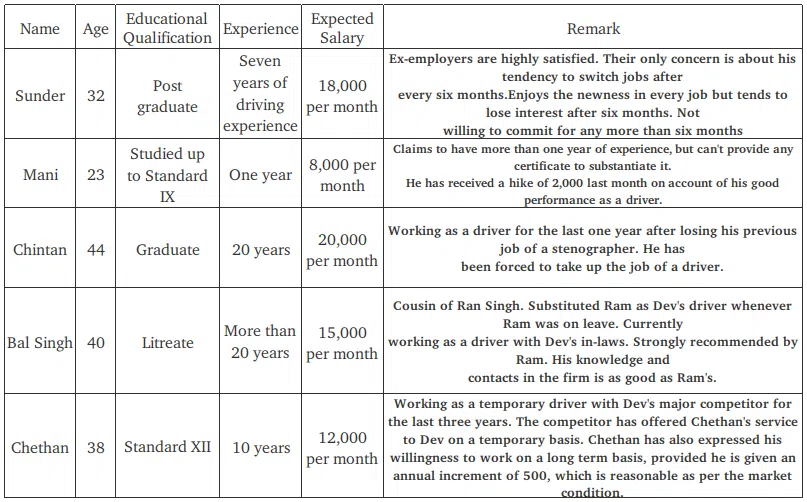
Dev is primarily looking for a stable and trustworthy driver, who can be a suitable replacement for Ram. His family members do not want Dev to appoint a young driver, as most of them are inexperienced. Dev’s driver is an employee of the firm and hence the appointment has to be routed through the HR manager of the firm. The HR manager prefers to maintain parity among all employees of the firm. He also needs to ensure that the selection of a new driver does not lead to discontent among the senior employees of the firm.
Question 97
In order to resolve the conflicting preferences, one of Dev’s friends suggested Dev, his family members and the HR manager to identify their most and the least preferred candidates without considering the concerns of other stakeholders.
I. Dev’s most and least preferred candidates: Bal Singh and Chetan respectively
II. Family members’ most and least preferred candidates: Bal Singh and Chintan respectively
III. HR manager’s most and least preferred candidates: Chethan and Bal Singh respectively
Which of the above three statements is/are in conformity with the information provided in the passage?
correct answer:- 1
Answer the questions on the basis of the information given in the following case.
Dev Anand, CEO of a construction company, recently escaped a potentially fatal accident. Dev had failed to notice a red light while driving his car and attending to his phone calls. His well-wishers advised him to get
a suitable replacement for the previous driver Ram Singh, who had resigned three months back. Ram Singh was not just a driver, but also a trusted lieutenant for Dev Anand for the last five years. Ram
used to interact with other drivers and gathered critical information that helped Dev in successfully bidding for different contracts. His inputs also helped Dev to identify some dishonest employees, and to
retain crucial employees who were considering attractive offers from his competitors. Some of the senior employees did not like the informal influence of Ram and made it difficult for him to continue in the
firm. Dev provided him an alternative job with one of his relatives. During the last three months Dev has considered different candidates for the post. The backgrounds of the candidates are given in the table below.
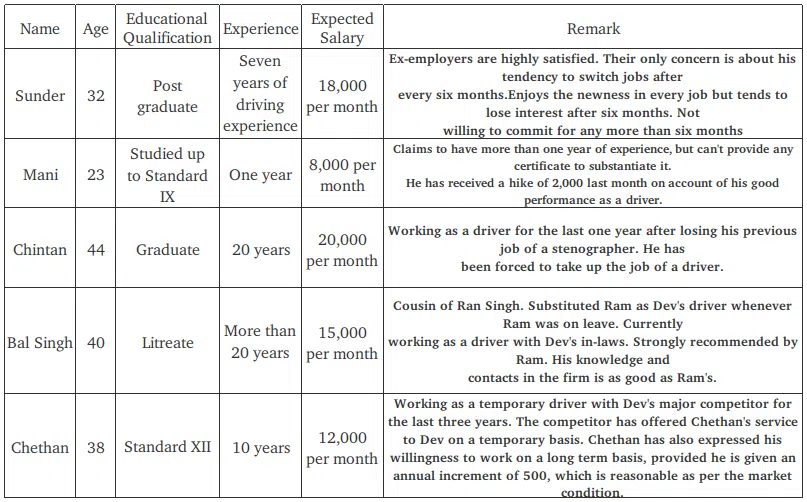
Dev is primarily looking for a stable and trustworthy driver, who can be a suitable replacement for Ram. His family members do not want Dev to appoint a young driver, as most of them are inexperienced. Dev’s driver is an employee of the firm and hence the appointment has to be routed through the HR manager of the firm. The HR manager prefers to maintain parity among all employees of the firm. He also needs to ensure that the selection of a new driver does not lead to discontent among the senior employees of the firm.
Question 98
Who among the following five candidates is most likely to be rejected by the GM (HR)?
correct answer:- 3
based on the case given below.
Ethical – a person is called unethical, when he deviates from principles. The principles and their use is often guided by two definitions: Moral: society’s code for individual survival Ethics: An individual’s code for society survival Naresh was a small time civil contractor in a small city. His major clients were the residents who wanted ad-hoc work like painting, building extensions to be done. His just prices had made him a preferred contractor for most of the clients who preferred him over other civil contractors. Always he followed the principle that client had to be kept happy – only by doing so it would be a win-win situation for both. However due to the unpredictability of such orders from residents, Naresh used to be idle for substantial part of the year. As a consequence, he could not expand his business. His two children were growing up and his existing business could not support their expenses. The medical expense of his elderly parents was another drain on his resources. The constant rise of prices in medical care and medicines was another issue. For Naresh, family’s concern was predominant. Naresh was, therefore, under pressure to expand his business. He was the sole earning member of his family, and he had to ensure their well being. He thought that by expanding his business, not only would he be able to care for his family in a better way, as well as offer employment to more number of masons and labourers. That would benefit their families as well. Naresh drew the boundary of his society to include himself, his family members, his employees and their family members. For expansion, the only option in the city was to enlist= as a contractor for government work. Before deciding, he sought advice from another contractor, Srikumar, who had been working on government projects for a long period of time. Srikumar followed the principle of always helping others, because he believed that he would be helped back in return some day. Srikumar had just one advice “The work is given to those who will win the bidding process and at the same time will give the maximum bribe. Prices quoted for work have to include bribes, else the bills will not get cleared and the supervisors will find multiple faults with the execution of work. This ensures survival and prosperity for contractors”. When asked about other contractors, Srikumar said “The government contractors are like a micro-society in themselves, almost like a brotherhood. Within that, they are highly competitive; however towards any external threat they are united to ensure no harm happens to any of their members”.
Question 99
Naresh decided to work as a government contractor. Following Srikumar’s advice, he
inflated the prices so that he could pay the bribes out the bills received.
correct answer:- 5
based on the case given below.
Ethical – a person is called unethical, when he deviates from principles. The principles and their use is often guided by two definitions: Moral: society’s code for individual survival Ethics: An individual’s code for society survival Naresh was a small time civil contractor in a small city. His major clients were the residents who wanted ad-hoc work like painting, building extensions to be done. His just prices had made him a preferred contractor for most of the clients who preferred him over other civil contractors. Always he followed the principle that client had to be kept happy – only by doing so it would be a win-win situation for both. However due to the unpredictability of such orders from residents, Naresh used to be idle for substantial part of the year. As a consequence, he could not expand his business. His two children were growing up and his existing business could not support their expenses. The medical expense of his elderly parents was another drain on his resources. The constant rise of prices in medical care and medicines was another issue. For Naresh, family’s concern was predominant. Naresh was, therefore, under pressure to expand his business. He was the sole earning member of his family, and he had to ensure their well being. He thought that by expanding his business, not only would he be able to care for his family in a better way, as well as offer employment to more number of masons and labourers. That would benefit their families as well. Naresh drew the boundary of his society to include himself, his family members, his employees and their family members. For expansion, the only option in the city was to enlist= as a contractor for government work. Before deciding, he sought advice from another contractor, Srikumar, who had been working on government projects for a long period of time. Srikumar followed the principle of always helping others, because he believed that he would be helped back in return some day. Srikumar had just one advice “The work is given to those who will win the bidding process and at the same time will give the maximum bribe. Prices quoted for work have to include bribes, else the bills will not get cleared and the supervisors will find multiple faults with the execution of work. This ensures survival and prosperity for contractors”. When asked about other contractors, Srikumar said “The government contractors are like a micro-society in themselves, almost like a brotherhood. Within that, they are highly competitive; however towards any external threat they are united to ensure no harm happens to any of their members”.
Question 100
A new supervisor had joined a government department where both Naresh and Srikumar were bidding for work. During the bidding process for a particular project, in an open meeting with all contractors and officers from the department, he produced a document which had the rates at which Naresh had worked for private clients for similar building related work. He accused Naresh and Srikumar of over-pricing for government work and threatened to disqualify them from the bidding process, if the rates are not brought down. Faced with that situation, Naresh gave a written reply that “I use materials of inferior quality for private work, and that is the reason for price difference”. Srikumar supported Naresh in the meeting by saying that he had seen Naresh’s work and he agreed. In this situation, it can be concluded that:
correct answer:- 4
based on the case given below.
Ethical – a person is called unethical, when he deviates from principles. The principles and their use is often guided by two definitions: Moral: society’s code for individual survival Ethics: An individual’s code for society survival Naresh was a small time civil contractor in a small city. His major clients were the residents who wanted ad-hoc work like painting, building extensions to be done. His just prices had made him a preferred contractor for most of the clients who preferred him over other civil contractors. Always he followed the principle that client had to be kept happy – only by doing so it would be a win-win situation for both. However due to the unpredictability of such orders from residents, Naresh used to be idle for substantial part of the year. As a consequence, he could not expand his business. His two children were growing up and his existing business could not support their expenses. The medical expense of his elderly parents was another drain on his resources. The constant rise of prices in medical care and medicines was another issue. For Naresh, family’s concern was predominant. Naresh was, therefore, under pressure to expand his business. He was the sole earning member of his family, and he had to ensure their well being. He thought that by expanding his business, not only would he be able to care for his family in a better way, as well as offer employment to more number of masons and labourers. That would benefit their families as well. Naresh drew the boundary of his society to include himself, his family members, his employees and their family members. For expansion, the only option in the city was to enlist= as a contractor for government work. Before deciding, he sought advice from another contractor, Srikumar, who had been working on government projects for a long period of time. Srikumar followed the principle of always helping others, because he believed that he would be helped back in return some day. Srikumar had just one advice “The work is given to those who will win the bidding process and at the same time will give the maximum bribe. Prices quoted for work have to include bribes, else the bills will not get cleared and the supervisors will find multiple faults with the execution of work. This ensures survival and prosperity for contractors”. When asked about other contractors, Srikumar said “The government contractors are like a micro-society in themselves, almost like a brotherhood. Within that, they are highly competitive; however towards any external threat they are united to ensure no harm happens to any of their members”.
Question 101
Lankawala, another contractor, when faced with the new supervisor’s demand to reduce prices for government work, asked him to guarantee that no bribes would be taken, and only then prices would be reduced. This was said in front of everyone. At this the supervisor forced Lankawala out of the meeting and threatened to black-list him. Lankawala did not say anything and walked away. Blacklisting of a contractor by one government department implied that Lankawala would not be able to participate in any government departments’ works. In late evening, the city was abuzz with the news that the supervisor’s dead body was seen on the
railway tracks. In the investigations that followed, no one who attended the meeting recounted the happenings in the meeting to the police. Getting involved in murder cases could lead to unpredictable outcomes such as becoming the potential suspect, or an accessory to the crime. Furthermore, cases could drag on for years, and one would have to appear in court as witnesses in response to court’s summons. This, for a contractor, was a serious threat to his business due to the disruptions created. However, Naresh wanted to speak out but was pressurized by Srikumar and other contractors not to, and as a result he did not. Due to this, the case was closed unresolved with no one found guilty. In this situation, it can be concluded that:
correct answer:- 1
on the basis of the information given in the following case.
Saral Co. is operating in seven north-eastern states of the country. The organization has a history of participative decision making, wherein people deliberate openly about pros and cons of every important decision, and a broad consensus is taken before taking the final decision. In Saral Co. every employee gets a salary proportional to the sales achieved. A new General Manager (GM) joined during the beginning of this month and challenged the organization’s sole focus on sales to determine salaries. He urged the top management to include two more additional parameters in determining the salaries of the employees, viz. collection of information about competitors and the quality of relationship with the retailers.
Question 102
Manohar, the highest earning employee for the last three years, vehemently opposes the GM’s
proposal. Which of the following could be most likely reason for him to oppose the proposal?
correct answer:- 5
on the basis of the information given in the following case.
Saral Co. is operating in seven north-eastern states of the country. The organization has a history of participative decision making, wherein people deliberate openly about pros and cons of every important decision, and a broad consensus is taken before taking the final decision. In Saral Co. every employee gets a salary proportional to the sales achieved. A new General Manager (GM) joined during the beginning of this month and challenged the organization’s sole focus on sales to determine salaries. He urged the top management to include two more additional parameters in determining the salaries of the employees, viz. collection of information about competitors and the quality of relationship with the retailers.
Question 103
The top management of Saral Co. refused to implement the proposal of new GM from the beginning of next month, which of the following could be the most justified reason for the management’s refusal?
correct answer:- 5