NTA JEE Main 9th April 2017 Online
For the following questions answer them individually
NTA JEE Main 9th April 2017 Online - Question 11
$$N$$ moles of diatomic gas in a cylinder is at a temperature $$T$$. Heat is supplied to the cylinder such that the temperature remains constant but $$n$$ moles of the diatomic gas get converted into monoatomic gas. The change in the total kinetic energy of the gas is
NTA JEE Main 9th April 2017 Online - Question 12
A block of mass 0.1 kg is connected to an elastic spring of spring constant 640 N m$$^{-1}$$ and oscillates in a damping medium of damping constant $$10^{-2}$$ kg s$$^{-1}$$. The system dissipates its energy gradually. The time taken for its mechanical energy of vibration to drop to half of its initial value, is closest to-
NTA JEE Main 9th April 2017 Online - Question 13
In an experiment to determine the period of a simple pendulum of length 1 m, it is attached to different spherical bobs of radii $$r_1$$ and $$r_2$$. The two spherical bobs have uniform mass distribution. If the relative difference in the periods, is found to be $$5 \times 10^{-4}$$ s, the difference in radii, $$|r_1 - r_2|$$ is best-given by

NTA JEE Main 9th April 2017 Online - Question 14
A standing wave is formed by the superposition of two waves travelling in opposite directions. The transverse displacement is given by, $$y(x, t) = 0.5 \sin\left(\frac{5\pi}{4}x\right) \cos(200\pi t)$$. What is the speed of the travelling wave moving in the positive $$x$$ direction? ($$x$$ and $$t$$ are in meter and second, respectively)
NTA JEE Main 9th April 2017 Online - Question 15
Four closed surfaces and corresponding charge distributions are shown below.
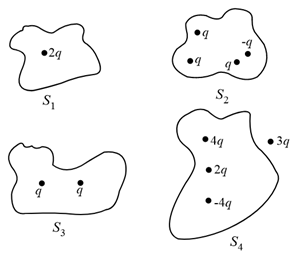
Let the respective electric fluxes through the surfaces be $$\phi_1$$, $$\phi_2$$, $$\phi_3$$ and $$\phi_4$$. Then:
NTA JEE Main 9th April 2017 Online - Question 16
A negative test charge is moving near a long straight wire carrying a current. The force acting on the test charge is parallel to the direction of the current. The motion of the charge is:
NTA JEE Main 9th April 2017 Online - Question 17
A combination of parallel plate capacitors is maintained at a certain potential difference.
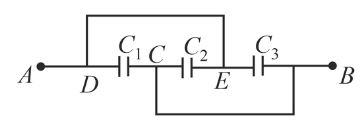
When a 3 mm thick slab is introduced between all the plates, in order to maintain the same potential difference, the distance between the plates is increased by 2.4 mm. Find the dielectric constant of the slab.
NTA JEE Main 9th April 2017 Online - Question 18
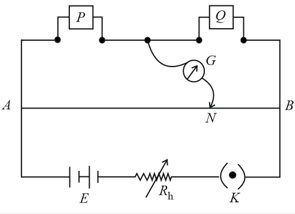
In a meter bridge experiment resistances are connected as shown in the figure. Initially resistance $$P = 4 \; \Omega$$ and the neutral point $$N$$ is at 60 cm from $$A$$. Now an unknown resistance $$R$$ is connected in series to $$P$$ and the new position of the neutral point is at 80 cm from $$A$$. The value of unknown resistance $$R$$ is -
NTA JEE Main 9th April 2017 Online - Question 19
A uniform wire of length $$l$$ and radius $$r$$ has a resistance of 100 $$\Omega$$. It is recast into a wire of radius $$\frac{r}{2}$$. The resistance of new wire will be-
NTA JEE Main 9th April 2017 Online - Question 20
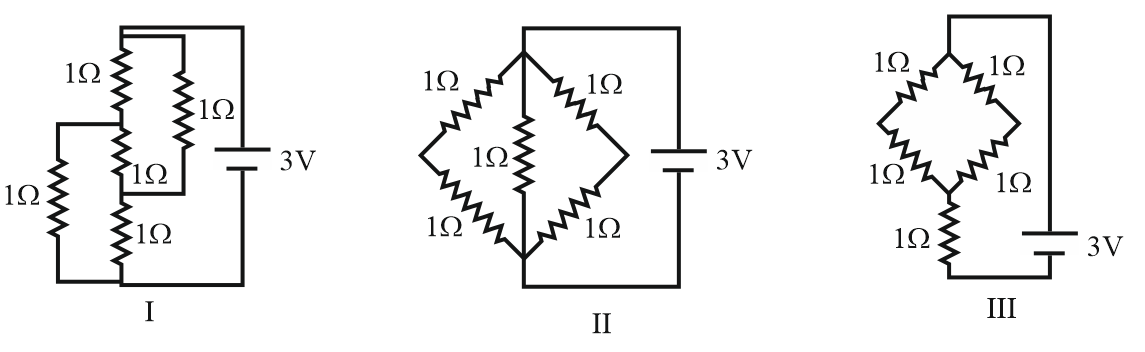
The figure shows three circuits I, II and III which are connected to a 3 V battery. If the powers dissipated by the configurations I, II and III are $$P_1$$, $$P_2$$ and $$P_3$$ respectively, then -