
Join Our JEE Preparation Group
Prep with like-minded aspirants; Get access to free daily tests and study material.
Sign in
Please select an account to continue using cracku.in
↓ →
Join Our JEE Preparation Group
Prep with like-minded aspirants; Get access to free daily tests and study material.
Let $$S_n = \frac{1}{1^3} + \frac{1+2}{1^3+2^3} + \frac{1+2+3}{1^3+2^3+3^3} + \ldots + \frac{1+2+\ldots+n}{1^3+2^3+\ldots+n^3}$$. If 100 $$S_n = n$$, then $$n$$ is equal to:
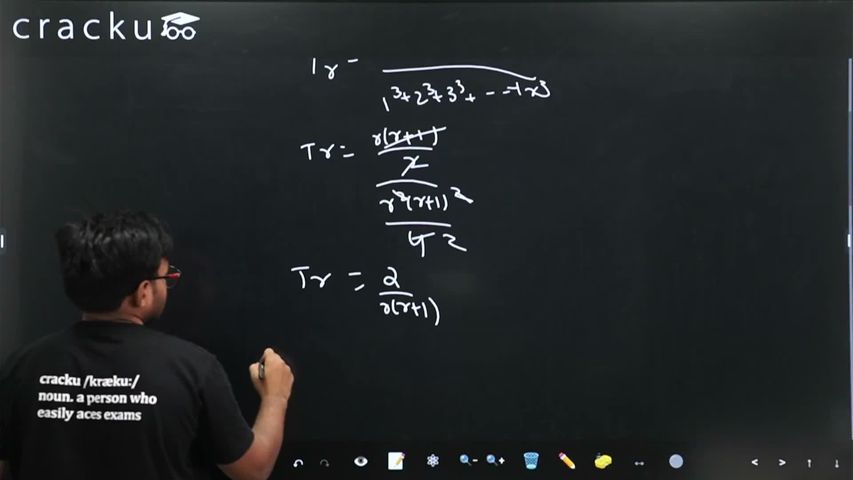
First, observe the general term of the series. For any positive integer $$k$$, the numerator of the $$k^{\text{th}}$$ fraction is the sum of the first $$k$$ natural numbers:
$$1+2+\ldots+k \;=\; \frac{k(k+1)}{2}.$$
The denominator of the same fraction is the sum of the cubes of the first $$k$$ natural numbers. A standard identity tells us that this sum equals the square of the numerator just written:
$$1^{3}+2^{3}+\ldots+k^{3} \;=\; \left(\frac{k(k+1)}{2}\right)^{2}.$$
Hence the $$k^{\text{th}}$$ fraction inside $$S_n$$ is
$$\frac{\dfrac{k(k+1)}{2}}{\left(\dfrac{k(k+1)}{2}\right)^{2}}.$$
We simplify the above step by step:
$$\frac{\dfrac{k(k+1)}{2}}{\left(\dfrac{k(k+1)}{2}\right)^{2}} \;=\; \frac{\dfrac{k(k+1)}{2}}{\dfrac{k^{2}(k+1)^{2}}{4}} \;=\; \frac{k(k+1)}{2}\;\times\;\frac{4}{k^{2}(k+1)^{2}} \;=\; \frac{4k(k+1)}{2k^{2}(k+1)^{2}} \;=\; \frac{2}{k(k+1)}.$$
Therefore every term simplifies neatly, and the entire sum $$S_n$$ becomes
$$S_n = \sum_{k=1}^{n} \frac{2}{k(k+1)}.$$
To evaluate this telescoping sum, recall the decomposition
$$\frac{1}{k(k+1)} \;=\; \frac{1}{k} - \frac{1}{k+1}.$$
Multiplying by 2 we have
$$\frac{2}{k(k+1)} \;=\; 2\left(\frac{1}{k} - \frac{1}{k+1}\right).$$
Now add from $$k=1$$ up to $$k=n$$:
$$S_n \;=\; 2\sum_{k=1}^{n}\left(\frac{1}{k} - \frac{1}{k+1}\right) \;=\; 2\Bigl[\left(1 - \frac12\right) + \left(\frac12 - \frac13\right) + \left(\frac13 - \frac14\right) + \ldots + \left(\frac1n - \frac1{\,n+1\,}\right)\Bigr].$$
All the intermediate terms cancel pairwise, leaving only the very first $$1$$ and the very last $$-\dfrac1{\,n+1\,}$$:
$$S_n \;=\; 2\left(1 - \frac{1}{\,n+1\,}\right) \;=\; 2\left(\frac{n+1-1}{\,n+1\,}\right) \;=\; 2\left(\frac{n}{\,n+1\,}\right) \;=\; \frac{2n}{\,n+1\,}.$$
The problem states that $$100\,S_n = n$$. Substitute the expression just found:
$$100 \times \frac{2n}{\,n+1\,} = n.$$
Clear the denominator by multiplying both sides by $$n+1$$:
$$100 \times 2n = n(n+1).$$
Hence
$$200n = n^{2} + n.$$
Gather all terms on one side:
$$0 = n^{2} + n - 200n$$
$$0 = n^{2} - 199n.$$
Factor out $$n$$:
$$n(n - 199) = 0.$$
This gives the possibilities $$n = 0$$ or $$n = 199$$. Because $$n$$ counts the number of terms in the original sum, it must be a positive integer, so we reject $$n = 0$$ and keep
$$n = 199.$$
Among the supplied choices, 199 corresponds to Option B.
Hence, the correct answer is Option B.
Was this solution helpful?
Click on the Email ☝️ to Watch the Video Solution
Create a FREE account and get:
_1.webp)

Educational materials for JEE preparation

Ask our AI anything

AI can make mistakes. Please verify important information.
AI can make mistakes. Please verify important information.


