Join WhatsApp Icon JEE WhatsApp Group

NTA JEE Main 9th April 2017 Online

For the following questions answer them individually

A physical quantity $$P$$ is described by the relation $$P = a^{\frac{1}{2}} b^2 c^3 d^{-4}$$. If the relative errors in the measurement of $$a, b, c$$ and $$d$$ respectively, are 2%, 1%, 3% and 5%. Then the relative error in $$P$$ will be:

A car is standing 200 m behind a bus, which is also at rest. The two start moving at the same instant but with different forward accelerations. The bus has acceleration 2 m s$$^{-2}$$ and the car has acceleration 4 m s$$^{-2}$$. The car will catch up with the bus after time:

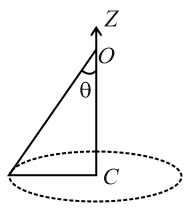
A conical pendulum of length $$l$$ makes an angle $$\theta = 45^\circ$$ with respect to Z-axis and moves in a circle in the XY plane. The radius of the circle is 0.4 m and its center is vertically below O. The speed of the pendulum, in its circular path, will be - (Take $$g = 10$$ m s$$^{-2}$$)

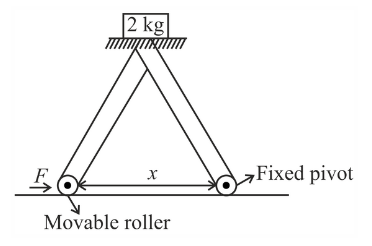
The machine as shown has 2 rods of length 1 m connected by a pivot at the top. The end of one rod is connected to the floor by a stationary pivot and the end of the other rod has a roller that rolls along the floor in a slot. As the roller goes back and forth, a 2 kg weight moves up and down. If the roller is moving towards right at a constant speed, the weight moves up with a:

image

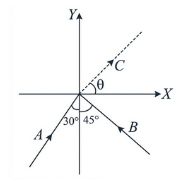
Two particles $$A$$ and $$B$$ of equal mass $$M$$ are moving with the same speed $$v$$ as shown in figure. They collide completely inelastic and move as a single particle $$C$$. The angle $$\theta$$ that the path of $$C$$ makes with the X-axis is given by-

image

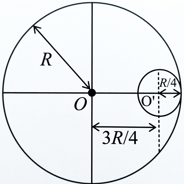
A circular hole of radius $$\frac{R}{4}$$ is made in a thin uniform disc having mass and radius $$R$$, as shown in figure. The moment of inertia of the remaining portion of the disc about an axis passing through the point O and perpendicular to the plane of the disc is-

image

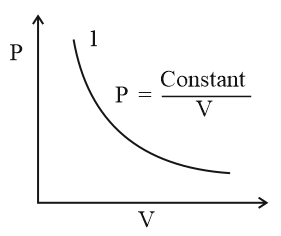
The mass density of a spherical body is given by $$\rho(r) = \frac{k}{r}$$ for $$r \le R$$ and $$\rho(r) = 0$$ for $$r > R$$, where $$r$$ is the distance from the center. The correct graph that describes qualitatively the acceleration, $$a$$ of a test particle as a function of $$r$$ is:

Two tubes of radii $$r_1$$ and $$r_2$$ and lengths $$l_1$$ and $$l_2$$, respectively, are connected in series and a liquid flows through each of them in stream line conditions. $$P_1$$ and $$P_2$$ are pressure differences across the two tubes. If $$P_2$$ is $$4P_1$$ and $$l_2$$ is $$\frac{l_1}{4}$$ then the radius $$r_2$$ will be equal to:

A steel rail of length 5 m and area of cross section 40 cm$$^2$$ is prevented from expanding along its length while the temperature rises by 10°C. If coefficient of linear expansion and Young's modulus of steel are $$1.2 \times 10^{-5}$$ K$$^{-1}$$ and $$2 \times 10^{11}$$ N m$$^{-2}$$ respectively, the force developed in the rail is approximately:

$$N$$ moles of diatomic gas in a cylinder is at a temperature $$T$$. Heat is supplied to the cylinder such that the temperature remains constant but $$n$$ moles of the diatomic gas get converted into monoatomic gas. The change in the total kinetic energy of the gas is

A block of mass 0.1 kg is connected to an elastic spring of spring constant 640 N m$$^{-1}$$ and oscillates in a damping medium of damping constant $$10^{-2}$$ kg s$$^{-1}$$. The system dissipates its energy gradually. The time taken for its mechanical energy of vibration to drop to half of its initial value, is closest to-

In an experiment to determine the period of a simple pendulum of length 1 m, it is attached to different spherical bobs of radii $$r_1$$ and $$r_2$$. The two spherical bobs have uniform mass distribution. If the relative difference in the periods, is found to be $$5 \times 10^{-4}$$ s, the difference in radii, $$|r_1 - r_2|$$ is best-given by

A standing wave is formed by the superposition of two waves travelling in opposite directions. The transverse displacement is given by, $$y(x, t) = 0.5 \sin\left(\frac{5\pi}{4}x\right) \cos(200\pi t)$$. What is the speed of the travelling wave moving in the positive $$x$$ direction? ($$x$$ and $$t$$ are in meter and second, respectively)

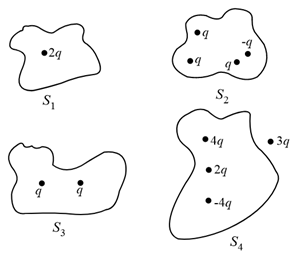
Four closed surfaces and corresponding charge distributions are shown below.

Let the respective electric fluxes through the surfaces be $$\phi_1$$, $$\phi_2$$, $$\phi_3$$ and $$\phi_4$$. Then:

A negative test charge is moving near a long straight wire carrying a current. The force acting on the test charge is parallel to the direction of the current. The motion of the charge is:

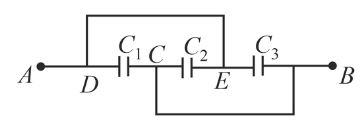
A combination of parallel plate capacitors is maintained at a certain potential difference.

image

When a 3 mm thick slab is introduced between all the plates, in order to maintain the same potential difference, the distance between the plates is increased by 2.4 mm. Find the dielectric constant of the slab.

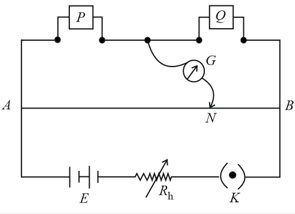
In a meter bridge experiment resistances are connected as shown in the figure. Initially resistance $$P = 4 \; \Omega$$ and the neutral point $$N$$ is at 60 cm from $$A$$. Now an unknown resistance $$R$$ is connected in series to $$P$$ and the new position of the neutral point is at 80 cm from $$A$$. The value of unknown resistance $$R$$ is -

image

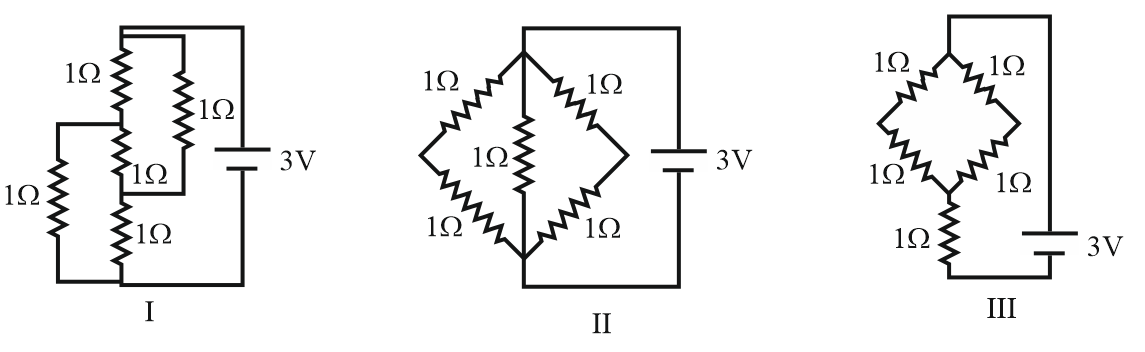
The figure shows three circuits I, II and III which are connected to a 3 V battery. If the powers dissipated by the configurations I, II and III are $$P_1$$, $$P_2$$ and $$P_3$$ respectively, then -

A uniform magnetic field $$B$$ of 0.3 T is along the positive Z-direction. A rectangular loop (abcd) of sides 10 cm $$\times$$ 5 cm carries a current $$I$$ of 12 A. Out of the following different orientations which one corresponds to stable equilibrium?

A sinusoidal voltage of peak value 283 V and angular frequency 320 s$$^{-1}$$ is applied to a series LCR circuit. Given that $$R = 5 \; \Omega$$, $$L = 25$$ mH and $$C = 1000 \; \mu$$F. The total impedance and phase difference between the voltage across the source and the current will respectively be-

The electric field component of a monochromatic radiation is given by $$\vec{E} = 2E_0 \cos kz \cos \omega t \; \hat{i}$$. Its magnetic field $$\vec{B}$$ is then given by:

In an experiment a convex lens of focal length 15 cm is placed coaxially on an optical bench in front of a convex mirror at a distance of 5 cm from it. It is found that an object and its image coincide, if the object is placed at a distance of 20 cm from the lens. The focal length of the convex mirror is-

A single slit of width 0.1 mm is illuminated by a parallel beam of light of wavelength 6000 Å and diffraction bands are observed on a screen 0.5 m from the slit. The distance of the third dark band from the central bright band is:

A laser light of wavelength 660 nm is used to weld Retina detachment. If a laser pulse of width 60 ms and power 0.5 kW is used, the approximate number of photons in the pulse are (Take Planck's Constant, $$h = 6.62 \times 10^{-34}$$ J s)

The acceleration of an electron in the first orbit of the hydrogen atom ($$n = 1$$) is:

Imagine that a reactor converts all the given mass into energy and that it operates at a power level of $$10^9$$ Watt. The mass of the fuel consumed per hour, in the reactor, will be: (velocity of light, $$c$$ is $$3 \times 10^8$$ m s$$^{-1}$$)

A signal is to be transmitted through a wave of wavelength $$\lambda$$, using a linear antenna. The length $$l$$ of the antenna and effective power radiated $$P_{\text{eff}}$$ will be given, respectively, as- ($$K$$ is a constant of proportionality)

What quantity (in mL) of a 45% acid solution of a mono-protic strong acid must be mixed with a 20% solution of the same acid to produce 800 mL of a 29.875% acid solution?

The electron in the hydrogen atom undergoes transition from higher orbitals to orbital of radius 211.6 pm. This transition is associated with

The electronic configuration with the highest ionization enthalpy is:

The group having triangular planar structure is:

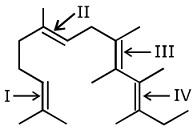
The increasing order of the boiling points for the following compounds is:
(I) C$$_2$$H$$_5$$OH    (II) C$$_2$$H$$_5$$Cl    (III) C$$_2$$H$$_5$$CH$$_3$$    (IV) C$$_2$$H$$_5$$OCH$$_3$$

At 300 K, the density of a certain gaseous molecule at 2 bar is double to that of dinitrogen (N$$_2$$) at 4 bar. The molar mass of the gaseous molecule is

An ideal gas undergoes isothermal expansion at constant pressure. During the process:

A gas undergoes change from state A to state B. In this process, the heat absorbed and work done by the gas is 5 J and 8 J, respectively. Now gas is brought back to A by another process during which 3 J of heat is evolved. In this reverse process of B to A.

The following reaction occurs in the Blast Furnace where iron ore is reduced to iron metal:
Fe$$_2$$O$$_3$$(s) + 3CO(g) $$\rightleftharpoons$$ 2Fe(l) + 3CO$$_2$$(g)
Using the Le Chatelier's principle, predict which one of the following will not disturb the equilibrium?

Which of the following is a set of greenhouse gases?

A solution is prepared by mixing 8.5 g of CH$$_2$$Cl$$_2$$ and 11.95 g of CHCl$$_3$$. If vapour pressure of CH$$_2$$Cl$$_2$$ and CHCl$$_3$$ at 298K are 415 and 200 mm Hg respectively, the mole fraction of CHCl$$_3$$ in vapour form is: (Molar mass of Cl = 35.5 g mol$$^{-1}$$)

To find the standard potential of M$$^{3+}$$/M electrode, the following cell is constituted:
Pt | M/M$$^{3+}$$ (0.001 mol L$$^{-1}$$) / Ag$$^+$$ (0.01 mol L$$^{-1}$$) / Ag
The emf of the cell is found to be 0.421 volt at 298 K. The standard potential of half-reaction M$$^{3+}$$ + 3e$$^-$$ $$\rightarrow$$ M at 298 K will be:
(Given: $$E^\ominus_{Ag^+/Ag}$$ at 298 K = 0.80 volt)

The rate of a reaction quadruples when the temperature changes from 300 to 310 K. The activation energy of this reaction is:
(Assume Activation energy and pre-exponential factor are independent of temperature;
ln(2) = 0.693; R = 8.314 J mol$$^{-1}$$ K$$^{-1}$$)

Adsorption of gas on a surface follows Freundlich adsorption isotherm. The plot of log $$\frac{x}{m}$$ versus log(P) gives a straight line with slope equal to 0.5, then:
($$\frac{x}{m}$$ is the mass of the gas adsorbed per gram of adsorbent)

The number of P $$-$$ OH bonds and the oxidation state of phosphorus atom in pyrophosphoric acid (H$$_4$$P$$_2$$O$$_7$$), respectively are:

The correct sequence of decreasing number of $$\pi$$-bonds in the structure of $$H_2SO_3$$, $$H_2SO_4$$ and $$H_2S_2O_7$$ is:

XeF$$_6$$ on partial hydrolysis with water, produces a compound X. The same compound X is formed when XeF$$_6$$ reacts with silica. The compound X is:

[Co$$_2$$(CO)$$_8$$] displays

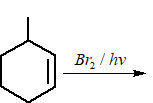
A compound of molecular formula C$$_8$$H$$_8$$O$$_2$$ reacts with acetophenone to form a single cross-aldol product in the presence of base. The same compound on reaction with concentrated NaOH forms benzyl alcohol as one of the products. The structure of the compound is:

Among the following compounds, the increasing order of their basic strength is:

The incorrect statement among the following is

The equation $$Im\left(\frac{iz - 2}{z - i}\right) + 1 = 0$$, $$z \in \mathbb{C}$$, $$z \neq i$$ represents a part of a circle having radius equal to:

If three positive numbers $$a$$, $$b$$ and $$c$$ are in A.P. such that $$abc = 8$$, then the minimum possible value of $$b$$ is:

Let $$S_n = \frac{1}{1^3} + \frac{1+2}{1^3+2^3} + \frac{1+2+3}{1^3+2^3+3^3} + \ldots + \frac{1+2+\ldots+n}{1^3+2^3+\ldots+n^3}$$. If 100 $$S_n = n$$, then $$n$$ is equal to:

The coefficient of $$x^{-5}$$ in the binomial expansion of $$\left(\frac{x+1}{x^{\frac{2}{3}} - x^{\frac{1}{3}} + 1} - \frac{x-1}{x - x^{\frac{1}{2}}}\right)^{10}$$ where $$x \neq 0, 1$$ is

The lengths of two adjacent sides of a cyclic quadrilateral are 2 units and 5 units and the angle between them is 60°. If the area of the quadrilateral is $$4\sqrt{3}$$ sq. units, then the perimeter of the quadrilateral is

A square, of each side 2, lies above the x-axis and has one vertex at the origin. If one of the sides passing through the origin makes an angle 30° with the positive direction of the x-axis, then the sum of the x-coordinates of the vertices of the square is:

If $$y = mx + c$$ is the normal at a point on the parabola $$y^2 = 8x$$ whose focal distance is 8 units, then $$|c|$$ is equal to:

The eccentricity of an ellipse having centre at the origin, axes along the co-ordinate axes and passing through the points $$(4, -1)$$ and $$(-2, 2)$$ is

The contrapositive of the statement 'If two numbers are not equal, then their squares are not equal', is

The sum of 100 observations and the sum of their squares are 400 & 2475, respectively. Later on, three observations 3, 4 & 5 were found to be incorrect. If the incorrect observations are omitted, then the variance of the remaining observations is

For two $$3 \times 3$$ matrices $$A$$ and $$B$$, let $$A + B = 2B'$$ and $$3A + 2B = I_3$$, where $$B'$$ is the transpose of $$B$$ and $$I_3$$ is $$3 \times 3$$ identity matrix. Then:

If $$x = a$$, $$y = b$$, $$z = c$$ is a solution of the system of linear equations
$$x + 8y + 7z = 0$$
$$9x + 2y + 3z = 0$$
$$x + y + z = 0$$
Such that the point $$(a, b, c)$$ lies on the plane $$x + 2y + z = 6$$, then $$2a + b + c$$ equals:

The function $$f : N \to I$$ defined by $$f(x) = x - 5\left[\frac{x}{5}\right]$$, where $$N$$ is the set of natural numbers and $$[x]$$ denotes the greatest integer less than or equal to $$x$$, is:

The value of $$k$$ which the function $$f(x) = \begin{cases} \left(\frac{4}{5}\right)^{\frac{\tan 4x}{\tan 5x}}, & 0 < x < \frac{\pi}{2} \\ k + \frac{2}{5}, & x = \frac{\pi}{2} \end{cases}$$ is continuous at $$x = \frac{\pi}{2}$$, is

If $$2x = y^{\frac{1}{5}} + y^{-\frac{1}{5}}$$ and $$(x^2 - 1)\frac{d^2y}{dx^2} + \lambda x \frac{dy}{dx} + ky = 0$$, then $$\lambda + k$$ is equal to

The function $$f$$ defined by $$f(x) = x^3 - 3x^2 + 5x + 7$$ is:

If $$f\left(\frac{3x - 4}{3x + 4}\right) = x + 2$$, $$x \neq -\frac{4}{3}$$, and $$\int f(x)dx = A \log|1 - x| + Bx + C$$, then the ordered pair $$(A, B)$$ is equal to

If $$\lim_{n \to \infty} \left(\frac{1^a + 2^a + \ldots + n^a}{(n+1)^{a-1}[(na+1) + (na+2) + \ldots + (na+n)]}\right) = \frac{1}{60}$$ for some positive real number $$a$$, then $$a$$ is equal to

Let $$f$$ be a polynomial function such that $$f(3x) = f'(x) \cdot f''(x)$$, for all $$x \in R$$. Then:

A tangent to the curve, $$y = f(x)$$ at $$P(x, y)$$ meets x-axis at $$A$$ and y-axis at $$B$$. If $$AP : BP = 1 : 3$$ and $$f(1) = 1$$, then the curve also passes through the point

If the vector $$\vec{b} = 3\hat{j} + 4\hat{k}$$ is written as the sum of a vector $$\vec{b_1}$$, parallel to $$\vec{a} = \hat{i} + \hat{j}$$ and a vector $$\vec{b_2}$$, perpendicular to $$\vec{a}$$, then $$\vec{b_1} \times \vec{b_2}$$ is equal to:

If the line, $$\frac{x - 3}{1} = \frac{y + 2}{-1} = \frac{z + \lambda}{-2}$$ lies in the plane, $$2x - 4y + 3z = 2$$, then the shortest distance between this line and the line, $$\frac{x - 1}{12} = \frac{y}{9} = \frac{z}{4}$$ is

If a variable plane, at a distance of 3 units from the origin, intersects the coordinate axes at $$A$$, $$B$$ & $$C$$, then the locus of the centroid of $$\triangle ABC$$ is

From a group of 10 men and 5 women, four member committees are to be formed each of which must contain at least one woman. Then the probability for these committees to have more women than men, is:

Let $$E$$ & $$F$$ be two independent events. The probability that $$E$$ & $$F$$ happen is $$\frac{1}{12}$$ and the probability that neither $$E$$ nor $$F$$ happens is $$\frac{1}{2}$$, then a value of $$\frac{P(E)}{P(F)}$$ is: