
Join Our JEE Preparation Group
Prep with like-minded aspirants; Get access to free daily tests and study material.
Sign in
Please select an account to continue using cracku.in
↓ →
Join Our JEE Preparation Group
Prep with like-minded aspirants; Get access to free daily tests and study material.
An ideal gas undergoes isothermal expansion at constant pressure. During the process:
We have an ideal gas that expands isothermally at constant pressure. The task is to examine how its enthalpy $$H$$ and entropy $$S$$ change during the process.
First, recall the relation between enthalpy and temperature for an ideal gas. For any ideal gas, enthalpy is a function of temperature only, and it is given by the expression
$$H = n\,C_p\,T,$$
where $$n$$ is the number of moles and $$C_p$$ is the molar heat capacity at constant pressure. Because the process is isothermal, we have
$$T_2 = T_1 \; \Longrightarrow \; \Delta T = T_2-T_1 = 0.$$
Hence the change in enthalpy is
$$\Delta H = n\,C_p\,(T_2-T_1)=n\,C_p\,(0)=0.$$
So, during the isothermal expansion the enthalpy remains constant.
Now we turn to the entropy change. The definition of entropy change for any reversible path is
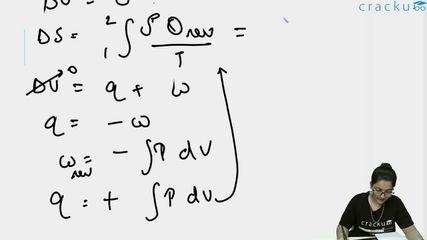
$$\Delta S = \int_{1}^{2} \frac{\delta Q_{\text{rev}}}{T}.$$
For an isothermal process of an ideal gas, the change in internal energy is zero because $$U= n\,C_vT$$ and $$\Delta T=0$$. From the first law of thermodynamics, $$\delta Q_{\text{rev}} = \delta W_{\text{rev}}$$ under these conditions because $$\delta W_{\text{rev}} = P\,dV$$ and $$\Delta U = 0$$. Substituting $$\delta Q_{\text{rev}} = P\,dV$$ into the entropy integral gives
$$\Delta S = \int_{V_1}^{V_2} \frac{P\,dV}{T}.$$
Using the ideal-gas equation $$P\,V = n\,R\,T\; \Longrightarrow \; P = \dfrac{nRT}{V},$$ we substitute for $$P$$:
$$\Delta S = \int_{V_1}^{V_2} \frac{nRT}{V\,T}\,dV = \int_{V_1}^{V_2} \frac{nR}{V}\,dV = nR \int_{V_1}^{V_2} \frac{dV}{V} = nR \,\ln\!\left(\frac{V_2}{V_1}\right).$$
Because the gas expands, $$V_2 > V_1$$, which implies $$\dfrac{V_2}{V_1} > 1$$ and therefore
$$\ln\!\left(\frac{V_2}{V_1}\right) > 0.$$
Thus,
$$\Delta S = nR \,\ln\!\left(\frac{V_2}{V_1}\right) > 0,$$
so the entropy increases.
Combining the two results, we see that enthalpy stays unchanged while entropy rises. This description matches Option A.
Hence, the correct answer is Option A.
Was this solution helpful?
Click on the Email ☝️ to Watch the Video Solution
Create a FREE account and get:
_1.webp)

Educational materials for JEE preparation

Ask our AI anything

AI can make mistakes. Please verify important information.
AI can make mistakes. Please verify important information.


