
Join Our JEE Preparation Group
Prep with like-minded aspirants; Get access to free daily tests and study material.
Sign in
Please select an account to continue using cracku.in
↓ →
Join Our JEE Preparation Group
Prep with like-minded aspirants; Get access to free daily tests and study material.
A gas undergoes change from state A to state B. In this process, the heat absorbed and work done by the gas is 5 J and 8 J, respectively. Now gas is brought back to A by another process during which 3 J of heat is evolved. In this reverse process of B to A.
We begin with the first law of thermodynamics, which states
$$\Delta U = Q - W$$
Here $$Q$$ is the heat absorbed by the gas (positive if absorbed, negative if released) and $$W$$ is the work done by the gas on the surroundings (positive if done by the gas, negative if done on the gas).
The gas first goes from state A to state B. For this forward process we are told
$$Q_{AB} = +5 \text{ J}, \qquad W_{AB} = +8 \text{ J}$$
Using the first law, the change in internal energy for this step is
$$\Delta U_{AB} = Q_{AB} - W_{AB} = 5\ \text{J} - 8\ \text{J} = -3\ \text{J}$$
So the internal energy decreases by $$3 \text{ J}$$ when the system moves from A to B.
Next the gas returns from B back to A by some other path. Because the system finally returns to its initial state, the total change in internal energy over the entire cycle must be zero. Hence, for the reverse path (B to A) we must have
$$\Delta U_{BA} = -\Delta U_{AB} = -(-3\ \text{J}) = +3\ \text{J}$$
During this reverse step it is given that heat is evolved, i.e. released, equal to $$3 \text{ J}$$. Therefore
$$Q_{BA} = -3\ \text{J}$$
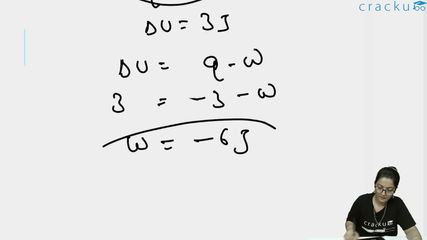
Again applying the first law, but now to the path B to A:
$$\Delta U_{BA} = Q_{BA} - W_{BA}$$
Substituting the known values, we get
$$3\ \text{J} = (-3\ \text{J}) - W_{BA}$$
Rearranging to isolate $$W_{BA}$$:
$$3\ \text{J} + 3\ \text{J} = - W_{BA}$$
$$6\ \text{J} = - W_{BA}$$
$$W_{BA} = -6\ \text{J}$$
The negative sign signifies that the work is not done by the gas but rather on the gas. Its magnitude is $$6 \text{ J}$$.
Therefore, during the reverse process from B to A, $$6 \text{ J}$$ of work is done by the surroundings on the gas.
Hence, the correct answer is Option B.
Was this solution helpful?
Click on the Email ☝️ to Watch the Video Solution
Create a FREE account and get:
_1.webp)

Educational materials for JEE preparation

Ask our AI anything

AI can make mistakes. Please verify important information.
AI can make mistakes. Please verify important information.


