
Join Our JEE Preparation Group
Prep with like-minded aspirants; Get access to free daily tests and study material.
Sign in
Please select an account to continue using cracku.in
↓ →
Join Our JEE Preparation Group
Prep with like-minded aspirants; Get access to free daily tests and study material.
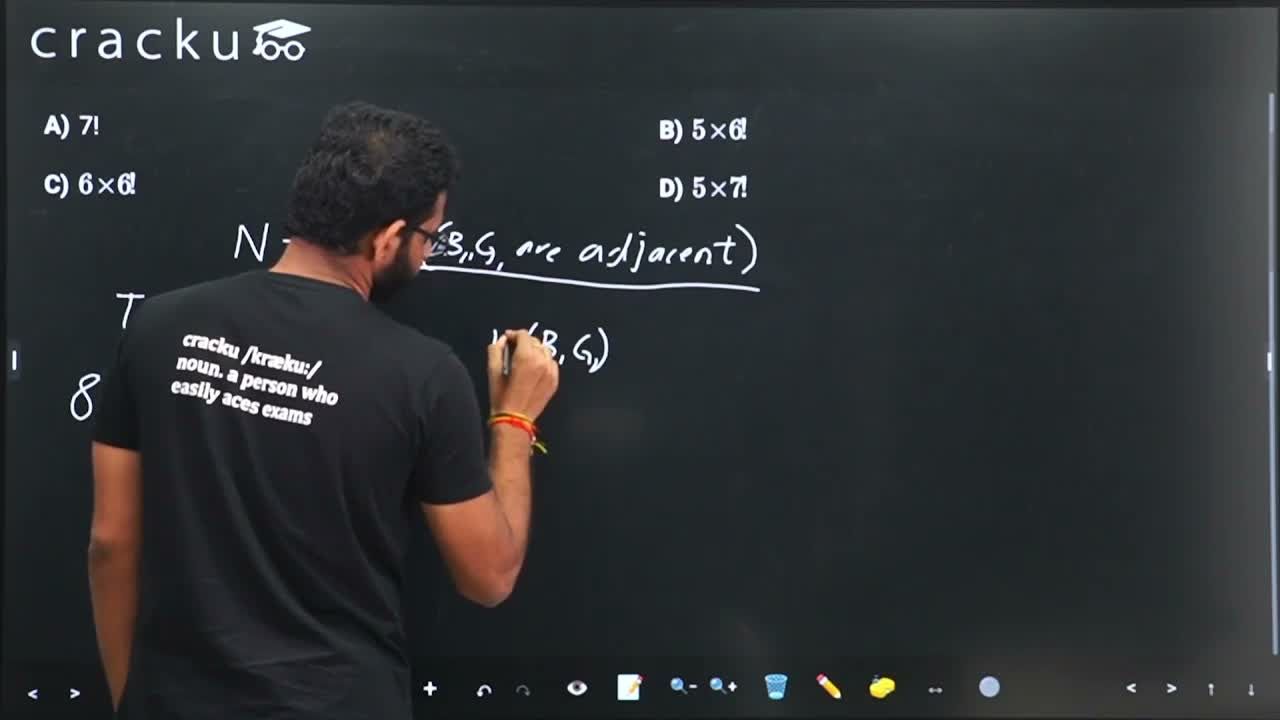
The number of ways in which 5 boys and 3 girls can be seated on a round table if a particular boy $$B_1$$ and a particular girl $$G_1$$ never sit adjacent to each other, is:
Let us begin by observing that there are 5 boys and 3 girls, so altogether $$5+3=8$$ persons have to be seated around one round table.
On a circular table, rotations of a complete seating are not considered different. Therefore, if there were no restriction at all, the total number of circular permutations of the 8 distinct persons would be
$$\bigl(8-1\bigr)! \;=\;7!.$$
Now impose the given restriction: the particular boy $$B_1$$ and the particular girl $$G_1$$ must never sit next to each other. A convenient way to handle such a restriction is to count the “bad” arrangements in which they are adjacent and then subtract that count from the total count.
Step 1: Count the arrangements in which $$B_1$$ and $$G_1$$ are adjacent.
When two specified persons have to be adjacent on a round table, we may temporarily tie them together and treat them as a single “super person.” However, note that inside that pair the order could be $$B_1G_1$$ or $$G_1B_1$$; hence there are $$2$$ internal arrangements.
After forming the pair we effectively have $$1 \text{ (pair)} + 6 \text{ (other individuals)} \;=\;7$$ distinct entities to arrange around the circle.
The number of circular permutations of 7 distinct entities is
$$\bigl(7-1\bigr)! \;=\;6!.$$
For each of these $$6!$$ ways, the internal order of the pair can be chosen in $$2$$ ways. Hence the total number of “bad” arrangements is
$$N_{\text{adjacent}} \;=\;2 \times 6!.$$
Step 2: Subtract the “bad” arrangements from the total.
The number of desired arrangements (where $$B_1$$ and $$G_1$$ are not adjacent) equals
$$N_{\text{desired}} \;=\;7! \;-\;2 \times 6!.$$
Now simplify this expression algebraically:
$$\begin{aligned} 7! &= 7 \times 6!,\\[4pt] N_{\text{desired}} &= 7 \times 6! \;-\;2 \times 6! \\[4pt] &= \bigl(7-2\bigr) \times 6! \\[4pt] &= 5 \times 6!. \end{aligned}$$
This quantity matches the expression given in Option B.
Hence, the correct answer is Option B.
Was this solution helpful?
Click on the Email ☝️ to Watch the Video Solution
Create a FREE account and get:
_1.webp)

Educational materials for JEE preparation

Ask our AI anything

AI can make mistakes. Please verify important information.
AI can make mistakes. Please verify important information.


