
Join Our JEE Preparation Group
Prep with like-minded aspirants; Get access to free daily tests and study material.
Sign in
Please select an account to continue using cracku.in
↓ →
Join Our JEE Preparation Group
Prep with like-minded aspirants; Get access to free daily tests and study material.
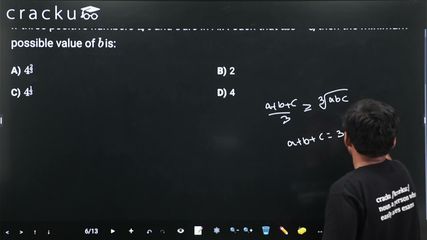
If three positive numbers $$a$$, $$b$$ and $$c$$ are in A.P. such that $$abc = 8$$, then the minimum possible value of $$b$$ is:
Let the three positive numbers be $$a$$, $$b$$ and $$c$$ with $$a<b<c$$; they are stated to be in arithmetic progression, so the common difference can be denoted by $$d\ge 0$$ and we may write
$$a=b-d,\qquad b=b,\qquad c=b+d.$$
The condition of the problem gives the product
$$abc=8.$$
Because the three numbers are positive, we may compare their arithmetic mean (AM) with their geometric mean (GM). Calculating the AM,
$$\text{AM}=\frac{a+b+c}{3}=\frac{(b-d)+b+(b+d)}{3}=\frac{3b}{3}=b.$$
Next, using the given product, the GM is
$$\text{GM}=(abc)^{1/3}=8^{1/3}=2.$$
A fundamental inequality for any three positive numbers is
$$\text{AM}\ge\text{GM}.$$
Substituting the values we have just found,
$$b\ge 2.$$
This inequality shows that $$b$$ cannot be smaller than $$2$$. To see that $$b=2$$ is actually attainable, we choose $$d=0$$, giving
$$a=b=c=2,$$
and then
$$abc=2\cdot 2\cdot 2=8,$$
exactly as required. Thus $$b=2$$ is not only a lower bound but is also achievable, making it the minimum possible value.
Hence, the correct answer is Option B.
Was this solution helpful?
Click on the Email ☝️ to Watch the Video Solution
Create a FREE account and get:
_1.webp)

Educational materials for JEE preparation

Ask our AI anything

AI can make mistakes. Please verify important information.
AI can make mistakes. Please verify important information.


