
Join Our JEE Preparation Group
Prep with like-minded aspirants; Get access to free daily tests and study material.
Sign in
Please select an account to continue using cracku.in
↓ →
Join Our JEE Preparation Group
Prep with like-minded aspirants; Get access to free daily tests and study material.
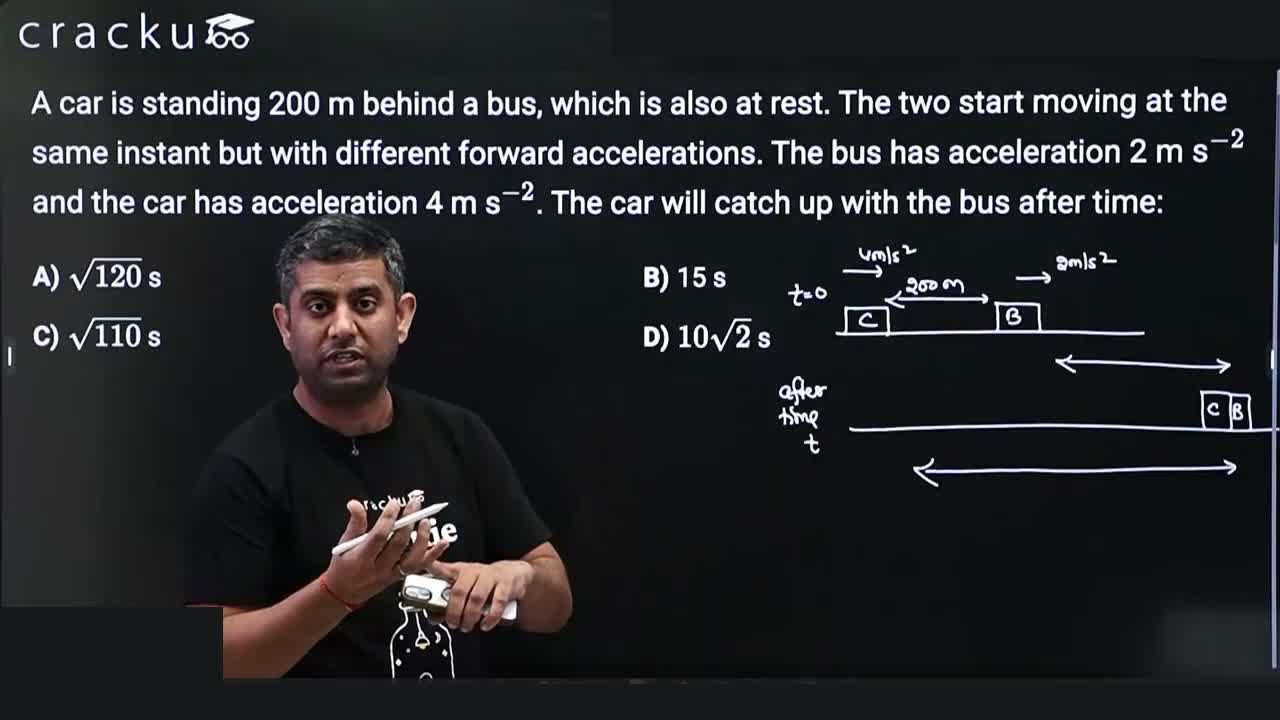
A car is standing 200 m behind a bus, which is also at rest. The two start moving at the same instant but with different forward accelerations. The bus has acceleration 2 m s$$^{-2}$$ and the car has acceleration 4 m s$$^{-2}$$. The car will catch up with the bus after time:
We are given that, at the initial instant, the bus and the car are both at rest and the car is 200 m behind the bus. Hence, the initial separation between them is $$200\;\text{m}$$.
Both vehicles begin to move simultaneously along the same straight road, but with different forward accelerations. The acceleration of the bus is
$$a_b = 2\;\text{m s}^{-2},$$
while the acceleration of the car is
$$a_c = 4\;\text{m s}^{-2}.$$
Because they start from rest, their initial velocities are both
$$u_b = 0\;\text{m s}^{-1}, \qquad u_c = 0\;\text{m s}^{-1}.$$
For motion with uniform acceleration we use the kinematic relation
$$s = ut + \frac{1}{2} a t^2,$$
where $$s$$ is the displacement in time $$t$$, $$u$$ is the initial velocity, and $$a$$ is the constant acceleration.
Let the time at which the car catches up with the bus be $$t$$ seconds. At that moment the car must cover the initial 200 m gap in addition to whatever distance the bus itself has travelled. An elegant way to handle this is to look at the relative motion between the two vehicles.
The relative (car with respect to bus) initial velocity is
$$u_{\text{rel}} = u_c - u_b = 0 - 0 = 0\;\text{m s}^{-1}.$$
The relative acceleration is
$$a_{\text{rel}} = a_c - a_b = 4 - 2 = 2\;\text{m s}^{-2}.$$
In the relative frame, the car has to cover the entire initial separation of 200 m. Therefore, the relative displacement to be achieved is
$$s_{\text{rel}} = 200\;\text{m}.$$
Applying the same kinematic equation to the relative motion, we write
$$s_{\text{rel}} = u_{\text{rel}}\,t + \frac{1}{2}\,a_{\text{rel}}\,t^2.$$
Substituting the known values, we have
$$200 = 0 \cdot t + \frac{1}{2}\,(2)\,t^2.$$
The term with the initial velocity drops out, leaving
$$200 = 1 \cdot t^2.$$
So
$$t^2 = 200.$$
Taking the positive square root (time must be positive), we get
$$t = \sqrt{200} = \sqrt{100 \times 2} = 10\sqrt{2}\;\text{s}.$$
Hence, the correct answer is Option D.
Was this solution helpful?
Click on the Email ☝️ to Watch the Video Solution
Create a FREE account and get:
_1.webp)

Educational materials for JEE preparation

Ask our AI anything

AI can make mistakes. Please verify important information.
AI can make mistakes. Please verify important information.


