
Join Our JEE Preparation Group
Prep with like-minded aspirants; Get access to free daily tests and study material.
Sign in
Please select an account to continue using cracku.in
↓ →
Join Our JEE Preparation Group
Prep with like-minded aspirants; Get access to free daily tests and study material.
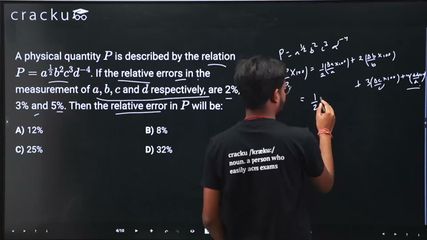
A physical quantity $$P$$ is described by the relation $$P = a^{\frac{1}{2}} b^2 c^3 d^{-4}$$. If the relative errors in the measurement of $$a, b, c$$ and $$d$$ respectively, are 2%, 1%, 3% and 5%. Then the relative error in $$P$$ will be:
We are given the physical quantity
$$P = a^{\frac{1}{2}}\, b^{2}\, c^{3}\, d^{-4}.$$
First, recall the rule for propagation of relative errors in a product of powers. If a quantity $$Q$$ is expressed as
$$Q = x^{p}\, y^{q}\, z^{r}\ldots,$$
then the relative error in $$Q$$ is obtained from
$$\frac{\Delta Q}{Q} = |p|\frac{\Delta x}{x} + |q|\frac{\Delta y}{y} + |r|\frac{\Delta z}{z} + \ldots.$$
Here $$\Delta x/x,\; \Delta y/y,\; \Delta z/z$$ are the relative errors (usually quoted as percentages) in the measurements of $$x,\; y,\; z,$$ and the absolute values of the exponents are taken because an error is always a positive quantity.
Now we match our expression for $$P$$ with the rule:
Comparing $$P = a^{\frac{1}{2}}\, b^{2}\, c^{3}\, d^{-4}$$ with $$Q = x^{p}\, y^{q}\, z^{r}\ldots,$$ we identify the exponents:
$$p = \frac{1}{2}, \qquad q = 2, \qquad r = 3, \qquad s = -4.$$
The given relative errors are
$$\frac{\Delta a}{a} = 2\% ,\qquad \frac{\Delta b}{b} = 1\% ,\qquad \frac{\Delta c}{c} = 3\% ,\qquad \frac{\Delta d}{d} = 5\% .$$
Substituting the absolute values of the exponents and the corresponding relative errors into the formula, we obtain
$$\frac{\Delta P}{P} = \Bigl|\frac{1}{2}\Bigr|\frac{\Delta a}{a} + |2|\frac{\Delta b}{b} + |3|\frac{\Delta c}{c} + |{-4}|\frac{\Delta d}{d}.$$
Writing every term explicitly,
$$\frac{\Delta P}{P} = \frac{1}{2}\times 2\% \;+\; 2\times 1\% \;+\; 3\times 3\% \;+\; 4\times 5\%.$$
Now we perform each multiplication step by step:
$$\frac{1}{2}\times 2\% = 1\%,$$
$$2\times 1\% = 2\%,$$
$$3\times 3\% = 9\%,$$
$$4\times 5\% = 20\%.$$
Add all these individual contributions to find the total relative error:
$$\frac{\Delta P}{P} = 1\% + 2\% + 9\% + 20\%.$$
The additions go as follows:
$$1\% + 2\% = 3\%,$$
$$3\% + 9\% = 12\%,$$
$$12\% + 20\% = 32\%.$$
So the relative error in $$P$$ is
$$\frac{\Delta P}{P} = 32\%.$$
Hence, the correct answer is Option D.
Was this solution helpful?
Click on the Email ☝️ to Watch the Video Solution
Create a FREE account and get:
_1.webp)

Educational materials for JEE preparation

Ask our AI anything

AI can make mistakes. Please verify important information.
AI can make mistakes. Please verify important information.


