
Join Our JEE Preparation Group
Prep with like-minded aspirants; Get access to free daily tests and study material.
Sign in
Please select an account to continue using cracku.in
↓ →
Join Our JEE Preparation Group
Prep with like-minded aspirants; Get access to free daily tests and study material.
In a meter bridge experiment resistances are connected as shown in the figure. Initially resistance $$P = 4 \; \Omega$$ and the neutral point $$N$$ is at 60 cm from $$A$$. Now an unknown resistance $$R$$ is connected in series to $$P$$ and the new position of the neutral point is at 80 cm from $$A$$. The value of unknown resistance $$R$$ is -
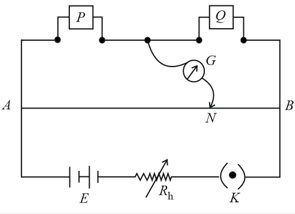
We recall that the meter bridge works on the principle of the Wheatstone bridge. For a balanced bridge, the ratio of the resistances in the two gaps is equal to the ratio of the corresponding lengths of the wire, that is
$$\frac{\text{Resistance in left gap}}{\text{Resistance in right gap}} \;=\; \frac{\text{Length of wire from }A\text{ to }N} {\text{Length of wire from }N\text{ to the other end}}.$$
Initially only the resistance $$P$$ is placed in the left gap, while an unknown resistance, which we will call $$Q$$, is present in the right gap. We are told that $$P = 4 \;\Omega$$ and that the neutral point $$N$$ is found at 60 cm from end $$A$$. The total length of the wire is 100 cm, so the right-side length is
$$100\;\text{cm} - 60\;\text{cm} = 40\;\text{cm}.$$
Applying the Wheatstone‐bridge relation we have
$$\frac{P}{Q} = \frac{60}{40}.$$
Substituting $$P = 4\;\Omega$$ gives
$$\frac{4}{Q} = \frac{60}{40}.$$
First reduce the numerical fraction on the right:
$$\frac{60}{40} = \frac{3}{2}.$$
So
$$\frac{4}{Q} = \frac{3}{2}.$$
Cross-multiplying,
$$4 \times 2 = 3 \times Q,$$
$$8 = 3Q,$$
$$Q = \frac{8}{3}\;\Omega.$$
Now an additional resistance $$R$$ is connected in series with $$P$$, so the total resistance in the left gap becomes $$P + R$$. In the new situation the balance point shifts to 80 cm from end $$A$$. Hence the left-side length is 80 cm and the right-side length is
$$100\;\text{cm} - 80\;\text{cm} = 20\;\text{cm}.$$
Applying the Wheatstone relation again, we now write
$$\frac{P + R}{Q} = \frac{80}{20}.$$
Simplify the fraction on the right:
$$\frac{80}{20} = 4.$$
Therefore,
$$\frac{P + R}{Q} = 4.$$
Cross-multiplying gives
$$(P + R) = 4Q.$$
Substituting the known values $$P = 4\;\Omega$$ and $$Q = \dfrac{8}{3}\;\Omega$$, we get
$$4 + R = 4 \left(\frac{8}{3}\right).$$
Compute the right-hand side:
$$4 \left(\frac{8}{3}\right) = \frac{32}{3}\;\Omega.$$
Hence
$$4 + R = \frac{32}{3}.$$
To isolate $$R$$ subtract 4 Ω (that is, $$\dfrac{12}{3}\;\Omega$$) from both sides:
$$R = \frac{32}{3} - \frac{12}{3} = \frac{20}{3}\;\Omega.$$
This simplifies numerically to approximately 6.67 Ω, but the exact fractional form is already one of the options.
Hence, the correct answer is Option C.
Was this solution helpful?
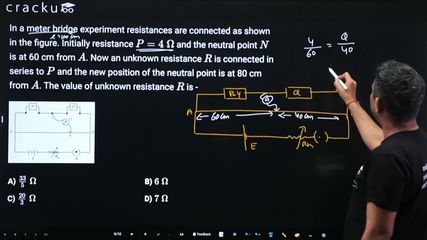
Click on the Email ☝️ to Watch the Video Solution
Create a FREE account and get:
_1.webp)

Educational materials for JEE preparation

Ask our AI anything

AI can make mistakes. Please verify important information.
AI can make mistakes. Please verify important information.


